
Verwandte Artikel zu The Profit Zone: How Strategic Business Design Will...
Inhaltsangabe
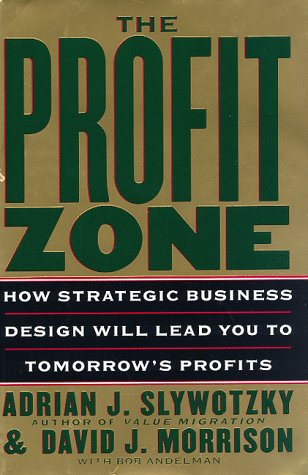
Reveals the profit-making strategies of ten of the world's greatest business personalities, showing how managers can beat the competition to the profit zone
Die Inhaltsangabe kann sich auf eine andere Ausgabe dieses Titels beziehen.
Über die Autorin bzw. den Autor
ADRIAN J. SLYWOTZKY is the author of <i>Value Migration</i> and the coauthor of <i>The Profit Zone</i> and <i>Profit Patterns</i>. Mr. Slywotzky is a graduate of Harvard College and has an M.B.A. from the Harvard Business School and a J.D. from Harvard Law School. He is vice president of Mercer Management Consulting and was recently selected by <i>Industry Week</i> as one of the six most influential people in management. <br><br>DAVID J. MORRISON is the coauthor of <i>The Profit Zone</i> and <i>Profit Patterns</i>. A graduate of the U.S. Naval Academy, he also holds an engineering degree from Princeton and an M.B.A. from Harvard Business School. Mr. Morrison is vice chairman of Mercer Management Consulting and head of MercerDigital, the firm's e-commerce practice.<br><br><br>&l
Aus dem Klappentext
companies create sustained, superior profits year after year? Why are they always far ahead of competitors in discovering the ever-changing profit zones of their industry? Why do others languish as their traditional way of doing business turns into a no-profit zone? <br><br><b>The Profit Zone</b> provides the answers. It is an original and practical explanation of how and why high profit happens, revealing the strategies of twelve of today's great success stories--a group of companies and executives that have created over $700 billion in market value for their shareholders. More importantly, it shows the lessons that can be learned from the business design of these companies--adaptations that enabled them to always be several steps ahead of competitors in meeting customer priorities. Some examples:<br>The profit lessons any product company can learn from Jack Welch's "sell solution, not just the box" business design at GE.<br>How Nicholas Hayek's creation of low-end, profit
Auszug. © Genehmigter Nachdruck. Alle Rechte vorbehalten.
Chapter 1
Market share is Dead
The number one problem in business today is profitability. Where will you be allowed to make a profit in your industry? Where is the profit zone today? Where will it be tomorrow?
The profit zone is the area of your economic neighborhood where you are allowed to earn a profit. To reach and operate in the profit zone is the goal of every company.
You've been told how to get there. "Get high market share and the profit will follow." "Get high growth and your profits will expand." As a manager, you were schooled in how the pursuit of market share and growth automatically places you on a direct route to business success.
However, these formerly direct roads have become mazes riddled with traps, wrong turns, and dead ends. Many large companies, after taking the turn toward market share and volume growth, have only hit a profitless wall.
* * *
Market share was the grand old metric, the guiding light, the compass of the product-centric age. Companies focused on improving their product and building economies of scale. This product-centric thinking led to the battle cry: "Get more market share and the profit will follow."
In the past decade, some disturbing examples began to subvert the widespread faith in market share as the ultimate goal and guarantor of business success. Consider the experience of IBM, DEC, GM, Ford, United Airlines, US Steel, Kodak, Sears, and Kmart. All achieved leading market share positions: number one or number two in their industries. Yet all these market share leaders saw their profitability begin to erode during the 1980s. Their dominant share positions did not protect them. As profitability began to be detached from market share, shareholders began to suffer. Despite their strong market position, these market share leaders significantly underperformed the S&P 500 from 1985 to 1995.
Several of these companies have recently initiated radical changes in their business design. Their new focus on profit, not just market share, has led to dramatic rebounds in value. As a result, many other traditional market share leaders have been encouraged to reconsider the assumptions on which their business design is built.
As you think about your own business, ask yourself: Am I managing for market share, or for profit? Is the market share I own profitable and alive, or is it profitless and dead?
There are countless businesses with high market share but low profitability and low shareholder value. The Japanese have a lock on the memory chip market. USAir once dominated air travel in the eastern United States. Philips is a leader in consumer electronics. None of these companies has experienced significant value growth.
Nor are these isolated cases. The list goes on:
* A&P had a high share of grocery sales.
* Intel had a high share of memory chips.
* WordPerfect had a high share of word processor software.
* DEC had a high share of minicomputers.
* Kmart had a high share of the urban discount business.
Each company was a market share triumph and a profitability disaster. In a broad cross-section of high market share situations, the right economic response has been: "So what?"
Many companies simply hoped that profitability would return. Some managers inside the companies suspected that it would not, but were hesitant to bring that suspicion to the surface and open up a debate. How could they possibly argue against a high market share position?
Other managers, in their private, honest moments, knew that the profit would never come back but were hesitant to confront the issue openly, fearing that the organization's morale would plummet.
Intel was an exception. It was the one company on the above list that confronted the issue head-on. It had high market share in memory chips in 1985, but Intel's managers recognized that its market share was dead, valueless, and profitless. The 1980s game was over; it was time to build the company's next business design.
Companies like Intel force us to think harder about-or to completely rethink-market share as a predictor of profitability.
Am I Managing for Volume Growth or Value Growth?
"Be in high-growth markets." In the old economic order, in the age of market share, volume growth was a guarantor of success. Growth was what we were taught to pursue. It created higher profits for all, including market share laggards, companies with poor business designs, and companies that were poorly managed. A rising tide raised all boats. One manager articulated the classic view: "There are no management problems that volume growth can't solve. Even if we manage poorly, rising revenue helps cover the mistakes we made."
This maxim, too, has been shaken. Industry growth and a company's value (stock price) growth no longer have a one-to-one correlation. Fast-growing industries such as PC manufacturing, consumer electronics, telecommunications, and software have each produced scores of terminally unprofitable companies. By contrast, no-growth or low-growth industries have produced some of the most successful companies in the world. Coca-Cola achieved significant value growth in the low-growth beverage industry, as did General Electric (GE) in a collection of low-growth manufacturing industries, and Swatch in the low-growth watchmaking industry.
The two most valuable ideas in the old economic order, market share and growth, have become the two most dangerous ideas in the new order. To apply these ideas appropriately (and safely), you must understand the rise of no-profit zones in the economy.
No-Profit Zones
Companies used to be able to command a premium price by simply showing up. There were relatively few players in any competitive arena, and customers held little power. Over the past two decades, however, advances in industrial technology, innovation in business design, increases in global competition, and tremendous improvements in information technology have altered the game. In the face of intense competition, companies in many industries have leveraged efficiency gains and competed for market share by lowering price.
Simultaneously, information has become more accessible to customers, allowing them to conveniently shop for the best deals and the best prices. This forces all contenders to match price reductions or lose customers to a lower-priced competitor. It creates no-profit zones. In the old world, the rule was: Every industry makes money, and the market share leaders make the most money. There have always been one or two exceptions, such as agriculture or passenger rail travel, but they were few and far between.
In the past decade, the rule was broken. Today, no-profit zones are everywhere, and they are growing. The map of the economy is covered with more and larger patches of unprofitability. No-profit zones come in various forms. They can be a part of the value chain (e.g., distribution in computing); they can be a customer segment (e.g., the Medicaid segment in healthcare, or the grocery segment in carbonated beverages); they can be an entire industry (e.g., environmental remediation); they can be individual customers (e.g., Wal-Mart or other large, powerful buyers); or they can be entire business models (e.g., hub-and-spoke airlines, or integrated steel mills).
No-profit zones are the black holes of the business universe. In a physical black hole, light waves go in, but never come back out. In an economic black hole, investment dollars go in, but the profit dollars never come back out.
Paradoxically, the devout pursuit of market share may be the single greatest creator of no-profit zones in the economy.
Imagine an industry with ten competitors. By definition, their market shares...
„Über diesen Titel“ kann sich auf eine andere Ausgabe dieses Titels beziehen.
Suchergebnisse für The Profit Zone: How Strategic Business Design Will...

Beispielbild für diese ISBN
The Profit Zone: How Strategic Business Design Will Lead You to Tomorrow's Profits
Anbieter: World of Books (was SecondSale), Montgomery, IL, USA
Verkäuferbewertung 5 von 5 Sternen

Zustand: Good. Item in good condition. Textbooks may not include supplemental items i.e. CDs, access codes etc. Artikel-Nr. 00085734157
Gebraucht kaufen
EUR 4,02
Versand gratis
Versand innerhalb von USA
Versand innerhalb von USA
Anzahl: 11 verfügbar
Beispielbild für diese ISBN
The Profit Zone: How Strategic Business Design Will Lead You to Tomorrow's Profits
Anbieter: ThriftBooks-Dallas, Dallas, TX, USA
Verkäuferbewertung 5 von 5 Sternen
Hardcover. Zustand: As New. No Jacket. Pages are clean and are not marred by notes or folds of any kind. ~ ThriftBooks: Read More, Spend Less. Artikel-Nr. G0812929004I2N00
Gebraucht kaufen
EUR 6,19
Versand gratis
Versand innerhalb von USA
Versand innerhalb von USA
Anzahl: 1 verfügbar
Beispielbild für diese ISBN
The Profit Zone: How Strategic Business Design Will Lead You to Tomorrow's Profits
Anbieter: ThriftBooks-Atlanta, AUSTELL, GA, USA
Verkäuferbewertung 5 von 5 Sternen
Hardcover. Zustand: As New. No Jacket. Pages are clean and are not marred by notes or folds of any kind. ~ ThriftBooks: Read More, Spend Less. Artikel-Nr. G0812929004I2N00
Gebraucht kaufen
EUR 6,19
Versand gratis
Versand innerhalb von USA
Versand innerhalb von USA
Anzahl: 1 verfügbar
Beispielbild für diese ISBN
The Profit Zone : How Strategic Business Design Will Lead You to Tomorrow's Profits
Verlag:
Crown Publishing Group, The, 1997
ISBN 10: 0812929004
ISBN 13: 9780812929003
Gebraucht
Hardcover
Erstausgabe
Anbieter: Better World Books: West, Reno, NV, USA
Verkäuferbewertung 5 von 5 Sternen
Zustand: Good. 1st. Pages intact with minimal writing/highlighting. The binding may be loose and creased. Dust jackets/supplements are not included. Stock photo provided. Product includes identifying sticker. Better World Books: Buy Books. Do Good. Artikel-Nr. 3525633-6
Gebraucht kaufen
EUR 6,21
Versand gratis
Versand innerhalb von USA
Versand innerhalb von USA
Anzahl: 3 verfügbar
Beispielbild für diese ISBN
The Profit Zone : How Strategic Business Design Will Lead You to Tomorrow's Profits
Verlag:
Crown Publishing Group, The, 1997
ISBN 10: 0812929004
ISBN 13: 9780812929003
Gebraucht
Hardcover
Erstausgabe
Anbieter: Better World Books: West, Reno, NV, USA
Verkäuferbewertung 5 von 5 Sternen
Zustand: Very Good. 1st. Pages intact with possible writing/highlighting. Binding strong with minor wear. Dust jackets/supplements may not be included. Stock photo provided. Product includes identifying sticker. Better World Books: Buy Books. Do Good. Artikel-Nr. 3525635-6
Gebraucht kaufen
EUR 6,21
Versand gratis
Versand innerhalb von USA
Versand innerhalb von USA
Anzahl: 1 verfügbar
Beispielbild für diese ISBN
The Profit Zone: How Strategic Business Design Will Lead You to Tomorrow's Profits
Anbieter: Wonder Book, Frederick, MD, USA
Verkäuferbewertung 5 von 5 Sternen
Zustand: Very Good. Very Good condition. Very Good dust jacket. A copy that may have a few cosmetic defects. May also contain light spine creasing or a few markings such as an owner's name, short gifter's inscription or light stamp. Artikel-Nr. G05A-03549
Gebraucht kaufen
EUR 6,28
Versand gratis
Versand innerhalb von USA
Versand innerhalb von USA
Anzahl: 2 verfügbar
Beispielbild für diese ISBN
The Profit Zone: How Strategic Business Design Will Lead You to Tomorrow's Profits
Anbieter: Wonder Book, Frederick, MD, USA
Verkäuferbewertung 5 von 5 Sternen
Zustand: Very Good. Very Good condition. Good dust jacket. A copy that may have a few cosmetic defects. May also contain light spine creasing or a few markings such as an owner's name, short gifter's inscription or light stamp. Artikel-Nr. M05G-01678
Gebraucht kaufen
EUR 6,28
Versand gratis
Versand innerhalb von USA
Versand innerhalb von USA
Anzahl: 1 verfügbar
Beispielbild für diese ISBN
Strategic Business Design
Anbieter: AwesomeBooks, Wallingford, Vereinigtes Königreich
Verkäuferbewertung 5 von 5 Sternen
Hardcover. Zustand: Very Good. Strategic Business Design This book is in very good condition and will be shipped within 24 hours of ordering. The cover may have some limited signs of wear but the pages are clean, intact and the spine remains undamaged. This book has clearly been well maintained and looked after thus far. Money back guarantee if you are not satisfied. See all our books here, order more than 1 book and get discounted shipping. Artikel-Nr. 7719-9780812929003
Gebraucht kaufen
EUR 4,80
EUR 4,81 Versand
Versand von Vereinigtes Königreich nach USA
Versand von Vereinigtes Königreich nach USA
Anzahl: 2 verfügbar
Beispielbild für diese ISBN
Strategic Business Design
Anbieter: WorldofBooks, Goring-By-Sea, WS, Vereinigtes Königreich
Verkäuferbewertung 5 von 5 Sternen
Hardback. Zustand: Very Good. The book has been read, but is in excellent condition. Pages are intact and not marred by notes or highlighting. The spine remains undamaged. Artikel-Nr. GOR002092372
Gebraucht kaufen
EUR 3,75
EUR 6,53 Versand
Versand von Vereinigtes Königreich nach USA
Versand von Vereinigtes Königreich nach USA
Anzahl: 3 verfügbar
Beispielbild für diese ISBN
The Profit Zone : How Strategic Business Design Will Lead You to Tomorrow's Profits
Verlag:
Crown Publishing Group, The, 1997
ISBN 10: 0812929004
ISBN 13: 9780812929003
Gebraucht
Hardcover
Erstausgabe
Anbieter: Better World Books Ltd, Dunfermline, Vereinigtes Königreich
Verkäuferbewertung 5 von 5 Sternen
Zustand: Good. 1st. Former library copy. Pages intact with minimal writing/highlighting. The binding may be loose and creased. Dust jackets/supplements are not included. Includes library markings. Stock photo provided. Product includes identifying sticker. Better World Books: Buy Books. Do Good. Artikel-Nr. GRP10139955
Gebraucht kaufen
EUR 5,68
EUR 5,83 Versand
Versand von Vereinigtes Königreich nach USA
Versand von Vereinigtes Königreich nach USA
Anzahl: 1 verfügbar