
Verwandte Artikel zu Aol.Com: How Steve Case Beat Bill Gates, Nailed the...
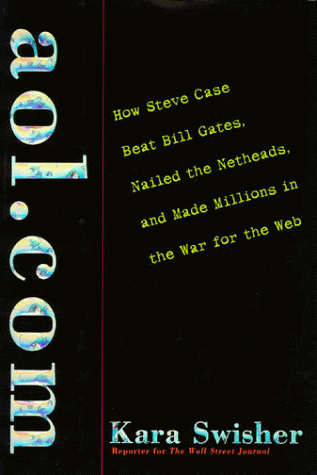
Aol.Com: How Steve Case Beat Bill Gates, Nailed the Netheads, and Made Millions in the War for the Web - Hardcover
Inhaltsangabe
Reveals how America Online became the world's biggest Internet service
Die Inhaltsangabe kann sich auf eine andere Ausgabe dieses Titels beziehen.
Über die Autorin bzw. den Autor
<b>Kara Swisher</b> has covered AOL and the Internet for the business section of <b>The Washington Post</b> since 1994. Now reporting on Silicon Valley for The Wall Street Journal, she lives in San Francisco.
Aus dem Klappentext
a Swisher, then a reporter at The Washington Post, was granted unprecedented access to one of the hottest and most closely watched companies in the world, America Online, Inc. In <b>aol.com</b>, Swisher has written a book that captures the secrets of how AOL beat the competition and became the world's biggest online company. Swisher also reveals the company's behind-the-scenes dealings with Microsoft cofounders Bill Gates and Paul Allen, CompuServe, Prodigy, Netscape, and the Christian Right.<br><br>Throughout its existence, AOL has repeatedly been written off by the media and the high-tech world. Bill Gates threatened to buy it or bury it. Deep-pocketed competitors such as CompuServe and Prodigy thought little of their smaller rival. And AOL made matters worse by committing a series of public-relations and technical blunders that became front page news and enraged its subscribers.<br><br>But the company--a "cyber-cockroach&
Auszug. © Genehmigter Nachdruck. Alle Rechte vorbehalten.
the canary in the coal mine
The truth is: nobody knows.
And, because most often they do not know that they do not know, no one will ever tell you that truth.
Some people don't know because they are too hopeful and sometimes because they are very greedy. Some are profoundly stupid or are a little too smart.
But in the spanking new world of the Internet, nobody knows because everyone and everything has just been born.
Which is why Steve Case found himself on May 8, 1997 cruising on the calm waters of Lake Washington in Seattle on a boat carrying him and more than 100 other chief executives toward the 20,000-square-foot, $40 million home of Bill Gates.
Case was definitely not supposed to be there--if you had
paid heed over the years to a variety of learned Wall Street pundits, savvy journalists, pontificating technology consultants, and waspish naysayers in Silicon Valley. And the computer online service, America Online Inc., which he had built into the world's largest, was just one tiny step away from falling right over the precipice.
The dirge had been endless: AOL was nothing. AOL was history. AOL was dead.
Yet there Case stood--perhaps the liveliest corporate corpse one might ever meet--chatting with American Airlines head Robert Crandall, kibitzing with a cadre of Microsoft's top executives, and joking with Vice President Al Gore.
In the near distance, in Bellevue, Case could just make out the outlines of Gates's glass-and-wood palace, still being built on the lakeshore, where an elaborate dinner awaited them. Getting to see the famed technological Xanadu that Gates was constructing for himself was the highlight of a flashy, two-day CEO "technology summit" Microsoft had organized. There had been speeches all day. Now a dinner of spring salmon, fiddlehead fern bisque, and tortes with Rainier huckleberries awaited them.
As the boat wended its way from its launching point on Lake Union, surrounded by a flotilla of security boats to protect this small ship carrying very powerful people, to the place Case jokingly was calling "Bill's San Simeon" (after William Randolph Hearst's egotistical monument to himself), the man from AOL thought it was all just a little too bizarre.
He was happy to have been invited, of course, but felt decidedly out of place. He had quipped to Microsoft finance chief Greg Maffei and other executives from the company that he felt like a spy deep in enemy territory. He ribbed them, asking playfully if he should be taking notes on any stray Microsoft secrets he could glean, and sending them off in a bottle over the side of the ship. But inside his head, he wondered seriously: Should he even be here at all, still standing? Had it only been four years ago that Case had been told by Gates that it was probably the end for AOL?
Gates--whose leadership of Microsoft and ensuing vast wealth had made him into an American business icon on the level of John D. Rockefeller--had been spectacularly wrong.
After the talks between them in 1993 had led nowhere, Gates had created his own online service as he had promised. But, in two years of trying and after hundreds of millions of dollars were spent, Gates's Microsoft Network had not bested AOL. With AOL now four times as large, it had not even come close.
No one had-yet.
This much was true: in the last decade of the twentieth century, an entirely new medium--online communications via the personal computer--had been born. It was being hailed as the next great technological innovation, in the same league as the telephone, the radio, and television.
Few times in American business history has an entire industry been created from almost nothing and captured the attention and imagination of millions of consumers, setting off a titanic clash for money, power, and dominance among some of America's greatest businesses. But such has been the case with the Internet and the online services industry since its mainstream emergence at the start of the 1990s. And of the many companies vying to create empires in cyberspace, there was now none better known than AOL.
In much the same way that Coca-Cola had become the name most people associated with sugared soda, the brand of this emerging new medium had turned out to be AOL. Since its founding only ten years before, the company had grown from a dinky computer games service aimed at teenage boys into a huge business with more than $1 billion in revenue. It had become, in the process, the way most Americans reached the Internet. With nearly ten million subscribers worldwide, its "circulation" was much larger than that of any of the major newspapers in the United States.
Yet it was also a company in constant danger. Innumerable challenges had given AOL a heart-rending roller coaster ride all along the way, and many observers had long predicted AOL's imminent demise. In 1993, they claimed that AOL was too small to compete with CompuServe and Prodigy (online services backed by big bucks from major U.S. corporations). AOL was too glitchy and simplistic to catch on with consumers, they opined in 1994. AOL was vulnerable to a withering frontal attack from Microsoft, they declared in 1995. AOL was going to really get knocked flat by the growing popularity of the Internet's World Wide Web, they announced in 1996. And finally, in 1997, they could say with absolute assurance, AOL was going to be its own executioner, shooting itself dead with a dizzying series of corporate missteps.
And there were so many other AOL killers: the telephone companies, with their advantage in all things wired; the media conglomerates, with their abundant content; the scrappier Internet service providers, with their low prices.
Beginning in the spring of 1996, the punches came hard: a precipitous stock drop that had cut AOL's market value by two-thirds; the increase of an online trend called "churn" that signaled dangerously restless customers; the embarrassing departure, after only four months, of a top executive brought in to discipline AOL's free-wheeling culture; another drastic restructuring of the corporate body and business plan; a restating of financial results that wiped out all the profits AOL had ever claimed it made; a shift in pricing that caused subscriptions to surge, but resulted in seriously blocked access for users; and one lawsuit after another over pricing, access, and stock value.
Case, who had come to personify the company, had been called sleazy, a soap salesman, a liar, a fool.
But he was still there. Case, in fact, had turned out to be the Rasputin of the Internet, with no one able to deliver the long-expected deathblow. All the nicknames AOL had acquired over the years had the exact same theme: the cockroach of cyberspace, the digital Dracula, the Lazarus of the online...
„Über diesen Titel“ kann sich auf eine andere Ausgabe dieses Titels beziehen.
Suchergebnisse für Aol.Com: How Steve Case Beat Bill Gates, Nailed the...

Beispielbild für diese ISBN
Gaol.Com: How Steve Case Beat Bill Gates
Anbieter: World of Books (was SecondSale), Montgomery, IL, USA
Verkäuferbewertung 5 von 5 Sternen

Hardback. Zustand: Fair. Artikel-Nr. CIN0812928962A
Gebraucht kaufen
EUR 5,51
Versand gratis
Versand innerhalb von USA
Versand innerhalb von USA
Anzahl: 1 verfügbar
Beispielbild für diese ISBN
aol.com: How Steve Case Beat Bill Gates, Nailed the Netheads, and Made Millions in the War for the Web
Anbieter: ThriftBooks-Dallas, Dallas, TX, USA
Verkäuferbewertung 5 von 5 Sternen
Hardcover. Zustand: Good. No Jacket. Missing dust jacket; Pages can have notes/highlighting. Spine may show signs of wear. ~ ThriftBooks: Read More, Spend Less. Artikel-Nr. G0812928962I3N01
Gebraucht kaufen
EUR 6,03
Versand gratis
Versand innerhalb von USA
Versand innerhalb von USA
Anzahl: 1 verfügbar
Beispielbild für diese ISBN
aol.com: How Steve Case Beat Bill Gates, Nailed the Netheads, and Made Millions in the War for the Web
Anbieter: ThriftBooks-Dallas, Dallas, TX, USA
Verkäuferbewertung 5 von 5 Sternen
Hardcover. Zustand: Good. No Jacket. Pages can have notes/highlighting. Spine may show signs of wear. ~ ThriftBooks: Read More, Spend Less. Artikel-Nr. G0812928962I3N00
Gebraucht kaufen
EUR 6,03
Versand gratis
Versand innerhalb von USA
Versand innerhalb von USA
Anzahl: 1 verfügbar
Beispielbild für diese ISBN
aol.com: How Steve Case Beat Bill Gates, Nailed the Netheads, and Made Millions in the War for the Web
Anbieter: Wonder Book, Frederick, MD, USA
Verkäuferbewertung 5 von 5 Sternen
Zustand: Very Good. Very Good condition. Very Good dust jacket. A copy that may have a few cosmetic defects. May also contain light spine creasing or a few markings such as an owner's name, short gifter's inscription or light stamp. Artikel-Nr. T14A-06374
Gebraucht kaufen
EUR 6,79
Versand gratis
Versand innerhalb von USA
Versand innerhalb von USA
Anzahl: 2 verfügbar
Beispielbild für diese ISBN
aol.com: How Steve Case Beat Bill Gates, Nailed the Netheads, and Made Millions in the War for the Web
Anbieter: Wonder Book, Frederick, MD, USA
Verkäuferbewertung 5 von 5 Sternen
Zustand: Very Good. Very Good condition. Good dust jacket. A copy that may have a few cosmetic defects. May also contain light spine creasing or a few markings such as an owner's name, short gifter's inscription or light stamp. Artikel-Nr. I28A-03449
Gebraucht kaufen
EUR 6,79
Versand gratis
Versand innerhalb von USA
Versand innerhalb von USA
Anzahl: 1 verfügbar
Beispielbild für diese ISBN
AOL.com : How Steve Case Beat Bill Gates, Nailed the Netheads, and Made Millions in the War for the Web
Verlag:
Crown Publishing Group, The, 1998
ISBN 10: 0812928962
ISBN 13: 9780812928969
Gebraucht
Hardcover
Erstausgabe
Anbieter: Better World Books: West, Reno, NV, USA
Verkäuferbewertung 5 von 5 Sternen
Zustand: Very Good. 1st ed. Pages intact with possible writing/highlighting. Binding strong with minor wear. Dust jackets/supplements may not be included. Stock photo provided. Product includes identifying sticker. Better World Books: Buy Books. Do Good. Artikel-Nr. GRP97909078
Gebraucht kaufen
EUR 6,93
Versand gratis
Versand innerhalb von USA
Versand innerhalb von USA
Anzahl: 1 verfügbar
Beispielbild für diese ISBN
AOL.com : How Steve Case Beat Bill Gates, Nailed the Netheads, and Made Millions in the War for the Web
Verlag:
Crown Publishing Group, The, 1998
ISBN 10: 0812928962
ISBN 13: 9780812928969
Gebraucht
Hardcover
Erstausgabe
Anbieter: Better World Books: West, Reno, NV, USA
Verkäuferbewertung 5 von 5 Sternen
Zustand: Good. 1st ed. Pages intact with minimal writing/highlighting. The binding may be loose and creased. Dust jackets/supplements are not included. Stock photo provided. Product includes identifying sticker. Better World Books: Buy Books. Do Good. Artikel-Nr. 3525261-75
Gebraucht kaufen
EUR 6,93
Versand gratis
Versand innerhalb von USA
Versand innerhalb von USA
Anzahl: 1 verfügbar
Beispielbild für diese ISBN
aol.com: How Steve Case Beat Bill Gates, Nailed the Netheads, and Made Millions in the War for the Web
Anbieter: Robinson Street Books, IOBA, Binghamton, NY, USA
Verkäuferbewertung 4 von 5 Sternen

Hardcover. Zustand: Very Good. Prompt Shipment, shipped in Boxes, Tracking PROVIDEDVery good in very good dust jacket. First edition *. Artikel-Nr. lower26kr1094
Gebraucht kaufen
EUR 12,42
EUR 8,48 Versand
Versand innerhalb von USA
Versand innerhalb von USA
Anzahl: 1 verfügbar
Beispielbild für diese ISBN
aol.com: How Steve Case Beat Bill Gates, Nailed the Netheads, and Made Millions in the War for the Web
Anbieter: Robinson Street Books, IOBA, Binghamton, NY, USA
Verkäuferbewertung 4 von 5 Sternen
Hardcover. Zustand: As New. Prompt Shipment, shipped in Boxes, Tracking PROVIDEDFine in Fine dust jacket. First edition.*. Artikel-Nr. ware37brmb026
Gebraucht kaufen
EUR 12,42
EUR 8,48 Versand
Versand innerhalb von USA
Versand innerhalb von USA
Anzahl: 1 verfügbar
Beispielbild für diese ISBN
aol.com: How Steve Case Beat Bill Gates, Nailed the Netheads, and Made Millions in the War for the Web
Anbieter: Robinson Street Books, IOBA, Binghamton, NY, USA
Verkäuferbewertung 4 von 5 Sternen
Hardcover. Zustand: Good. Prompt Shipment, shipped in Boxes, Tracking PROVIDEDGood in very good dust jacket. Previous owner's name in ink on front free end paper. First edition *. Artikel-Nr. ware59kr3732
Gebraucht kaufen
EUR 12,42
EUR 8,48 Versand
Versand innerhalb von USA
Versand innerhalb von USA
Anzahl: 1 verfügbar