
Verwandte Artikel zu The Complete Small-Business Sourcebook: Information,...
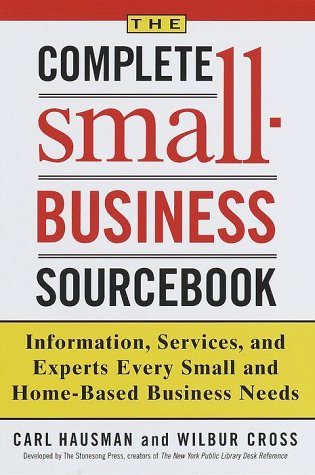
The Complete Small-Business Sourcebook: Information, Services, and Experts Every Small and Home-Based Business Needs - Hardcover
Inhaltsangabe
Answers business questions
Die Inhaltsangabe kann sich auf eine andere Ausgabe dieses Titels beziehen.
Über die Autorin bzw. den Autor
<b>Carl Hausman</b> is the author of The Connected World and Small Business Franchises Made Simple, among many other books, and a consultant whose clients include AT&T and Newsday. A former television reporter, talk-show host, magazine writer, and newspaper columnist, Hausman has testified (about journalism ethics) before Congress and taught at New York University and Rowan University in Glassboro, New Jersey. <br><br><b>Wilbur Cross</b> is a veteran journalist and former editor at Time, Inc. He lives on Hilton Head Island, South Carolina.
Aus dem Klappentext
your business is small or home-based doesn't mean you can't have the resources of a major corporation at your fingertips. The Complete Small-Business Sourcebook provides a cornucopia of places and people to help answer almost every kind of business question, from how to raise capital to where to find a consultant, and much more.<br><br><b>ONE-STOP RESOURCE:</b> The Sourcebook provides fast, easy access to the kind of information that used to require hours <br>of searching through piles of directories, pamphlets, and news clippings.<br><br><b>TWENTY MAJOR CATEGORIES:</b> The Sourcebook covers every issue facing today's small-business person: What are the best sources for venture capital? How do I find a marketing professional to help me sell my product? Where can I get legal information about whether to incorporate, set up a partnership, or be a sole proprietor?<br><br><b>FACTS AT YOUR FINGERTIPS:</b> The information within is drawn from hundreds of reliable sour
Auszug. © Genehmigter Nachdruck. Alle Rechte vorbehalten.
Chapter 1--The Idea
It may come to you all at once. Or maybe you have been turning the idea over in your mind for years. But now you've made the decision: you'll start your own business. You're convinced that the idea is viable. You're sure there is a hungry market for your products or services.
Testing the Concept
A great idea is an excellent beginning, but it's only a beginning. You have a lot of important homework to do. Now is the time to investigate:
Is enough capital available, or can it be acquired, to launch the enterprise and maintain its momentum?
Is a suitable location available?
Can the population in the area surrounding the location support your kind of business?
Is the local economy, or the market in which you will compete, in a healthy condition?
Can suitable employees or contractors be recruited?
Will the business be resistant to economic fluctuations, fickle consumer tastes, or changing legislation?
Could any legal entanglements or extraordinary legal risks cause unexpected financial liability?
Above and beyond these basic requirements, you need patience. It will take time for the business to become known, gather paying customers, and reach a break-even point. This precarious introductory period is when most failures occur. Your total personal commitment is a must. Even though you may be steadily adding employees in the initial stage, you must hold a tight rein on the business, controlling all the major management and operational functions. During this period, you may be working days, nights, and weekends, and consistent profitability may be a mirage on a distant horizon.
Do You Have What It Takes? A Self-Test
The start-up period can be expected to continue for a year or two-or longer, for a more complicated enterprise. Financially, personally, and psychologically, these can be punishing years. Are you up to the challenge? Ask yourself these questions before you make the decision to become an entrepreneur:
Do I have the self-confidence needed to undertake the venture? Can I get on the phone and make calls to prospective customers, or make cold sales calls on the street?
For the business I have in mind, is the timing right, both seasonally and from the viewpoint of consumers' buying trends?
Are my personal attributes right for the task? Am I self-motivated, a hard worker, comfortable managing other people whom I will need for assistance, and willing to sacrifice my private interests and leisure time to devote a full effort to the job?
Do I have the competitive spirit required to run a business in the face of stiff and persistent rivals-other owners and managers who will be aiming at the same clients and/or customers? Do I have the drive and the imagination to compete in the marketplace?
Am I willing to make the necessary financial sacrifices-to focus my monetary efforts on this new business, even if it means investing my own nest egg? Or do I have enough fortitude and poise to approach banks or other prospective lenders and obtain the necessary financing?
Can I survive a situation in which I have no regular, dependable paycheck and sometimes may have to hold off some creditors until my business reaches a point where I can pay myself a salary or expenses? Can I cut back on my personal financial obligations in order to avoid unmanageable debt?
Have I prepared a professional "road map" to guide me in the direction I want the business to take? Have I clearly marked the route for long-term growth and development of the firm?
Do I know how to take advantage of the resources, public and private, that are available to help me chart the best course to my goals?
This sourcebook has been prepared to help you answer the last question affirmatively and, in the process, to help you meet all the other requirements for being a successful entrepreneur.
Putting the Business Plan on Paper
An essential job, early in the venture's creation, is development of a business plan, a meticulous definition of the business you are starting. The business plan is useful both as an initial road map and, later, as a vehicle for obtaining loans and funding. Your plan should cover the following subject areas:
Management: The names and qualifications of the owner(s) and manager(s) of the new business, their addresses and other vital statistics.
Financial needs: How much funding you will require now and later on, for what purpose, and from what classification of lender; your expected income and expenses, sources of additional capital, and projected time periods for reducing debt.
The market: The potential outlets today and in the future, and the methods you expect to use to attract customers, make sales, and provide related services.
Competition: How strong your rivals are, and how you expect to survive and prosper in spite of them.
Duties and responsibilities: Who will do what, and how pertinent functions and operations will be handled on a day-to-day basis.
Future prospects: What they are and why they are realistic; an evaluation of the market area and where your new company will fit in.
„Über diesen Titel“ kann sich auf eine andere Ausgabe dieses Titels beziehen.
Suchergebnisse für The Complete Small-Business Sourcebook: Information,...

Beispielbild für diese ISBN
Complete Small-Business Sourcebook: Information, Services, and Experts Every Small and Home-Based Business Needs
Anbieter: ThriftBooks-Atlanta, AUSTELL, GA, USA
Verkäuferbewertung 5 von 5 Sternen

Hardcover. Zustand: Good. No Jacket. Missing dust jacket; Pages can have notes/highlighting. Spine may show signs of wear. ~ ThriftBooks: Read More, Spend Less. Artikel-Nr. G0812928245I3N01
Gebraucht kaufen
EUR 12,12
Versand gratis
Versand innerhalb von USA
Versand innerhalb von USA
Anzahl: 1 verfügbar
Beispielbild für diese ISBN
Complete Small-Business Sourcebook: Information, Services, and Experts Every Small and Home-Based Business Needs
Anbieter: ThriftBooks-Atlanta, AUSTELL, GA, USA
Verkäuferbewertung 5 von 5 Sternen
Hardcover. Zustand: Good. No Jacket. Pages can have notes/highlighting. Spine may show signs of wear. ~ ThriftBooks: Read More, Spend Less. Artikel-Nr. G0812928245I3N00
Gebraucht kaufen
EUR 12,12
Versand gratis
Versand innerhalb von USA
Versand innerhalb von USA
Anzahl: 1 verfügbar
Beispielbild für diese ISBN
The Complete Small-Business Sourcebook : Information, Services and Experts Every Small and Home-Based Business Needs
Verlag:
Crown Publishing Group, The, 1998
ISBN 10: 0812928245
ISBN 13: 9780812928242
Gebraucht
Hardcover
Anbieter: Better World Books: West, Reno, NV, USA
Verkäuferbewertung 5 von 5 Sternen
Zustand: Very Good. Former library copy. Pages intact with possible writing/highlighting. Binding strong with minor wear. Dust jackets/supplements may not be included. Includes library markings. Stock photo provided. Product includes identifying sticker. Better World Books: Buy Books. Do Good. Artikel-Nr. 53543784-6
Gebraucht kaufen
EUR 12,95
Versand gratis
Versand innerhalb von USA
Versand innerhalb von USA
Anzahl: 1 verfügbar
Beispielbild für diese ISBN
Complete Small-Business Sourcebook: Information, Services, and Experts Every Small and Home-Based Business Needs
Anbieter: Robinson Street Books, IOBA, Binghamton, NY, USA
Verkäuferbewertung 4 von 5 Sternen

Hardcover. Zustand: As New. Prompt Shipment, shipped in Boxes, Tracking PROVIDEDFine. Artikel-Nr. ld4966
Gebraucht kaufen
EUR 12,23
EUR 8,35 Versand
Versand innerhalb von USA
Versand innerhalb von USA
Anzahl: 1 verfügbar