
Verwandte Artikel zu Closed Chambers: The First Eyewitness Account of the...
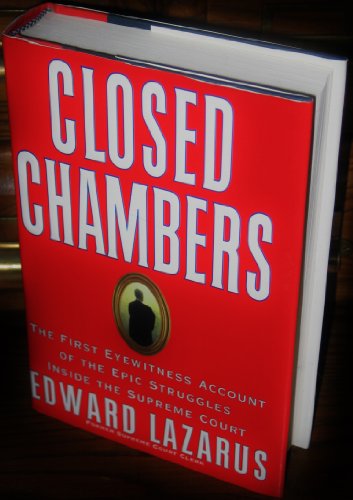
Closed Chambers: The First Eyewitness Account of the Epic Struggles Inside the Supreme Court - Hardcover
Inhaltsangabe
For the first time, a former law clerk to the Supreme Court reveals how the Court decides its cases, offering a devastating portrait of justice perverted by politics and unduly influenced by the power of anonymous clerks. 75,000 first printing. Tour.
Die Inhaltsangabe kann sich auf eine andere Ausgabe dieses Titels beziehen.
Über die Autorin bzw. den Autor
Edward Lazarus served as a law clerk to Supreme Court Justice Harry A. Blackmun from 1988 to 1989. He is also the author of Black Hills/White Justice, which the Harvard Law Review praised as "meticulously researched and eloquently written." Lazarus has contributed to such publications as The Atlantic, U.S. News & World Report, and the Los Angeles Times. He is a graduate of Yale College and Yale Law School, and currently works as a federal prosecutor in Los Angeles.
Aus dem Klappentext
Court of the United States is the most powerful court in the world. It is also the branch of our government most shrouded in mystery, misunderstanding, and myth.. Isolated in a marble temple, supposedly insulated from the pressures of politics, nine unelected Justices are charged with protecting our most cherished rights and shaping our fundamental laws. They are assisted by roughly thirty-six law clerks each year, the best and brightest of the nation's young lawyers, who routinely go on to fill the highest ranks of our government, courts, law schools, and law firms.
Never before has one of these clerks stepped forward to reveal how the Court really works--and why it often fails the country and the cause of justice. In this groundbreaking book, award-winning historian Edward Lazarus, a former clerk to Justice Harry A. Blackmun, guides the reader through the Court's inner sanctum, explaining as only an eyewitness can the collisions of
Auszug. © Genehmigter Nachdruck. Alle Rechte vorbehalten.
The Highest Court in the Land
They looked like rock 'n' roll fans camped out for the night in front of a box office. Huddled under ponchos, sheets of plastic, or converted trash bags, several dozen people formed a ragged line on the sidewalk and talked quietly as a steady late-night rain soaked their makeshift waterproofing. Up front, two policemen kept sullen watch over the still-growing crowd.
But the location was not a box office, and the event was not a rock concert. It was the Supreme Court of the United States, and the occasion was the deciding of Planned Parenthood of Southeastern Pennsylvania v. Casey, the abortion test case of 1992 that many expected would mark the death of Roe v. Wade and a woman's constitutional right to obtain an abortion.
Some who stood vigil were partisans, lawyers for various legal and political organizations. Others were soldiers from the protracted street war over abortion rights. One woman, in her fifties, had worked on the underground abortion network in the pre-Roe days when California girls were hustled across the border to Tijuana for quick operations. The man next to her, a midwesterner, was part of Operation Rescue's army of
anti-abortion crusaders. He had been a "baby doe," a volunteer on the abortion clinic barricades, provoking arrest in the name of the unborn. Carol Urich, first in line, forty-eight and wheelchair bound, had never been to the Court before. Still, Roe v. Wade had defined her political identity and she wanted to bear witness at the making of its history.
Her mother had suffered through an illegal abortion in 1933, and Carol, pro-choice in memoria, was still haunted by the fear and pain of that story. So she and dozens of others with memories and convictions no less searing braved the rain and the long night just to sit silently in the Court's majestic chamber as the Justices, the nine high priests of
American law, announced Roe's fate.
The Court itself, a Greek-style temple commanding the crest of Capitol Hill, loomed above them in the dim light of the storm. Set atop a broad marble plaza and thirty-six steps, the Court stands in a splendid isolation appropriate to its place at the pinnacle of the national judiciary, one of the three independent and "coequal" branches of American government. Once dubbed the Ivory Tower by architecture critics, the Court has a Corinthian colonnade and massive twenty-foot-high bronze doors that guard the single most powerful judicial institution in the Western world.
Lights still shone in several offices to the right of the Court's entrance, and an occasional silhouette passed across the windows. A few in the crowd outside speculated whether the figure was a janitor, a law clerk, or perhaps even one of the Justices. Others wondered aloud about why Court business might still be going on so late at night.
As I watched them, I thought back to a similar scene three years earlier: July 2, 1989, the eve of the Court's decision in another landmark abortion case, Webster v. Reproductive Health Services. Then, too, I had been present as a small cross section of America lined up for seats at the next morning's session. On that night, though, my view had been from inside the Court, my shadow observed by the murmuring crowd below.
From July 1988 through July 1989--in Court parlance October Term 1988--I served as one of four law clerks to Justice Harry A. Blackmun, the author of Roe. This book is an outgrowth of that incomparable experience, meant to capture the judgments and feelings I formed while working for him and to examine how they have changed over what is now more than eight years of reflection.
At the outset, I confess that during my year of total immersion in the world of the Court--often ninety hours a week inside the building itself--I found myself almost inadvertently following Pericles' advice to the citizens of ancient Athens: to look upon their home and fall in love with her. From the solemnity of the velvet-draped courtroom to the ornate brilliance of the gold leaf on the library ceiling, from the cloistered silence of the private corridors to the chatter of tourists admiring the Great Hall, the Court radiates a sense of tradition and higher purpose that even in a cynical age inspires belief in the sanctity of law and the possibility of justice. To contribute even in a fleeting way to the history of this place is an honor deeply felt by every one of its employees and creates a powerful loyalty to the institution. Over the course of my year there, I certainly came to share this devotion.
At the same time, what I saw inside the Court--how it worked or failed to work, the strengths and weaknesses of the Justices who presided while I was there, the role of clerks like me--all this left me with an irrepressible sense of disquiet. Part of this book is an attempt to
explain and analyze that disquiet. All of this book is an attempt to give both lawyers and the lay public a better understanding of a particularly significant and tumultuous period in the Court's history. It is at most a small exaggeration to say that legal rules and
litigation have become Americans' civil religion and that if we share one sacred text, it is our Constitution. Whether the issue is abortion, race discrimination, sexual harassment, the environment, criminal justice, religious liberty, freedom of speech, or almost any other
aspect of how we live and even how we die, Americans have come almost routinely to expect the courts, especially the Supreme Court, to take sides on every issue of national urgency and help resolve our most vexing social problems.
As a result, pilgrims like those who braved the rain to witness the Court's decision in Casey have become commonplace. So have political marches on the Court and demonstrations on its steps. And the confirmation hearings for prospective Justices, from the repudiation of Robert Bork to the inquisitions of Clarence Thomas and Anita Hill, have
been transformed into political theater of the highest consequence. All this, it seems, marks a national recognition of how important control of the Court has become to shaping the contours of our government and the spirit of our society.
But for all the attention we now pay to it, the Court remains shrouded in confusion and misunderstanding. Indeed, amid the hedging and dodging of the confirmation hearings, the frequent headlines about legal precedents saved or overturned, the charges and countercharges of "politicizing" the judiciary, and much misleading talk about judicial
"activism," "strict construction," and "original intent," I fear that we now feel more but think less about the essential questions of how the Court reaches its decisions, why its integrity and vitality matter so much, and what role it should play in our democracy.
No single volume can address these issues comprehensively. But I hope that what follows will add some measure of light and clarity to what, regrettably, has been a rapidly gathering dusk. I came of age with an essentially idealized image of the Supreme Court,
an image defined by the events of July 24, 1974. On that day, the Court ordered President Richard Nixon to turn over to the Watergate special prosecutor, Leon Jaworski, a series of highly incriminating tape recordings that the president previously had withheld on the ground of "executive privilege." Although three of the participating Justices had
been appointed by Nixon, the Court's judgment against the president was unanimous.
And although releasing the tapes would brand him both a liar and a probable felon, Nixon respected the authority of the Court and complied with its ruling. Seventeen days later, he resigned. Today I carry with me a very different image of the Court. It is of an institution broken into unyielding...
„Über diesen Titel“ kann sich auf eine andere Ausgabe dieses Titels beziehen.
Suchergebnisse für Closed Chambers: The First Eyewitness Account of the...

Beispielbild für diese ISBN
Closed Chambers: The First Eyewitness Account of the Epic Struggles inside the Supreme Court
Anbieter: World of Books (was SecondSale), Montgomery, IL, USA
Verkäuferbewertung 5 von 5 Sternen

Hardback. Zustand: Fair. Artikel-Nr. 00100535494
Gebraucht kaufen
EUR 4,42
Versand gratis
Versand innerhalb von USA
Versand innerhalb von USA
Anzahl: 1 verfügbar
Beispielbild für diese ISBN
Closed Chambers: The First Eyewitness Account of the Epic Struggles inside the Supreme Court
Anbieter: World of Books (was SecondSale), Montgomery, IL, USA
Verkäuferbewertung 5 von 5 Sternen
Hardback. Zustand: Good. Artikel-Nr. 00100556140
Gebraucht kaufen
EUR 4,42
Versand gratis
Versand innerhalb von USA
Versand innerhalb von USA
Anzahl: 2 verfügbar
Beispielbild für diese ISBN
Closed Chambers: The First Eyewitness Account of the Epic Struggles Inside the Supreme Court
Anbieter: ThriftBooks-Dallas, Dallas, TX, USA
Verkäuferbewertung 5 von 5 Sternen
Hardcover. Zustand: Very Good. No Jacket. Former library book; May have limited writing in cover pages. Pages are unmarked. ~ ThriftBooks: Read More, Spend Less. Artikel-Nr. G0812924029I4N10
Gebraucht kaufen
EUR 5,97
Versand gratis
Versand innerhalb von USA
Versand innerhalb von USA
Anzahl: 1 verfügbar
Beispielbild für diese ISBN
Closed Chambers: The First Eyewitness Account of the Epic Struggles Inside the Supreme Court
Anbieter: ThriftBooks-Atlanta, AUSTELL, GA, USA
Verkäuferbewertung 5 von 5 Sternen
Hardcover. Zustand: Very Good. No Jacket. May have limited writing in cover pages. Pages are unmarked. ~ ThriftBooks: Read More, Spend Less. Artikel-Nr. G0812924029I4N00
Gebraucht kaufen
EUR 5,97
Versand gratis
Versand innerhalb von USA
Versand innerhalb von USA
Anzahl: 1 verfügbar
Beispielbild für diese ISBN
Closed Chambers: The First Eyewitness Account of the Epic Struggles Inside the Supreme Court
Anbieter: ThriftBooks-Atlanta, AUSTELL, GA, USA
Verkäuferbewertung 5 von 5 Sternen
Hardcover. Zustand: Very Good. No Jacket. Former library book; May have limited writing in cover pages. Pages are unmarked. ~ ThriftBooks: Read More, Spend Less. Artikel-Nr. G0812924029I4N10
Gebraucht kaufen
EUR 5,97
Versand gratis
Versand innerhalb von USA
Versand innerhalb von USA
Anzahl: 1 verfügbar
Beispielbild für diese ISBN
Closed Chambers: The First Eyewitness Account of the Epic Struggles Inside the Supreme Court
Anbieter: ThriftBooks-Dallas, Dallas, TX, USA
Verkäuferbewertung 5 von 5 Sternen
Hardcover. Zustand: Very Good. No Jacket. May have limited writing in cover pages. Pages are unmarked. ~ ThriftBooks: Read More, Spend Less. Artikel-Nr. G0812924029I4N00
Gebraucht kaufen
EUR 5,97
Versand gratis
Versand innerhalb von USA
Versand innerhalb von USA
Anzahl: 1 verfügbar
Beispielbild für diese ISBN
Closed Chambers: The First Eyewitness Account of the Epic Struggles Inside the Supreme Court
Anbieter: Wonder Book, Frederick, MD, USA
Verkäuferbewertung 5 von 5 Sternen
Zustand: Very Good. Very Good condition. Like New dust jacket. A copy that may have a few cosmetic defects. May also contain light spine creasing or a few markings such as an owner's name, short gifter's inscription or light stamp. Artikel-Nr. M09A-03954
Gebraucht kaufen
EUR 6,57
Versand gratis
Versand innerhalb von USA
Versand innerhalb von USA
Anzahl: 1 verfügbar
Beispielbild für diese ISBN
Closed Chambers: The First Eyewitness Account of the Epic Struggles Inside the Supreme Court
Verlag:
Crown (edition First Edition), 1998
ISBN 10: 0812924029
ISBN 13: 9780812924022
Gebraucht
Hardcover
Erstausgabe
Anbieter: BooksRun, Philadelphia, PA, USA
Verkäuferbewertung 5 von 5 Sternen
Hardcover. Zustand: Very Good. First Edition. It's a well-cared-for item that has seen limited use. The item may show minor signs of wear. All the text is legible, with all pages included. It may have slight markings and/or highlighting. Artikel-Nr. 0812924029-11-1
Gebraucht kaufen
EUR 6,65
Versand gratis
Versand innerhalb von USA
Versand innerhalb von USA
Anzahl: 1 verfügbar
Beispielbild für diese ISBN
Closed Chambers : The First Eyewitness Account of the Epic Struggles Inside the Supreme Court
Verlag:
Crown Publishing Group, The, 1998
ISBN 10: 0812924029
ISBN 13: 9780812924022
Gebraucht
Hardcover
Anbieter: Better World Books, Mishawaka, IN, USA
Verkäuferbewertung 5 von 5 Sternen
Zustand: Good. Former library copy. Pages intact with minimal writing/highlighting. The binding may be loose and creased. Dust jackets/supplements are not included. Includes library markings. Stock photo provided. Product includes identifying sticker. Better World Books: Buy Books. Do Good. Artikel-Nr. 39812321-75
Gebraucht kaufen
EUR 6,69
Versand gratis
Versand innerhalb von USA
Versand innerhalb von USA
Anzahl: 1 verfügbar
Beispielbild für diese ISBN
Closed Chambers : The First Eyewitness Account of the Epic Struggles Inside the Supreme Court
Verlag:
Crown Publishing Group, The, 1998
ISBN 10: 0812924029
ISBN 13: 9780812924022
Gebraucht
Hardcover
Anbieter: Better World Books, Mishawaka, IN, USA
Verkäuferbewertung 5 von 5 Sternen
Zustand: Good. Pages intact with minimal writing/highlighting. The binding may be loose and creased. Dust jackets/supplements are not included. Stock photo provided. Product includes identifying sticker. Better World Books: Buy Books. Do Good. Artikel-Nr. 38539381-6
Gebraucht kaufen
EUR 6,69
Versand gratis
Versand innerhalb von USA
Versand innerhalb von USA
Anzahl: 1 verfügbar