
Verwandte Artikel zu Prentice Alvin: The Tales of Alvin Maker, Book Three
Inhaltsangabe
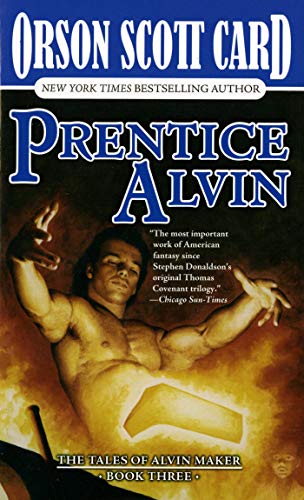
The Tales of Alvin Maker series from bestselling author Orson Scott Card continues in volume three, Prentice Alvin. Young Alvin returns to the town of his birth, and begins his apprenticeship with Makepeace Smith, committing seven years of his life in exchange for the skills and knowledge of a blacksmith. But Alvin must also learn to control and use his own talent, that of a Maker, else his destiny will be unfulfilled.
The Tales of Alvin Maker series
Seventh Son
Red Prophet
Prentice Alvin
Alvin Journeyman
Heartfire
The Crystal City
Die Inhaltsangabe kann sich auf eine andere Ausgabe dieses Titels beziehen.
Über die Autorin bzw. den Autor
Orson Scott Card is the author of the novels Ender's Game, Ender's Shadow, and Speaker for the Dead. Ender's Game and Speaker for the Dead both won Hugo and Nebula Awards, making Card the only author to win these two top prizes in consecutive years. There are seven other novels to date in The Ender Universe series. Card has also written fantasy: The Tales of Alvin Maker is a series of fantasy novels set in frontier America; The Lost Gate, is a contemporary magical fantasy. Card has written many other stand-alone sf and fantasy novels, as well as movie tie-ins and games, and publishes an internet-based science fiction and fantasy magazine, Orson Scott Card's Intergalactic Medicine Show. Card was born in Washington and grew up in California, Arizona, and Utah. He served a mission for the LDS Church in Brazil in the early 1970s. Besides his writing, Card directs plays and teaches writing and literature at Southern Virginia University. He lives in Greensboro, North Carolina, with his wife, Kristine Allen Card, and youngest daughter, Zina Margaret.
Von der hinteren Coverseite
The Tales of Alvin Maker III
"The most important work of American fantasy since Stephen Donaldson's original Thomas covenant trilogy."—Chicago Sun-Times
Praise for The Tales of Alvin Maker
"A tribute to the art of storytelling. . . highly recommended."—Library Journal
"Card has uncovered a rich vein of folklore and magic here, to which his assured handling of old time religion and manifest love of children is admirably suited: an appealing and intriguing effort."—Kirkus Reviews
"A beguiling book. . . robust but reflective blend of folktale, history, parable and personal testimony, pioneer narrative. The series promises to be a ‘story of deep delight.'"—Publishers Weekly
"Card is one of the most important writers in the field."—Ben Bova
"[Card's] versatility of style, subject, and approach makes him unique in the SF field!"—Anne McCaffrey
"With the third installment in his tales of Alvin Maker series, Card's alternative frontier America epic continues to be a significant event in fantasy publishing."—Booklist
"The best fantasy series now in progress."—Publishers Weekly
If you read only one fantasy this year, this is the one.
Auszug. © Genehmigter Nachdruck. Alle Rechte vorbehalten.
Prentice Alvin
The Tales of Alvin Maker, Volume IIIBy Orson Scott CardTor Fantasy
Copyright © 1989 Orson Scott CardAll right reserved.
ISBN: 9780812502121
Prentice Alvin
1
The Overseer
LET ME START my history of Alvin's prenticeship where things first began to go wrong. It was a long way south, a man that Alvin had never met nor never would meet in all his life. Yet he it was who started things moving down the path that would lead to Alvin doing what the law called murder--on the very day that his prenticeship ended and he rightly became a man.
It was a place in Appalachee, in 1811, before Appalachee signed the Fugitive Slave Treaty and joined the United States. It was near the borders where Appalachee and the Crown Colonies meet, so there wasn't a White man but aspired to own a passel of Black slaves to do his work for him.
Slavery, that was a kind of alchemy for such White folk, or so they reckoned. They calculated a way of turning each bead of a Black man's sweat into gold and each moan of despair from a Black woman's throat into the sweet clear sound of a silver coin ringing on the money-changer's table. There was buying and selling of souls in that place. Yet there was nary a one of them who understood the whole price they paid for owning other folk.
Listen tight, and I'll tell you how the world looked from inside Cavil Planter's heart. But make sure the children are asleep, for this is a part of my tale that children ought not to hear, for it deals with hungers they don't understand too well, and I don't aim for this story to teach them.
Cavil Planter was a godly man, a church-going man, a tithepayer. All his slaves were baptized and given Christian names as soon as they understood enough English to be taught the gospel. He forbade them to practice their dark arts--he never allowed them to slaughter so much as a chicken themselves, lest they convert such an innocent act into a sacrifice to some hideous god. In all ways Cavil Planter served the Lord as best he could.
So, how was the poor man rewarded for his righteousness? His wife, Dolores, she was beset with terrible aches and pains, her wrists and fingers twisting like an old woman's. By the time she was twenty-five she went to sleep most nights crying, so that Cavil could not bear to share the room with her.
He tried to help her. Packs of cold water, soaks of hot water, powders and potions, spending more than he could afford on those charlatan doctors with their degrees from the University of Camelot, and bringing in an endless parade of preachers with their eternal prayers and priests with their hocum pocus incantations. All of it accomplished nigh onto nothing. Every night he had to lie there listening to her cry until she whimpered, whimper until her breath became a steady in and out, whining just a little on the out-breath, a faint little wisp of pain.
It like to drove Cavil mad with pity and rage and despair. For months on end it seemed to him that he never slept at all. Work all day, then at night lie there praying for relief. If not for her, then for him.
It was Dolores herself who gave him peace at night. "You have work to do each day, Cavil, and can't do it unless you sleep. I can't keep silent, and you can't bear to hear me. Please--sleep in another room."
Cavil offered to stay anyway. "I'm your husband, I belong here"--he said it, but she knew better.
"Go," she said. She even raised her voice. "Go!"
So he went, feeling ashamed of how relieved he felt. He slept that night without interruption, a whole five hours until dawn, slept well for the first time in months, perhaps years--and arose in the morning consumed with guilt for not keeping his proper place beside his wife.
In due time, though, Cavil Planter became accustomed to sleeping alone. He visited his wife often, morning and night. They took meals together. Cavil sitting on a chair in her room, his food on a small side table, Dolores lying in bed as a Black woman carefully spooned food into her mouth while her hands sprawled on the bedsheets like dead crabs.
Even sleeping in another room, Cavil wasn't free of torment. There would be no babies. There would be no sons to raise up to inherit Cavil's fine plantation. There would be no daughters to give away in magnificent weddings. The ballroom downstairs--when he brought Dolores into the fine new house he had built for her, he had said, "Our daughters will meet their beaux in this ballroom, and first touch their hands, the way our hands first touched in your father's house." Now Dolores never saw the ballroom. She came downstairs only on Sundays to go to church and on those rare days when new slaves were purchased, so she could see to their baptism.
Everyone saw her on such occasions, and admired them both for their courage and faith in adversity. But the admiration of his neighbors was scant comfort when Cavil surveyed the ruins of his dreams. All that he prayed for--it's as if the Lord wrote down the list and then in the margin noted "no, no, no" on every line.
The disappointments might have embittered a man of weaker faith. But Cavil Planter was a godly, upright man, and whenever he had the faintest thought that God might have treated him badly, he stopped whatever he was doing and pulled the small psaltery from his pocket and whispered aloud the words of the wise man.
In thee, O Lord, do I put my trust; Bow down thine ear to me; Be thou my strong rock.
He concentrated his mind firmly, and the doubts and resentments quickly fled. The Lord was with Cavil Planter, even in his tribulations.
Until the morning he was reading in Genesis and he came upon the first two verses of chapter 16.
Now Sarai Abram's wife bare him no children: and she had an handmaid. an Egyptian, whose name was Hagar. And Sarai said unto Abram, Behold now. the Lord hath restrained me from hearing: I pray thee, go in unto my maid: it may be that I may obtain children by her.
At that moment the thought came into his mind, Abraham was a righteous man, and so am I. Abraham's wife bore him no children, and mine likewise has no hope. There was an African slavewoman in their household, as there are such women in mine. Why shouldn't I do as Abraham did, and father children by one of these?
The moment the thought came into his head, he shuddered in horror. He'd heard gossip of White Spaniards and French and Portuguese in the jungle islands to the south who lived openly with Black women--truly they were the lowest kind of creature, like men who do with beasts. Besides, how could a child of a Black woman ever be an heir to him? A mix-up boy could no more take possession of an Appalachee plantation than fly. Cavil just put the thought right out of his mind.
But as he sat at breakfast with his wife, the thought came back. He found himself watching the Black woman who fed his wife. Like Hagar, this woman is Egyptian, isn't she? He noticed how her body twisted lithely at the waist as she bore the spoon from tray to mouth. Noticed how as she leaned forward to hold the cup to the frail woman's lips, the servant's breasts swung down to press against her blouse. Noticed how her gentle fingers brushed crumbs anddrops from Dolores's lips. He thought of those fingers touching him, and trembled slightly. Yet it felt like an earthquake inside him.
He rushed from the room with...
„Über diesen Titel“ kann sich auf eine andere Ausgabe dieses Titels beziehen.
Suchergebnisse für Prentice Alvin: The Tales of Alvin Maker, Book Three

Beispielbild für diese ISBN
Prentice Alvin (Tales of Alvin Maker, Book 3)
Verlag:
Tor Fantasy (edition Later Printing (3rd)), 1989
ISBN 10: 0812502124
ISBN 13: 9780812502121
Gebraucht
Mass Market Paperback
Anbieter: BooksRun, Philadelphia, PA, USA
Verkäuferbewertung 5 von 5 Sternen

Mass Market Paperback. Zustand: Very Good. Later Printing (3rd). It's a well-cared-for item that has seen limited use. The item may show minor signs of wear. All the text is legible, with all pages included. It may have slight markings and/or highlighting. Artikel-Nr. 0812502124-11-1
Gebraucht kaufen
EUR 4,09
Versand gratis
Versand innerhalb von USA
Versand innerhalb von USA
Anzahl: 1 verfügbar
Beispielbild für diese ISBN
Prentice Alvin (Tales of Alvin Maker, Book 3)
Verlag:
Tor Fantasy (edition Later Printing (3rd)), 1989
ISBN 10: 0812502124
ISBN 13: 9780812502121
Gebraucht
Mass Market Paperback
Anbieter: BooksRun, Philadelphia, PA, USA
Verkäuferbewertung 5 von 5 Sternen
Mass Market Paperback. Zustand: Fair. Later Printing (3rd). The item might be beaten up but readable. May contain markings or highlighting, as well as stains, bent corners, or any other major defect, but the text is not obscured in any way. Artikel-Nr. 0812502124-7-22
Gebraucht kaufen
EUR 4,21
Versand gratis
Versand innerhalb von USA
Versand innerhalb von USA
Anzahl: 1 verfügbar
Beispielbild für diese ISBN
Prentice Alvin: The Tales of Alvin Maker, Book Three
Anbieter: ThriftBooks-Atlanta, AUSTELL, GA, USA
Verkäuferbewertung 5 von 5 Sternen
Paperback. Zustand: Fair. No Jacket. Readable copy. Pages may have considerable notes/highlighting. ~ ThriftBooks: Read More, Spend Less. Artikel-Nr. G0812502124I5N00
Gebraucht kaufen
EUR 5,76
Versand gratis
Versand innerhalb von USA
Versand innerhalb von USA
Anzahl: 1 verfügbar
Beispielbild für diese ISBN
Prentice Alvin: The Tales of Alvin Maker, Book Three
Anbieter: ThriftBooks-Reno, Reno, NV, USA
Verkäuferbewertung 5 von 5 Sternen
Paperback. Zustand: Very Good. No Jacket. May have limited writing in cover pages. Pages are unmarked. ~ ThriftBooks: Read More, Spend Less. Artikel-Nr. G0812502124I4N00
Gebraucht kaufen
EUR 5,76
Versand gratis
Versand innerhalb von USA
Versand innerhalb von USA
Anzahl: 1 verfügbar
Beispielbild für diese ISBN
Prentice Alvin: The Tales of Alvin Maker, Book Three
Anbieter: ThriftBooks-Dallas, Dallas, TX, USA
Verkäuferbewertung 5 von 5 Sternen
Paperback. Zustand: Very Good. No Jacket. May have limited writing in cover pages. Pages are unmarked. ~ ThriftBooks: Read More, Spend Less. Artikel-Nr. G0812502124I4N00
Gebraucht kaufen
EUR 5,76
Versand gratis
Versand innerhalb von USA
Versand innerhalb von USA
Anzahl: 1 verfügbar
Beispielbild für diese ISBN
Prentice Alvin: The Tales of Alvin Maker, Book Three
Anbieter: ThriftBooks-Atlanta, AUSTELL, GA, USA
Verkäuferbewertung 5 von 5 Sternen
Paperback. Zustand: Very Good. No Jacket. May have limited writing in cover pages. Pages are unmarked. ~ ThriftBooks: Read More, Spend Less. Artikel-Nr. G0812502124I4N00
Gebraucht kaufen
EUR 5,76
Versand gratis
Versand innerhalb von USA
Versand innerhalb von USA
Anzahl: 1 verfügbar
Beispielbild für diese ISBN
Prentice Alvin (Tales of Alvin Maker, Book 3) (Alvin Maker, 3)
Anbieter: Wonder Book, Frederick, MD, USA
Verkäuferbewertung 5 von 5 Sternen
Zustand: Very Good. Very Good condition. A copy that may have a few cosmetic defects. May also contain light spine creasing or a few markings such as an owner's name, short gifter's inscription or light stamp. Artikel-Nr. F08M-01733
Gebraucht kaufen
EUR 6,21
Versand gratis
Versand innerhalb von USA
Versand innerhalb von USA
Anzahl: 3 verfügbar
Beispielbild für diese ISBN
Prentice Alvin : The Tales of Alvin Maker, Book Three
Verlag:
Doherty Associates, LLC, Tom, 1989
ISBN 10: 0812502124
ISBN 13: 9780812502121
Gebraucht
Softcover
Anbieter: Better World Books, Mishawaka, IN, USA
Verkäuferbewertung 5 von 5 Sternen
Zustand: Good. First Thus. Former library copy. Pages intact with minimal writing/highlighting. The binding may be loose and creased. Dust jackets/supplements are not included. Includes library markings. Stock photo provided. Product includes identifying sticker. Better World Books: Buy Books. Do Good. Artikel-Nr. 6068302-6
Gebraucht kaufen
EUR 6,35
Versand gratis
Versand innerhalb von USA
Versand innerhalb von USA
Anzahl: 1 verfügbar
Beispielbild für diese ISBN
Prentice Alvin : The Tales of Alvin Maker, Book Three
Verlag:
Doherty Associates, LLC, Tom, 1989
ISBN 10: 0812502124
ISBN 13: 9780812502121
Gebraucht
Softcover
Anbieter: Better World Books, Mishawaka, IN, USA
Verkäuferbewertung 5 von 5 Sternen
Zustand: Good. First Thus. Pages intact with minimal writing/highlighting. The binding may be loose and creased. Dust jackets/supplements are not included. Stock photo provided. Product includes identifying sticker. Better World Books: Buy Books. Do Good. Artikel-Nr. 3523596-75
Gebraucht kaufen
EUR 6,35
Versand gratis
Versand innerhalb von USA
Versand innerhalb von USA
Anzahl: 1 verfügbar
Beispielbild für diese ISBN
Prentice Alvin : The Tales of Alvin Maker, Book Three
Anbieter: Better World Books: West, Reno, NV, USA
Verkäuferbewertung 5 von 5 Sternen
Zustand: Very Good. First Thus. Pages intact with possible writing/highlighting. Binding strong with minor wear. Dust jackets/supplements may not be included. Stock photo provided. Product includes identifying sticker. Better World Books: Buy Books. Do Good. Artikel-Nr. GRP97710476
Gebraucht kaufen
EUR 6,35
Versand gratis
Versand innerhalb von USA
Versand innerhalb von USA
Anzahl: 1 verfügbar