
Verwandte Artikel zu Addiction and Devotion in Early Modern England (Haney...
Addiction and Devotion in Early Modern England (Haney Foundation) - Hardcover
Buch 45 von 65: Haney Foundation Series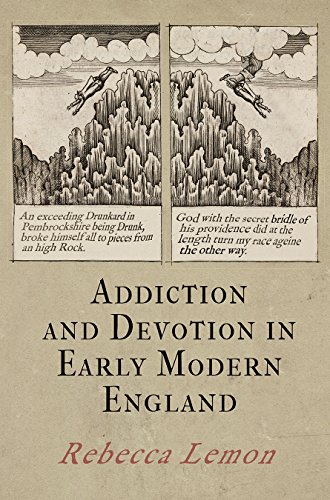
Inhaltsangabe
Rebecca Lemon illuminates a previously-buried conception of addiction, as a form of devotion at once laudable, difficult, and extraordinary, that has been concealed by the persistent modern link of addiction to pathology. Surveying sixteenth-century invocations, she reveals how early moderns might consider themselves addicted to study, friendship, love, or God. However, she also uncovers their understanding of addiction as a form of compulsion that resonates with modern scientific definitions. Specifically, early modern medical tracts, legal rulings, and religious polemic stressed the dangers of addiction to alcohol in terms of disease, compulsion, and enslavement. Yet the relationship between these two understandings of addiction was not simply oppositional, for what unites these discourses is a shared emphasis on addiction as the overthrow of the will.
Etymologically, "addiction" is a verbal contract or a pledge, and even as sixteenth-century audiences actively embraced addiction to God and love, writers warned against commitment to improper forms of addiction, and the term became increasingly associated with disease and tyranny. Examining canonical texts including Doctor Faustus, Twelfth Night, Henry IV, and Othello alongside theological, medical, imaginative, and legal writings, Lemon traces the variety of early modern addictive attachments. Although contemporary notions of addiction seem to bear little resemblance to its initial meanings, Lemon argues that the early modern period's understanding of addiction is relevant to our modern conceptions of, and debates about, the phenomenon.
Die Inhaltsangabe kann sich auf eine andere Ausgabe dieses Titels beziehen.
Über die Autorin bzw. den Autor
Rebecca Lemon is Associate Professor of English at the University of Southern California and author of Treason by Words: Literature, Law, and Rebellion in Shakespeare's England.
Auszug. © Genehmigter Nachdruck. Alle Rechte vorbehalten.
Preface
Addiction is, at its root, about pronouncing a sentence. This sentence might be, as its etymology suggests, an expression of an idea: ad + dīcere, "to speak, say." Or it might be, as in its legal definition, an assignment, such as sentencing someone to prison; following the term's origin in Roman contract law, an addict was an individual, usually a debtor, who had been sentenced or condemned. Addīctus is thus one assigned by decree, made over, bound, or—in one mode of such commitment—devoted.
What, then, does William Prynne mean when he warns against "those who addict themselves to Playes" or cautions readers to avoid those men who strive "earnestly to addict themselves to their trade of acting"? For modern readers he seems to view the theater as a drug, lulling its audiences into narcotic passivity. And indeed, the theater does at times stand as a site of addiction, which, Circe-like, has the power to entrap playgoers: plays are drugs, actors are drug peddlers, and audiences are unwitting victims or eager consumers. Yet this pejorative (even demonic) reading of the word "addict," while arguably at stake in Prynne's description, ignores the word's broader semantic and conceptual history. Eighteenth-century writers deploy the word in its modern signification—"the compulsion and need to continue taking a drug," a usage appearing in 1779 in the work of Samuel Johnson—but sixteenth-century writers instead drew largely on the concept of addiction from its Latin origins to designate service, debt, and dedication.
Unearthing this hidden history behind early modern invocations of addiction, this book offers two primary insights. First, and most important, it illuminates a previously buried conception of addiction as a form of devotion at once laudable, difficult, extraordinary, and even heroic. This view has been concealed by the persistent link of addiction to pathology and modernity: current understandings of, and scholarship on, addiction connect it to globalization, medicalization, and capitalism. Surveying sixteenth-century invocations reveals instead that one might be addicted to study, friendship, love, or God. Prynne cautions that one might addict oneself to stage plays, but his warning rings differently if addiction in the sixteenth century signals a form of pledged dedication. Within Prynne's caution lies the potential for sincere praise for the act of addiction itself. Rather than rebuking a mode of potentially excessive attachment (addiction), he instead cautions audiences against the wrong kind of addiction: to the false idol of the theater, where actors lure spectators into a form of devotion that should belong to God.
Second, this book uncovers an early modern understanding of addiction as a form of compulsion that resonates with modern scientific definitions. Specifically, the project traces how early modern medical tracts, legal rulings, and religious polemics stress the dangers of addiction to alcohol in terms of disease, compulsion, and enslavement. Early modern debates about tobacco, gambling, and sex also deploy, at times, the language of compulsion and vulnerability that comprises early modern addiction. But this book concentrates on alcohol for two reasons: first, the historical evidence on excessive, habitual drinking is more abundant than for other substances; and second, the scholarship on early modern drinking is well established, providing a critical framework for my own contribution. Certainly, the scholarship on good fellowship and the conviviality of sixteenth-century tavern culture contrasts with an emphasis on the compulsive nature of addicted drinking. Yet a host of early modern writers deploy a language of addiction to describe how the choice and inclination of good fellowship in drinking shifts, through habit and custom, into the necessity of habitual, excessive drunkenness.
The relationship between these two understandings of addiction is not solely oppositional nor can it be so easily mapped onto historical narratives, such as a shift from sixteenth-century devotion to eighteenth-century compulsion. Both meanings of addiction appear in the early modern period. What unites these apparently opposed discourses is a shared emphasis, both rhetorical and experiential, on addiction as an overthrow of the will. Being open to a form of strong inspiration, often described as ravishment, the addict is indeed breathed into by the spirit. This spirit might be God, it might be love, or it might be alcohol. But in an experience of ravishment, the addict is inhabited by another, be it a person, object, or idea.
Addiction is, in its spirituous potential, a form of devotion. Early modern lexicographers helped illuminate this relation by using the terms as synonyms. Glossing "addiction," dictionaries turn to the words "devotion" and "dedication," just as in defining "devotion" they deploy the terms "addict" and "addiction." Even as the word "devotion" is most immediately associated with religious worship, it also functioned—as its connection to addiction reveals—independently of a Christian framework. This is because devotion, like addiction, accounts for a position of loyalty to something or someone: one gives oneself up, as a devotee or addict, zealously and exclusively. Nonreligious use of the word draws on its Latin root: dēvovēre (to devote), designated an "earnest addiction or application" and a form of "enthusiastic attachment or loyalty." To be devoted is to be "zealously attached or addicted to a person or cause." One exhibits devotion to a king, to a beloved, to an action, or to a pastime. Both addiction and devotion are forms of service: to be devoted is to exhibit "attached service," to be at someone's command or disposal. Finally, devotion, like addiction, concerns speech: vowing in the case of devotion, and pledging in the case of addiction.
For if early modern addiction concerns an individual subsumed in relation to another, it also involves a dependence on declarative speech. Addiction not only designates a committed relationship of the addict to the substance, spirit, or person to whom he or she is devoted, but also hinges—as noted above—on a verbal contract or pledge. While modern definitions of addiction seem to bear little trace of the term's etymology and early definition, this project uncovers these historical origins, participating in what Jeffrey Masten has called a "renewed historical philology." In his appeal to attend to words and their histories, he writes, "We have not sufficiently attended to etymology—the history of words (the history in words)," urging scholars "to be more carefully attuned to the ways that etymologies, shorn of their associations with 'origin,' persist in a word and its surrounding discourse." In the case of the word "addict," its etymological connection to speaking and pledging, as well as its expression of devotion, might appear entirely buried in modern uses of the term. But this range of meanings persists in early modern usage. Drawing attention to addiction as an utterance uncovers how speaking forth is fundamental to the addictive process. It also reveals such pledging as a challenge to self-sovereignty, as the addict commits to another person or object. Forms of addictive speech—be they pledges, vows, or contracts—track this challenge in their divide between imperative and reflexive articulations: one is attached or compelled by an authority or, alternately and relatedly, one devotes oneself, as with Prynne's caution to those who "addict themselves" to plays or to acting. If Roman and modern invocations of addiction draw largely on the imperative form, in the sixteenth century the reflexive construction proves dominant: addiction represents an exercise of will even in the relinquishing of it, a...
„Über diesen Titel“ kann sich auf eine andere Ausgabe dieses Titels beziehen.
Suchergebnisse für Addiction and Devotion in Early Modern England (Haney...

Beispielbild für diese ISBN
Addiction and Devotion in Early Modern England (Haney Foundation Series)
Verlag:
University of Pennsylvania Press, 2018
ISBN 10: 0812249968
ISBN 13: 9780812249965
Gebraucht
Hardcover
Anbieter: Books From California, Simi Valley, CA, USA
Verkäuferbewertung 4 von 5 Sternen

hardcover. Zustand: Very Good. Artikel-Nr. mon0003829816
Gebraucht kaufen
EUR 15,05
EUR 4,44 Versand
Versand innerhalb von USA
Versand innerhalb von USA
Anzahl: 1 verfügbar
Beispielbild für diese ISBN
Addiction and Devotion in Early Modern England (Haney Foundation Series)
Verlag:
University of Pennsylvania Press, 2018
ISBN 10: 0812249968
ISBN 13: 9780812249965
Gebraucht
Hardcover
Anbieter: Powell's Bookstores Chicago, ABAA, Chicago, IL, USA
Verkäuferbewertung 5 von 5 Sternen

Hardcover. Zustand: Used-Very Good. Zustand des Schutzumschlags: dj. Cloth, dj. Minor shelf wear. Else a bright, clean copy. Artikel-Nr. 1964959
Gebraucht kaufen
EUR 16,50
EUR 4,45 Versand
Versand innerhalb von USA
Versand innerhalb von USA
Anzahl: 1 verfügbar
Beispielbild für diese ISBN
Addiction and Devotion in Early Modern England (Haney Foundation Series)
Verlag:
University of Pennsylvania Press, 2018
ISBN 10: 0812249968
ISBN 13: 9780812249965
Gebraucht
Hardcover
Erstausgabe
Anbieter: Jackson Street Booksellers, Omaha, NE, USA
Verkäuferbewertung 5 von 5 Sternen
Hardcover. Zustand: As New. Zustand des Schutzumschlags: As New. 1st Edition. As New in As New Jacket. 1st Printing. Lit Crit. Artikel-Nr. 163335
Gebraucht kaufen
EUR 22,92
EUR 5,79 Versand
Versand innerhalb von USA
Versand innerhalb von USA
Anzahl: 1 verfügbar
Beispielbild für diese ISBN
Addiction and Devotion in Early Modern England
Verlag:
University of Pennsylvania Press, 2018
ISBN 10: 0812249968
ISBN 13: 9780812249965
Neu
Hardcover
Anbieter: PBShop.store UK, Fairford, GLOS, Vereinigtes Königreich
Verkäuferbewertung 5 von 5 Sternen
HRD. Zustand: New. New Book. Shipped from UK. Established seller since 2000. Artikel-Nr. FW-9780812249965
Neu kaufen
EUR 69,52
EUR 5,99 Versand
Versand von Vereinigtes Königreich nach USA
Versand von Vereinigtes Königreich nach USA
Anzahl: 5 verfügbar
Beispielbild für diese ISBN
Addiction and Devotion in Early Modern England (Haney Foundation Series)
Verlag:
University of Pennsylvania Press, 2018
ISBN 10: 0812249968
ISBN 13: 9780812249965
Neu
Hardcover
Anbieter: Majestic Books, Hounslow, Vereinigtes Königreich
Verkäuferbewertung 4 von 5 Sternen
Zustand: New. Artikel-Nr. 383879689
Neu kaufen
EUR 81,40
EUR 7,75 Versand
Versand von Vereinigtes Königreich nach USA
Versand von Vereinigtes Königreich nach USA
Anzahl: 3 verfügbar
Beispielbild für diese ISBN
Addiction and Devotion in Early Modern England (Haney Foundation Series)
Verlag:
University of Pennsylvania Press, 2018
ISBN 10: 0812249968
ISBN 13: 9780812249965
Neu
Hardcover
Anbieter: Ria Christie Collections, Uxbridge, Vereinigtes Königreich
Verkäuferbewertung 5 von 5 Sternen
Zustand: New. In English. Artikel-Nr. ria9780812249965_new
Neu kaufen
EUR 83,96
EUR 13,46 Versand
Versand von Vereinigtes Königreich nach USA
Versand von Vereinigtes Königreich nach USA
Anzahl: 5 verfügbar
Beispielbild für diese ISBN
Addiction and Devotion in Early Modern England
Anbieter: Revaluation Books, Exeter, Vereinigtes Königreich
Verkäuferbewertung 5 von 5 Sternen
Hardcover. Zustand: Brand New. 304 pages. 9.50x6.50x1.00 inches. In Stock. Artikel-Nr. __0812249968
Neu kaufen
EUR 101,67
EUR 14,90 Versand
Versand von Vereinigtes Königreich nach USA
Versand von Vereinigtes Königreich nach USA
Anzahl: 2 verfügbar
Beispielbild für diese ISBN
Addiction and Devotion in Early Modern England (Haney Foundation Series)
Verlag:
University of Pennsylvania Press, Inc., 2018
ISBN 10: 0812249968
ISBN 13: 9780812249965
Neu
Hardcover
Anbieter: Kennys Bookstore, Olney, MD, USA
Verkäuferbewertung 5 von 5 Sternen
Zustand: New. 2018. Illustrated. Hardcover. . . . . . Books ship from the US and Ireland. Artikel-Nr. V9780812249965
Neu kaufen
EUR 107,74
EUR 9,35 Versand
Versand innerhalb von USA
Versand innerhalb von USA
Anzahl: 1 verfügbar
Foto des Verkäufers
Addiction and Devotion in Early Modern England
Anbieter: moluna, Greven, Deutschland
Verkäuferbewertung 5 von 5 Sternen
Gebunden. Zustand: New. Über den AutorRebecca LemonInhaltsverzeichnisPrefaceIntroduction. Addiction in (Early) ModernityChapter 1. Scholarly Addiction in Doctor FaustusChapter 2. Addicted Love in T. Artikel-Nr. 595036552
Neu kaufen
EUR 73,51
EUR 48,99 Versand
Versand von Deutschland nach USA
Versand von Deutschland nach USA
Anzahl: Mehr als 20 verfügbar
Beispielbild für diese ISBN
Addiction and Devotion in Early Modern England
Anbieter: Revaluation Books, Exeter, Vereinigtes Königreich
Verkäuferbewertung 5 von 5 Sternen
Hardcover. Zustand: Brand New. 304 pages. 9.50x6.50x1.00 inches. In Stock. Artikel-Nr. x-0812249968
Neu kaufen
EUR 111,85
EUR 14,90 Versand
Versand von Vereinigtes Königreich nach USA
Versand von Vereinigtes Königreich nach USA
Anzahl: 2 verfügbar