
Verwandte Artikel zu Frontier Cities: Encounters at the Crossroads of Empire
Inhaltsangabe
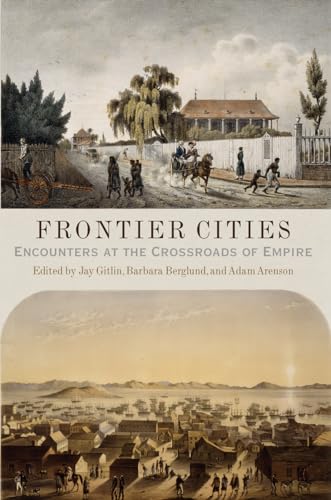
Macau, New Orleans, St. Louis, Pittsburgh, and San Francisco. All of these metropolitan centers were once frontier cities, urban areas irrevocably shaped by cross-cultural borderland beginnings. Spanning a wide range of periods and locations, and including stories of eighteenth-century Detroit, nineteenth-century Seattle, and twentieth-century Los Angeles, Frontier Cities recovers the history of these urban places and shows how, from the start, natives and newcomers alike shared streets, buildings, and interwoven lives. Not only do frontier cities embody the earliest matrix of the American urban experience; they also testify to the intersections of colonial, urban, western, and global history. The twelve essays in this collection paint compelling portraits of frontier cities and their inhabitants: the French traders who bypassed imperial regulations by throwing casks of brandy over the wall to Indian customers in eighteenth-century Montreal; Isaac Friedlander, San Francisco's Grain King; and Adrien de Pauger, who designed the Vieux Carré in New Orleans. Exploring the economic and political networks, imperial ambitions, and personal intimacies of frontier city development, this collection demonstrates that these cities followed no mythic line of settlement, nor did they move lockstep through a certain pace or pattern of evolution. An introduction puts the collection in historical context, and the epilogue ponders the future of frontier cities in the midst of contemporary globalization. With innovative concepts and a rich selection of maps and images, Frontier Cities imparts a crucial untold chapter in the construction of urban history and place.
Die Inhaltsangabe kann sich auf eine andere Ausgabe dieses Titels beziehen.
Über die Autorin bzw. den Autor
Jay Gitlin is Associate Director of the Howard R. Lamar Center for the Study of Frontiers and Borders at Yale University. Barbara Berglund is Associate Professor of History at the University of South Florida. Adam Arenson is Assistant Professor of History at the University of Texas at El Paso.
Auszug. © Genehmigter Nachdruck. Alle Rechte vorbehalten.
Introduction
Local Crossroads, Global Networks, and Frontier Cities
Jay Gitlin, Barbara Berglund, and Adam Arenson
In 1800, a Kansas chief known as Coeur qui Brule wrote to the lieutenant governor of Spanish Louisiana, expressing his desire to visit St. Louis: "depuis longtemps je désire voir la ville [for a long time I have wanted to see the town]." Understanding that St. Louis was a place of French manners and values that explicitly equated civilization with urbanity, this native leader was eager for a chance to tour and experience the newest French city in North America. Coeur qui Brule recognized the significance of the cities European Americans built on North American frontiers. With his French name and apparent French language skills, Coeur qui Brule also embodied the kind of social and cultural mixing that occurred in frontier cities, at the heart of the imperial encounter. He further remarked that he did not want to visit, like some chiefs, to seek presents. On the contrary, he said, "I have the heart of a Frenchman (j'ai le coeur d'un français)."
Coeur qui Brule, however, would also have been acutely aware that he would always be a visitor in St. Louis: that the city was, from its inception, a French home, not an Indian one. When a group of 150 Missouri Indians arrived in 1764, while Auguste Chouteau and Pierre de Laclède's workmen were first laying out the town, Laclède hurried back to the site and carefully explained why the Missouri had to leave, disabusing them of their notion to settle in the heart of the new post. Revealingly, before they left, the women and children of the group were engaged to dig a cellar for the company's main building. Yet despite this exclusionary gesture, St. Louis, like other frontier cities, quickly established itself as a place of both enduring interest and influence within Indian country—to Coeur qui Brule and so many others.
Fifty years ago, Richard C. Wade provided an insight that continues to generate surprise: "Towns were the spearheads of the frontier," he declared in the first sentence of The Urban Frontier (1959). "Planted far in advance of the line of settlement, they held the West for the approaching population." As Coeur qui Brule had experienced one hundred and fifty years before that, towns and cities typically preceded rural settlements throughout early North America.
This volume is dedicated to documenting encounters like Coeur qui Brule's, and to explicating Wade's still-surprising insight that the phrase frontier city is not an oxymoron, not a contradiction in terms. We renew conversations about what the juxtaposition of frontier and city reveal, exploring these fascinating, if unexpected, locales.
Frontier cities are urban settlements that emerge from an initial frontier encounter. They are defined by the interplay between their global contexts—economic, cultural, and political ties, as well as the regulations of uninformed and distant policymakers—and their diverse local actors. In frontier cities, natives and newcomers, hemmed in by practical considerations as they shared streets, buildings, and interwoven lives, created the earliest matrix of the American urban experience.
In these urban spaces of encounter, natives and newcomers alike were shaped by both front-door policy decisions and back-door intimacies and interactions. Even the most basic urban places contained many homes, sites of exchange, and roads that entered into, crossed, and left town. Its residents held connections to a wider world, whether through national or linguistic ties, economic networks, or memories of places across the seas or across the mountains that shaped their lives. These qualities gave rise to the Chinese migrants who established fishing camps on the eastern shores of San Francisco Bay in the early 1850s, to the French traders bypassing imperial regulations by throwing casks of brandy over the wall to Indian customers on the Rue St. Paul in eighteenth-century Montreal, and to a young indigenous boy named Elvis playing his air guitar outside the contemporary frontier city of Manaus in Brazil.
Frontier cities thus emerge as ideal places to see the intimate personal interactions of new settlements, their world-changing importance in the process of state-making, and how the legacies of these patterns of global and local interaction continue to shape cities to this day. They have much to teach us about the complex interactions between diverse peoples and nations; about the power of symbols and metaphors; and about productively reframing the dialogue between the fields of urban, early American, postcolonial, and American western history.
* * *
Recognizing that our key terms, frontier and city, have a long history of varied and multiple usages, we begin by offering some broad parameters that reflect the ways frontier and city are conceptualized in this volume. The expansiveness of these concepts is what, in large measure, gives them their appealing and ongoing explanatory power, but we want to make sure that we can all understand how we, and our contributors, are using these simple yet profound terms.
A frontier is fundamentally an edge and thus a potential meeting ground, a place of convergence. Although the word's first uses appear in early modern Europe, its contemporary resonance comes from association with the history of the American West—and with westering writ large. Within western history, the term has a contentious yet vitally productive past—rooted in the work of Frederick Jackson Turner and, in particular, his 1893 essay, "The Significance of the Frontier in American History." Turner viewed the frontier as an east-to-west moving line where "savagery and civilization" met—where hardy pioneers confronted indigenous peoples and the natural environment, and where they established mostly rural settlements whose residents and institutions manifested characteristics, such as individualism and democracy, which Turner perceived as central to American national identity.
While Turner's ideas about the frontier are plagued by sentiments common for his time, his positioning of the frontier as the crucible that forged characteristics central to the making of the American nation and his identification of the frontier as a process through which Euro-Americans conquered the American West and built a landed empire can still be very useful analytical frameworks. Recognizing this, we join those scholars who have reconceptualized frontiers as varied and multifarious zones of encounter, produced by the global push of empire-building nation-states. In these spaces, different peoples worked together—willingly or unwillingly—as they shaped the environment, created mechanisms of economic and cultural exchange, and established some principles for governance in situations typically structured by unequal power relations.
Seen in this way, frontiers illuminate the centrality of empire-building and nation- making to North American and global expansion because they are among the most significant places where those processes occur. Imperial ambitions and realities among the English, Spanish, French, and Russians drove settlement in North America, and imperial aims fueled the expansion of the United States from early on. By defining frontier cities in ways that actively link them to empire-building and nation-making across North America and beyond, our goal is to both re-energize the concept of the frontier within the historiography of the American West and to simultaneously dislodge it from that tradition—to show that frontiers are not unique to the American West—and to demonstrate how the concept of the frontier has relevance for other fields dealing with intertwined histories of conquest and...
„Über diesen Titel“ kann sich auf eine andere Ausgabe dieses Titels beziehen.
Suchergebnisse für Frontier Cities: Encounters at the Crossroads of Empire

Beispielbild für diese ISBN
Frontier Cities: Encounters at the Crossroads of Empire
Verlag:
University of Pennsylvania Press, 2012
ISBN 10: 0812244680
ISBN 13: 9780812244687
Gebraucht
Hardcover
Anbieter: World of Books (was SecondSale), Montgomery, IL, USA
Verkäuferbewertung 5 von 5 Sternen

Hardback. Zustand: Very Good. Frontier Cities recovers the history of borderland cities in a range of periods and locations-from eighteenth-century Detroit and nineteenth-century Seattle to twentieth-century Los Angeles. Frontier cities embody the earliest mode of American urban experience and testify to the intersections of colonial, urban, western, and global history. Artikel-Nr. 00106794242
Gebraucht kaufen
EUR 6,56
Versand gratis
Versand innerhalb von USA
Versand innerhalb von USA
Anzahl: 1 verfügbar
Beispielbild für diese ISBN
Frontier Cities: Encounters at the Crossroads of Empire
Verlag:
University of Pennsylvania Press (edition ), 2012
ISBN 10: 0812244680
ISBN 13: 9780812244687
Gebraucht
Hardcover
Anbieter: BooksRun, Philadelphia, PA, USA
Verkäuferbewertung 5 von 5 Sternen
Hardcover. Zustand: Very Good. It's a well-cared-for item that has seen limited use. The item may show minor signs of wear. All the text is legible, with all pages included. It may have slight markings and/or highlighting. Artikel-Nr. 0812244680-11-1
Gebraucht kaufen
EUR 8,13
Versand gratis
Versand innerhalb von USA
Versand innerhalb von USA
Anzahl: 1 verfügbar
Beispielbild für diese ISBN
Frontier Cities: Encounters at the Crossroads of Empire
Verlag:
University of Pennsylvania Press (edition ), 2012
ISBN 10: 0812244680
ISBN 13: 9780812244687
Gebraucht
Hardcover
Anbieter: BooksRun, Philadelphia, PA, USA
Verkäuferbewertung 5 von 5 Sternen
Hardcover. Zustand: Very Good. It's a well-cared-for item that has seen limited use. The item may show minor signs of wear. All the text is legible, with all pages included. It may have slight markings and/or highlighting. Artikel-Nr. 0812244680-8-1
Gebraucht kaufen
EUR 9,11
Versand gratis
Versand innerhalb von USA
Versand innerhalb von USA
Anzahl: 1 verfügbar
Beispielbild für diese ISBN
Frontier Cities
Verlag:
MT - University of Pennsylvania Press, 2012
ISBN 10: 0812244680
ISBN 13: 9780812244687
Neu
Hardcover
Anbieter: PBShop.store UK, Fairford, GLOS, Vereinigtes Königreich
Verkäuferbewertung 5 von 5 Sternen
HRD. Zustand: New. New Book. Shipped from UK. Established seller since 2000. Artikel-Nr. FW-9780812244687
Neu kaufen
EUR 62,43
EUR 6,02 Versand
Versand von Vereinigtes Königreich nach USA
Versand von Vereinigtes Königreich nach USA
Anzahl: 1 verfügbar
Foto des Verkäufers
Frontier Cities : Encounters at the Crossroads of Empire
Verlag:
University of Pennsylvania Press, 2012
ISBN 10: 0812244680
ISBN 13: 9780812244687
Gebraucht
Hardcover
Anbieter: GreatBookPricesUK, Woodford Green, Vereinigtes Königreich
Verkäuferbewertung 5 von 5 Sternen
Zustand: As New. Unread book in perfect condition. Artikel-Nr. 18920570
Gebraucht kaufen
EUR 61,64
EUR 18,00 Versand
Versand von Vereinigtes Königreich nach USA
Versand von Vereinigtes Königreich nach USA
Anzahl: Mehr als 20 verfügbar
Beispielbild für diese ISBN
Frontier Cities: Encounters at the Crossroads of Empire
Verlag:
University of Pennsylvania Press, 2012
ISBN 10: 0812244680
ISBN 13: 9780812244687
Neu
Hardcover
Anbieter: Ria Christie Collections, Uxbridge, Vereinigtes Königreich
Verkäuferbewertung 5 von 5 Sternen
Zustand: New. In English. Artikel-Nr. ria9780812244687_new
Neu kaufen
EUR 90,01
EUR 13,55 Versand
Versand von Vereinigtes Königreich nach USA
Versand von Vereinigtes Königreich nach USA
Anzahl: 1 verfügbar
Foto des Verkäufers
Frontier Cities : Encounters at the Crossroads of Empire
Verlag:
University of Pennsylvania Press, 2012
ISBN 10: 0812244680
ISBN 13: 9780812244687
Gebraucht
Hardcover
Anbieter: GreatBookPricesUK, Woodford Green, Vereinigtes Königreich
Verkäuferbewertung 5 von 5 Sternen
Zustand: good. May show signs of wear, highlighting, writing, and previous use. This item may be a former library book with typical markings. No guarantee on products that contain supplements Your satisfaction is 100% guaranteed. Twenty-five year bookseller with shipments to over fifty million happy customers. Artikel-Nr. 18920570-5
Gebraucht kaufen
EUR 88,77
EUR 18,00 Versand
Versand von Vereinigtes Königreich nach USA
Versand von Vereinigtes Königreich nach USA
Anzahl: 4 verfügbar
Beispielbild für diese ISBN
Frontier Cities: Encounters at the Crossroads of Empire
Verlag:
University of Pennsylvania Press, 2012
ISBN 10: 0812244680
ISBN 13: 9780812244687
Neu
Hardcover
Anbieter: Kennys Bookstore, Olney, MD, USA
Verkäuferbewertung 5 von 5 Sternen
Zustand: New. 2012. Hardcover. . . . . . Books ship from the US and Ireland. Artikel-Nr. V9780812244687
Neu kaufen
EUR 101,28
EUR 9,41 Versand
Versand innerhalb von USA
Versand innerhalb von USA
Anzahl: 1 verfügbar
Beispielbild für diese ISBN
Frontier Cities Encounters at the Crossroads of Empire
Anbieter: Revaluation Books, Exeter, Vereinigtes Königreich
Verkäuferbewertung 5 von 5 Sternen
Hardcover. Zustand: Brand New. 296 pages. 9.10x0.90x6.30 inches. In Stock. Artikel-Nr. x-0812244680
Neu kaufen
EUR 106,08
EUR 15,00 Versand
Versand von Vereinigtes Königreich nach USA
Versand von Vereinigtes Königreich nach USA
Anzahl: 2 verfügbar