
Verwandte Artikel zu How Real Estate Developers Think: Design, Profits,...
How Real Estate Developers Think: Design, Profits, and Community (City in the Twenty-First Century) - Softcover
Buch 28 von 53: The City in the Twenty-First Century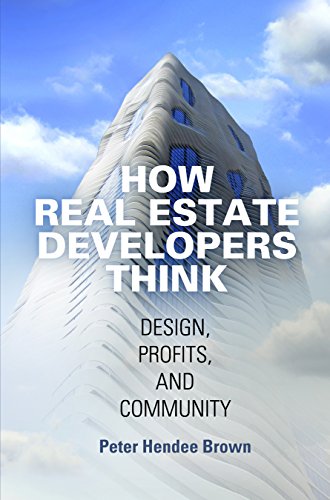
Inhaltsangabe
Cities are always changing: streets, infrastructure, public spaces, and buildings are constantly being built, improved, demolished, and replaced. But even when a new project is designed to improve a community, neighborhood residents often find themselves at odds with the real estate developer who proposes it. Savvy developers are willing to work with residents to allay their concerns and gain public support, but at the same time, a real estate development is a business venture financed by private investors who take significant risks. In How Real Estate Developers Think, Peter Hendee Brown explains the interests, motives, and actions of real estate developers, using case studies to show how the basic principles of development remain the same everywhere even as practices vary based on climate, local culture, and geography. An understanding of what developers do and why they do it will help community members, elected officials, and others participate more productively in the development process in their own communities.
Based on interviews with over a hundred people involved in the real estate development business in Chicago, Miami, Portland (Oregon), and the Twin Cities of Minneapolis and St. Paul, How Real Estate Developers Think considers developers from three different perspectives. Brown profiles the careers of individual developers to illustrate the character of the entrepreneur, considers the roles played by innovation, design, marketing, and sales in the production of real estate, and examines the risks and rewards that motivate developers as people. Ultimately, How Real Estate Developers Think portrays developers as creative visionaries who are able to imagine future possibilities for our cities and communities and shows that understanding them will lead to better outcomes for neighbors, communities, and cities.
Die Inhaltsangabe kann sich auf eine andere Ausgabe dieses Titels beziehen.
Über die Autorin bzw. den Autor
Peter Hendee Brown is an architect, planner, and development consultant based in Minneapolis, where he also teaches at the Humphrey School of Public Affairs at the University of Minnesota. He is author of America's Waterfront Revival: Port Authorities and Urban Redevelopment, also available from the University of Pennsylvania Press.
Auszug. © Genehmigter Nachdruck. Alle Rechte vorbehalten.
Prologue
A Brick Wall in Evanston
We used to call them our town founders and we honored them by erecting their statues in our town squares. Today we just call them "developers."
—Andrés Duany, Miami architect and planner
The Costs of Opposition
In 2002 a Chicago developer named Neil Ornoff hired the architect David Haymes and his firm, Pappageorge Haymes, to design a twenty-unit residential project on a corner site at 525 Kedzie Street, in Evanston, Illinois, a northern suburb of Chicago. "The alderman—the city councilman—was really fearful of the people who lived in the adjacent building and were concerned about losing views they had across the vacant parcel, so he asked the developer to work with them," recalled Haymes. "We designed a beautiful building," but the design required a small portion of the building to be a little bit taller than what the height limits in the code allowed. The site plan also required the developer to seek relief on a parking rule that required a twenty-foot setback from the street to the building face to allow for on-street parking for the property, even though all of the parking for the building was going to be accommodated onsite, within the building, and concealed from view. These were routine and modest variance requests but, as Haymes recalls, "The neighbors simply said no, we are going to oppose the project."
So Haymes went back to the drawing board and redesigned the façade on the side of the building that faced the neighbors, adding articulation and setbacks that made the building look better from the neighboring property but increased project costs. This time the neighbors said, "No, that is a very nice design, but we are still going to oppose it." So the developer said, "That's it—we will build it 'as-of-right,'" which means per the letter of the code and without any variances. Haymes redesigned the building, eliminating the small portion that was to be taller and changing the site plan to accommodate the required twenty-foot setback. He stripped off all of the articulation and setbacks on the side facing the neighboring building because there wasn't room and the developer no longer felt the need to incur the costs required to curry favor with the neighbors. "We gave them an unadorned brick wall facing their building because we had to push our own building so far back on the property." In the end, it took the developer and his team more than two years to obtain the approvals required to build a small, twenty-unit condominium project and by then it was late to market. The project opened in 2007, just as the housing bubble burst. The condominium units failed to sell out at pro forma prices so the developer was unable to fully repay the construction loan. The bank foreclosed on the property and sold it to another owner who converted it to apartments.
In addition to providing architectural design services to developers, David Haymes and his partner have done some small development projects themselves and Haymes is also the head of his own community organization, so he has seen development from those viewpoints too. "There are still some in my community group who harbor those really harsh feelings about developers; they just don't want change. They don't trust developers because anything a developer does is going to be a change, and so they hammer any developer who comes in. Fortunately," says Haymes, "over time, my community group has become more sensitive and understanding of what development is. We have also come to understand that we are better off having a say than not being involved at all, because if you take the attitude that you don't want to talk to somebody then you are going to have to live with the consequences."
Haymes sympathizes with how the public views developers but at the same time he finds that the whole process is far too distrustful to be productive. When Haymes presents at a public meeting, his job is to support his client by positively representing the project, but Haymes says he almost always fully backs and believes in what he is doing for that client. "That is why it is disturbing for us when the developer really is making an honest and forthright effort but he's being abused and we are being called liars and whores." Haymes is disturbed not only because the developer's efforts are being minimized, but also because good things for communities are being passed up—like what happened in Evanston.
In what became a lose-lose outcome, the developer spent extra time and money in a costly and fruitless effort to secure the support of the neighbors. But at the same time, in overplaying their hand the neighbors failed to stop the project and also still lost their views across the vacant parcel, views that were not really theirs to begin with. In giving up their leverage they also gave up views of a more handsome façade from their own windows in exchange for a plain brick wall. By forcing the developer into an as-of-right design, the neighbors forfeited the opportunity to let the developer of the adjacent property increase the value of their own property by building a more attractive building next door.
Unfortunately, for everyone involved, the neighbors misunderstood that the developer had rights and options too. Indeed, his best option was to give up trying to do a more creative design that required minor variances and settle for an as-to-right design that complied with all codes and regulations and could be administratively approved without the need for zoning commission review and a public hearing. The developer could no longer bear the carrying costs on the property, the uncertainty of the approvals process, and the related risk of being late to market. He needed to regain control of the project.
More important, the developer understood the neighbors' strategic position better than they did themselves—certainly better than they understood his position and particularly his property rights. If the neighbors had only been able to see the project from the developer's viewpoint, they may have realized that taking an absolute position—opposition—was a risky strategy that was not necessarily in their own best interests. Then they may have been more open to a collaborative approach and the ability to influence the design in a way that would have maximized the benefits flowing from the project to them and to the larger community.
A Common Story
Unfortunately, this is a common story and anyone who lived in an urban neighborhood in the 2000s and since can probably remember attending a meeting of the neighborhood organization and hearing a contentious debate over a similar project. Nearby neighbors of development projects deserve consideration, and savvy developers know that they will gain public support and attract more potential buyers and tenants if they listen and adjust their designs to reflect the community's feedback and concerns. But how can community members most effectively use their influence to improve the design of a project? Which things can a developer change, which are nonnegotiable, and how can the neighbors tell the difference? How can the neighbors even tell the difference between a good project and a bad one? What powers do members of the community have to influence private business decisions through the public regulatory review process? And what should the neighbors do when a developer walks through the door with a proposal for a project?
The most common strategies are apathy or opposition. Apathy means de facto support and forfeiture of the opportunity to become engaged and to contribute useful local knowledge to improving the project for all parties. Blanket opposition, on the other hand, signals the end of a discussion rather than the beginning of one, and, again, it turns away from the opportunity to positively influence a...
„Über diesen Titel“ kann sich auf eine andere Ausgabe dieses Titels beziehen.
Suchergebnisse für How Real Estate Developers Think: Design, Profits,...

Beispielbild für diese ISBN
How Real Estate Developers Think: Design, Profits, and Community (The City in the Twenty-First Century)
Verlag:
University of Pennsylvania Press, 2018
ISBN 10: 0812224051
ISBN 13: 9780812224054
Gebraucht
Paperback
Anbieter: WorldofBooks, Goring-By-Sea, WS, Vereinigtes Königreich
Verkäuferbewertung 5 von 5 Sternen

Paperback. Zustand: Very Good. The book has been read, but is in excellent condition. Pages are intact and not marred by notes or highlighting. The spine remains undamaged. Artikel-Nr. GOR010776810
Gebraucht kaufen
EUR 14,73
EUR 6,64 Versand
Versand von Vereinigtes Königreich nach USA
Versand von Vereinigtes Königreich nach USA
Anzahl: 1 verfügbar
Beispielbild für diese ISBN
How Real Estate Developers Think: Design, Profits, and Community
Verlag:
University of Pennsylvania Press, 2018
ISBN 10: 0812224051
ISBN 13: 9780812224054
Gebraucht
Paperback
Anbieter: World of Books (was SecondSale), Montgomery, IL, USA
Verkäuferbewertung 5 von 5 Sternen
Paperback. Zustand: Good. Based on interviews in Portland, Chicago, Miami, and Minneapolis/Saint Paul, How Real Estate Developers Think depicts the entrepreneurial personality of the developer, explores the meaning of "good design," and examines the economic risks and rewards of development. Artikel-Nr. 00110883844
Gebraucht kaufen
EUR 21,70
Versand gratis
Versand innerhalb von USA
Versand innerhalb von USA
Anzahl: 2 verfügbar
Foto des Verkäufers
How Real Estate Developers Think: Design, Profits, and Community (The City in the Twenty-First Century)
Verlag:
University of Pennsylvania Press, 2018
ISBN 10: 0812224051
ISBN 13: 9780812224054
Gebraucht
Softcover
Anbieter: Dream Books Co., Denver, CO, USA
Verkäuferbewertung 5 von 5 Sternen
Zustand: good. Gently used with minimal wear on the corners and cover. A few pages may contain light highlighting or writing, but the text remains fully legible. Dust jacket may be missing, and supplemental materials like CDs or codes may not be included. May be ex-library with library markings. Ships promptly! Artikel-Nr. DBV.0812224051.G
Gebraucht kaufen
EUR 21,71
Versand gratis
Versand innerhalb von USA
Versand innerhalb von USA
Anzahl: 1 verfügbar
Beispielbild für diese ISBN
How Real Estate Developers Think: Design, Profits, and Community (The City in the Twenty-First Century)
Verlag:
University of Pennsylvania Press, 2018
ISBN 10: 0812224051
ISBN 13: 9780812224054
Gebraucht
Paperback
Anbieter: Books From California, Simi Valley, CA, USA
Verkäuferbewertung 4 von 5 Sternen

Paperback. Zustand: Very Good. Artikel-Nr. mon0004229563
Gebraucht kaufen
EUR 22,94
EUR 4,44 Versand
Versand innerhalb von USA
Versand innerhalb von USA
Anzahl: 1 verfügbar
Beispielbild für diese ISBN
How Real Estate Developers Think
Anbieter: PBShop.store UK, Fairford, GLOS, Vereinigtes Königreich
Verkäuferbewertung 5 von 5 Sternen
PAP. Zustand: New. New Book. Shipped from UK. Established seller since 2000. Artikel-Nr. FW-9780812224054
Neu kaufen
EUR 36,49
EUR 5,95 Versand
Versand von Vereinigtes Königreich nach USA
Versand von Vereinigtes Königreich nach USA
Anzahl: 15 verfügbar
Beispielbild für diese ISBN
How Real Estate Developers Think: Design, Profits, and Community (The City in the Twenty-First Century)
Verlag:
University of Pennsylvania Press, 2018
ISBN 10: 0812224051
ISBN 13: 9780812224054
Neu
Softcover
Anbieter: Ria Christie Collections, Uxbridge, Vereinigtes Königreich
Verkäuferbewertung 5 von 5 Sternen
Zustand: New. In English. Artikel-Nr. ria9780812224054_new
Neu kaufen
EUR 49,69
EUR 13,39 Versand
Versand von Vereinigtes Königreich nach USA
Versand von Vereinigtes Königreich nach USA
Anzahl: Mehr als 20 verfügbar
Beispielbild für diese ISBN
How Real Estate Developers Think: Design, Profits, and Community
Verlag:
University of Pennsylvania Press, 2018
ISBN 10: 0812224051
ISBN 13: 9780812224054
Neu
Softcover
Anbieter: Kennys Bookstore, Olney, MD, USA
Verkäuferbewertung 5 von 5 Sternen
Zustand: New. 2018. Reprint. Paperback. . . . . . Books ship from the US and Ireland. Artikel-Nr. V9780812224054
Neu kaufen
EUR 54,82
EUR 9,34 Versand
Versand innerhalb von USA
Versand innerhalb von USA
Anzahl: Mehr als 20 verfügbar
Beispielbild für diese ISBN
How Real Estate Developers Think Design, Profits, and Community
Anbieter: Revaluation Books, Exeter, Vereinigtes Königreich
Verkäuferbewertung 5 von 5 Sternen
Paperback. Zustand: Brand New. 325 pages. 8.75x6.00x0.75 inches. In Stock. Artikel-Nr. x-0812224051
Neu kaufen
EUR 54,22
EUR 11,86 Versand
Versand von Vereinigtes Königreich nach USA
Versand von Vereinigtes Königreich nach USA
Anzahl: 2 verfügbar
Beispielbild für diese ISBN
HOW REAL ESTATE DEVELOPERS THINK
Verlag:
University of Pennsylvania Press, 2018
ISBN 10: 0812224051
ISBN 13: 9780812224054
Neu
Softcover
Anbieter: Speedyhen, Hertfordshire, Vereinigtes Königreich
Verkäuferbewertung 5 von 5 Sternen
Zustand: NEW. Artikel-Nr. NW9780812224054
Neu kaufen
EUR 36,47
EUR 48,62 Versand
Versand von Vereinigtes Königreich nach USA
Versand von Vereinigtes Königreich nach USA
Anzahl: 3 verfügbar
Foto des Verkäufers
How Real Estate Developers Think: Design, Profits, and Community
Anbieter: moluna, Greven, Deutschland
Verkäuferbewertung 5 von 5 Sternen
Zustand: New. Based on interviews in Portland, Chicago, Miami, and Minneapolis/Saint Paul, How Real Estate Developers Think depicts the entrepreneurial personality of the developer, explores the meaning of good design, and examines the economic risks and rewards of dev. Artikel-Nr. 595035785
Neu kaufen
EUR 46,48
EUR 48,99 Versand
Versand von Deutschland nach USA
Versand von Deutschland nach USA
Anzahl: 3 verfügbar