
Verwandte Artikel zu Cross-Border Marriages: Gender and Mobility in Transnational...
Inhaltsangabe
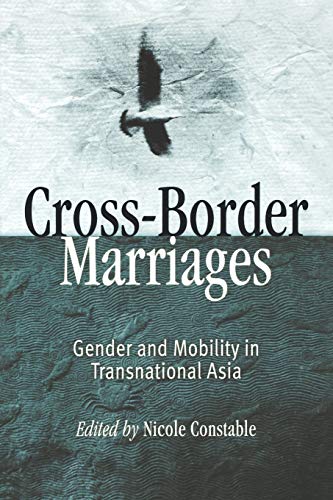
Illuminating how international marriages are negotiated, arranged, and experienced, Cross-Border Marriages is the first book to chart marital migrations involving women and men of diverse national, ethnic, and class backgrounds. The migrations studied here cross geographical borders of provinces, rural-urban borders within nation-states, and international boundaries, including those of China, Japan, South Korea, India, Vietnam, the Philippines, the United States, and Canada. Looking at assumptions about the connection between international marriages and poverty, opportunism, and women's mobility, the book draws attention to ideas about global patterns of inequality that are thought to pressure poor women to emigrate to richer countries, while simultaneously suggesting the limitations of such views.
Breaking from studies that regard the international bride as a victim of circumstance and the mechanisms of international marriage as traffic in commodified women, these essays challenge any simple idea of global hypergamy and present a nuanced understanding where a variety of factors, not the least of which is desire, come into play. Indeed, most contemporary marriage-scapes involve women who relocate in order to marry; rarely is it the men. But Nicole Constable and the volume contributors demonstrate that, contrary to popular belief, these brides are not necessarily poor, nor do they categorically marry men who are above them on the socioeconomic ladder.
Although often women may appear to be moving "up" from a less developed country to a more developed one, they do not necessarily move higher on the chain of economic resources. Complicating these and other assumptions about international marriages, the essays in this volume draw from interviews and rich ethnographic materials to examine women's and men's agency, their motivations for marriage, and the importance of familial pressures and obligations, cultural imaginings, fantasies, and desires, in addition to personal and economic factors.
Border-crossing marriages are significant for what they reveal about the intersection of local and global processes in the everyday lives of women and men whose marital opportunities variably yield both rich possibilities and bitter disappointments.
Die Inhaltsangabe kann sich auf eine andere Ausgabe dieses Titels beziehen.
Über die Autorin bzw. den Autor
Nicole Constable, Professor of Anthropology at the University of Pittsburgh, is the author of Romance on a Global Stage: Pen Pals, Virtual Ethnography and "Mail Order" Brides, among other works.
Auszug. © Genehmigter Nachdruck. Alle Rechte vorbehalten.
INTRODUCTION
The narrator and protagonist in a surrealistic short story by Yoko Tawada (1998) entitled "Missing Heels" is identified as a Japanese "mail-order bride." The story opens with her arrival in an unspecified European country to live with the husband she has yet to meet face-to-face. In an attempt to learn more about the local culture, she recruits the help of a woman teacher. The interaction between the two women encapsulates some of the stark contrasts between perspectives of and about foreign brides. The story, told from the bride's first-person perspective, also hints at some of the paradoxes of the idea that women aspire to and often achieve upward mobility through such marriages. The bride recounts how the woman teacher carefully looked her over and then informed her thatrecently women of an inferior sort were being brought into the country from poorer parts of the world, and since far too many of the men were interested in them, marriage opportunities for her more liberated countrywomen were becoming more and more limited. She sat there waiting for my reaction.
"I didn't know that," I replied.
"These are people who marry only for money," she went on, "who come from poor villages, and get divorced and go back to them when they've saved up enough. They're uneducated, which makes it extremely difficult to teach them what living as man and wife really means...."
"But I'm not like those women," I declared. "I gave this decision lots of thought, and came here of my own free will."
"Poor people have no will of their own," she said in a scathing tone of voice. "Whatever they do, they have no choice in the matter—poverty drives them to it." Having spoken her mind she sat, perhaps in anticipation of a counterattack, with her hands in lightly gripped fists and her chin thrust slightly forward, waiting for an answer.
Although I'd never made up my mind about anything before, this marriage had definitely been my own decision, so being told that poor people have no choice in anything was more than I could stand. "What do you know about someone you're meeting for the first time?" I fired back (Tawada 1998:104-5, emphasis added).This fictional interaction between a bitter European teacher and an immigrant bride is noteworthy not only because it neatly elucidates many common stereotypes of foreign brides or so-called mail-order brides but also because of the bride's refusal to accept such claims. The passage complicates common assumptions about the connection between poverty, opportunism, women's mobility, and the assumed "lack of free will" or lack of agency of foreign women who marry local men. It draws attention to ideas about global patterns of inequality that are thought to pressure poor women to immigrate to richer countries, where their marriages deprive "superior" local women of husbands. Yet it simultaneously suggests the limitations of such views, since the bride is from Japan (a wealthy and "advanced" nation) and has married into a small and seemingly remote European town of her own free will, as she insists. European husbands are depicted as scarce and desirable instruments of mobility, who are eager to marry "inferior" but available foreign women, and who in so doing upset the local status quo. Yet the husband also emerges as a complex figure, despite the fact that he remains invisible throughout most of the story. He provides his wife with shelter in a large house and leaves her a daily allowance. She hears him move about, imagines him in various forms in her dreams, and occasionally glimpses him watching her. Only in the last scene does he finally appear, in the bizarre form of a dead squid.
This story is remarkable for the way in which it challenges prevailing assumptions about "mail-order brides" as simply victims or trafficked women. It allows the bride to speak for herself, assert her self-determination, and tell her own story. Her voice as narrator simultaneously denies her the lack of agency and the victimhood that the local teacher and others attribute to foreign brides. Ultimately, we know little about her background or that of her husband, but what we do know is enough to disrupt the popular logic of the passive and desperate Asian bride who escapes from poverty and backwardness to a wealthy and advanced West.
The chapters in this book draw on stories, conversations, interviews, vignettes, and ethnographic descriptions, as well as materials from the popular media, introduction agencies and marriage brokers. The authors examine the varied perspectives, motivations, and experiences of brides and grooms—and, in some cases, their family members—as they imagine, enter into, resist, or promote particular sorts of cross-border marriages. While our modes of writing differ from Tawada's, our purpose is in some ways similar: collectively, we question many of the bald assumptions about the passivity or desperation of foreign brides; disrupt simplistic notions about upward marital mobility; and offer close ethnographic scrutiny and deep analysis of the local and global processes that make such marriages imaginable and realizable. We seek to convey the variety of experiences among a diversity of Asian women. Like Tawada, several contributors question the popular stereotypes of foreign brides as mail-order brides, commodities, or trafficked women. Yet while we stress the existence of women's and men's agency, we also recognize the limits and different degrees of agency they exhibit, and in some cases the presence and pressure that may be exerted by parents, siblings, and children. We also consider the varied and uneven ways in which economic factors, familial obligations, cultural fantasies and imaginings, and personal motives may come into play. Collectively, we call to mind the multiple ways in which international cross-border marriages are linked to wider regional, national, global, and transnational processes, while at the same time we acknowledge many of the ways in which such international marriages are not entirely new. Drawing on ethnographic studies of marriages that span geographically from China's hinterlands, the Philippines, Vietnam, South Korea, and Japan, to India, and to Canada and the United States, we consider what types of borders are crossed, how, and by whom. How are such border crossings gendered? How are such marriages initiated, arranged, or negotiated? In what sense can these marriages be considered "hypergamous" (upwardly mobile for women), and what are the paradoxes of marital mobility that might simultaneously be considered upward, downward, or lateral, depending on whether we consider class, lifestyle, education, social status, or geographical mobility? As we suggest, greater distances may be associated with new forms of empowerment and also disempowerment for women. Moreover, we pay special attention to how such marriages build on brides' and grooms' contradictory transnational fantasies, desires, and imaginings of marriage, tradition, and modernity.
GENDER AND GLOBAL MARRIAGE-SCAPES
In recent decades, amid new and expanding forms of globalization and capital flows, increased time/space compression facilitated by rapid electronic forms of communication, and the emergence of what Arjun Appadurai calls a "global imagination" (1996), marriages that cross the borders of nation-states have become increasingly common, although they have—until recently—captured relatively little scholarly attention. Such marriages are especially interesting because they do not represent a global free-for-all in which all combinations—regardless of class, nationality, ethnicity, or gender, for example—are possible. Rather, they form marriage-scapes that are shaped and limited by existing and emerging cultural, social, historical, and political-economic factors. They are also shaped by what Patricia Pessar and Sarah Mahler...
„Über diesen Titel“ kann sich auf eine andere Ausgabe dieses Titels beziehen.
Suchergebnisse für Cross-Border Marriages: Gender and Mobility in Transnational...

Beispielbild für diese ISBN
Cross-Border Marriages: Gender and Mobility in Transnational Asia
Verlag:
University of Pennsylvania Press, 2004
ISBN 10: 0812218914
ISBN 13: 9780812218916
Gebraucht
Paperback
Anbieter: ThriftBooks-Atlanta, AUSTELL, GA, USA
Verkäuferbewertung 5 von 5 Sternen

Paperback. Zustand: Very Good. No Jacket. May have limited writing in cover pages. Pages are unmarked. ~ ThriftBooks: Read More, Spend Less. Artikel-Nr. G0812218914I4N00
Gebraucht kaufen
EUR 22,76
Versand gratis
Versand innerhalb von USA
Versand innerhalb von USA
Anzahl: 1 verfügbar
Beispielbild für diese ISBN
Cross-Border Marriages: Gender and Mobility in Transnational Asia
Verlag:
University of Pennsylvania Press, 2005
ISBN 10: 0812218914
ISBN 13: 9780812218916
Gebraucht
Softcover
Anbieter: Anybook.com, Lincoln, Vereinigtes Königreich
Verkäuferbewertung 5 von 5 Sternen
Zustand: Fair. This is an ex-library book and may have the usual library/used-book markings inside.This book has soft covers. Book contains pencil markings. In fair condition, suitable as a study copy. Please note the Image in this listing is a stock photo and may not match the covers of the actual item,450grams, ISBN:9780812218916. Artikel-Nr. 9897717
Gebraucht kaufen
EUR 21,95
EUR 15,86 Versand
Versand von Vereinigtes Königreich nach USA
Versand von Vereinigtes Königreich nach USA
Anzahl: 1 verfügbar
Beispielbild für diese ISBN
Cross-Border Marriages: Gender and Mobility in Transnational Asia
Verlag:
University of Pennsylvania Press, 2005
ISBN 10: 0812218914
ISBN 13: 9780812218916
Gebraucht
Softcover
Anbieter: Anybook.com, Lincoln, Vereinigtes Königreich
Verkäuferbewertung 5 von 5 Sternen
Zustand: Good. This is an ex-library book and may have the usual library/used-book markings inside.This book has soft covers. In good all round condition. Please note the Image in this listing is a stock photo and may not match the covers of the actual item,450grams, ISBN:9780812218916. Artikel-Nr. 5842368
Gebraucht kaufen
EUR 23,05
EUR 15,86 Versand
Versand von Vereinigtes Königreich nach USA
Versand von Vereinigtes Königreich nach USA
Anzahl: 1 verfügbar
Beispielbild für diese ISBN
Cross-Border Marriages
Verlag:
MT - University of Pennsylvania Press, 2004
ISBN 10: 0812218914
ISBN 13: 9780812218916
Neu
PAP
Anbieter: PBShop.store UK, Fairford, GLOS, Vereinigtes Königreich
Verkäuferbewertung 5 von 5 Sternen
PAP. Zustand: New. New Book. Shipped from UK. Established seller since 2000. Artikel-Nr. FW-9780812218916
Neu kaufen
EUR 35,39
EUR 4,85 Versand
Versand von Vereinigtes Königreich nach USA
Versand von Vereinigtes Königreich nach USA
Anzahl: 1 verfügbar
Beispielbild für diese ISBN
Cross-Border Marriages: Gender and Mobility in Transnational Asia
Verlag:
University of Pennsylvania Press, 2004
ISBN 10: 0812218914
ISBN 13: 9780812218916
Neu
Softcover
Anbieter: Ria Christie Collections, Uxbridge, Vereinigtes Königreich
Verkäuferbewertung 5 von 5 Sternen
Zustand: New. In English. Artikel-Nr. ria9780812218916_new
Neu kaufen
EUR 34,73
EUR 13,97 Versand
Versand von Vereinigtes Königreich nach USA
Versand von Vereinigtes Königreich nach USA
Anzahl: 1 verfügbar
Beispielbild für diese ISBN
CrossBorder Marriages Gender and Mobility in Transnational Asia
Anbieter: Revaluation Books, Exeter, Vereinigtes Königreich
Verkäuferbewertung 5 von 5 Sternen
Paperback. Zustand: Brand New. 220 pages. 8.75x6.00x0.75 inches. In Stock. Artikel-Nr. x-0812218914
Neu kaufen
EUR 43,02
EUR 11,66 Versand
Versand von Vereinigtes Königreich nach USA
Versand von Vereinigtes Königreich nach USA
Anzahl: 2 verfügbar
Beispielbild für diese ISBN
Cross-Border Marriages
Verlag:
University of Pennsylvania Press, 2004
ISBN 10: 0812218914
ISBN 13: 9780812218916
Neu
Softcover
Anbieter: Kennys Bookstore, Olney, MD, USA
Verkäuferbewertung 5 von 5 Sternen
Zustand: New. Explores the patterns of marriages of Asian women, including the legendary "mail-order bride." Editor(s): Constable, Nicole. Num Pages: 232 pages, black & white illustrations. BIC Classification: 1F; JHBK. Category: (G) General (US: Trade). Dimension: 229 x 152 x 13. Weight in Grams: 341. . 2004. Paperback. . . . . Books ship from the US and Ireland. Artikel-Nr. V9780812218916
Neu kaufen
EUR 46,57
EUR 9,04 Versand
Versand innerhalb von USA
Versand innerhalb von USA
Anzahl: 1 verfügbar
Beispielbild für diese ISBN
Cross-Border Marriages
Verlag:
University of Pennsylvania Press, 2004
ISBN 10: 0812218914
ISBN 13: 9780812218916
Neu
Softcover
Anbieter: Majestic Books, Hounslow, Vereinigtes Königreich
Verkäuferbewertung 4 von 5 Sternen

Zustand: New. pp. 228 2:B&W 6 x 9 in or 229 x 152 mm Perfect Bound on Creme w/Gloss Lam. Artikel-Nr. 4414275
Neu kaufen
EUR 49,01
EUR 7,58 Versand
Versand von Vereinigtes Königreich nach USA
Versand von Vereinigtes Königreich nach USA
Anzahl: 1 verfügbar
Foto des Verkäufers
Cross-Border Marriages
Verlag:
University of Pennsylvania Press, 2004
ISBN 10: 0812218914
ISBN 13: 9780812218916
Neu
Softcover
Anbieter: moluna, Greven, Deutschland
Verkäuferbewertung 5 von 5 Sternen
Zustand: New. Explores the patterns of marriages of Asian women, including the legendary mail-order bride. Über den AutorNicole Constable, Professor of Anthropology at the University of Pittsburgh, is the author of Romance on a Global Stage:. Artikel-Nr. 867671464
Neu kaufen
EUR 35,52
EUR 48,99 Versand
Versand von Deutschland nach USA
Versand von Deutschland nach USA
Anzahl: Mehr als 20 verfügbar
Foto des Verkäufers
Cross-Border Marriages : Gender and Mobility in Transnational Asia
Verlag:
University Of Pennsylvania Press Sep 2004, 2004
ISBN 10: 0812218914
ISBN 13: 9780812218916
Neu
Taschenbuch
Anbieter: AHA-BUCH GmbH, Einbeck, Deutschland
Verkäuferbewertung 5 von 5 Sternen
Taschenbuch. Zustand: Neu. Neuware - Illuminating how international marriages are negotiated, arranged, and experienced, Cross-Border Marriages is the first book to chart marital migrations involving women and men of diverse national, ethnic, and class backgrounds. The migrations studied here cross geographical borders of provinces, rural-urban borders within nation-states, and international boundaries, including those of China, Japan, South Korea, India, Vietnam, the Philippines, the United States, and Canada. Looking at assumptions about the connection between international marriages and poverty, opportunism, and women's mobility, the book draws attention to ideas about global patterns of inequality that are thought to pressure poor women to emigrate to richer countries, while simultaneously suggesting the limitations of such views. Breaking from studies that regard the international bride as a victim of circumstance and the mechanisms of international marriage as traffic in commodified women, these essays challenge any simple idea of global hypergamy and present a nuanced understanding where a variety of factors, not the least of which is desire, come into play. Indeed, most contemporary marriage-scapes involve women who relocate in order to marry; rarely is it the men. But Nicole Constable and the volume contributors demonstrate that, contrary to popular belief, these brides are not necessarily poor, nor do they categorically marry men who are above them on the socioeconomic ladder. Although often women may appear to be moving 'up' from a less developed country to a more developed one, they do not necessarily move higher on the chain of economic resources. Complicating these and other assumptions about international marriages, the essays in this volume draw from interviews and rich ethnographic materials to examine women's and men's agency, their motivations for marriage, and the importance of familial pressures and obligations, cultural imaginings, fantasies, and desires, in addition to personal and economic factors. Border-crossing marriages are significant for what they reveal about the intersection of local and global processes in the everyday lives of women and men whose marital opportunities variably yield both rich possibilities and bitter disappointments. Artikel-Nr. 9780812218916
Neu kaufen
EUR 44,00
EUR 61,77 Versand
Versand von Deutschland nach USA
Versand von Deutschland nach USA
Anzahl: 1 verfügbar