
Inhaltsangabe
"Art is thinking in images."?Victor Shklovsky
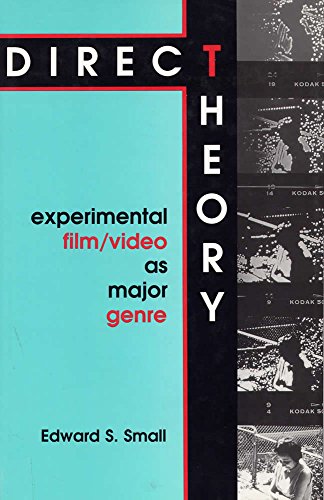
Undulating water patterns; designs etched directly into exposed film; computer- generated, pulsating, multihued light tapestries?the visual images that often constitute experimental film and video provide the basis for Edward S. Small’s argument for a new theory defining this often overlooked and misunderstood genre. In a radical revision of film theory incorporating a semiotic system, Small contends that experimental film/video constitutes a mode of theory that bypasses written or spoken words to directly connect Ferdinand de Saussure’s "signifier" and "signified," the image and the viewer. This new theory leads Small to develop a case for the establishment of experimental film/video as a major genre.
Small contends that the aesthetic of experimental film/video would best be understood as a coordinate major genre separate from genres such as fictive narrative and documentary. He employs eight experimental technical/structural characteristics to demonstrate this thesis: the autonomy of the artist or a-collaborative construction; economic independence; brevity; an affinity for animation and special effects that embraces video technology and computer graphics; use of the phenomenology of mental imagery, including dreams, reveries, and hallucinations; an avoidance of verbal language as either dialogue or narration; an exploration of nonnarrative structure; and a pronounced reflexivity?drawing the audience’s attention to the art of the film through images rather than through the mediation of words.
Along with a theoretical approach, Small provides an overview of the historical development of experimental film as a genre. He covers seven decades beginning in France and Germany in the 1920s with European avant-garde and underground films and ends with a discussion of experimental videos of the 1990s. He highlights certain films and provides a sampling of frames from them to demonstrate the heightened reflexivity when images rather than words are the transmitters: for example, Ralph Steiner’s 1929 H2O, a twelve-minute, wordless, realistic study of water patterns, and Bruce Conner’s 1958 A Movie, which unites his themes of war-weapons-death and sexuality not by narrative digesis but by intellectual montage juxtapositions. Small also examines experimental video productions such as Stephen Beck’s 1977 Video Weavings, which has a simple musical score and abstract images recalling American Indian rugs and tapestries.
Small adds classic and contemporary film theory discussions to this historical survey to further develop his direct-theory argument and his presentation of experimental film/video as a separate major genre. He stresses that the function of experimental film/video is "neither to entertain nor persuade but rather to examine the quite omnipresent yet little understood pictos [semiotic symbols] that mark and measure our postmodern milieu."
Die Inhaltsangabe kann sich auf eine andere Ausgabe dieses Titels beziehen.
Über die Autorinnen und Autoren
Edward S. Small is a professor of theatre and film at the University of Kansas. He is a film theorist with a specialization in semiotics and a prize-winning film/video artist specializing in experimental production.
Edward S. Small is a professor of theatre and film at the University of Kansas.
„Über diesen Titel“ kann sich auf eine andere Ausgabe dieses Titels beziehen.
Weitere beliebte Ausgaben desselben Titels

Suchergebnisse für Direct Theory: Experimental Film/Video As Major Genre

Beispielbild für diese ISBN
Direct Theory: Experimental Film/Video as Major Genre
Verlag:
Southern Illinois University Press, 1995
ISBN 10: 0809319209
ISBN 13: 9780809319206
Gebraucht
Paperback
Anbieter: ThriftBooks-Dallas, Dallas, TX, USA
Verkäuferbewertung 5 von 5 Sternen

Paperback. Zustand: Good. No Jacket. Pages can have notes/highlighting. Spine may show signs of wear. ~ ThriftBooks: Read More, Spend Less. Artikel-Nr. G0809319209I3N00
Gebraucht kaufen
EUR 10,47
Versand gratis
Versand innerhalb von USA
Versand innerhalb von USA
Anzahl: 1 verfügbar
Beispielbild für diese ISBN
Direct Theory: Experimental Film/Video as Major Genre
Verlag:
Southern Illinois University Pre, 1995
ISBN 10: 0809319209
ISBN 13: 9780809319206
Gebraucht
paperback
Anbieter: Books From California, Simi Valley, CA, USA
Verkäuferbewertung 4 von 5 Sternen

paperback. Zustand: Good. Artikel-Nr. mon0003547329
Gebraucht kaufen
EUR 11,36
EUR 4,28 Versand
Versand innerhalb von USA
Versand innerhalb von USA
Anzahl: 1 verfügbar
Beispielbild für diese ISBN
Direct Theory
Verlag:
Southern Illinois University Press, 1995
ISBN 10: 0809319209
ISBN 13: 9780809319206
Gebraucht
Paperback
Anbieter: WorldofBooks, Goring-By-Sea, WS, Vereinigtes Königreich
Verkäuferbewertung 5 von 5 Sternen
Paperback. Zustand: Very Good. The book has been read, but is in excellent condition. Pages are intact and not marred by notes or highlighting. The spine remains undamaged. Artikel-Nr. GOR012106427
Gebraucht kaufen
EUR 22,59
EUR 6,46 Versand
Versand von Vereinigtes Königreich nach USA
Versand von Vereinigtes Königreich nach USA
Anzahl: 1 verfügbar
Beispielbild für diese ISBN
Direct Theory: Experimental Film/Video as Major Genre
Verlag:
Southern Illinois University Press, 1995
ISBN 10: 0809319209
ISBN 13: 9780809319206
Gebraucht
Softcover
Anbieter: Phatpocket Limited, Waltham Abbey, HERTS, Vereinigtes Königreich
Verkäuferbewertung 5 von 5 Sternen
Zustand: Good. Your purchase helps support Sri Lankan Children's Charity 'The Rainbow Centre'. Ex-library, so some stamps and wear, but in good overall condition. Our donations to The Rainbow Centre have helped provide an education and a safe haven to hundreds of children who live in appalling conditions. Artikel-Nr. Z1-C-090-03030
Gebraucht kaufen
EUR 21,14
EUR 12,28 Versand
Versand von Vereinigtes Königreich nach USA
Versand von Vereinigtes Königreich nach USA
Anzahl: 3 verfügbar