
Verwandte Artikel zu Jewish Destinies: Citizenship, State, and Community...
Inhaltsangabe
A trenchant analysis of the place of minorities in a national culture.
Can members of minority cultures be full and equal citizens of a democratic state? Or do community allegiances override loyalty to the state? And who defines a minority community-its members or the state? Pierre Birnbaum asks these crucial questions about France-a nation where 89 percent of the people feel that racism is widespread and 70 percent agree that there are "too many Arabs." Arabs are today's targets, but racism has also been directed at other groups, including Jews.
Jews became full citizens of France only at the Revolution, and historians have traditionally held that the state, in thus emancipating Jews and allowing them to join French society as individuals, severed the ties that had once bound the Jewish community together. But Birnbaum shows that the history of Jews in France-and of attitudes toward them-is not so linear. Rather, he finds that anti-Semitism has risen and fallen along with other forms of racism and xenophobia, and he argues that Jews in France today are once again viewed as members of an isolated community-no matter what their degree of assimilation. Birnbaum's conclusions about state and community have broad-reaching implications for all societies that struggle to incorporate minority groups-including the United States.
Die Inhaltsangabe kann sich auf eine andere Ausgabe dieses Titels beziehen.
Über die Autorin bzw. den Autor
Pierre Birnbaum, professor of political science at the Sorbonne, is the author of more than a dozen books. Those published in English include Anti-Semitism in France, States and Collective Action, and The Heights of Power.
Rezensionen
It's a truism that French Jews, the first granted equal rights in Europe, are less closely tied together than Jews in other lands. After all, one of the main champions of emancipating the Jews during the French Revolution, Abbe Henri Gregoire, did so in the hopes of converting them. In this series of essays, the author, a professor of political science at the Sorbonne, shows that the history and present of French Jews as a minority in relation to the larger community is much more complex. But Birnbaum considers this relationship in a curious, and limited, way: rather than retracing the history of French Jewry, most of the book tracks the history of anti-Semitism. Despite the desire to belong to France, the author notes that when anti-Semitism rears its ugly head, as during the Dreyfus Affair, when a French Jewish army officer was accused of treason, and during WWII, when a Nazi collaborationist regime ruled France, French Jewish intellectuals, despite their universalist leanings, demonstrate an allegiance to other Jews. Nor has the question of anti-Semitism disappeared: the author notes that while a majority of French citizens condemned the 1990 digging up and impaling of a Jewish body in the town of Carpentras, the event also created an anti-Semitic backlash. As the author puts it, for Jews "it is no small feat to negotiate the arduous path between citizenship and community, assimilation and identity." But a description of the history of what French Jews have created, rather than what they and their fellow French citizens have reacted to, would have helped readers better understand that path.
Copyright 2000 Reed Business Information, Inc.
While France enters the next millennium as an embattled multicultural society, like much of the rest of the West, Birnbaum (Political Science/the Sorbonne; Anti-Semitism in France, not reviewed) ponders the nation's Jews as a weathervane for social change. Although the Jews of France were emancipated by the Revolution, and their position in an ambiguously secular French society advanced further by Napoleon, their place in the nation has always been uncertain, often troubled. Birnbaum begins his series of interlocking essays with an examination of the evolution of the free Franco-Jewish community. Just as the society itself was ambiguous in its secularismafter all, the Jacobins had knocked the Church from its privileged place alongside the Bourbon thronethe status of another religious community was inevitably problematic as well. Jews found that they were able to rise as full participants in French civil society, but that freedom also made them more visible targets of virulent anti-Semitism. Birnbaum is most original and successful in his five pivotal essays on the poisonous atmosphere surrounding the Dreyfus affair. His detailed analysis of the anti-Dreyfusards, their opposition to the Republic, and their open and vicious anti-Semitism presents a different picture of L'Affaire than the one most familiar to Americans. Even more than the final essays on contemporary France, this section is pointedly suggestive about recent history. The Catholic Church's role in the anti-Dreyfus movements makes the post-WWII efforts of some Catholic priests to shield such enemies of France as Klaus Barbie and Marcel Papon less baffling. Regrettably, although his analyses are long on insight and intelligence, Birnbaum is a dry writer, and much of this important volume, despite its many resonances for Americas own multicultural debates, is a hard slog. -- Copyright ©2000, Kirkus Associates, LP. All rights reserved.
„Über diesen Titel“ kann sich auf eine andere Ausgabe dieses Titels beziehen.
Suchergebnisse für Jewish Destinies: Citizenship, State, and Community...

Foto des Verkäufers
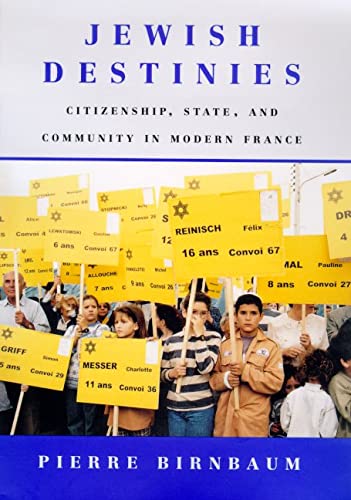
Jewish Destinies: Citizenship, State, and Community in Modern France
Anbieter: BoundlessBookstore, Wallingford, Vereinigtes Königreich
Verkäuferbewertung 5 von 5 Sternen

Zustand: Good. VG condition book with dust jacket. DJ is clean, has fresh colours and has little wear to edges, price clipped. Book has clean and bright contents. Artikel-Nr. 9999-99984440222
Gebraucht kaufen
EUR 3,65
EUR 8,25 Versand
Versand von Vereinigtes Königreich nach USA
Versand von Vereinigtes Königreich nach USA
Anzahl: 1 verfügbar
Beispielbild für diese ISBN
Jewish Destinies : Citizenship, State, and Community in Modern France
Verlag:
Farrar, Straus & Giroux, 2000
ISBN 10: 0809061015
ISBN 13: 9780809061013
Gebraucht
Hardcover
Anbieter: Better World Books, Mishawaka, IN, USA
Verkäuferbewertung 5 von 5 Sternen
Zustand: Good. Former library copy. Pages intact with minimal writing/highlighting. The binding may be loose and creased. Dust jackets/supplements are not included. Includes library markings. Stock photo provided. Product includes identifying sticker. Better World Books: Buy Books. Do Good. Artikel-Nr. 3514654-6
Gebraucht kaufen
EUR 13,13
Versand gratis
Versand innerhalb von USA
Versand innerhalb von USA
Anzahl: 1 verfügbar
Beispielbild für diese ISBN
Jewish Destinies : Citizenship, State, and Community in Modern France
Verlag:
Farrar, Straus & Giroux, 2000
ISBN 10: 0809061015
ISBN 13: 9780809061013
Gebraucht
Hardcover
Anbieter: Better World Books, Mishawaka, IN, USA
Verkäuferbewertung 5 von 5 Sternen
Zustand: Very Good. Pages intact with possible writing/highlighting. Binding strong with minor wear. Dust jackets/supplements may not be included. Stock photo provided. Product includes identifying sticker. Better World Books: Buy Books. Do Good. Artikel-Nr. 3514655-6
Gebraucht kaufen
EUR 13,13
Versand gratis
Versand innerhalb von USA
Versand innerhalb von USA
Anzahl: 1 verfügbar
Beispielbild für diese ISBN
Jewish Destinies: Citizenship, State, and Community in Modern France
Anbieter: ThriftBooks-Dallas, Dallas, TX, USA
Verkäuferbewertung 5 von 5 Sternen
Hardcover. Zustand: Very Good. No Jacket. May have limited writing in cover pages. Pages are unmarked. ~ ThriftBooks: Read More, Spend Less. Artikel-Nr. G0809061015I4N00
Gebraucht kaufen
EUR 14,63
Versand gratis
Versand innerhalb von USA
Versand innerhalb von USA
Anzahl: 1 verfügbar
Beispielbild für diese ISBN
Jewish Destinies: Citizenship, State, and Community in Modern France.
Verlag:
Hill and Wang, New York, 2000
ISBN 10: 0809061015
ISBN 13: 9780809061013
Gebraucht
Hardcover
Anbieter: Henry Hollander, Bookseller, Los Angeles, CA, USA
Verkäuferbewertung 4 von 5 Sternen

Hardbound. Zustand: Very Good. First American Edition. Octavo in dust jacket, xii, map, 324 pp., notes, index With a Preface to the American Edition and a Afterword: 1999. A clean new copy as opposed to the Better W. beat up crap copies. Artikel-Nr. 22104
Gebraucht kaufen
EUR 9,16
EUR 6,25 Versand
Versand innerhalb von USA
Versand innerhalb von USA
Anzahl: 3 verfügbar
Beispielbild für diese ISBN
Jewish Destinies: Citizenship, State, and Community in Modern France
Anbieter: Anybook.com, Lincoln, Vereinigtes Königreich
Verkäuferbewertung 5 von 5 Sternen
Zustand: Good. This is an ex-library book and may have the usual library/used-book markings inside.This book has hardback covers. Clean from markings. In good all round condition. No dust jacket. Please note the Image in this listing is a stock photo and may not match the covers of the actual item,650grams, ISBN:0809061015. Artikel-Nr. 9840189
Gebraucht kaufen
EUR 14,97
EUR 15,41 Versand
Versand von Vereinigtes Königreich nach USA
Versand von Vereinigtes Königreich nach USA
Anzahl: 1 verfügbar