
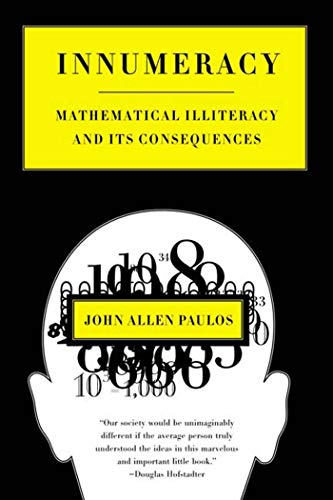
Inhaltsangabe
Readers of Innumeracy will be rewarded with scores of astonishing facts, a fistful of powerful ideas, and, most important, a clearer, more quantitative way of looking at their world.
Why do even well-educated people understand so little about mathematics? And what are the costs of our innumeracy? John Allen Paulos, in his celebrated bestseller first published in 1988, argues that our inability to deal rationally with very large numbers and the probabilities associated with them results in misinformed governmental policies, confused personal decisions, and an increased susceptibility to pseudoscience of all kinds. Innumeracy lets us know what we're missing, and how we can do something about it.
Sprinkling his discussion of numbers and probabilities with quirky stories and anecdotes, Paulos ranges freely over many aspects of modern life, from contested elections to sports stats, from stock scams and newspaper psychics to diet and medical claims, sex discrimination, insurance, lotteries, and drug testing.
Die Inhaltsangabe kann sich auf eine andere Ausgabe dieses Titels beziehen.
Über die Autorin bzw. den Autor
John Allen Paulos is a professor of mathematics at Temple University. His books include the bestseller Innumeracy: Mathematical Illiteracy and Its Consequences (H&W, 1988), Irreligion: A Mathematician Explains Why the Arguments for God Just Don't Add Up, A Mathematician Plays the Stock Market, and A Mathematician Reads the Newspapers.
Auszug. © Genehmigter Nachdruck. Alle Rechte vorbehalten.
Innumeracy
Mathematical Illiteracy and Its ConsequencesBy John Allen PaulosHill and Wang
Copyright © 2001 John Allen PaulosAll right reserved.
ISBN: 9780809058402
Innumeracy
1 Examples and Principles
Two aristocrats are out horseback riding and one challenges the other to see which can come up with the larger number. The second agrees to the contest, concentrates for a few minutes, and proudly announces, "Three." The proposer of the game is quiet for half an hour, then finally shrugs and concedes defeat.
A summer visitor enters a hardware store in Maine and buys a large number of expensive items. The skeptical, reticent owner doesn't say a word as he adds the bill on the cash register. When he's finished,he points to the total and watches as the man counts out $1,528.47. He then methodically recounts the money once, twice, three times. The visitor finally asks if he's given him the right amount of money, to which the Mainer grudgingly responds, "Just barely."
The mathematician G. H. Hardy was visiting his protégé, the Indian mathematician Ramanujan, in the hospital. To make small talk, he remarked that 1729, the number of the taxi which had brought him, was a rather dull number, to which Ramanujan replied immediately, "No, Hardy! No, Hardy! It is a very interesting number. It is the smallest number expressible as the sum of two cubes in two different ways."
BIG NUMBERS, SMALL PROBABILITIES
People's facility with numbers ranges from the aristocratic to the Ramanujanian, but it's an unfortunate fact that most are on the aristocrats' side of our old Mainer. I'm always amazed and depressed when I encounter students who have no idea what the population of the United States is, or the approximate distance from coast to coast, or roughly what percentage of the world is Chinese. I sometimes ask them as an exercise to estimate how fast human hair grows in miles per hour, or approximately how many people die on earth each day, or how many cigarettes are smoked annually in this country. Despite some initial reluctance (one student maintained that hair just doesn't grow in miles per hour),they often improve their feeling for numbers dramatically.
Without some appreciation of common large numbers, it's impossible to react with the proper skepticism to terrifying reports that more than a million American kids are kidnapped each year, or with the proper sobriety to a warhead carrying a megaton of explosive power--the equivalent of a million tons (or two billion pounds) of TNT.
And if you don't have some feeling for probabilities, automobile accidents might seem a relatively minor problem of local travel, whereas being killed by terrorists might seem to be a major risk when going overseas. As often observed, however, the 45,000 people killed annually on American roads are approximately equal in number to all American dead in the Vietnam War. On the other hand, the seventeen Americans killed by terrorists in 1985 were among the 28 million of us who traveled abroad that year--that's one chance in 1.6 million of becoming a victim. Compare that with these annual rates in the United States: one chance in 68,000 of choking to death; one chance in 75,000 of dying in a bicycle crash; one chance in 20,000 of drowning; and one chance in only 5,300 of dying in a car crash.
Confronted with these large numbers and with the correspondingly small probabilities associated with them, the innumerate will inevitably respond with the non sequitur, "Yes, but what if you're that one," and then nod knowingly, as if they've demolished your argument with their penetrating insight. This tendency to personalize is, as we'll see, a characteristic of many people who suffer from innumeracy.Equally typical is a tendency to equate the risk from some obscure and exotic malady with the chances of suffering from heart and circulatory disease, from which about 12,000 Americans die each week.
There's a joke I like that's marginally relevant. An old married couple in their nineties contact a divorce lawyer, who pleads with them to stay together. "Why get divorced now after seventy years of marriage? Why not last it out? Why now?" The little old lady finally pipes up in a creaky voice: "We wanted to wait until the children were dead."
A feeling for what quantities or time spans are appropriate in various contexts is essential to getting the joke. Slipping between millions and billions or between billions and trillions should in this sense be equally funny, but it isn't, because we too often lack an intuitive feeling for these numbers. Many educated people have little grasp for these numbers and are even unaware that a million is 1,000,000; a billion is 1,000,000,000; and a trillion, 1,000,000,000,000.
A recent study by Drs. Kronlund and Phillips of the University of Washington showed that most doctors' assessments of the risks of various operations, procedures, and medications (even in their own specialties) were way off the mark, often by several orders of magnitude. I once had a conversation with a doctor who, within approximately twenty minutes, stated that a certain procedure he was contemplating (a) had a one-chance-in-a-million risk associated with it; (b) was 99 percent safe; and(c) usually went quite well. Given the fact that so many doctors seem to believe that there must be at least eleven people in the waiting room if they're to avoid being idle, I'm not surprised at this new evidence of their innumeracy.
For very big or very small numbers, so-called scientific notation is often clearer and easier to work with than standard notation and I'll therefore sometimes use it. There's nothing very tricky about it: 10N is 1 with N zeroes following it, so 104 is 10,000 and 109 is a billion. 10-N is 1 divided by 10N, so 10-4 is 1 divided by 10,000 or .0001 and 10-2 is one hundredth. 4 106 is 4 1,000,000 or 4,000,000; 5.3 108 is 5.3 100,000,000 or 530,000,000; 2 10-3 is 2 1/1,000 or .002; 3.4 10-7 is 3.4 1/10,000,000 or .00000034.
Why don't news magazines and newspapers make appropriate use of scientific notation in their stories? The notation is not nearly as arcane as many of the topics discussed in these media, and it's considerably more useful than the abortive switch to the metric system about which so many boring articles were written. The expression 7.39842 1010 is more comprehensible and legible than seventy-three billion nine hundred and eighty-four million and two hundred thousand.
Expressed in scientific notation, the answers to the questions posed earlier are: human hair grows at a rate of roughly 10-8 miles per hour; approximately 2.5 105 people die each day on earth; and approximately 5 1011 cigarettes are smoked each year in the United States. Standard notation forthese numbers is: .00000001 miles per hour; about 250,000 people; approximately 500,000,000,000 cigarettes.
BLOOD, MOUNTAINS, AND BURGERS
In a Scientific American column on innumeracy, the computer scientist Douglas Hofstadter cites the case of the Ideal Toy Company, which stated on the package of the original Rubik cube that there were more than three billion possible states the cube could attain. Calculations show that there are more than 4 1019 possible states, 4 with 19 zeroes after it. What the package says isn't wrong; there are more than three billion...
„Über diesen Titel“ kann sich auf eine andere Ausgabe dieses Titels beziehen.
Weitere beliebte Ausgaben desselben Titels

Suchergebnisse für Innumeracy: Mathematical Illiteracy and Its Consequences

Beispielbild für diese ISBN
Innumeracy Mathematical Illite
Anbieter: World of Books (was SecondSale), Montgomery, IL, USA
Verkäuferbewertung 5 von 5 Sternen

Zustand: Good. Item in good condition. Textbooks may not include supplemental items i.e. CDs, access codes etc. Artikel-Nr. 00097437944
Gebraucht kaufen
EUR 3,33
Versand gratis
Versand innerhalb von USA
Versand innerhalb von USA
Anzahl: 12 verfügbar
Beispielbild für diese ISBN
Innumeracy Mathematical Illite
Anbieter: World of Books (was SecondSale), Montgomery, IL, USA
Verkäuferbewertung 5 von 5 Sternen
Zustand: Acceptable. Item in acceptable condition! Textbooks may not include supplemental items i.e. CDs, access codes etc. Artikel-Nr. 00100708925
Gebraucht kaufen
EUR 3,33
Versand gratis
Versand innerhalb von USA
Versand innerhalb von USA
Anzahl: 2 verfügbar
Foto des Verkäufers
Innumeracy: Mathematical Illiteracy and Its Consequences
Anbieter: Dream Books Co., Denver, CO, USA
Verkäuferbewertung 5 von 5 Sternen
Zustand: good. Gently used with minimal wear on the corners and cover. A few pages may contain light highlighting or writing, but the text remains fully legible. Dust jacket may be missing, and supplemental materials like CDs or codes may not be included. May be ex-library with library markings. Ships promptly! Artikel-Nr. 4EKGU9008PJU_ns
Gebraucht kaufen
EUR 3,37
Versand gratis
Versand innerhalb von USA
Versand innerhalb von USA
Anzahl: 2 verfügbar
Foto des Verkäufers
Innumeracy: Mathematical Illiteracy and Its Consequences
Anbieter: Dream Books Co., Denver, CO, USA
Verkäuferbewertung 5 von 5 Sternen
Zustand: acceptable. This copy has clearly been enjoyedâ"expect noticeable shelf wear and some minor creases to the cover. Binding is strong, and all pages are legible. May contain previous library markings or stamps. Artikel-Nr. DBV.0809058405.A
Gebraucht kaufen
EUR 3,63
Versand gratis
Versand innerhalb von USA
Versand innerhalb von USA
Anzahl: 1 verfügbar
Beispielbild für diese ISBN
Innumeracy: Mathematical Illiteracy and Its Consequences
Verlag:
Hill and Wang (edition First Edition), 2001
ISBN 10: 0809058405
ISBN 13: 9780809058402
Gebraucht
Paperback
Erstausgabe
Anbieter: BooksRun, Philadelphia, PA, USA
Verkäuferbewertung 5 von 5 Sternen
Paperback. Zustand: Very Good. First Edition. It's a well-cared-for item that has seen limited use. The item may show minor signs of wear. All the text is legible, with all pages included. It may have slight markings and/or highlighting. Artikel-Nr. 0809058405-11-1
Gebraucht kaufen
EUR 4,91
Versand gratis
Versand innerhalb von USA
Versand innerhalb von USA
Anzahl: 2 verfügbar
Beispielbild für diese ISBN
Innumeracy: Mathematical Illiteracy and Its Consequences
Anbieter: ThriftBooks-Phoenix, Phoenix, AZ, USA
Verkäuferbewertung 5 von 5 Sternen
Paperback. Zustand: Good. No Jacket. Pages can have notes/highlighting. Spine may show signs of wear. ~ ThriftBooks: Read More, Spend Less. Artikel-Nr. G0809058405I3N00
Gebraucht kaufen
EUR 5,73
Versand gratis
Versand innerhalb von USA
Versand innerhalb von USA
Anzahl: 1 verfügbar
Beispielbild für diese ISBN
Innumeracy: Mathematical Illiteracy and Its Consequences
Anbieter: ThriftBooks-Reno, Reno, NV, USA
Verkäuferbewertung 5 von 5 Sternen
Paperback. Zustand: Good. No Jacket. Pages can have notes/highlighting. Spine may show signs of wear. ~ ThriftBooks: Read More, Spend Less. Artikel-Nr. G0809058405I3N00
Gebraucht kaufen
EUR 5,73
Versand gratis
Versand innerhalb von USA
Versand innerhalb von USA
Anzahl: 1 verfügbar
Beispielbild für diese ISBN
Innumeracy: Mathematical Illiteracy and Its Consequences
Anbieter: ThriftBooks-Dallas, Dallas, TX, USA
Verkäuferbewertung 5 von 5 Sternen
Paperback. Zustand: Good. No Jacket. Missing dust jacket; Pages can have notes/highlighting. Spine may show signs of wear. ~ ThriftBooks: Read More, Spend Less. Artikel-Nr. G0809058405I3N01
Gebraucht kaufen
EUR 5,73
Versand gratis
Versand innerhalb von USA
Versand innerhalb von USA
Anzahl: 1 verfügbar
Beispielbild für diese ISBN
Innumeracy: Mathematical Illiteracy and Its Consequences
Anbieter: ThriftBooks-Atlanta, AUSTELL, GA, USA
Verkäuferbewertung 5 von 5 Sternen
Paperback. Zustand: Good. No Jacket. Pages can have notes/highlighting. Spine may show signs of wear. ~ ThriftBooks: Read More, Spend Less. Artikel-Nr. G0809058405I3N00
Gebraucht kaufen
EUR 5,73
Versand gratis
Versand innerhalb von USA
Versand innerhalb von USA
Anzahl: 2 verfügbar
Beispielbild für diese ISBN
Innumeracy: Mathematical Illiteracy and Its Consequences
Anbieter: ThriftBooks-Dallas, Dallas, TX, USA
Verkäuferbewertung 5 von 5 Sternen
Paperback. Zustand: Good. No Jacket. Pages can have notes/highlighting. Spine may show signs of wear. ~ ThriftBooks: Read More, Spend Less. Artikel-Nr. G0809058405I3N00
Gebraucht kaufen
EUR 5,73
Versand gratis
Versand innerhalb von USA
Versand innerhalb von USA
Anzahl: 2 verfügbar