
Verwandte Artikel zu Freedom's Cap: The United States Capitol and the...
Inhaltsangabe
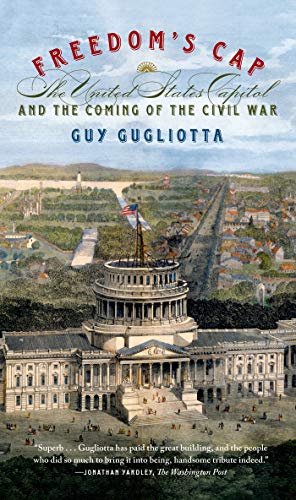
The history of the modern United States Capitol, the iconic seat of the U.S. government, is also the history of America's most tumultuous years. As the majestic new building rose above Washington's skyline, battles over slavery and secession were ripping the country apart. Ground was broken just months after Congress adopted the compromise of 1850. Workers began to bolt the Capitol's 9-million-pound cast-iron dome into place in 1856. The statue Freedom was placed atop it in 1863, five months after the Battle of Gettysburg. Little known is the greater irony: the United States owes the building's scale and magnificence to Jefferson Davis, who remained the Capitol's staunchest advocate up until the week he left Washington to become president of the Confederacy. Davis's protégé and the engineer in charge was army captain Montgomery C. Meigs, who as Lincoln's quartermaster general of the Union Army would never forgive Davis's betrayal of the nation. The Capitol's brilliant architect, and Meigs's longtime rival, was Thomas U. Walter, a Southern sympathizer who would turn fiercely against the South and all who had betrayed the Union.
In Freedom's Cap, Guy Gugliotta, an award-winning journalist, science writer, and author, has captured with impeccable historical detail the clash of personalities behind the building of the Capitol and its extraordinary design and engineering.
Die Inhaltsangabe kann sich auf eine andere Ausgabe dieses Titels beziehen.
Über die Autorin bzw. den Autor
Guy Gugliotta covered Congress during a sixteen-year career as a national reporter for The Washington Post and for the last six years has been a freelance writer. He has written for The New York Times, National Geographic, Wired, Discover, and Smithsonian. He is the coauthor of Kings of Cocaine.
Auszug. © Genehmigter Nachdruck. Alle Rechte vorbehalten.
Freedom's Cap
The United States Capitol and the Coming of the Civil WarBy Guy GugliottaHill and Wang
Copyright © 2013 Guy GugliottaAll right reserved.
ISBN: 9780809046836
Freedom's Cap
1
"CONGRESS HOUSE"
In 1850, the city of Washington was almost sixty years old. It had a population of 40,001, of whom 26 percent were classified as "colored" and 5 percent were slaves.1 Congress had 233 House members and sixty-two senators from thirty-one states. Democrats held a plurality in the House and a solid Senate majority, but the president was a Whig. He was General Zachary Taylor, "Old Rough and Ready," hero of the Battle of Buena Vista in the recently concluded Mexican War. The most important political question facing Taylor and the Congress was how to divide up the immense piece of territory that the United States had won in this unequal struggle. How many new states would there be? How would their boundaries be drawn? How many of them would be free, and how many slave? None of these questions had easy answers, and slavery was a topic so poisonous that it threatened disunion or even civil war. Stalling, a favorite congressional tactic to avoid unpleasant tasks, would not work. Prospectors had discovered gold in the new territory of California; ninety-five thousand fortune hunters, speculators, settlers, and former Mexican citizens were already there, and more were on the way.2 California needed to become a state, and quickly. The problem of the "Mexican Cession" would not wait.
Debate began as soon as the 31st Congress convened in December 1849, and lawmakers, lobbyists, diplomats, townspeople, tourists, vendors, and vagrants converged every day on the U.S. Capitol, Washington's largest and tallest building. It commanded the city, even definedit, for the luminaries who worked there eclipsed most of the lesser-known transients who held the presidency. Congress was always the best show in town, and visitors to the Capitol could climb the steps of the eastern entrance, walk into the cavernous Rotunda, and choose: the Senate on the right-hand, or northern, side, or the House of Representatives on the south side. On any given day they had a chance to hear, among others, Clay, Webster, and perhaps even the ailing Calhoun.
Or even speak with them. An interesting mix of formality and informality reigned in the Capitol. Lawmakers--especially senators--dressed elegantly, for the most part, and those visitors who watched the debates from the Senate and House galleries were expected to dress well themselves--and to behave accordingly. Apart from debates, however, the public mingled freely with their elected officials. No senator or House member had an office of his own--they were all men--and all of themconducted the majority of their official and personal business at their chamber desks or out in the hallways, where they chatted with constituents, visitors, lobbyists, news reporters, and whoever else might be in the building.
But by 1850, the Capitol had many defects. Walls were cracking, roofs sagged, timbers rotted. The Senate sweltered in the summer but was so cold in winter that the inhabitants wrapped themselves in quilts or blankets. Sam Houston, wearing a multicolored Indian poncho, a cougar skin vest, and a Mexican sombrero, would whittle wooden hearts during debate, sending pages to deliver them to pretty ladies seated in the gallery. 3 Older senators, in particular, stayed close to the hickory stoves and had to be pried away when debate began.4 In the House, the acoustics were so bad that members could not hear each other unless they stood next to whoever was speaking or found one of the sweet spots that allowed them to eavesdrop on a colleague in conversation halfway across the room. Serious people had suggested more than once that the bedlam imposed on the House by its peculiar physics was a key reason why members always seemed to be at each other's throats.5
Yet the worst flaw was that the Capitol was not big enough. In addition to Congress, it also housed the Supreme Court, the Library of Congress, the vice president's office, and the office of the commissioner of public buildings. It was crowded and cramped--more so every year. Committees needed more meeting rooms. Maybe the Senate heating and the House acoustics could be fixed, although this was doubtful. But there was no fix for the space problem. The country was only going to get bigger, and the government had to keep pace.
The Capitol began in 1790 as the centerpiece of a plan hatched by President George Washington and Secretary of State Thomas Jefferson to transform a ten-mile-square chunk of farmland and bucolic wilderness on the border between Maryland and Virginia into a federal district. With impressive wooded bluffs and flatland thickets, it would straddle a lovely stretch of the Potomac riverfront below Great Falls. In time, it was thought, the new capital would flourish as a commercial metropolis linking North and South to promote national unity and economic prosperity.6
Certainly, the site had drawbacks. The weather in summer was dreadful, and would-be residents risked losing loved ones to dysentery, malaria, yellow fever, smallpox, diphtheria, typhoid, cholera, and other deadly diseases. And there was nowhere to buy much of anything beyond basic foodstuffs, lumber, hand tools, plug tobacco, whiskey, and tack for the horses.
Yet these shortcomings were no worse on the Potomac than in most places. Disease was ubiquitous, and the District, green and pretty in 1790, probably seemed at the time to be healthier than Philadelphia, the biggest city in the United States and the temporary seat of government. And anyway, Philadelphia was relatively close by for those who needed to send away for a book, a set of wineglasses, or the dress for a daughter's wedding.
Washington and Jefferson must have known that the capital's early development would be attended by political carping, sectional controversy between North and South, and a callous disregard for the city's needs. But they probably would not have predicted that these headaches would persistin one form or another for six decades. Before 1850, the story of the U.S. Capitol and the city it commanded is in many respects one of grand conception, questionable judgment, and spotty execution. Every good idea was matched by a corresponding mistake--caused by indifference, bad taste, or a ruinous compulsion to do it on the cheap. The Capitol should have been a source of pride to the lawmakers who worked there, but just as often it was a source of irritation.
The French-born engineer Pierre Charles L'Enfant, hired by Washington to design the city, divided the District into a grid, with public plazas and squares connected by wide diagonal avenues.7 The city's principal building, and the center of the grid, would be called "Congress House" and was to be built at the city's highest point, on "Jenkins Hill," so named by L'Enfant after the farmer who owned it even though no one named Jenkins had ever lived there. And when Jefferson reviewed and edited L'Enfant's plan before publication, he crossed out the words "Congress House" wherever they appeared and instead inserted the word "Capitol," endowing the building with the primacy it would never relinquish.8
From the foot of Jenkins Hill, on the Capitol's West Front, L'Enfant drew the Mall, a large open space intended as a park, stretching more than a mile to the Potomac. The...
„Über diesen Titel“ kann sich auf eine andere Ausgabe dieses Titels beziehen.
Suchergebnisse für Freedom's Cap: The United States Capitol and the...

Beispielbild für diese ISBN
Freedom's Cap
Anbieter: World of Books (was SecondSale), Montgomery, IL, USA
Verkäuferbewertung 5 von 5 Sternen

Paperback. Zustand: Good. The history of the modern U.S. Capitol, the iconic seat of American government, is also the history of America's most tumultuous years. As the majestic new building rose above Washington's skyline, battles over slavery and secession ripped the country apart. Ground was broken just months after Congress adopted the Compromise of 1850. Workers began to bolt the Capitol's nine-million-pound cast-iron dome into place in 1856. The Statue of Freedom was placed atop it in 1863, five months after the Battle of Gettysburg. Little known is the greater irony: America owes the building's scale and magnificence to Jefferson Davis, who remained the Capitol's staunchest advocate up until the week he left Washington to become president of the Confederacy. Davis' protege and the engineer in charge was army captain Montgomery Meigs, who as Lincoln's quartermaster general of the Union Army would never forgive Davis' betrayal of the nation. The Capitol's brilliant architect, and Meigs' longtime rival, was Thomas U. Walter, a Southern sympathizer who would turn fiercely against the South and all who had betrayed the Union. Artikel-Nr. 00098410526
Gebraucht kaufen
EUR 5,90
Versand gratis
Versand innerhalb von USA
Versand innerhalb von USA
Anzahl: 2 verfügbar
Beispielbild für diese ISBN
Freedom's Cap: The United States Capitol and the Coming of the Civil War
Verlag:
Hill and Wang (edition ), 2013
ISBN 10: 0809046830
ISBN 13: 9780809046836
Gebraucht
Paperback
Anbieter: BooksRun, Philadelphia, PA, USA
Verkäuferbewertung 5 von 5 Sternen
Paperback. Zustand: Very Good. It's a well-cared-for item that has seen limited use. The item may show minor signs of wear. All the text is legible, with all pages included. It may have slight markings and/or highlighting. Artikel-Nr. 0809046830-11-1
Gebraucht kaufen
EUR 5,91
Versand gratis
Versand innerhalb von USA
Versand innerhalb von USA
Anzahl: 1 verfügbar
Beispielbild für diese ISBN
Freedom's Cap: The United States Capitol and the Coming of the Civil War
Anbieter: Wonder Book, Frederick, MD, USA
Verkäuferbewertung 5 von 5 Sternen
Zustand: Good. Good condition. A copy that has been read but remains intact. May contain markings such as bookplates, stamps, limited notes and highlighting, or a few light stains. Artikel-Nr. C10A-03741
Gebraucht kaufen
EUR 6,52
Versand gratis
Versand innerhalb von USA
Versand innerhalb von USA
Anzahl: 3 verfügbar
Beispielbild für diese ISBN
Freedom's Cap: The United States Capitol and the Coming of the Civil War
Anbieter: Wonder Book, Frederick, MD, USA
Verkäuferbewertung 5 von 5 Sternen
Zustand: Very Good. Very Good condition. A copy that may have a few cosmetic defects. May also contain light spine creasing or a few markings such as an owner's name, short gifter's inscription or light stamp. Artikel-Nr. D02L-01929
Gebraucht kaufen
EUR 6,52
Versand gratis
Versand innerhalb von USA
Versand innerhalb von USA
Anzahl: 1 verfügbar
Beispielbild für diese ISBN
Freedom's Cap
Anbieter: ThriftBooks-Atlanta, AUSTELL, GA, USA
Verkäuferbewertung 5 von 5 Sternen
Paperback. Zustand: Very Good. No Jacket. May have limited writing in cover pages. Pages are unmarked. ~ ThriftBooks: Read More, Spend Less. Artikel-Nr. G0809046830I4N00
Gebraucht kaufen
EUR 6,85
Versand gratis
Versand innerhalb von USA
Versand innerhalb von USA
Anzahl: 1 verfügbar
Beispielbild für diese ISBN
Freedom's Cap
Anbieter: ThriftBooks-Atlanta, AUSTELL, GA, USA
Verkäuferbewertung 5 von 5 Sternen
Paperback. Zustand: Good. No Jacket. Former library book; Pages can have notes/highlighting. Spine may show signs of wear. ~ ThriftBooks: Read More, Spend Less. Artikel-Nr. G0809046830I3N10
Gebraucht kaufen
EUR 6,85
Versand gratis
Versand innerhalb von USA
Versand innerhalb von USA
Anzahl: 1 verfügbar
Beispielbild für diese ISBN
Freedom's Cap : The United States Capitol and the Coming of the Civil War
Verlag:
Farrar, Straus & Giroux, 2013
ISBN 10: 0809046830
ISBN 13: 9780809046836
Gebraucht
Softcover
Anbieter: Better World Books, Mishawaka, IN, USA
Verkäuferbewertung 5 von 5 Sternen
Zustand: Very Good. Pages intact with possible writing/highlighting. Binding strong with minor wear. Dust jackets/supplements may not be included. Stock photo provided. Product includes identifying sticker. Better World Books: Buy Books. Do Good. Artikel-Nr. 6033060-6
Gebraucht kaufen
EUR 8,57
Versand gratis
Versand innerhalb von USA
Versand innerhalb von USA
Anzahl: 1 verfügbar
Beispielbild für diese ISBN
Freedom's Cap: The United States Capitol and the Coming of the Civil War
Anbieter: Redux Books, Grand Rapids, MI, USA
Verkäuferbewertung 5 von 5 Sternen
Paperback. Zustand: Very Good. Paperback. Pages are clean and unmarked. Covers show very minor shelving wear. APPEARS UNREAD. ALMOST LIKE NEW.; 100% Satisfaction Guaranteed! Ships same or next business day! Artikel-Nr. 142510220066
Gebraucht kaufen
EUR 9,18
Versand gratis
Versand innerhalb von USA
Versand innerhalb von USA
Anzahl: 1 verfügbar
Beispielbild für diese ISBN
Freedom's Cap: The United States Capitol and the Coming of the Civil War
Anbieter: Roundabout Books, Greenfield, MA, USA
Verkäuferbewertung 4 von 5 Sternen

paperback. Zustand: Near Fine. Condition Notes: Excellent, unmarked copy with little wear and tight binding. We ship in recyclable American-made mailers. 100% money-back guarantee on all orders. Artikel-Nr. 1755056
Gebraucht kaufen
EUR 15,14
Versand gratis
Versand innerhalb von USA
Versand innerhalb von USA
Anzahl: 1 verfügbar
Beispielbild für diese ISBN
Freedom's Cap The United States Capitol and the Coming of the Civil War
Anbieter: True Oak Books, Highland, NY, USA
Verkäuferbewertung 5 von 5 Sternen
Paperback. Zustand: Very Good-. Yellowing to pages due to age. - Great overall condition. Minor cosmetic wear. No noteworthy blemishes. No writing.; - We offer free returns for any reason and respond promptly to all inquiries. Your order will be packaged with care and ship on the same or next business day. Buy with confidence. Artikel-Nr. TOB203-22793-A-1.49
Gebraucht kaufen
EUR 15,58
Versand gratis
Versand innerhalb von USA
Versand innerhalb von USA
Anzahl: 1 verfügbar