
Verwandte Artikel zu Dawn
Inhaltsangabe
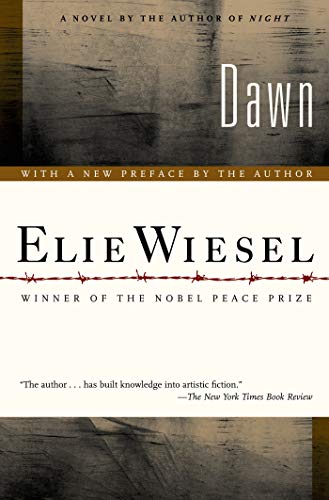
Elie Wiesel's Dawn is an eloquent meditation on the compromises, justifications, and sacrifices that human beings make when they murder other human beings.
"The author . . . has built knowledge into artistic fiction." -The New York Times Book Review
Elisha is a young Jewish man, a Holocaust survivor, and an Israeli freedom fighter in British-controlled Palestine; John Dawson is the captured English officer he will murder at dawn in retribution for the British execution of a fellow freedom fighter. The night-long wait for morning and death provides Dawn, Elie Wiesel's ever more timely novel, with its harrowingly taut, hour-by-hour narrative. Caught between the manifold horrors of the past and the troubling dilemmas of the present, Elisha wrestles with guilt, ghosts, and ultimately God as he waits for the appointed hour and his act of assassination.
The basis for the 2014 film of the same name, now available on streaming and home video.
Die Inhaltsangabe kann sich auf eine andere Ausgabe dieses Titels beziehen.
Über die Autorin bzw. den Autor
Elie Wiesel (1928-2016) is the author of more than fifty books, including Night, his harrowing account of his experiences in Nazi concentration camps. The book, first published in 1955, was selected for Oprah's Book Club in 2006, and continues to be an important reminder of man's capacity for inhumanity. Wiesel was Andrew W. Mellon Professor in the Humanities at Boston University, and lived with his family in New York City. He was awarded the Nobel Peace Prize in 1986.
Auszug. © Genehmigter Nachdruck. Alle Rechte vorbehalten.
Dawn
By ELIE WIESELHILL AND WANG
Copyright © 2006 Elie WieselAll right reserved.
ISBN: 978-0-8090-3772-8
Chapter One
SOMEWHERE A CHILD began to cry. In the house across the way an old woman closed the shutters. It was hot with all the heat of an autumn evening in Palestine.Standing near the window I looked out at the transparent twilight whose descent made the city seem silent, motionless, unreal, and very far away. Tomorrow, I thought for the hundredth time, I shall kill a man, and I wondered if the crying child and the woman across the way knew.
I did not know the man. To my eyes he had no face; he did not even exist, for I knew nothing about him. I did not know whether he scratched his nose when he ate, whether he talked or kept quiet when he was making love, whether he gloried in his hate, whether he betrayed his wife or his God or his own future. All I knew was that he was an Englishman and my enemy. The two terms were synonymous.
"Don't torture yourself," said Gad in a low voice. "This is war."
His words were scarcely audible, and I was tempted to tell him to speak louder, because no one could possibly hear. The child's crying covered all other sounds. But I could not open my mouth, because I was thinking of the man who was doomed to die. Tomorrow, I said to myself, we shall be bound together for all eternity by the tie that binds a victim and his executioner.
"It's getting dark," said Gad. "Shall I put on the light?"
I shook my head. The darkness was not yet complete. As yet there was no face at the window to mark the exact moment when day changed into night.
A beggar had taught me, a long time ago, how to distinguish night from day. I met him one evening in my home town when I was saying my prayers in the overheated synagogue, a gaunt, shadowy fellow, dressed in shabby black clothes, with a look in his eyes that was not of this world. It was at the beginning of the war. I was twelve years old, my parents were still alive, and God still dwelt in our town.
"Are you a stranger?" I asked him.
"I'm not from around here," he said in a voice that seemed to listen rather than speak.
Beggars inspired me with mingled feelings of love and fear. I knew that I ought to be kind to them, for they might not be what they seemed. Hassidic literature tells us that a beggar may be the prophet Elijah in disguise, come to visit the earth and the hearts of men and to offer the reward of eternal life to those who treat him well. Nor is the prophet Elijah the only one to put on the garb of a beggar. The Angel of Death delights in frightening men in the same way. To do him wrong is more dangerous; he may take a man's life or his soul in return.
And so the stranger in the synagogue inspired me with fear. I asked him if he was hungry and he said no. I tried to find out if there was anything he wanted, but without success. I had an urge to do something for him, but did not know what.
The synagogue was empty and the candles had begun to burn low. We were quite alone, and I was overcome by increasing anxiety. I knew that I shouldn't be there with him at midnight, for that is the hour when the dead rise up from their graves and come to say their prayers. Anyone they find in the synagogue risks being carried away, for fear he betray their secret.
"Come to my house," I said to the beggar. "There you can find food to eat and a bed in which to sleep."
"I never sleep," he replied.
I was quite sure then that he was not a real beggar. I told him that I had to go home and he offered to keep me company. As we walked along the snow-covered streets he asked me if I was ever afraid of the dark.
"Yes, I am," I said. I wanted to add that I was afraid of him, too, but I felt he knew that already.
"You mustn't be afraid of the dark," he said, gently grasping my arm and making me shudder. "Night is purer than day; it is better for thinking and loving and dreaming. At night everything is more intense, more true. The echo of words that have been spoken during the day takes on a new and deeper meaning. The tragedy of man is that he doesn't know how to distinguish between day and night. He says things at night that should only be said by day."
He came to a halt in front of my house. I asked him again if he didn't want to come in, but he said no, he must be on his way. That's it, I thought; he's going back to the synagogue to welcome the dead.
"Listen," he said, digging his fingers into my arm. "I'm going to teach you the art of distinguishing between day and night. Always look at a window, and failing that look into the eyes of a man. If you see a face, any face, then you can be sure that night has succeeded day. For, believe me, night has a face."
Then, without giving me time to answer, he said good-by and disappeared into the snow.
Every evening since then I had made a point of standing near a window to witness the arrival of night. And every evening I saw a face outside. It was not always the same face, for no one night was like another. In the beginning I saw the face of the beggar. Then, after my father's death, I saw his face, with the eyes grown large with death and memory. Sometimes total strangers lent the night their tearful face or their forgotten smile. I knew nothing about them except that they were dead.
"Don't torture yourself in the dark," said Gad. "This is war."
I thought of the man I was to kill at dawn, and of the beggar. Suddenly I had an absurd thought: what if the beggar were the man I was to kill?
Outside, the twilight faded abruptly away as it so often does in the Middle East. The child was still crying, it seemed to me more plaintively than before. The city was like a ghost ship, noiselessly swallowed up by the darkness.
I looked out the window, where a shadowy face was taking shape out of the deep of the night. A sharp pain caught my throat. I could not take my eyes off the face. It was my own.
AN HOUR EARLIER Gad had told me the Old Man's decision. The execution was to take place, as executions always do, at dawn. His message was no surprise; like everyone else I was expecting it. Everyone in Palestine knew that the Movement always kept its word. And the English knew it too.
A month earlier one of our fighters, wounded during a terrorist operation, had been hauled in by the police and weapons had been found on him. A military tribunal had chosen to exact the penalty stipulated by martial law: death by hanging. This was the tenth death sentence the mandatory power in Palestine had imposed upon us. The Old Man decided that things had gone far enough; he was not going to allow the English to transform the Holy Land into a scaffold. And so he announced a new line of action-reprisals.
By means of posters and underground-radio broadcasts he issued a solemn warning: Do not hang David ben Moshe; his death will cost you dear. From now on, for the hanging of every Jewish fighter an English mother will mourn the death of her son. To add weight to his words the Old Man ordered us to take a hostage, preferably an army officer. Fate willed that our victim should be Captain John Dawson. He was out walking alone one night, and this made him an easy prey for our men were on the lookout for English officers who walked alone in the night.
John Dawson's kidnapping plunged the whole country into a state of nervous tension. The English army proclaimed a forty-eight-hour curfew, every house was searched, and hundreds of suspects were arrested. Tanks were stationed at the crossroads, machine guns set up on the rooftops,...
„Über diesen Titel“ kann sich auf eine andere Ausgabe dieses Titels beziehen.
Suchergebnisse für Dawn

Beispielbild für diese ISBN
Dawn
Anbieter: World of Books (was SecondSale), Montgomery, IL, USA
Verkäuferbewertung 5 von 5 Sternen

Paperback. Zustand: Fair. Elie Wiesel's Dawn is an eloquent meditation on the compromises, justifications, and sacrifices that human beings make when they murder other human beings. "The author . . . has built knowledge into artistic fiction." --The New York Times Book Review Elisha is a young Jewish man, a Holocaust survivor, and an Israeli freedom fighter in British-controlled Palestine; John Dawson is the captured English officer he will murder at dawn in retribution for the British execution of a fellow freedom fighter. The night-long wait for morning and death provides Dawn, Elie Wiesel's ever more timely novel, with its harrowingly taut, hour-by-hour narrative. Caught between the manifold horrors of the past and the troubling dilemmas of the present, Elisha wrestles with guilt, ghosts, and ultimately God as he waits for the appointed hour and his act of assassination. The basis for the 2014 film of the same name, now available on streaming and home video. Artikel-Nr. 00100040965
Gebraucht kaufen
EUR 4,50
Versand gratis
Versand innerhalb von USA
Versand innerhalb von USA
Anzahl: 6 verfügbar
Beispielbild für diese ISBN
Dawn
Anbieter: World of Books (was SecondSale), Montgomery, IL, USA
Verkäuferbewertung 5 von 5 Sternen
Paperback. Zustand: Good. Elie Wiesel's Dawn is an eloquent meditation on the compromises, justifications, and sacrifices that human beings make when they murder other human beings. "The author . . . has built knowledge into artistic fiction." --The New York Times Book Review Elisha is a young Jewish man, a Holocaust survivor, and an Israeli freedom fighter in British-controlled Palestine; John Dawson is the captured English officer he will murder at dawn in retribution for the British execution of a fellow freedom fighter. The night-long wait for morning and death provides Dawn, Elie Wiesel's ever more timely novel, with its harrowingly taut, hour-by-hour narrative. Caught between the manifold horrors of the past and the troubling dilemmas of the present, Elisha wrestles with guilt, ghosts, and ultimately God as he waits for the appointed hour and his act of assassination. The basis for the 2014 film of the same name, now available on streaming and home video. Artikel-Nr. 00105222989
Gebraucht kaufen
EUR 4,50
Versand gratis
Versand innerhalb von USA
Versand innerhalb von USA
Anzahl: Mehr als 20 verfügbar
Foto des Verkäufers
Dawn
Anbieter: Dream Books Co., Denver, CO, USA
Verkäuferbewertung 5 von 5 Sternen
Zustand: very_good. Pages are clean with no markings. May show minor signs of wear or cosmetic defects marks, cuts, bends, or scuffs on the cover, spine, pages, or dust jacket. May have remainder marks on edges. Artikel-Nr. DBV.0809037726.VG
Gebraucht kaufen
EUR 4,51
Versand gratis
Versand innerhalb von USA
Versand innerhalb von USA
Anzahl: 1 verfügbar
Foto des Verkäufers
Dawn
Anbieter: Dream Books Co., Denver, CO, USA
Verkäuferbewertung 5 von 5 Sternen
Zustand: acceptable. This copy has clearly been enjoyedâ"expect noticeable shelf wear and some minor creases to the cover. Binding is strong, and all pages are legible. May contain previous library markings or stamps. Artikel-Nr. DBV.0809037726.A
Gebraucht kaufen
EUR 4,79
Versand gratis
Versand innerhalb von USA
Versand innerhalb von USA
Anzahl: 2 verfügbar
Beispielbild für diese ISBN
Dawn : A Novel
Verlag:
Farrar, Straus & Giroux, 2006
ISBN 10: 0809037726
ISBN 13: 9780809037728
Gebraucht
Softcover
Anbieter: Better World Books: West, Reno, NV, USA
Verkäuferbewertung 5 von 5 Sternen
Zustand: Good. Tra. Former library copy. Pages intact with minimal writing/highlighting. The binding may be loose and creased. Dust jackets/supplements are not included. Includes library markings. Stock photo provided. Product includes identifying sticker. Better World Books: Buy Books. Do Good. Artikel-Nr. 2512136-6
Gebraucht kaufen
EUR 6,17
Versand gratis
Versand innerhalb von USA
Versand innerhalb von USA
Anzahl: 3 verfügbar
Beispielbild für diese ISBN
Dawn : A Novel
Verlag:
Farrar, Straus & Giroux, 2006
ISBN 10: 0809037726
ISBN 13: 9780809037728
Gebraucht
Softcover
Anbieter: Better World Books, Mishawaka, IN, USA
Verkäuferbewertung 5 von 5 Sternen
Zustand: Good. Tra. Former library copy. Pages intact with minimal writing/highlighting. The binding may be loose and creased. Dust jackets/supplements are not included. Includes library markings. Stock photo provided. Product includes identifying sticker. Better World Books: Buy Books. Do Good. Artikel-Nr. 2512136-6
Gebraucht kaufen
EUR 6,17
Versand gratis
Versand innerhalb von USA
Versand innerhalb von USA
Anzahl: 3 verfügbar
Beispielbild für diese ISBN
Dawn : A Novel
Verlag:
Farrar, Straus & Giroux, 2006
ISBN 10: 0809037726
ISBN 13: 9780809037728
Gebraucht
Softcover
Anbieter: Better World Books, Mishawaka, IN, USA
Verkäuferbewertung 5 von 5 Sternen
Zustand: Good. Tra. Pages intact with minimal writing/highlighting. The binding may be loose and creased. Dust jackets/supplements are not included. Stock photo provided. Product includes identifying sticker. Better World Books: Buy Books. Do Good. Artikel-Nr. 4194630-6
Gebraucht kaufen
EUR 6,17
Versand gratis
Versand innerhalb von USA
Versand innerhalb von USA
Anzahl: Mehr als 20 verfügbar
Beispielbild für diese ISBN
Dawn : A Novel
Verlag:
Farrar, Straus & Giroux, 2006
ISBN 10: 0809037726
ISBN 13: 9780809037728
Gebraucht
Softcover
Anbieter: Better World Books: West, Reno, NV, USA
Verkäuferbewertung 5 von 5 Sternen
Zustand: Good. Tra. Pages intact with minimal writing/highlighting. The binding may be loose and creased. Dust jackets/supplements are not included. Stock photo provided. Product includes identifying sticker. Better World Books: Buy Books. Do Good. Artikel-Nr. 4194630-6
Gebraucht kaufen
EUR 6,17
Versand gratis
Versand innerhalb von USA
Versand innerhalb von USA
Anzahl: 3 verfügbar
Beispielbild für diese ISBN
Dawn
Anbieter: ThriftBooks-Dallas, Dallas, TX, USA
Verkäuferbewertung 5 von 5 Sternen
Paperback. Zustand: Good. No Jacket. Pages can have notes/highlighting. Spine may show signs of wear. ~ ThriftBooks: Read More, Spend Less. Artikel-Nr. G0809037726I3N00
Gebraucht kaufen
EUR 6,32
Versand gratis
Versand innerhalb von USA
Versand innerhalb von USA
Anzahl: 3 verfügbar
Beispielbild für diese ISBN
Dawn
Anbieter: ThriftBooks-Phoenix, Phoenix, AZ, USA
Verkäuferbewertung 5 von 5 Sternen
Paperback. Zustand: Fair. No Jacket. Readable copy. Pages may have considerable notes/highlighting. ~ ThriftBooks: Read More, Spend Less. Artikel-Nr. G0809037726I5N00
Gebraucht kaufen
EUR 6,32
Versand gratis
Versand innerhalb von USA
Versand innerhalb von USA
Anzahl: 9 verfügbar