
Verwandte Artikel zu The Specter of Communism: The United States and the...
The Specter of Communism: The United States and the Origins of the Cold War, 1917-1953 (Hill and Wang Critical Issues) - Softcover
Buch 2 von 4: Hill and Wang Critical Issues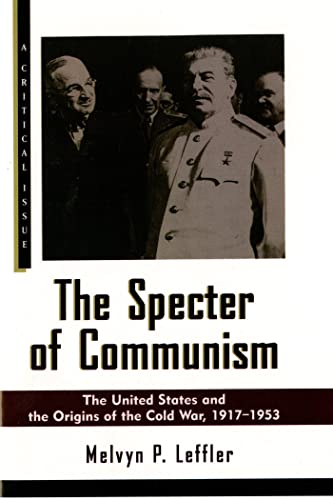
Inhaltsangabe
The Hill and Wang Critical Issues Series: concise, affordable works on pivotal topics in American history, society, and politics.
The Specter of Communism is a concise history of the origins of the Cold War and the evolution of U.S.-Soviet relations, from the Bolshevik revolution to the death of Stalin. Using not only American documents but also those from newly opened archives in Russia, China, and Eastern Europe, Leffler shows how the ideological animosity that existed from Lenin's seizure of power onward turned into dangerous confrontation. By focusing on American political culture and American anxieties about the Soviet political and economic threat, Leffler suggests new ways of understanding the global struggle staged by the two great powers of the postwar era.Die Inhaltsangabe kann sich auf eine andere Ausgabe dieses Titels beziehen.
Über die Autorin bzw. den Autor
Melvyn P. Leffler
Von der hinteren Coverseite
This book is a concise history of the origins of the Cold War and the evolution of U.S.-Soviet relations, from the Bolshevik revolution to the death of Stalin. Using not only American documents but also those from newly opened archives in Russia, China, and Eastern Europe, Melvyn Leffler shows how the ideological animosity that existed from Lenin's seizure of power onward turned into dangerous confrontation.
Auszug. © Genehmigter Nachdruck. Alle Rechte vorbehalten.
The Specter of Communism
The United States and the Origins of the Cold War, 1917-1953By Melvyn P. LefflerHill and Wang
Copyright © 1994 Melvyn P. LefflerAll right reserved.
ISBN: 9780809015740
The Specter of Communism
( 1 )
THE BACKGROUND 1917-1941
FROM the beginning, there was an ideological clash. When the Bolsheviks seized power in Russia in November 1917, in the midst of World War I, they appealed to workers everywhere to overthrow their governments. "We summon you to this struggle, workers of all countries! There is no other way. The crimes of the ruling, exploiting classes in this war have been countless. These crimes cry out for revolutionary revenge." 1
The Bolsheviks believed that their revolution in Russia would be crushed if they did not sue for peace, spark revolution abroad, and consolidate their victory at home. They appealed to the exhausted peoples of Europe to support their campaign for a peace without annexations and without indemnities, a peace based on the principle of self-determination for peoples everywhere. In December, the Council of People's Commissars appropriated two million rubles for the international revolutionary movement. The message was direct: "The workers' revolution calls upon the working classes of all countries to revolt."2
The Bolsheviks envisioned a classless society in a warless world. They talked of a vast expansion of democracy, a democracy for the poor and the powerless. They said they would abolish private property, allocate control of the workplace to the workers themselves, fairly distribute the fruits of production, and give the peasants the land on which they labored. Their rhetoric of peace and self-determination encoded a message tocommon people of all lands to rise up and empower themselves. The Bolsheviks wanted them to overturn an exploitative political and economic system that subjected them to the impersonal functioning of a marketplace economy and that forced them to wage war in behalf of capitalists seeking colonial markets, raw materials, and investment opportunities.
But profound disillusionment and social ferment in the warring countries did not lead to immediate revolutionary upheaval. Within weeks the Bolsheviks had to decide whether to sign a humiliating peace with Germany or to sustain the deadly struggle. Some Bolsheviks abhorred a separate peace, one that would make them accomplices of German imperialism. Notwithstanding the odds, they wanted to work for revolution abroad.
But V. I. Lenin, the leader of the Bolsheviks, rebuffed this line of reasoning. If the struggle persisted, he argued, the revolution would be crushed. Russian soldiers were deserting their military units in great numbers, and the German onslaught could not be stopped. A peace had to be signed with Germany so that the Bolsheviks could concentrate on defeating their domestic foes. "The hands of the Socialist government," Lenin remonstrated, "must be absolutely free for the job of vanquishing the bourgeoisie in our own country."3
Lenin exercised the decisive voice in support of signing the separate treaty with Germany, the Treaty of Brest-Litovsk. In March 1918 the Bolsheviks relinquished the Ukraine as well as Poland, Finland, Estonia, Latvia, Lithuania, and a slice of land (Kars) along the border with Turkey. These territories contained a substantial percentage of Russia's raw materials and industrial infrastructure, perhaps as much as three-quarters of its iron and steel, a quarter of its railway network, a quarter of its population, and a large share of its most fertile soil.
Lenin hoped he would gain the necessary time to develop an army, organize the economy, and defeat the multiple opponents who threatened from every direction. His position was desperate. Large parts of Russia were occupied by the Germans. National minorities were battling for local autonomy. Counterrevolutionary, or "White," forces were gathering momentum. And, meanwhile, Russia's industrial economy was disintegrating. Hungry and disenchanted workers left the cities in great numbers. Angry and rebellious peasants refused to sell their crops for worthless currency.
The situation was chaotic. The Bolsheviks, like many of their domestic foes, were willing to take aid from any quarter. Despite the separate peace with the Kaiser, Lenin and his comrades did not feel secure. The Germans, in the midst of their gigantic offensive on the western front in France, continued to gobble up chunks of Russian territory along the Black and Crimean seas and supported separatist movements from the Baltic to the Caucasus. The Bolsheviks, therefore, solicited aid and assistance from Russia's former allies--the British, the French, and the Americans--even while they continued to iron out their treaty and trade arrangements with the Germans.
During the spring of 1918 Leon Trotsky, the commander of the Red army, and Georgi Chicherin, the commissar in charge of foreign affairs, met frequently with American and British diplomatic emissaries, military attachés, and philanthropic officials. In addition to seeking formal diplomatic recognition, they wanted food, military supplies, technical assistance, and credits. Bowing to an Allied request, they agreed that 70,000 Czech troops might travel east along the Trans-Siberian railroad to Vladivostok where they would cross the oceans and eventually join the battle on the western front. But Trotsky and Chicherin were not willing to resume the war against the Central Powers. And desperate to win the struggle on the home front, they indoctrinated and liberated German and Austrian prisoners of war, seeking to use them against their domestic foes.
The rhetoric and actions of the Bolsheviks ignited fear, revulsion, and uncertainty in Washington. The American secretary of state, Robert Lansing, abhorred Bolshevism. He saw it as a new form of despotism, a class despotism "subversive of the rights of man, and hostile to justice and liberty."4 Appalled by the Bolsheviks' efforts to withdraw from the conflict, Lansing urged President Woodrow Wilson not to recognize the fledgling new regime. The United States, Lansing believed, should awaitthe formation of "a strong and stable government founded on the principles of democracy and the equality of man," a government that would guarantee "every citizen of free Russia ... the enjoyment of his inherent rights of life, liberty and the pursuit of happiness."5
The president agreed that the United States must exercise extreme caution. The Bolsheviks angered him. He was agitated by their repudiation of the debts of former Russian governments and by their removal of Allied war supplies from Archangel, a key port on the White Sea. Still more upsetting to Wilson was the Bolshevik dissolution of the Constituent Assembly, the most democratically elected body Russia had ever experienced. Garnering only 175 out of 715 seats in the Assembly, Lenin could not dominate it, so he decided to disband it. Although Trotsky argued that the principles of democracy had to be "trampled underfoot" for the "sake of the loftier principles of a social revolution," Wilson deemed Trotsky to be "absolutely untrustworthy" and was morally repulsed by Bolshevik contempt for majority rule.6 Maintaining that the Bolsheviks did not represent the Russian people, Wilson was not inclined to recognize their government.
Bolshevik appeals to the war-wearied masses of Europe and their clamor for a peace without annexations and indemnities deeply troubled American...
„Über diesen Titel“ kann sich auf eine andere Ausgabe dieses Titels beziehen.
Suchergebnisse für The Specter of Communism: The United States and the...

Beispielbild für diese ISBN
The Specter of Communism The U
Anbieter: World of Books (was SecondSale), Montgomery, IL, USA
Verkäuferbewertung 5 von 5 Sternen

Zustand: Very Good. Item in very good condition! Textbooks may not include supplemental items i.e. CDs, access codes etc. Artikel-Nr. 00109250083
Gebraucht kaufen
EUR 4,71
Versand gratis
Versand innerhalb von USA
Versand innerhalb von USA
Anzahl: 1 verfügbar
Beispielbild für diese ISBN
The Specter of Communism The U
Anbieter: World of Books (was SecondSale), Montgomery, IL, USA
Verkäuferbewertung 5 von 5 Sternen
Zustand: Good. Item in good condition. Textbooks may not include supplemental items i.e. CDs, access codes etc. Artikel-Nr. 00096662255
Gebraucht kaufen
EUR 4,71
Versand gratis
Versand innerhalb von USA
Versand innerhalb von USA
Anzahl: 6 verfügbar
Beispielbild für diese ISBN
The Specter of Communism: The United States and the Origins of the Cold War, 1917-1953 (Hill and Wang Critical Issues)
Anbieter: World of Books (was SecondSale), Montgomery, IL, USA
Verkäuferbewertung 5 von 5 Sternen
Zustand: Acceptable. Item in acceptable condition! Textbooks may not include supplemental items i.e. CDs, access codes etc. Artikel-Nr. 00093774293
Gebraucht kaufen
EUR 4,71
Versand gratis
Versand innerhalb von USA
Versand innerhalb von USA
Anzahl: 3 verfügbar
Beispielbild für diese ISBN
The Specter of Communism: The United States and the Origins of the Cold War, 1917-1953 (Hill and Wang Critical Issues)
Verlag:
Hill and Wang (edition ), 1994
ISBN 10: 0809015749
ISBN 13: 9780809015740
Gebraucht
Paperback
Anbieter: BooksRun, Philadelphia, PA, USA
Verkäuferbewertung 5 von 5 Sternen
Paperback. Zustand: Very Good. It's a well-cared-for item that has seen limited use. The item may show minor signs of wear. All the text is legible, with all pages included. It may have slight markings and/or highlighting. Artikel-Nr. 0809015749-8-6
Gebraucht kaufen
EUR 4,72
Versand gratis
Versand innerhalb von USA
Versand innerhalb von USA
Anzahl: 1 verfügbar
Beispielbild für diese ISBN
The Specter of Communism: The United States and the Origins of the Cold War, 1917-1953
Verlag:
Farrar, Strauss & Giroux-3pl, 1994
ISBN 10: 0809015749
ISBN 13: 9780809015740
Gebraucht
Paperback
Anbieter: ThriftBooks-Atlanta, AUSTELL, GA, USA
Verkäuferbewertung 5 von 5 Sternen
Paperback. Zustand: Very Good. No Jacket. Former library book; May have limited writing in cover pages. Pages are unmarked. ~ ThriftBooks: Read More, Spend Less. Artikel-Nr. G0809015749I4N10
Gebraucht kaufen
EUR 5,79
Versand gratis
Versand innerhalb von USA
Versand innerhalb von USA
Anzahl: 1 verfügbar
Beispielbild für diese ISBN
The Specter of Communism : The United States and the Origins of the Cold War, 1917-1953
Verlag:
Farrar, Straus & Giroux, 1994
ISBN 10: 0809015749
ISBN 13: 9780809015740
Gebraucht
Softcover
Anbieter: Better World Books, Mishawaka, IN, USA
Verkäuferbewertung 5 von 5 Sternen
Zustand: Good. communism Edition. Pages intact with minimal writing/highlighting. The binding may be loose and creased. Dust jackets/supplements are not included. Stock photo provided. Product includes identifying sticker. Better World Books: Buy Books. Do Good. Artikel-Nr. 4091275-6
Gebraucht kaufen
EUR 5,98
Versand gratis
Versand innerhalb von USA
Versand innerhalb von USA
Anzahl: 4 verfügbar
Beispielbild für diese ISBN
The Specter of Communism: The United States and the Origins of the Cold War, 1917-1953 (Hill and Wang Critical Issues)
Anbieter: Wonder Book, Frederick, MD, USA
Verkäuferbewertung 5 von 5 Sternen
Zustand: Good. Good condition. A copy that has been read but remains intact. May contain markings such as bookplates, stamps, limited notes and highlighting, or a few light stains. Artikel-Nr. J03C-01990
Gebraucht kaufen
EUR 6,21
Versand gratis
Versand innerhalb von USA
Versand innerhalb von USA
Anzahl: 3 verfügbar
Beispielbild für diese ISBN
The Specter of Communism: The United States and the Origins of the Cold War, 1917-1953 (Hill and Wang Critical Issues)
Anbieter: Books From California, Simi Valley, CA, USA
Verkäuferbewertung 4 von 5 Sternen

Paperback. Zustand: Good. minor wear and creasing. Artikel-Nr. mon0003528614
Gebraucht kaufen
EUR 3,55
EUR 4,31 Versand
Versand innerhalb von USA
Versand innerhalb von USA
Anzahl: 1 verfügbar
Beispielbild für diese ISBN
The Specter of Communism: The United States and the Origins of the Cold War, 1917-1953 (Hill and Wang Critical Issues)
Verlag:
Hill and Wang, 1994
ISBN 10: 0809015749
ISBN 13: 9780809015740
Gebraucht
Paperback
Erstausgabe
Anbieter: Books From California, Simi Valley, CA, USA
Verkäuferbewertung 4 von 5 Sternen
Paperback. Zustand: Good. First Edition. Remainder mark on the top along with a minor stain on the same side as the mark. Artikel-Nr. mon0003136557
Gebraucht kaufen
EUR 5,01
EUR 4,31 Versand
Versand innerhalb von USA
Versand innerhalb von USA
Anzahl: 1 verfügbar
Beispielbild für diese ISBN
The Specter of Communism: The United States and the Origins of the Cold War, 1917-1953 (Hill and Wang Critical Issues)
Anbieter: AwesomeBooks, Wallingford, Vereinigtes Königreich
Verkäuferbewertung 5 von 5 Sternen
Paperback. Zustand: Very Good. The Specter of Communism: The United States and the Origins of the Cold War, 1917-1953 (Hill and Wang Critical Issues) This book is in very good condition and will be shipped within 24 hours of ordering. The cover may have some limited signs of wear but the pages are clean, intact and the spine remains undamaged. This book has clearly been well maintained and looked after thus far. Money back guarantee if you are not satisfied. See all our books here, order more than 1 book and get discounted shipping. Artikel-Nr. 7719-9780809015740
Gebraucht kaufen
EUR 11,57
EUR 4,81 Versand
Versand von Vereinigtes Königreich nach USA
Versand von Vereinigtes Königreich nach USA
Anzahl: 2 verfügbar