
Verwandte Artikel zu FDR: The First Hundred Days (Critical Issue)
Inhaltsangabe
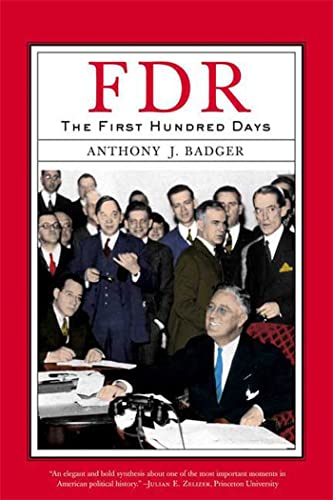
The Hundred Days, Franklin Roosevelt's first fifteen weeks in office, have become the stuff of legend, a mythic yardstick against which every subsequent American president has felt obliged to measure himself. The renowned historian Anthony J. Badger cuts through decades of politicized history to provide a succinct, balanced, and timely reminder that Roosevelt's accomplishment was above all else an exercise in exceptional political craftsmanship.
Roosevelt entered the White House in 1933 confronting 25 percent unemployment, bank closings, and a nationwide crisis in confidence. From March 9 to June 16, FDR secured sixteen major bills, many of which gave extraordinary discretionary power to the president. From legalizing the sale of beer to providing mortgage relief to millions of Americans, Roosevelt launched the New Deal that conservatives have been working to roll back ever since. Reintroducing the contingency that marked those fateful days, Badger humanizes Roosevelt and suggests a far more useful yardstick for future presidents: the politics of the possible under the guidance of principle.
Die Inhaltsangabe kann sich auf eine andere Ausgabe dieses Titels beziehen.
Über die Autorin bzw. den Autor
Anthony J. Badger
Auszug. © Genehmigter Nachdruck. Alle Rechte vorbehalten.
FDR: The First Hundred Days
By Anthony J. BadgerHill and Wang
Copyright © 2009 Anthony J. BadgerAll right reserved.
ISBN: 9780809015603
Introduction
In the week following Franklin D. Roosevelt’s inauguration as president of the United States on March 4, 1933, more than 460,000 Americans wrote to him in the White House. This unprecedented personal communication from ordinary Americans continued. During the rest of his presidency an average of more than six thousand people a day wrote to him. Hoover had had one secretary to handle incoming correspondence that averaged six hundred letters a day. Roosevelt had to bring in fifty people to staff the White House mail room. The volume of correspondence generated led Roosevelt to conclude that neither the National Archives nor the Library of Congress could store this material in Washington. He proposed building a presidential library to house the documents of his presidency on his own estate at Hyde Park. He deeded the land to the federal government and raised the money from his friends and supporters to build the library. In return, Congress agreed to staff and administer it. FDR laid the cornerstone for his library on November 19, 1939. In his speech, he was at pains to highlight the letters of those ordinary Americans who had written to him over the previous six years when he said:
Of the papers which will come to rest here, I personally attach less importance to the documents of those who have occupied high public or private office than I do the spontaneous letters which have come to me...from men, from women, and from children in every part of the United States, telling me of their conditions and problems and giving me their own opinions.
Within two years of his death, his pre-presidential papers were open to scholars for study. By 1950, 85 percent of the Roosevelt papers had been cleared and could be used. In the battle for historical reputation, Roosevelt had defeated Herbert Hoover just as he had in the 1932 general election. It would not be until 1967 that historians could start scholarly work on the Hoover presidency, when his papers were made available at the Hoover Library, in West Branch, Iowa.
By establishing his library, Roosevelt transformed the keeping and status of presidential records. Before 1933 these papers were assumed to be the private property of the incumbents when they left office. Their preservation was haphazard: sometimes they ended up in the Library of Congress; often they remained in private hands or were destroyed. Presidents after Roosevelt have all raised private funds to establish ever grander presidential libraries, whose operation taxpayers fund.
Publicly, Roosevelt appeared modest and restrained about memorializing his presidency. He wanted no elaborate memorial in Washington. Instead, he requested a small marble slab, simply inscribed, to be placed outside the National Archives. In fact, Roosevelt was neither modest nor disinterested in shaping his historical legacy. He originally intended to screen all his correspondence personally before it could be transferred to his library. He anticipated three thousand visitors a week coming to the library and museum. What they would be interested in, he believed, was not the documentary record of his presidency but the artifacts of his life: everything that he had collected, from naval prints to stamps to books. He personally scaled down the reading area that would be set aside for scholars.
The mere existence of the library shaped the legacy Roosevelt bequeathed to his successors and historians in a substantive way. His plans perpetuated "the presidential synthesis" in which American history is seen largely through the lens of presidential administrations. Roosevelt left his successors a model of a dynamic, activist presidency that could not be ignored. All subsequent presidents, especially liberal Democrats, have labored "in the shadow of FDR." Their presidential accomplishments have been judged by the standards of the strong, charismatic national leadership that Roosevelt displayed in the fight, first, against the Great Depression, then against the Axis powers in World War II.
Nowhere was the standard set by Roosevelt more daunting for his successors than in his extraordinary achievements during his first hundred days in office.
Taking the reins of government on March 4, 1933, when the banks were closed and the nation paralyzed, Roosevelt warned Americans that, if Congress did not act decisively, he would ask it for "broad executive power to wage war against the emergency, as great as the power that would be given to me if we were in fact invaded by a foreign foe." That passage drew the most sustained applause of the day. The cantankerous Congress, which had been gridlocked in bitter recrimination with the outgoing president, responded enthusiastically to Roosevelt’s patriotic appeals. Congressmen laid aside previous divisions, discarded long-held principles, and grasped, both for themselves and for the executive, vast, often unspecified, powers unheard of in peacetime. By June 16, after one hundred days of frenzied activity, sixteen pieces of major legislation gave the federal government the power to decide which banks should or should not reopen, to regulate the Stock Exchange, to determine the gold value of the dollar, to prescribe minimum wages and prices, to pay farmers not to produce, to pay money to the unemployed, to plan and regenerate a whole river basin across six states, to spend billions of dollars on public works, and to underwrite credit for bankers, homeowners, and farmers.
Presidents have been expected to follow FDR’s lead. When in 1992 Bill Clinton was elected during a recession, it was predicted that he would "in his first hundred days... take a muscular Franklin Roosevelt–like approach to the slump." As Jimmy Carter’s adviser Stuart Eizenstat noted, since FDR, "the first hundred days of an administration have been closely watched as a sign of what can be expected over the course of the entire administration." The first hundred days of the New Deal have served as a model for future presidents of bold leadership and executive-legislative harmony. Throughout his presidency, Lyndon B. Johnson consistently measured his record against that of his political hero, FDR. In April 1965 he pressed his congressional liaison man, Larry O’Brien, to "jerk out every damn little bill you can and get them down here by the 12th" because "on the 12th you’ll have the best Hundred Days. Better than he did!...if you’ll just put out that propaganda...that they’ve done more than they did in Roosevelt’s Hundred Days."
Even if The New York Times was right on April 24, 1993, when it announced that "the hundred days test is, of course, fundamentally silly," most presidents have felt themselves held to account by it. Concerned that he would fail the test, Richard Nixon wrote in 1969, "In about five weeks we will have completed 100 days since the Inauguration. I would like to have this week a summary of the legislative proposals we have already sent to the Congress, and a hard analysis of what other legislative proposals will have been sent to the Congress for action before the 100 day...
„Über diesen Titel“ kann sich auf eine andere Ausgabe dieses Titels beziehen.
Suchergebnisse für FDR: The First Hundred Days (Critical Issue)

Beispielbild für diese ISBN
FDR: The First Hundred Days (Critical Issue)
Verlag:
Hill and Wang (edition First Edition), 2009
ISBN 10: 0809015609
ISBN 13: 9780809015603
Gebraucht
Paperback
Erstausgabe
Anbieter: BooksRun, Philadelphia, PA, USA
Verkäuferbewertung 5 von 5 Sternen

Paperback. Zustand: Fair. First Edition. The item might be beaten up but readable. May contain markings or highlighting, as well as stains, bent corners, or any other major defect, but the text is not obscured in any way. Artikel-Nr. 0809015609-7-1-13
Gebraucht kaufen
EUR 4,40
Versand gratis
Versand innerhalb von USA
Versand innerhalb von USA
Anzahl: 1 verfügbar
Beispielbild für diese ISBN
Fdr: The First Hundred Days
Anbieter: ThriftBooks-Dallas, Dallas, TX, USA
Verkäuferbewertung 5 von 5 Sternen
Paperback. Zustand: Good. No Jacket. Pages can have notes/highlighting. Spine may show signs of wear. ~ ThriftBooks: Read More, Spend Less. Artikel-Nr. G0809015609I3N00
Gebraucht kaufen
EUR 5,90
Versand gratis
Versand innerhalb von USA
Versand innerhalb von USA
Anzahl: 1 verfügbar
Beispielbild für diese ISBN
Fdr: The First Hundred Days
Anbieter: ThriftBooks-Atlanta, AUSTELL, GA, USA
Verkäuferbewertung 5 von 5 Sternen
Paperback. Zustand: Very Good. No Jacket. May have limited writing in cover pages. Pages are unmarked. ~ ThriftBooks: Read More, Spend Less. Artikel-Nr. G0809015609I4N00
Gebraucht kaufen
EUR 5,90
Versand gratis
Versand innerhalb von USA
Versand innerhalb von USA
Anzahl: 1 verfügbar
Beispielbild für diese ISBN
Fdr: The First Hundred Days
Anbieter: ThriftBooks-Dallas, Dallas, TX, USA
Verkäuferbewertung 5 von 5 Sternen
Paperback. Zustand: As New. No Jacket. Pages are clean and are not marred by notes or folds of any kind. ~ ThriftBooks: Read More, Spend Less. Artikel-Nr. G0809015609I2N00
Gebraucht kaufen
EUR 5,90
Versand gratis
Versand innerhalb von USA
Versand innerhalb von USA
Anzahl: 1 verfügbar
Beispielbild für diese ISBN
FDR: the First Hundred Days
Verlag:
Farrar, Straus & Giroux, 2009
ISBN 10: 0809015609
ISBN 13: 9780809015603
Gebraucht
Softcover
Anbieter: Better World Books: West, Reno, NV, USA
Verkäuferbewertung 5 von 5 Sternen
Zustand: Very Good. Former library copy. Pages intact with possible writing/highlighting. Binding strong with minor wear. Dust jackets/supplements may not be included. Includes library markings. Stock photo provided. Product includes identifying sticker. Better World Books: Buy Books. Do Good. Artikel-Nr. 7886914-6
Gebraucht kaufen
EUR 6,47
Versand gratis
Versand innerhalb von USA
Versand innerhalb von USA
Anzahl: 1 verfügbar
Beispielbild für diese ISBN
FDR: the First Hundred Days
Verlag:
Farrar, Straus & Giroux, 2009
ISBN 10: 0809015609
ISBN 13: 9780809015603
Gebraucht
Softcover
Anbieter: Better World Books, Mishawaka, IN, USA
Verkäuferbewertung 5 von 5 Sternen
Zustand: Good. Pages intact with minimal writing/highlighting. The binding may be loose and creased. Dust jackets/supplements are not included. Stock photo provided. Product includes identifying sticker. Better World Books: Buy Books. Do Good. Artikel-Nr. 15101170-6
Gebraucht kaufen
EUR 6,47
Versand gratis
Versand innerhalb von USA
Versand innerhalb von USA
Anzahl: 3 verfügbar
Beispielbild für diese ISBN
FDR: the First Hundred Days
Verlag:
Farrar, Straus & Giroux, 2009
ISBN 10: 0809015609
ISBN 13: 9780809015603
Gebraucht
Softcover
Anbieter: Better World Books Ltd, Dunfermline, Vereinigtes Königreich
Verkäuferbewertung 5 von 5 Sternen
Zustand: Very Good. Pages intact with possible writing/highlighting. Binding strong with minor wear. Dust jackets/supplements may not be included. Stock photo provided. Product includes identifying sticker. Better World Books: Buy Books. Do Good. Artikel-Nr. 3514191-6
Gebraucht kaufen
EUR 5,93
EUR 5,83 Versand
Versand von Vereinigtes Königreich nach USA
Versand von Vereinigtes Königreich nach USA
Anzahl: 1 verfügbar
Beispielbild für diese ISBN
FDR: The First Hundred Days (Critical Issue)
Anbieter: MusicMagpie, Stockport, Vereinigtes Königreich
Verkäuferbewertung 5 von 5 Sternen
Zustand: Very Good. 1763373814. 11/17/2025 10:03:34 AM. Artikel-Nr. U9780809015603
Gebraucht kaufen
EUR 6,06
EUR 6,40 Versand
Versand von Vereinigtes Königreich nach USA
Versand von Vereinigtes Königreich nach USA
Anzahl: 1 verfügbar
Beispielbild für diese ISBN
FDR: The First Hundred Days (Critical Issue)
Anbieter: WorldofBooks, Goring-By-Sea, WS, Vereinigtes Königreich
Verkäuferbewertung 5 von 5 Sternen
Paperback. Zustand: Very Good. The book has been read, but is in excellent condition. Pages are intact and not marred by notes or highlighting. The spine remains undamaged. Artikel-Nr. GOR002744390
Gebraucht kaufen
EUR 7,47
EUR 6,53 Versand
Versand von Vereinigtes Königreich nach USA
Versand von Vereinigtes Königreich nach USA
Anzahl: 2 verfügbar
Beispielbild für diese ISBN
FDR: The First Hundred Days (Critical Issue)
Anbieter: Ammareal, Morangis, Frankreich
Verkäuferbewertung 5 von 5 Sternen
Softcover. Zustand: Très bon. Ammareal reverse jusqu'à 15% du prix net de cet article à des organisations caritatives. ENGLISH DESCRIPTION Book Condition: Used, Very good. Ammareal gives back up to 15% of this item's net price to charity organizations. Artikel-Nr. I-389-017
Gebraucht kaufen
EUR 3,15
EUR 16,50 Versand
Versand von Frankreich nach USA
Versand von Frankreich nach USA
Anzahl: 1 verfügbar