
Verwandte Artikel zu Spreading the American Dream: American Economic &...
Spreading the American Dream: American Economic & Cultural Expansion 1890-1945 (American Century) - Softcover
Buch 2 von 8: American Century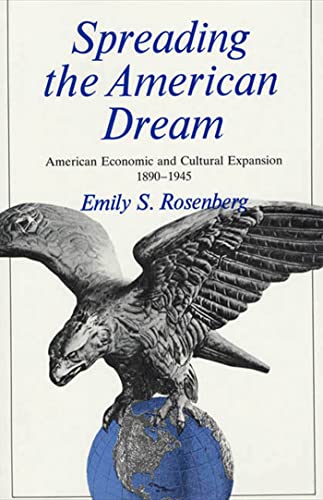
Inhaltsangabe
In examining the economic and cultural trs that expressed America's expansionist impulse during the first half of the twentieth century, Emily S. Rosenberg shows how U.S. foreign relations evolved from a largely private system to an increasingly public one and how, soon, the American dream became global.
Die Inhaltsangabe kann sich auf eine andere Ausgabe dieses Titels beziehen.
Über die Autorin bzw. den Autor
Emily Rosenberg
Auszug. © Genehmigter Nachdruck. Alle Rechte vorbehalten.
Spreading the American Dream
American Economic & Cultural Expansion 1890-1945By Emily RosenbergHill and Wang
Copyright © 1982 Emily RosenbergAll right reserved.
ISBN: 9780809001460
Spreading the American Dream
One
INTRODUCTION: THE AMERICAN DREAM
THE COLUMBIAN EXPOSITION OF 1893
A SPECTACULAR World's Fair, the Columbian Exposition, opened in Chicago in 1893. Acres of classical buildings, constructed especially for the fair, created an urban wonderland; it glittered with artistic splendor and burgeoned with America's latest technological achievements. After a visit to this White City, the French novelist and critic Paul Bourget wrote: "Chicago, the enormous town we see expanding, the gigantic plant which grows before our eyes seems now in this wonderfully new country to be in advance of the age. But is not this more or less true of all America?"
Bourget's comment was the kind Americans liked to quote; the exposition's exhibitors displayed their hopes for their country and for the world. Contrived and temporary, this Dream City flaunted America's faiths and glossed over its contradictions. Glamour triumphed over decay; time seemed suspended near the peak of perfection. From John Winthrop to Ralph Waldo Emerson to Josiah Strong, many Americans had thought, or hoped, that their country had escaped from history, that America was not just another power that would rise and then decline but that it was the quintessential civilization that would permanently culminate some long progression toward human betterment. Here, in rhetoric, iron, and stone, were the ideas and products that Americans prized and believedothers would gratefully accept. In the Dream City, America's most significant gifts to the twentieth-century world were already apparent: advanced technology and mass culture.
The amazing scientific and technological innovations of America's farmers--displayed in Agriculture Hall--overwhelmed viewers and demonstrated the United States' importance as an exporter of primary products. Impressive displays of wheat, corn, and other crops from the prairie states bespoke opulence and plenty. In this pavilion, at least, there was no mention of the overproduction, the falling prices, and the crushing debts plaguing the Midwest and attracting converts to the populist revolt.
Perched on a platform in one section of Agriculture Hall was a huge globe with an array of farm machines, all American-made, revolving around its circumference. America's preeminence in agricultural machinery was unmistakable, and manufacturers looked toward potential markets in the new and still-expanding farming frontiers of Manchuria, Siberia, Australia, Mexico, and Argentina. America's leading food processors, some already well known abroad, also displayed their latest techniques and products: Cudahy and Swift proudly showed beef extract; Gail Borden lined up cans of condensed milk; sugar refiners and soapmakers touted their innovations.
Transportation Hall showed off the "engines of progress" that had opened the prairies to commercial cultivation. Railroad companies built massive Grecian-style pavilions and used full-size models to illustrate the historical development of locomotives. The Pullman Company escorted visitors through an entire train, to show its luxurious sleeping and dining quarters. The railroad's prominent place at Chicago seemed appropriate: promoters presented the railroad as a major civilizing force, one bringing prosperity, communication, and understanding to the world.
The Pullman Company treated fairgoers to a large model of its other proud creation--the industrial town of Pullman. The neat workers' quarters, company stores, and cultural centers depicted an idyllic scene of industrial contentment. Within a few months, the great Pullman labor strike would mar the picture, permanently associating the town with class violence instead of harmony. But labor discontent, like farmers' revolts, had no place at Chicago. At the fair, Pullman was the promise of the future.
Other transportation exhibits heralded America's new world-wide role. Pneumatic conveyors promised to revolutionize retailing by eliminating bottlenecks in the distribution of goods. Elevators effortlessly transported people and goods. A model of a canal across Nicaragua showed how modern technology might bisect Central America and stimulate American trade with Asia. The International Navigation Company erected a full-size section of an ocean steamer, showing the numerous decks and the different classes of staterooms and dining rooms. Twenty thousand people a day visited this lavishly outfitted "ship," absorbing the idea that comfort and luxury were now the rule in ocean travel. The day of the American tourist traversing the globe was still in its infancy, but the crowds at Chicago indicated tourism's potential.
The vehicle exhibit lacked steam-, electric-, or petroleum-driven carriages, but future trends were evident all the same. American carriages were lighter and cheaper than European models. Unlike their competitors, they were, in the words of one commentator, made by "modern machinery and the systematic methods of large manufactories." They contrasted with the fine British coaches, which, the same American commentator noted, were "interesting on account of their style, long since out of fashion." Even before the automobile age, advanced technology and mass appeal distinguished America's transportation industry.
Machinery Hall also emphasized technological wizardry. There, the White City's massive power plant, run by Westinghouse's huge engine-dynamo units, generated electrical power in quantities never before produced. Oil, rather than coal, was used for fuel, and Standard Oil built a forty-mile experimental pipeline that carried the fuel into the fair. Fifteen electric motors distributed the electricity throughout the fairgrounds, clearly demonstrating advanced techniques of power transmission. Half this power flowed to the most amazing exhibit of all--Westinghouse's incandescent lighting system. Illuminating the entire fairgrounds and its buildings, this system constituted the largest central power station in the United States. Not to be outdone, General Electric erected a ten-foot, 6,000-pound searchlight--the largest in the world--and powered the Edison Tower of Light, a seventy-eight-foot shaft glowing with thousands of colored flashing lights. Chicago's fair awesomely demonstrated the new electrical age.
At Electricity Hall, power set in motion a mechanical world that seemed as marvelous in 1893 as it would seem commonplace in 1945. Most visitors got their first look at electric trolleys, long-distance phones, and electrical heaters. Edison's new kinetograph, in conjunction with a phonograph, visually reproduced an orator's movements and then synchronized these movements with the sound of his voice. G.E.'s elevated electric railroad safely speeded the huge crowds around the grounds. Other machinery exhibits highlighted Americans' talent for substituting technology for labor. All the fair's restaurants used dishwashing machines, and there were laundry and pressing machines, soapmaking machines, steamrollers, automatic sprinklers, street cleaners, and a machine that quickly weighed and bagged several tons of ground coffee a day. American sewing-machine companies such as Singer displayed improved versions of the home sewing machine. The Daily Columbian, a special World's Fair newspaper, spun off the latest steam-powered presses at the rate of...
„Über diesen Titel“ kann sich auf eine andere Ausgabe dieses Titels beziehen.
Suchergebnisse für Spreading the American Dream: American Economic &...

Beispielbild für diese ISBN
Spreading the American Dream
Anbieter: World of Books (was SecondSale), Montgomery, IL, USA
Verkäuferbewertung 5 von 5 Sternen

Paperback. Zustand: Very Good. In examining the economic and cultural trs that expressed America's expansionist impulse during the first half of the twentieth century, Emily S. Rosenberg shows how U.S. foreign relations evolved from a largely private system to an increasingly public one and how, soon, the American dream became global. Artikel-Nr. 00110809703
Gebraucht kaufen
EUR 6,17
Versand gratis
Versand innerhalb von USA
Versand innerhalb von USA
Anzahl: 2 verfügbar
Beispielbild für diese ISBN
Spreading the American Dream
Anbieter: World of Books (was SecondSale), Montgomery, IL, USA
Verkäuferbewertung 5 von 5 Sternen
Paperback. Zustand: Good. In examining the economic and cultural trs that expressed America's expansionist impulse during the first half of the twentieth century, Emily S. Rosenberg shows how U.S. foreign relations evolved from a largely private system to an increasingly public one and how, soon, the American dream became global. Artikel-Nr. 00105753168
Gebraucht kaufen
EUR 6,17
Versand gratis
Versand innerhalb von USA
Versand innerhalb von USA
Anzahl: 3 verfügbar
Beispielbild für diese ISBN
Spreading the American Dream: American Economic & Cultural Expansion 1890-1945
Anbieter: ThriftBooks-Dallas, Dallas, TX, USA
Verkäuferbewertung 5 von 5 Sternen
Paperback. Zustand: Fair. No Jacket. Readable copy. Pages may have considerable notes/highlighting. ~ ThriftBooks: Read More, Spend Less. Artikel-Nr. G0809001462I5N00
Gebraucht kaufen
EUR 6,18
Versand gratis
Versand innerhalb von USA
Versand innerhalb von USA
Anzahl: 1 verfügbar
Beispielbild für diese ISBN
Spreading the American Dream: American Economic & Cultural Expansion 1890-1945
Anbieter: ThriftBooks-Atlanta, AUSTELL, GA, USA
Verkäuferbewertung 5 von 5 Sternen
Paperback. Zustand: Good. No Jacket. Pages can have notes/highlighting. Spine may show signs of wear. ~ ThriftBooks: Read More, Spend Less. Artikel-Nr. G0809001462I3N00
Gebraucht kaufen
EUR 6,18
Versand gratis
Versand innerhalb von USA
Versand innerhalb von USA
Anzahl: 1 verfügbar
Beispielbild für diese ISBN
Spreading the American Dream: American Economic & Cultural Expansion 1890-1945
Anbieter: ThriftBooks-Dallas, Dallas, TX, USA
Verkäuferbewertung 5 von 5 Sternen
Paperback. Zustand: Good. No Jacket. Pages can have notes/highlighting. Spine may show signs of wear. ~ ThriftBooks: Read More, Spend Less. Artikel-Nr. G0809001462I3N00
Gebraucht kaufen
EUR 6,18
Versand gratis
Versand innerhalb von USA
Versand innerhalb von USA
Anzahl: 1 verfügbar
Beispielbild für diese ISBN
Spreading the American Dream : American Economic and Cultural Expansion, 1890-1945
Verlag:
Farrar, Straus & Giroux, 1982
ISBN 10: 0809001462
ISBN 13: 9780809001460
Gebraucht
Softcover
Erstausgabe
Anbieter: Better World Books, Mishawaka, IN, USA
Verkäuferbewertung 5 von 5 Sternen
Zustand: Good. 1st Ed. Former library copy. Pages intact with minimal writing/highlighting. The binding may be loose and creased. Dust jackets/supplements are not included. Includes library markings. Stock photo provided. Product includes identifying sticker. Better World Books: Buy Books. Do Good. Artikel-Nr. 4968168-20
Gebraucht kaufen
EUR 6,19
Versand gratis
Versand innerhalb von USA
Versand innerhalb von USA
Anzahl: 2 verfügbar
Beispielbild für diese ISBN
Spreading the American Dream (American Century)
Anbieter: Wonder Book, Frederick, MD, USA
Verkäuferbewertung 5 von 5 Sternen
Zustand: Good. Good condition. A copy that has been read but remains intact. May contain markings such as bookplates, stamps, limited notes and highlighting, or a few light stains. Artikel-Nr. E07I-01222
Gebraucht kaufen
EUR 6,43
Versand gratis
Versand innerhalb von USA
Versand innerhalb von USA
Anzahl: 1 verfügbar
Beispielbild für diese ISBN
Spreading the American Dream: American Economic and Cultural Expansion, 1890-1945 (American Century)
Anbieter: WorldofBooks, Goring-By-Sea, WS, Vereinigtes Königreich
Verkäuferbewertung 5 von 5 Sternen
Paperback. Zustand: Very Good. The book has been read, but is in excellent condition. Pages are intact and not marred by notes or highlighting. The spine remains undamaged. Artikel-Nr. GOR005545919
Gebraucht kaufen
EUR 4,06
EUR 6,69 Versand
Versand von Vereinigtes Königreich nach USA
Versand von Vereinigtes Königreich nach USA
Anzahl: 2 verfügbar
Beispielbild für diese ISBN
Spreading the American Dream: American Economic and Cultural Expansion 1890-1945
Anbieter: Anybook.com, Lincoln, Vereinigtes Königreich
Verkäuferbewertung 5 von 5 Sternen
Zustand: Good. This is an ex-library book and may have the usual library/used-book markings inside.This book has soft covers. In good all round condition. Please note the Image in this listing is a stock photo and may not match the covers of the actual item,350grams, ISBN:9780809001460. Artikel-Nr. 8696403
Gebraucht kaufen
EUR 3,08
EUR 15,57 Versand
Versand von Vereinigtes Königreich nach USA
Versand von Vereinigtes Königreich nach USA
Anzahl: 1 verfügbar
Beispielbild für diese ISBN
Spreading the American Dream: American Economic and Cultural Expansion 1890-1945
Anbieter: Anybook.com, Lincoln, Vereinigtes Königreich
Verkäuferbewertung 5 von 5 Sternen
Zustand: Fair. This is an ex-library book and may have the usual library/used-book markings inside.This book has soft covers. In fair condition, suitable as a study copy. Please note the Image in this listing is a stock photo and may not match the covers of the actual item,350grams, ISBN:9780809001460. Artikel-Nr. 8696404
Gebraucht kaufen
EUR 3,08
EUR 15,57 Versand
Versand von Vereinigtes Königreich nach USA
Versand von Vereinigtes Königreich nach USA
Anzahl: 1 verfügbar