
Verwandte Artikel zu Reality Radio: Telling True Stories in Sound (Documentary...
Inhaltsangabe
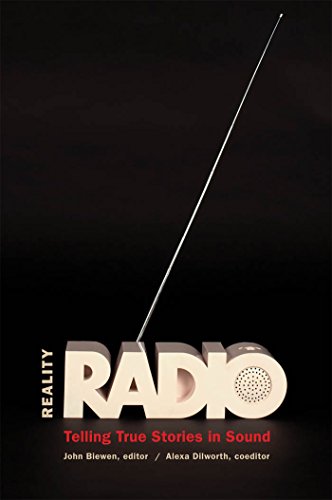
Over the last few decades, the radio documentary has developed into a strikingly vibrant form of creative expression. Millions of listeners hear arresting, intimate storytelling from an ever-widening array of producers on programs including This American Life, StoryCorps, and Radio Lab; online through such sites as Transom, the Public Radio Exchange, Hearing Voices, and Soundprint; and through a growing collection of podcasts.
Reality Radio celebrates today's best audio documentary work by bringing together some of the most influential and innovative practitioners from the United States, Canada, the United Kingdom, and Australia. In these nineteen essays, documentary artists tell--and demonstrate, through stories and transcripts--how they make radio the way they do, and why.
Whether the contributors to the volume call themselves journalists, storytellers, even audio artists--and although their essays are just as diverse in content and approach--all use sound to tell true stories, artfully.
Contributors:
Jad Abumrad
Jay Allison
damali ayo
John Biewen
Emily Botein
Chris Brookes
Scott Carrier
Katie Davis
Sherre DeLys
Lena Eckert-Erdheim
Ira Glass
Alan Hall
Natalie Kestecher
The Kitchen Sisters
Maria Martin
Karen Michel
Rick Moody
Joe Richman
Dmae Roberts
Stephen Smith
Sandy Tolan
Die Inhaltsangabe kann sich auf eine andere Ausgabe dieses Titels beziehen.
Über die Autorin bzw. den Autor
John Biewen is audio program director at the Center for Documentary Studies at Duke University, where he teaches and produces documentary work for NPR, PRI, American Public Media, and other public radio audiences. Alexa Dilworth is publishing director at the Center for Documentary Studies.
Von der hinteren Coverseite
Over the last few decades, the radio documentary has developed into a strikingly vibrant form of creative expression. This volume celebrates today's best audio documentary work by bringing together some of the most influential and innovative practitioners from the U.S., Canada, the U.K., and Australia. In these 19 essays, documentary makers tell relate how they make radio the way they do, and why.
Includes essays from Ira Glass, the Kitchen Sisters, Rick Moody, and producer Joe Richman, among others.
Auszug. © Genehmigter Nachdruck. Alle Rechte vorbehalten.
Reality Radio
Telling True Stories in SoundThe University of North Carolina Press
Copyright © 2010 The Center for Documentary StudiesAll right reserved.
ISBN: 978-0-8078-7102-7
Contents
FOREWORD Rick Moody............................................................................................ixINTRODUCTION John Biewen.......................................................................................1ARE WE ON THE AIR? Chris Brookes...............................................................................15THAT JACKIE KENNEDY MOMENT Scott Carrier.......................................................................27TALKING TO STRANGERS The Kitchen Sisters.......................................................................36NO HOLES WERE DRILLED IN THE HEADS OF ANIMALS IN THE MAKING OF THIS RADIO SHOW Jad Abumrad.....................44HARNESSING LUCK AS AN INDUSTRIAL PRODUCT Ira Glass.............................................................54COVERING HOME Katie Davis......................................................................................67WHAT DID SHE JUST SAY? damali ayo..............................................................................76OUT THERE Sherre DeLys.........................................................................................86CIGARETTES AND DANCE STEPS Alan Hall...........................................................................96UNREALITY RADIO Natalie Kestecher..............................................................................108FINDING THE POETRY Dmae Roberts................................................................................116DIARIES AND DETRITUS: ONE PERFECTIONIST'S SEARCH FOR IMPERFECTION Joe Richman..................................128LIVING HISTORY Stephen Smith...................................................................................135THE VOICE AND THE PLACE Sandy Tolan............................................................................147CROSSING BORDERS Maria Martin..................................................................................157ADVENTURERS IN SOUND Karen Michel..............................................................................165DRESSY GIRLS Lena Eckert-Erdheim...............................................................................171SALT IS FLAVOR AND OTHER TIPS LEARNED WHILE COOKING Emily Botein...............................................176AFTERWORD: LISTEN Jay Allison..................................................................................183About the Contributors..........................................................................................197Editor's Note: Hearing the Documentaries........................................................................205Acknowledgments.................................................................................................207
Chapter One
Are We on the Air?Chris Brookes
THERE IS ONE FEATURE that distinguishes me from other radio makers: geography. I am the only one whose production studio is located on the cliff where radio, as we know it, was born.
Long-distance radio transmission was delivered into the world at the top of my cliff in 1901 when Guglielmo Marconi received the first transatlantic radio transmission. So a century later when I sit down to my Pro Tools editing screen I'm conscious of the fact that two hundred feet above me is where Marconi did it, and on a foggy day all I have to do is look out my studio window to see his ghost. I like to think that this shapes my understanding of radio. It is a humble understanding, since my studio is only at the bottom of the cliff, not at the top.
Marconi spent three windy and freezing December days at the top of Signal Hill, St. John's, Newfoundland. He flew a kite to get his antenna up, glued his ear to a set of headphones, and listened for a signal transmitted from a huge spark-gap transmitter he'd built in Cornwall. He heard it, or at least he said he did. The signal was the Morse code letter "s," just pure binary information over the radio: three dots. And from my vantage point at the bottom of the cliff it seems to me this might explain why radio has been too often mistaken as a medium for information instead of evocation. Let me explain.
The important thing about the birth of radio on Signal Hill is that it didn't really happen. A physicist at Canada's National Research Council, Dr. John Belrose, has proved that it was scientifically impossible for Marconi to have heard his signal. He says Marconi had three strikes against him. Strike one had to do with the frequency of Marconi's transmission. Shortwave radio can be received over long distances because the signal bounces off the ionosphere-particularly at night, which is why of an evening you might hear Radio Moscow in New York. But Marconi's transmitter two thousand miles away in Cornwall wasn't shortwave; it was broadcasting in the low-frequency radio spectrum. Frequencies at the low end of the dial tend not to bounce, and consequently don't travel very far.
Strike two had to do with the time of day. Marconi claimed to have received the signal not at night but at noon. The ionosphere is not particularly active during daylight hours. Finally, ionospheric reflection can be influenced by sunspot activity. More sunspots enhance reflectivity; fewer sunspots diminish it. On December 12, 1901, there was unusually low sunspot activity. Strike three.
Marconi's signal could not have bounced, and it could not possibly have been heard over the curvature of the earth two thousand miles away in St. John's, Newfoundland. Dr. Belrose knows this in the twenty-first century, but nobody knew it in 1901. Back then people had never heard of the ionosphere. They were just trying to figure out how this new radio thing actually worked. Before they managed to do that, Marconi accidentally upped his frequency a couple of years later and lucked into successful transatlantic communication using shorter wavelengths at night. Very serendipitously for him.
But on that December day in 1901, if he couldn't have heard the signal at the top of my cliff, why did he say he did? It may have been a lie, and in 1901 some said as much. Alexander Graham Bell claimed it was a hoax. These days, Jack Belrose is more charitable. He points out that Marconi had so much riding on it. He was under huge financial pressure-building the transmitter had practically bankrupted his company-and if he didn't get a signal across the Atlantic he would be finished. Dr. Belrose thinks he wanted it so desperately that he imagined he heard the signal. And he suggests this speaks to Marconi's delicate state of mind and finances at the time.
Dr. John Belrose is a scientist. I'm a radio feature maker, and it suggests something more intriguing to me, something about the essential nature of radio: that compared to other media like print or even television, radio isn't the ideal way to convey information. A radio journalist who has to do a story about economics, for example, has his work cut out for him. Readers can plow through the same story in a newspaper, and when they get muddled they can go back and reread the facts and figures until they understand them. Television viewers can see graphs and pie charts. In radio, it goes by your ears once, and if you didn't get it, too bad.
What radio does best is stimulate the imagination. And we should have realized this in the very beginning. After all, the first of our senses to develop is that of hearing. Lying in the...
„Über diesen Titel“ kann sich auf eine andere Ausgabe dieses Titels beziehen.
Suchergebnisse für Reality Radio: Telling True Stories in Sound (Documentary...

Beispielbild für diese ISBN
Reality Radio: Telling True Stories in Sound (Documentary Arts and Culture, Published in association with the Center for Documentary Studies at Duke University)
ISBN 10: 0807871028
ISBN 13: 9780807871027
Gebraucht
Paperback
Anbieter: BooksRun, Philadelphia, PA, USA
Verkäuferbewertung 5 von 5 Sternen

Paperback. Zustand: Very Good. New edition. It's a well-cared-for item that has seen limited use. The item may show minor signs of wear. All the text is legible, with all pages included. It may have slight markings and/or highlighting. Artikel-Nr. 0807871028-11-1
Gebraucht kaufen
EUR 5,15
Versand gratis
Versand innerhalb von USA
Versand innerhalb von USA
Anzahl: 1 verfügbar
Beispielbild für diese ISBN
Reality Radio: Telling True Stories in Sound (Documentary Arts and Culture, Published in association with the Center for Documentary Studies at Duke University)
Verlag:
The University of North Carolina Press, 2010
ISBN 10: 0807871028
ISBN 13: 9780807871027
Gebraucht
Softcover
Anbieter: World of Books (was SecondSale), Montgomery, IL, USA
Verkäuferbewertung 5 von 5 Sternen
Zustand: Good. Item in good condition. Textbooks may not include supplemental items i.e. CDs, access codes etc. Artikel-Nr. 00088149194
Gebraucht kaufen
EUR 5,19
Versand gratis
Versand innerhalb von USA
Versand innerhalb von USA
Anzahl: 1 verfügbar
Beispielbild für diese ISBN
Reality Radio
Verlag:
University of North Carolina Press, 2010
ISBN 10: 0807871028
ISBN 13: 9780807871027
Gebraucht
Paperback
Anbieter: ThriftBooks-Atlanta, AUSTELL, GA, USA
Verkäuferbewertung 5 von 5 Sternen
Paperback. Zustand: Very Good. No Jacket. May have limited writing in cover pages. Pages are unmarked. ~ ThriftBooks: Read More, Spend Less. Artikel-Nr. G0807871028I4N00
Gebraucht kaufen
EUR 5,96
Versand gratis
Versand innerhalb von USA
Versand innerhalb von USA
Anzahl: 1 verfügbar
Beispielbild für diese ISBN
Reality Radio
Verlag:
University of North Carolina Press, 2010
ISBN 10: 0807871028
ISBN 13: 9780807871027
Gebraucht
Paperback
Anbieter: ThriftBooks-Dallas, Dallas, TX, USA
Verkäuferbewertung 5 von 5 Sternen
Paperback. Zustand: Very Good. No Jacket. May have limited writing in cover pages. Pages are unmarked. ~ ThriftBooks: Read More, Spend Less. Artikel-Nr. G0807871028I4N00
Gebraucht kaufen
EUR 5,96
Versand gratis
Versand innerhalb von USA
Versand innerhalb von USA
Anzahl: 1 verfügbar
Beispielbild für diese ISBN
Reality Radio
Verlag:
University of North Carolina Press, 2010
ISBN 10: 0807871028
ISBN 13: 9780807871027
Gebraucht
Paperback
Anbieter: ThriftBooks-Reno, Reno, NV, USA
Verkäuferbewertung 5 von 5 Sternen
Paperback. Zustand: Very Good. No Jacket. May have limited writing in cover pages. Pages are unmarked. ~ ThriftBooks: Read More, Spend Less. Artikel-Nr. G0807871028I4N00
Gebraucht kaufen
EUR 5,96
Versand gratis
Versand innerhalb von USA
Versand innerhalb von USA
Anzahl: 1 verfügbar
Beispielbild für diese ISBN
Reality Radio
Verlag:
University of North Carolina Press, 2010
ISBN 10: 0807871028
ISBN 13: 9780807871027
Gebraucht
Paperback
Anbieter: ThriftBooks-Dallas, Dallas, TX, USA
Verkäuferbewertung 5 von 5 Sternen
Paperback. Zustand: Good. No Jacket. Pages can have notes/highlighting. Spine may show signs of wear. ~ ThriftBooks: Read More, Spend Less. Artikel-Nr. G0807871028I3N00
Gebraucht kaufen
EUR 5,96
Versand gratis
Versand innerhalb von USA
Versand innerhalb von USA
Anzahl: 1 verfügbar
Beispielbild für diese ISBN
Reality Radio
Verlag:
University of North Carolina Press, 2010
ISBN 10: 0807871028
ISBN 13: 9780807871027
Gebraucht
Paperback
Anbieter: ThriftBooks-Reno, Reno, NV, USA
Verkäuferbewertung 5 von 5 Sternen
Paperback. Zustand: Fair. No Jacket. Readable copy. Pages may have considerable notes/highlighting. ~ ThriftBooks: Read More, Spend Less. Artikel-Nr. G0807871028I5N00
Gebraucht kaufen
EUR 5,96
Versand gratis
Versand innerhalb von USA
Versand innerhalb von USA
Anzahl: 1 verfügbar
Beispielbild für diese ISBN
Reality Radio
Verlag:
University of North Carolina Press, 2010
ISBN 10: 0807871028
ISBN 13: 9780807871027
Gebraucht
Paperback
Anbieter: ThriftBooks-Atlanta, AUSTELL, GA, USA
Verkäuferbewertung 5 von 5 Sternen
Paperback. Zustand: Fair. No Jacket. Readable copy. Pages may have considerable notes/highlighting. ~ ThriftBooks: Read More, Spend Less. Artikel-Nr. G0807871028I5N00
Gebraucht kaufen
EUR 5,96
Versand gratis
Versand innerhalb von USA
Versand innerhalb von USA
Anzahl: 1 verfügbar
Beispielbild für diese ISBN
Reality Radio
Verlag:
University of North Carolina Press, 2010
ISBN 10: 0807871028
ISBN 13: 9780807871027
Gebraucht
Paperback
Anbieter: ThriftBooks-Phoenix, Phoenix, AZ, USA
Verkäuferbewertung 5 von 5 Sternen
Paperback. Zustand: Very Good. No Jacket. May have limited writing in cover pages. Pages are unmarked. ~ ThriftBooks: Read More, Spend Less. Artikel-Nr. G0807871028I4N00
Gebraucht kaufen
EUR 5,96
Versand gratis
Versand innerhalb von USA
Versand innerhalb von USA
Anzahl: 1 verfügbar
Beispielbild für diese ISBN
Reality Radio
Verlag:
University of North Carolina Press, 2010
ISBN 10: 0807871028
ISBN 13: 9780807871027
Gebraucht
Paperback
Anbieter: ThriftBooks-Dallas, Dallas, TX, USA
Verkäuferbewertung 5 von 5 Sternen
Paperback. Zustand: As New. No Jacket. Pages are clean and are not marred by notes or folds of any kind. ~ ThriftBooks: Read More, Spend Less. Artikel-Nr. G0807871028I2N00
Gebraucht kaufen
EUR 5,96
Versand gratis
Versand innerhalb von USA
Versand innerhalb von USA
Anzahl: 1 verfügbar