
Verwandte Artikel zu A Shattered Nation: The Rise and Fall of the Confederacy,...
A Shattered Nation: The Rise and Fall of the Confederacy, 1861-1868 (Civil War America) - Softcover
Buch 38 von 177: Civil War America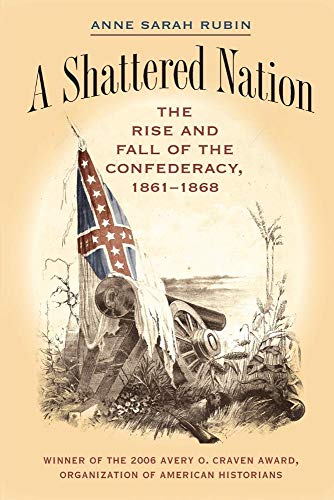
Inhaltsangabe
Historians often assert that Confederate nationalism had its origins in pre–Civil War sectional conflict with the North, reached its apex at the start of the war, and then dropped off quickly after the end of hostilities. Anne Sarah Rubin argues instead that white Southerners did not actually begin to formulate a national identity until it became evident that the Confederacy was destined to fight a lengthy war against the Union. She also demonstrates that an attachment to a symbolic or sentimental Confederacy existed independent of the political Confederacy and was therefore able to persist well after the collapse of the Confederate state. White Southerners redefined symbols and figures of the failed state as emotional touchstones and political rallying points in the struggle to retain local (and racial) control, even as former Confederates took the loyalty oath and applied for pardons in droves.
Exploring the creation, maintenance, and transformation of Confederate identity during the tumultuous years of the Civil War and Reconstruction, Rubin sheds new light on the ways in which Confederates felt connected to their national creation and provides a provocative example of what happens when a nation disintegrates and leaves its people behind to forge a new identity.
Die Inhaltsangabe kann sich auf eine andere Ausgabe dieses Titels beziehen.
Über die Autorin bzw. den Autor
Anne Sarah Rubin is associate professor of history at the University of Maryland, Baltimore County. She is coauthor, with Edward Ayers, of the electronic project Valley of the Shadow: Two Communities in the American Civil War: The Eve of War.
Von der hinteren Coverseite
Exploring the creation, maintenance, and transformation of Confederate identity during the tumultuous years of the Civil War and Reconstruction, Rubin sheds new light on the ways in which Confederates felt connected to their national creation and provides a provocative example of what happens when a nation disintegrates and leaves its people behind to forge a new identity.
Aus dem Klappentext
Exploring the creation, maintenance, and transformation of Confederate identity during the tumultuous years of the Civil War and Reconstruction, Rubin sheds new light on the ways in which Confederates felt connected to their national creation and provides a provocative example of what happens when a nation disintegrates and leaves its people behind to forge a new identity.
„Über diesen Titel“ kann sich auf eine andere Ausgabe dieses Titels beziehen.
Suchergebnisse für A Shattered Nation: The Rise and Fall of the Confederacy,...

Beispielbild für diese ISBN
A Shattered Nation: The Rise and Fall of the Confederacy, 1861-1868 (Civil War America)
Verlag:
The University of North Carolina, 2007
ISBN 10: 0807855928
ISBN 13: 9780807855928
Gebraucht
paperback
Anbieter: Books From California, Simi Valley, CA, USA
Verkäuferbewertung 4 von 5 Sternen

paperback. Zustand: Very Good. Artikel-Nr. mon0004238735
Gebraucht kaufen
EUR 6,86
EUR 4,35 Versand
Versand innerhalb von USA
Versand innerhalb von USA
Anzahl: 12 verfügbar
Foto des Verkäufers
A Shattered Nation: The Rise and Fall of the Confederacy, 1861-1868 (Civil War America)
Verlag:
The University of North Carolina Press, 2007
ISBN 10: 0807855928
ISBN 13: 9780807855928
Gebraucht
Hardcover
Anbieter: Southampton Books, Sag Harbor, NY, USA
Verkäuferbewertung 5 von 5 Sternen

Hardcover. Zustand: Like New. Book Club Edition. Book Club Edition. Not price-clipped. Published by University of North Carolina Press, 2005. Octavo. Hardcover. Book is like new. Dust jacket is like new.100% positive feedback. 30 day money back guarantee. NEXT DAY SHIPPING! Excellent customer service. Please email with any questions. All books packed carefully and ship with free delivery confirmation/tracking. All books come with free bookmarks. Ships from Sag Harbor, New York. Artikel-Nr. 353565
Gebraucht kaufen
EUR 17,95
EUR 4,35 Versand
Versand innerhalb von USA
Versand innerhalb von USA
Anzahl: 1 verfügbar
Beispielbild für diese ISBN
A Shattered Nation: The Rise and Fall of the Confederacy, 1861-1868 (Civil War America)
Verlag:
The University of North Carolina Press, 2007
ISBN 10: 0807855928
ISBN 13: 9780807855928
Neu
Softcover
Anbieter: Ria Christie Collections, Uxbridge, Vereinigtes Königreich
Verkäuferbewertung 5 von 5 Sternen
Zustand: New. In English. Artikel-Nr. ria9780807855928_new
Neu kaufen
EUR 38,21
EUR 13,14 Versand
Versand von Vereinigtes Königreich nach USA
Versand von Vereinigtes Königreich nach USA
Anzahl: Mehr als 20 verfügbar
Beispielbild für diese ISBN
A Shattered Nation The Rise and Fall of the Confederacy, 18611868
Anbieter: Revaluation Books, Exeter, Vereinigtes Königreich
Verkäuferbewertung 5 von 5 Sternen
Paperback. Zustand: Brand New. 1st edition. 336 pages. 9.00x6.25x0.75 inches. In Stock. Artikel-Nr. x-0807855928
Neu kaufen
EUR 49,69
EUR 11,64 Versand
Versand von Vereinigtes Königreich nach USA
Versand von Vereinigtes Königreich nach USA
Anzahl: 2 verfügbar
Foto des Verkäufers
A Shattered Nation: The Rise and Fall of the Confederacy, 1861-1868
Anbieter: moluna, Greven, Deutschland
Verkäuferbewertung 5 von 5 Sternen
Zustand: New. Über den AutorAnne Sarah Rubin is associate professor of history at the University of Maryland, Baltimore County. She is coauthor, with Edward Ayers, of the electronic project Valley of the Shadow: Two Communities in the American. Artikel-Nr. 898761421
Neu kaufen
EUR 44,46
EUR 48,99 Versand
Versand von Deutschland nach USA
Versand von Deutschland nach USA
Anzahl: Mehr als 20 verfügbar