
Verwandte Artikel zu Pickett's Charge in History and Memory (Civil War...
Pickett's Charge in History and Memory (Civil War America) - Softcover
Buch 61 von 177: Civil War America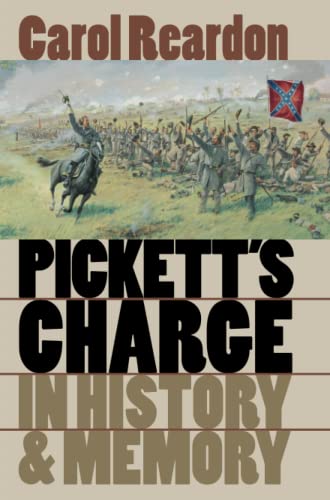
Inhaltsangabe
If, as many have argued, the Civil War is the most crucial moment in our national life and Gettysburg its turning point, then the climax of the climax, the central moment of our history, must be Pickett’s Charge. But as Carol Reardon notes, the Civil War saw many other daring assaults and stout defenses. Why, then, is it Pickett’s Charge at Gettysburg — and not, for example, Richardson’s Charge at Antietam or Humphreys’s Assault at Fredericksburg — that looms so large in the popular imagination? As this innovative study reveals, by examining the events of 3 July 1863 through the selective and evocative lens of 'memory' we can learn much about why Pickett’s Charge endures so strongly in the American imagination. Over the years, soldiers, journalists, veterans, politicians, orators, artists, poets, and educators, Northerners and Southerners alike, shaped, revised, and even sacrificed the 'history' of the charge to create 'memories' that met ever-shifting needs and deeply felt values. Reardon shows that the story told today of Pickett’s Charge is really an amalgam of history and memory. The evolution of that mix, she concludes, tells us much about how we come to understand our nation’s past.
Die Inhaltsangabe kann sich auf eine andere Ausgabe dieses Titels beziehen.
Über die Autorin bzw. den Autor
Carol Reardon is associate professor of history at Pennsylvania State University.
Auszug. © Genehmigter Nachdruck. Alle Rechte vorbehalten.
Chapter One
DISCONNECTED THREADS
Fifty years after Pickett's Charge, survivor D. B. Easley of the 14th Virginia finally admitted he had not seen very much of his regiment's most famous assault. He had become "so engrossed with his part of a fight" that he recalled "very little else." In apologizing for the haziness of his memory, he conceded an even more telling point: in the heat of battle, a soldier "fails to note all he does see." Offering an equally important caveat, a Pennsylvania captain explained that many soldiers could not describe the chaos of combat, so they filled their letters, diaries, and official reports with exaggerations, fabrications, generalizations, or laconic dispassion. He feared that despite the efforts of conscientious historians "to weave a symmetrical whole from such disconnected threads," they really preserved only a few bits of any military action, even one so dramatic as the great charge at Gettysburg on July 3, 1863.
A battlefield, according to military historian S. L. A. Marshall, is indeed "the lonesomest place which men share together." Each soldier's perceptions of what he saw or did in combat-or what he thought he saw or did-became individualized sets of memories. Moreover, such personal recollections are very selective. No soldier recalls every action he takes or every observation he makes in battle, argues historian Richard Holmes, because "the process of memory tends to emphasize the peaks and troughs of experience at the expense of the great grey level plain." Those peaks and troughs provide the disconnected threads of experience the Pennsylvania captain described. Only the most exceptional events, even on this momentous day in American military history, were likely to leave lasting marks in the soldiers' memories.
What did the survivors of that day tell us? Immediate postbattle musings offer glimpses of the horrific clash of arms. Collectively, however, they represent only a set of remarkable moments. These fragments of memory, as historian C. Vann Woodward has asserted, provide "the twilight zone between living memory and written history" that becomes the "breeding ground of mythology." All too often, however, this mythology wears the mantle of "history," and it is the perpetuation of this kind of record-written by the "eye who never saw the battle"-that Lieutenant Haskell dreaded.
What do those fragments tell us about what happened between Seminary Ridge and Cemetery Ridge at Gettysburg on the afternoon of July 3, 1863? They tell us many important things, and not all of them are obvious to the best scholars. Historians often miss one particularly important point about that day: thousands of soldiers marched away from Gettysburg with no lasting memory at all of the great charge of July 3. Pvt. Samuel A. Firebaugh of the 10th Virginia recalled his own tough fight on Culp's Hill early that same morning as "the hardest contested battle of the war, lasting 6 hours" but dismissed the assault that afternoon with "Hill attacked on the right." Col. Moses B. Lakeman of the 3rd Maine, after a hard fight at the Peach Orchard on July 2, summed up the next day with a few unspectacular observations: "Went to support of Second corps; no casualties. Rained at night. Enemy completely repulsed in our front all day. Commanding brigade." The grand assault left no mark at all in the memories of the thousands of Gettysburg's survivors who played no part in the attack or its repulse.
More interesting, of course, are the memories of soldiers who did participate in the event. Honest soldiers, such as Sergeant Easley, realized that they just did not see enough of the fighting on July 3 to explain very much about it. As a Pennsylvania soldier suggested, "None but the actors of the field can tell the story" of a battle, and even then, "each one can tell of his own knowledge but an infinitisimal part." This truth behind these veterans" observations compels both explanation and appreciation.
First, both the linear formations the armies used and the sheer numbers of soldiers involved in the fight on each side that day limited each combatant's field of vision. One of Davis's Mississippians best described the problem to his general a few years later: "I was very much like the French Soldier of whom you sometimes told us, who never saw anything while the battle was going on except the rump of his fat file leader."
In addition, the irregular terrain on the field of the great charge also limited what each soldier could see of the day's action. The physical conformation of the July 3 battlefield was-and still is-deceiving. Then, as now, trees, patches of underbrush, and rock outcroppings dotted the fields and slopes. The front of Webb's brigade stretched only several hundred yards, yet one man of the 72nd Pennsylvania later wrote that "those of us who were with the rest of the brigade knew nothing of the Sixty-Ninth [Pennsylvania], except as we heard their cheers and the crack of their rifles" because they were "partly concealed from view by the clump of trees." The land between Seminary and Cemetery Ridges rolls gently, often dipping low enough to hide and shelter advancing soldiers. A low finger of ground jutting westward from the area around the Angle and the clump of trees toward the Emmitsburg Road, a subtly significant terrain feature largely unnoticed in 1863 and seldom noted today, effectively cut the battlefield in two. This subtle ripple cut the lines of sight along the lines of command responsibility: Pettigrew and Trimble fought Hays north of it, Pickett fought Gibbon south of it. Only a few soldiers saw much of both clashes. Smoke and the sheer number of horses and men on the field also made it difficult for any single individual to see much that day.
While limitations in visual contact circumscribed what any one man actually saw of Pickett's Charge, Easley's assertion that a soldier in the heat of combat "fails to note all he does see" deserves even more explanation. If a soldier set in memory only certain peak experiences and left the troughs unrecorded, what factors determined what would be remembered?
Most soldiers who took part in the fight on July 3 had seen combat before, and those experiences shaped perceptions now. North Carolina artilleryman Joseph Graham watched Southern infantrymen look out over the valley and heard them say: "'That is worse than Malvern Hill." After the fight ended, Pvt. J. L. Bechtel of the 59th New York wrote: "Antietam was nothing compared to it." The battle at Fredericksburg the previous December supplied many soldiers with the most obvious point of comparison. Capt. Henry L. Abbott watched the advancing Confederates and knew his men "would give them Fredericksburg." Sgt. Alex McNeil of the 14th Connecticut bragged that his regiment "paid the Rebels back with Interest, for our defeat at Fredericksburg." On the day after the great charge, Capt. J. J. Young of the 26th North Carolina wrote that "it was a second Fredericksburg affair, only the wrong way."
Some veterans knew that they lost more than physical vigor when the adrenaline rush of battle waned. They could forget much of what they saw or did. In times of extreme stress such as that induced by combat, argues Richard Holmes, the human brain only "records clips of experience, often in erratic sequence." Lieutenant Haskell clearly understood something about the process of memory when he warned his brother not to expect to learn much about the fight from the postbattle accounts of senior officers: "The official reports may give results as to losses, with statements of attacks and repulses; they may also note the means by which results were attained, which is a statement of the number and kind of forces employed, but the connection between means and results, the mode, the battle proper, these reports touch lightly." Even Haskell did not claim to write anything more than "simply my account of the battle." Veterans...
„Über diesen Titel“ kann sich auf eine andere Ausgabe dieses Titels beziehen.
Suchergebnisse für Pickett's Charge in History and Memory (Civil War...

Beispielbild für diese ISBN
Pickett's Charge in History and Memory
Verlag:
University of North Carolina Press, 2003
ISBN 10: 0807854611
ISBN 13: 9780807854617
Gebraucht
Softcover
Anbieter: Better World Books, Mishawaka, IN, USA
Verkäuferbewertung 5 von 5 Sternen

Zustand: Good. Pages intact with minimal writing/highlighting. The binding may be loose and creased. Dust jackets/supplements are not included. Stock photo provided. Product includes identifying sticker. Better World Books: Buy Books. Do Good. Artikel-Nr. 7963526-6
Gebraucht kaufen
EUR 6,55
Versand gratis
Versand innerhalb von USA
Versand innerhalb von USA
Anzahl: 2 verfügbar
Beispielbild für diese ISBN
Pickett's Charge in History and Memory
Verlag:
The University of North Carolina Press, 2003
ISBN 10: 0807854611
ISBN 13: 9780807854617
Gebraucht
Softcover
Anbieter: Wonder Book, Frederick, MD, USA
Verkäuferbewertung 5 von 5 Sternen
Zustand: Very Good. Very Good condition. A copy that may have a few cosmetic defects. May also contain light spine creasing or a few markings such as an owner's name, short gifter's inscription or light stamp. Artikel-Nr. K14S-00171
Gebraucht kaufen
EUR 6,58
Versand gratis
Versand innerhalb von USA
Versand innerhalb von USA
Anzahl: 1 verfügbar
Beispielbild für diese ISBN
Pickett's Charge in History and Memory
Verlag:
University of North Carolina Press, 2003
ISBN 10: 0807854611
ISBN 13: 9780807854617
Gebraucht
Paperback
Anbieter: ThriftBooks-Atlanta, AUSTELL, GA, USA
Verkäuferbewertung 5 von 5 Sternen
Paperback. Zustand: Good. No Jacket. Pages can have notes/highlighting. Spine may show signs of wear. ~ ThriftBooks: Read More, Spend Less. Artikel-Nr. G0807854611I3N00
Gebraucht kaufen
EUR 8,21
Versand gratis
Versand innerhalb von USA
Versand innerhalb von USA
Anzahl: 1 verfügbar
Beispielbild für diese ISBN
Pickett's Charge in History and Memory
Verlag:
University of North Carolina Pre, 2003
ISBN 10: 0807854611
ISBN 13: 9780807854617
Gebraucht
Paperback
Anbieter: Books From California, Simi Valley, CA, USA
Verkäuferbewertung 4 von 5 Sternen

Paperback. Zustand: Very Good. Artikel-Nr. mon0003940499
Gebraucht kaufen
EUR 4,58
EUR 4,43 Versand
Versand innerhalb von USA
Versand innerhalb von USA
Anzahl: 2 verfügbar
Beispielbild für diese ISBN
Pickett's Charge in History and Memory
Verlag:
University of North Carolina Pre, 2003
ISBN 10: 0807854611
ISBN 13: 9780807854617
Gebraucht
Paperback
Anbieter: Books From California, Simi Valley, CA, USA
Verkäuferbewertung 4 von 5 Sternen
Paperback. Zustand: Fine. Artikel-Nr. mon0004102356
Gebraucht kaufen
EUR 5,71
EUR 4,43 Versand
Versand innerhalb von USA
Versand innerhalb von USA
Anzahl: 2 verfügbar
Beispielbild für diese ISBN
Pickett's Charge in History and Memory
Anbieter: Revaluation Books, Exeter, Vereinigtes Königreich
Verkäuferbewertung 5 von 5 Sternen
Paperback. Zustand: Brand New. 296 pages. 9.00x6.00x0.75 inches. In Stock. Artikel-Nr. x-0807854611
Neu kaufen
EUR 33,10
EUR 11,79 Versand
Versand von Vereinigtes Königreich nach USA
Versand von Vereinigtes Königreich nach USA
Anzahl: 2 verfügbar
Beispielbild für diese ISBN
Pickett's Charge in History and Memory
Verlag:
University of North Carolina Press, 2003
ISBN 10: 0807854611
ISBN 13: 9780807854617
Neu
Softcover
Anbieter: Majestic Books, Hounslow, Vereinigtes Königreich
Verkäuferbewertung 4 von 5 Sternen
Zustand: New. pp. 296 23 Illus., Map. Artikel-Nr. 7981958
Neu kaufen
EUR 46,64
EUR 7,66 Versand
Versand von Vereinigtes Königreich nach USA
Versand von Vereinigtes Königreich nach USA
Anzahl: 1 verfügbar