
Verwandte Artikel zu Time and Revolution: Marxism and the Design of Soviet...
Inhaltsangabe
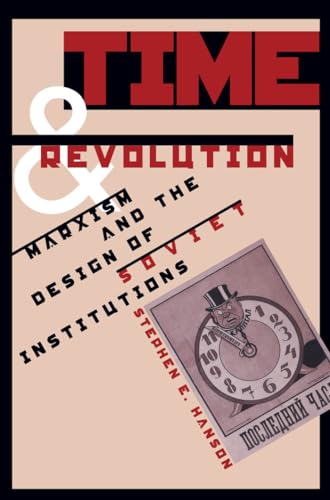
Stephen Hanson traces the influence of the Marxist conception of time in Soviet politics from Lenin to Gorbachev. He argues that the history of Marxism and Leninism reveals an unsuccessful revolutionary effort to reorder the human relationship with time and that this reorganization had a direct impact on the design of the central political, socioeconomic, and cultural institutions of the Soviet Union from 1917 to 1991.
Die Inhaltsangabe kann sich auf eine andere Ausgabe dieses Titels beziehen.
Über die Autorin bzw. den Autor
Stephen E. Hanson, assistant professor of political science at the University of Washington, is coeditor of Can Europe Work?: Germany and the Reconstruction of Post-Communist Societies.
„Über diesen Titel“ kann sich auf eine andere Ausgabe dieses Titels beziehen.
Suchergebnisse für Time and Revolution: Marxism and the Design of Soviet...

Beispielbild für diese ISBN
Time and Revolution: Marxism and the Design of Soviet Institutions
Verlag:
The University of North Carolina Press, 1997
ISBN 10: 0807846155
ISBN 13: 9780807846155
Neu
Softcover
Anbieter: California Books, Miami, FL, USA
Verkäuferbewertung 5 von 5 Sternen

Zustand: New. Artikel-Nr. I-9780807846155
Neu kaufen
EUR 66,17
EUR 2,68 Versand
Versand innerhalb von USA
Versand innerhalb von USA
Anzahl: Mehr als 20 verfügbar
Beispielbild für diese ISBN
Time and Revolution: Marxism and the Design of Soviet Institutions
Verlag:
The University of North Carolina Press, 1997
ISBN 10: 0807846155
ISBN 13: 9780807846155
Gebraucht
paperback
Anbieter: Studibuch, Stuttgart, Deutschland
Verkäuferbewertung 5 von 5 Sternen
paperback. Zustand: Gut. 276 Seiten; 9780807846155.3 Gewicht in Gramm: 1. Artikel-Nr. 1172725
Gebraucht kaufen
EUR 15,31
EUR 62,30 Versand
Versand von Deutschland nach USA
Versand von Deutschland nach USA
Anzahl: 1 verfügbar
Foto des Verkäufers
Time and Revolution
Verlag:
The University of North Carolina Press, US, 1997
ISBN 10: 0807846155
ISBN 13: 9780807846155
Neu
Paperback
Anbieter: Rarewaves.com USA, London, LONDO, Vereinigtes Königreich
Verkäuferbewertung 5 von 5 Sternen
Paperback. Zustand: New. New. Stephen Hanson traces the influence of the Marxist conception of time in Soviet politics from Lenin to Gorbachev. He argues that the history of Marxism and Leninism reveals an unsuccessful revolutionary effort to reorder the human relationship with time and that this reorganization had a direct impact on the design of the central political, socioeconomic and cultural institutions of the Soviet Union from 1917 to 1991. According to Hanson, westerners tend to envision time as both rational and inexorable. In a system in which ""time is money"", the clock dominates workers. Marx, however, believed that communist workers would be freed of the artificial distinction between leisure time and work time. As a result, they would be able to surpass capitalist production levels and ultimately control time itself. Hanson reveals the distinctive imprint of this philosophy on the formation and development of Soviet institutions, arguing that the breakdown of Gorbachev's ""perestroika"" and the resulting collapse of the Soviet Union demonstrate the failure of the idea. Artikel-Nr. LU-9780807846155
Neu kaufen
EUR 81,58
Versand gratis
Versand von Vereinigtes Königreich nach USA
Versand von Vereinigtes Königreich nach USA
Anzahl: Mehr als 20 verfügbar
Foto des Verkäufers
Time and Revolution : Marxism and the Design of Soviet Institutions
Verlag:
The University of North Carolina Press, 1997
ISBN 10: 0807846155
ISBN 13: 9780807846155
Gebraucht
Softcover
Anbieter: GreatBookPricesUK, Woodford Green, Vereinigtes Königreich
Verkäuferbewertung 5 von 5 Sternen
Zustand: As New. Unread book in perfect condition. Artikel-Nr. 321758
Gebraucht kaufen
EUR 69,14
EUR 17,98 Versand
Versand von Vereinigtes Königreich nach USA
Versand von Vereinigtes Königreich nach USA
Anzahl: Mehr als 20 verfügbar
Beispielbild für diese ISBN
Time and Revolution : Marxism and the Design of Soviet Institutions
Verlag:
The University of North Carolina Press, 1997
ISBN 10: 0807846155
ISBN 13: 9780807846155
Neu
Softcover
Anbieter: GreatBookPricesUK, Woodford Green, Vereinigtes Königreich
Verkäuferbewertung 5 von 5 Sternen
Zustand: New. Artikel-Nr. 321758-n
Neu kaufen
EUR 74,89
EUR 17,98 Versand
Versand von Vereinigtes Königreich nach USA
Versand von Vereinigtes Königreich nach USA
Anzahl: Mehr als 20 verfügbar
Beispielbild für diese ISBN
Time and Revolution Marxism and the Design of Soviet Institutions
Anbieter: Revaluation Books, Exeter, Vereinigtes Königreich
Verkäuferbewertung 5 von 5 Sternen
Paperback. Zustand: Brand New. 280 pages. 9.50x6.50x0.75 inches. In Stock. Artikel-Nr. x-0807846155
Neu kaufen
EUR 82,19
EUR 11,99 Versand
Versand von Vereinigtes Königreich nach USA
Versand von Vereinigtes Königreich nach USA
Anzahl: 2 verfügbar
Foto des Verkäufers
Time and Revolution
Verlag:
The University of North Carolina Press, US, 1997
ISBN 10: 0807846155
ISBN 13: 9780807846155
Neu
Paperback
Anbieter: Rarewaves.com UK, London, Vereinigtes Königreich
Verkäuferbewertung 5 von 5 Sternen
Paperback. Zustand: New. New. Stephen Hanson traces the influence of the Marxist conception of time in Soviet politics from Lenin to Gorbachev. He argues that the history of Marxism and Leninism reveals an unsuccessful revolutionary effort to reorder the human relationship with time and that this reorganization had a direct impact on the design of the central political, socioeconomic and cultural institutions of the Soviet Union from 1917 to 1991. According to Hanson, westerners tend to envision time as both rational and inexorable. In a system in which ""time is money"", the clock dominates workers. Marx, however, believed that communist workers would be freed of the artificial distinction between leisure time and work time. As a result, they would be able to surpass capitalist production levels and ultimately control time itself. Hanson reveals the distinctive imprint of this philosophy on the formation and development of Soviet institutions, arguing that the breakdown of Gorbachev's ""perestroika"" and the resulting collapse of the Soviet Union demonstrate the failure of the idea. Artikel-Nr. LU-9780807846155
Neu kaufen
EUR 79,80
EUR 77,91 Versand
Versand von Vereinigtes Königreich nach USA
Versand von Vereinigtes Königreich nach USA
Anzahl: Mehr als 20 verfügbar