
Verwandte Artikel zu The End of Homework: How Homework Disrupts Families,...
The End of Homework: How Homework Disrupts Families, Overburdens Children, and Limits Learning - Softcover
Inhaltsangabe
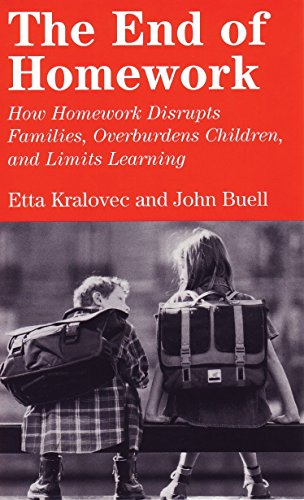
Etta Kralovec and John Buell are educators who dared to challenge one of the most widely accepted practices in American schools. Their provocative argument first published in this book, featured in Time and Newsweek, in numerous women's magazines, on national radio and network television broadcasts, was the first openly to challenge the gospel of "the more homework the better."
Consider:
* In 1901, homework was legally banned in parts of the U.S. There are no studies showing that assigning homework before junior high school improves academic achievement.
* Increasingly, students and their parents are told that homework must take precedence over music lessons, religious education, and family and community activities. As the homework load increases (and studies show it is increasing) these family priorities are neglected.
* Homework is a great discriminator, effectively allowing students whose families "have" to surge ahead of their classmates who may have less.
* Backpacks are literally bone-crushing, sometimes weighing as much as the child. Isn't it obvious we're overburdening our kids?
Die Inhaltsangabe kann sich auf eine andere Ausgabe dieses Titels beziehen.
Über die Autorin bzw. den Autor
Etta Kralovec, a recent Fulbright Fellow, took her Ed.D. from Teachers College, Columbia University. She was a high school teacher for over twelve years and professor of education and director of teacher education at the College of the Atlantic for eleven years.
John Buell, author of Democracy by Other Means and Sustainable Democracy, took his Ph.D. from the University of Massachusetts. He has taught at the College of the Atlantic.
Auszug. © Genehmigter Nachdruck. Alle Rechte vorbehalten.
The End of Homework
How Homework Disrupts Families, Overburdens Children, and Limits LearningBy Etta KralovecBeacon Press
Copyright © 2001 Etta KralovecAll right reserved.
ISBN: 9780807042199
Preface
Beth sits in increasing horror as her daughter's fifth-grade teacherreproaches the class's parents: "Many of the kids have after-schoolactivities like Hebrew school or town soccer league or piano lessons,but you should all remember that homework must alwaystake priority."
Every night Helene dreads coming home to a familiar scene:her fourth-grade daughter sits surrounded by a mess of papers atthe kitchen counter, grumpy or weepy, unable to complete herhomework and making everyone else share her misery.
Bob hardly ever sees his son, a sophomore in high school whodoes an average of four hours of homework a night and also workson the school paper, competes in debate, and manages the schooltrack team?all at his guidance counselor's urging. Greg leaves forschool at 6:30 A.M., rarely gets home before 6:00 P.M., and almostnever joins the family for dinner, since he always has exams to preparefor or papers to write. His weekends are often entirely consumedby meets, debates, and study.
Pat sits in an orthopedic surgeon's waiting room. Her daughter,Anna, has had back pain for quite some time. Pat is convincedthat her daughter's thirty-eight-pound backpack is contributingto her daughter's back problems. Anna is not alone. The AmericanAcademy of Orthopedic Surgeons (A.A.O.S.) reported that thousandsof kids have back, neck, and shoulder pain caused by theirheavy backpacks.
Margie phones her best friend Edna practically every night for"help" on the math homework. She really doesn't get fractions.What she really wants are the answers to the problems, and mostof the time she gets them. Neither girl wants to cheat, but Margiedefinitely will get into trouble if she doesn't turn in the homeworkand Edna just can't say no to her friend.
For the past eight years, we have been writing and speakingabout the problems associated with homework. During this time,we have never ceased to be amazed by the strong initial reaction toour work: "What? Are you crazy? Homework is good for kids,"or, "How can we compete with the Japanese if our kids don't dohomework?" Equally amazing, however, has been the number offolks who eventually come back to us and say, "You're right aboutone thing: homework is making a mess of our family life."
For a number of reasons, we believe that it is time for a publicdiscussion about the place of homework in the daily lives ofschools, children, and families. The topic is central to current debatesabout school reform. Before we abandon the public schoolsystem in favor of some form of privatization, we need to take ahard look at the schooling practices that undermine social life andcontribute to a growing sense of alienation and stress in students,their families, and the larger community.
Life for American families has changed dramatically over thepast twenty years. The requirements and expectations of theworkplace now take up a substantially greater proportion of theadult's day. It's not just the well-documented longer hours but alsothe cell phone, the portable computer, and e-mail that extend theworking day. This phenomenon is an increasingly common topicon talk shows, in news analyses, and at neighborhood barbecues.
Work and schoolwork are part of our system of core values,and they play a vital role in our lives, but they do not define the totalityof those lives. It is entirely legitimate and appropriate periodicallyto question the extent to which even core values shoulddominate our existence. Discussion about reasonable homeworklimits is more than just a debate about education; it provides an entréeinto other core concerns about our civilization.
We live in dread of what might happen if the enormoushomework burden borne by our students and their families wasreduced. We fear falling further behind other nations on certainstandardized tests. We are afraid our kids won't perform wellenough to get into the best colleges. We seem to have lost sight ofthe importance of family and community life.
If parents were no longer held captive by the demands of theirchildren's schools, they could develop their own priorities forfamily life. If students were permitted more freedom to structuretheir own time and to explore their own interests, they would findit much easier to develop both an authentic self and a meaningfulsocial life.
We believe that reform in homework practices is central to apolitics of family and personal liberation. Taking back our homelives will allow us to begin the process of enriching our communitylives. Drawing a clearer line between the school and thehome may enable families to reconstitute themselves as families,and help parents pass on to their children something other thanthe exhaustion of endless work.
Introduction
"There's just too much," Janet whispered to another motherduring soccer practice at their children's elementary school inthe coastal community of Blue Hill, Maine. Later that afternoon,over vegetables at the market, Rosalie asked a friend, "Do youthink they have too much homework?"
The same question was repeated throughout the communityas the amount of homework assigned to the seventh grade keptgrowing. Finally a group of mothers approached the principalabout the issue. Principal Patrick Phillips did what most prudentschool administrators would do: he formed a committee.
Fourteen interested members of the school board and thecommunity at large met to grapple with what a small group ofparents perceived as the "homework problem." Two key issues laybehind the parents' concern. First was the stress experienced bythe middle school students as they tried to balance the demands ofhomework with extracurricular activities and the need for familytime. Second was the inequity inherent in the fact many studentslacked the resources at home to compete on an equal footing withthose of their peers who had computers, highly educated parents,and virtually unlimited funds for school supplies.
The committee members were charged with formulating anew homework policy that would ultimately be presented to theschool board for approval. In late fall 1994, the group identifiedthe major concerns and questions being voiced around town:
What is homework? How much homework is too much?What are and should be the purposes of homework? Can differentassignments be given to different kids in one class? Who is responsiblefor homework?kids or their parents? How is homeworkgraded, scored, or assessed? What about quality versus quantity?How are age and developmental level factored into assignments?Is stress management an issue? How do extracurricular activities?school-sponsoredand family-based?factor in? What's thebest way to deal with students who put extra time into theirwork (i.e., the overachievers)? How are assignments coordinatedamong teachers?
Principal Phillips provided committee members with packetscontaining the homework policies of schools in surroundingcommunities, as well as recommendations from organizationssuch as the National School Boards Association. The real debatebegan at the next meeting, when members reported that...
„Über diesen Titel“ kann sich auf eine andere Ausgabe dieses Titels beziehen.
Suchergebnisse für The End of Homework: How Homework Disrupts Families,...

Beispielbild für diese ISBN
The End of Homework: How Homework Disrupts Families, Overburdens Children, and Limits Learning
Anbieter: World of Books (was SecondSale), Montgomery, IL, USA
Verkäuferbewertung 5 von 5 Sternen

Paperback. Zustand: Good. Etta Kralovec and John Buell are educators who dared to challenge one of the most widely accepted practices in American schools. Their provocative argument first published in this book, featured in Time and Newsweek, in numerous women's magazines, on national radio and network television broadcasts, was the first openly to challenge the gospel of "the more homework the better." Consider: * In 1901, homework was legally banned in parts of the U.S. There are no studies showing that assigning homework before junior high school improves academic achievement. * Increasingly, students and their parents are told that homework must take precedence over music lessons, religious education, and family and community activities. As the homework load increases (and studies show it is increasing) these family priorities are neglected. * Homework is a great discriminator, effectively allowing students whose families "have" to surge ahead of their classmates who may have less. * Backpacks are literally bone-crushing, sometimes weighing as much as the child. Isn't it obvious we're overburdening our kids? Artikel-Nr. 00071910222
Gebraucht kaufen
EUR 4,56
Versand gratis
Versand innerhalb von USA
Versand innerhalb von USA
Anzahl: 2 verfügbar
Beispielbild für diese ISBN
The End of Homework: How Homework Disrupts Families, Overburdens Children, and Limits Learning
Anbieter: World of Books (was SecondSale), Montgomery, IL, USA
Verkäuferbewertung 5 von 5 Sternen
Paperback. Zustand: Fair. Etta Kralovec and John Buell are educators who dared to challenge one of the most widely accepted practices in American schools. Their provocative argument first published in this book, featured in Time and Newsweek, in numerous women's magazines, on national radio and network television broadcasts, was the first openly to challenge the gospel of "the more homework the better." Consider: * In 1901, homework was legally banned in parts of the U.S. There are no studies showing that assigning homework before junior high school improves academic achievement. * Increasingly, students and their parents are told that homework must take precedence over music lessons, religious education, and family and community activities. As the homework load increases (and studies show it is increasing) these family priorities are neglected. * Homework is a great discriminator, effectively allowing students whose families "have" to surge ahead of their classmates who may have less. * Backpacks are literally bone-crushing, sometimes weighing as much as the child. Isn't it obvious we're overburdening our kids? Artikel-Nr. 00098827031
Gebraucht kaufen
EUR 4,56
Versand gratis
Versand innerhalb von USA
Versand innerhalb von USA
Anzahl: 1 verfügbar
Beispielbild für diese ISBN
The End of Homework: How Homework Disrupts Families, Overburdens Children, and Limits Learning
Anbieter: World of Books (was SecondSale), Montgomery, IL, USA
Verkäuferbewertung 5 von 5 Sternen
Paperback. Zustand: Very Good. Etta Kralovec and John Buell are educators who dared to challenge one of the most widely accepted practices in American schools. Their provocative argument first published in this book, featured in Time and Newsweek, in numerous women's magazines, on national radio and network television broadcasts, was the first openly to challenge the gospel of "the more homework the better." Consider: * In 1901, homework was legally banned in parts of the U.S. There are no studies showing that assigning homework before junior high school improves academic achievement. * Increasingly, students and their parents are told that homework must take precedence over music lessons, religious education, and family and community activities. As the homework load increases (and studies show it is increasing) these family priorities are neglected. * Homework is a great discriminator, effectively allowing students whose families "have" to surge ahead of their classmates who may have less. * Backpacks are literally bone-crushing, sometimes weighing as much as the child. Isn't it obvious we're overburdening our kids? Artikel-Nr. 00100152378
Gebraucht kaufen
EUR 4,56
Versand gratis
Versand innerhalb von USA
Versand innerhalb von USA
Anzahl: 1 verfügbar
Beispielbild für diese ISBN
The End of Homework: How Homework Disrupts Families, Overburdens Children, and Limits Learning
Verlag:
Beacon Press (edition ), 2001
ISBN 10: 0807042196
ISBN 13: 9780807042199
Gebraucht
Paperback
Anbieter: BooksRun, Philadelphia, PA, USA
Verkäuferbewertung 5 von 5 Sternen
Paperback. Zustand: Very Good. It's a well-cared-for item that has seen limited use. The item may show minor signs of wear. All the text is legible, with all pages included. It may have slight markings and/or highlighting. Artikel-Nr. 0807042196-11-6
Gebraucht kaufen
EUR 4,57
Versand gratis
Versand innerhalb von USA
Versand innerhalb von USA
Anzahl: 1 verfügbar
Beispielbild für diese ISBN
The End of Homework : How Homework Disrupts Families, Overburdens Children, and Limits Learning
Anbieter: Better World Books, Mishawaka, IN, USA
Verkäuferbewertung 5 von 5 Sternen
Zustand: Good. New Ed. Former library copy. Pages intact with minimal writing/highlighting. The binding may be loose and creased. Dust jackets/supplements are not included. Includes library markings. Stock photo provided. Product includes identifying sticker. Better World Books: Buy Books. Do Good. Artikel-Nr. 12791176-6
Gebraucht kaufen
EUR 6,17
Versand gratis
Versand innerhalb von USA
Versand innerhalb von USA
Anzahl: 1 verfügbar
Beispielbild für diese ISBN
The End of Homework : How Homework Disrupts Families, Overburdens Children, and Limits Learning
Anbieter: Better World Books, Mishawaka, IN, USA
Verkäuferbewertung 5 von 5 Sternen
Zustand: Very Good. New Ed. Pages intact with possible writing/highlighting. Binding strong with minor wear. Dust jackets/supplements may not be included. Stock photo provided. Product includes identifying sticker. Better World Books: Buy Books. Do Good. Artikel-Nr. 3510622-6
Gebraucht kaufen
EUR 6,17
Versand gratis
Versand innerhalb von USA
Versand innerhalb von USA
Anzahl: 1 verfügbar
Beispielbild für diese ISBN
The End of Homework: How Homework Disrupts Families, Overburdens Children, and Limits Learning
Anbieter: WorldofBooks, Goring-By-Sea, WS, Vereinigtes Königreich
Verkäuferbewertung 5 von 5 Sternen
Paperback. Zustand: Very Good. The book has been read, but is in excellent condition. Pages are intact and not marred by notes or highlighting. The spine remains undamaged. Artikel-Nr. GOR005194803
Gebraucht kaufen
EUR 14,65
EUR 6,67 Versand
Versand von Vereinigtes Königreich nach USA
Versand von Vereinigtes Königreich nach USA
Anzahl: 1 verfügbar
Beispielbild für diese ISBN
The End of Homework: How Homework Disrupts Families, Overburdens Children, and Limits Learning
Anbieter: Ria Christie Collections, Uxbridge, Vereinigtes Königreich
Verkäuferbewertung 5 von 5 Sternen
Zustand: New. In English. Artikel-Nr. ria9780807042199_new
Neu kaufen
EUR 30,02
EUR 11,16 Versand
Versand von Vereinigtes Königreich nach USA
Versand von Vereinigtes Königreich nach USA
Anzahl: Mehr als 20 verfügbar
Beispielbild für diese ISBN
The End of Homework: How Homework Disrupts Families, Overburdens Children, and Limits Learning
Anbieter: Revaluation Books, Exeter, Vereinigtes Königreich
Verkäuferbewertung 5 von 5 Sternen
Paperback. Zustand: Brand New. 136 pages. 8.50x5.25x0.50 inches. In Stock. Artikel-Nr. x-0807042196
Neu kaufen
EUR 32,97
EUR 11,91 Versand
Versand von Vereinigtes Königreich nach USA
Versand von Vereinigtes Königreich nach USA
Anzahl: 2 verfügbar
Beispielbild für diese ISBN
The End Of Homework
Anbieter: SZ Global, Toronto, ON, Kanada
Verkäuferbewertung 5 von 5 Sternen
Paperback. Zustand: New. Etta Kralovec and John Buell are educators who dared to challenge one of the most widely accepted practices in American schools. Their provocative argument first published in this book, featured inTimeandNewsweek,in numerous women's magazines, on national radio and network television broadcasts, was the first openly to challenge the gospel of 'the more homework the better.' Consider: * In 1901, homework was legally banned in parts of the U.S. There are no studies showing that assigning homework before junior high school improves academic achievement. * Increasingly, students and their parents are told that homework must take precedence over music lessons, religious education, and family and community activities. As the homework load increases (and studies show it is increasing) these family priorities are neglected. * Homework is a great discriminator, effectively allowing students whose families 'have' to surge ahead of their classmates who may have less. * Backpacks are literally bone-crushing, sometimes weighing as much as the child. Isn't it obvious we're overburdening our kids? Artikel-Nr. 9780807042199
Neu kaufen
EUR 25,11
EUR 34,04 Versand
Versand von Kanada nach USA
Versand von Kanada nach USA
Anzahl: 1 verfügbar