
Verwandte Artikel zu The Measure of our Success: A Letter to My Children...
Inhaltsangabe
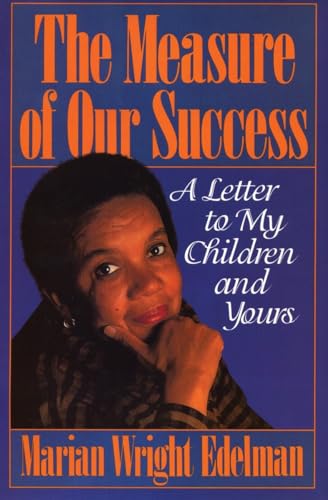
The number one New York Times bestseller—from the founder and president of the Children's Defense Fund
"This book is from the heart of a woman who practices each lesson she preaches."—Hillary Clinton
The Measure of Our Success is a compassionate message for parents trying to raise moral children, a tough and searching book that ought to be required reading for everyone.
Edelman speaks powerfully to her three sons about the mothering she gave them—mothering, she explains, that could not ignore other people's children who were in greater need.
In the book's centerpiece, "Twenty-Five Lessons for Life," we're invited to listen as a loving and extraordinarily committed mother gives her children lessons to live by.
The Measure of Our Success is an open letter to all America, and remains a timely message of hope and purpose for everyone.
Die Inhaltsangabe kann sich auf eine andere Ausgabe dieses Titels beziehen.
Über die Autorin bzw. den Autor
Marian Wright Edelman, civil rights activist, lawyer and author, is the founder of the Children’s Defense Fund which has sought to bring the plight of children to the attention of policy mkers and the public, and has been a vigorous advocate for the creation and funding of programs to improve children’s lives for over twenty years.
Auszug. © Genehmigter Nachdruck. Alle Rechte vorbehalten.
The Measure of Our Success
A Letter to My Children and YoursBy Marian Wright EdelmanBeacon Press
Copyright ©1992 Marian Wright EdelmanAll right reserved.
ISBN: 080703102X
Part One
A Family Legacy
South Carolina is my home state and I am the aunt, granddaughter, daughter, and sister of Baptist ministers. Service was as essential a part of my upbringing as eating and sleeping and going to school. The church was a hub of Black children's social existence, and caring Black adults were buffers against the segregated and hostile outside world that told us we weren't important. But our parents said it wasn't so, our teachers said it wasn't so, and our preachers said it wasn't so. The message of my racially segregated childhood was clear: let no man or woman look down on you, and look down on no man or woman.
We couldn't play in public playgrounds or sit at drugstore lunch counters and order a Coke, so Daddy built a playground and canteen behind the church. In fact, whenever he saw a need, he tried to respond. There were no Black homes for the aged in Bennettsville, so he began one across the street for which he and Mama and we children cooked and served and cleaned. And we children learned that it was our responsibility to take care of elderly family members and neighbors, and that everyone was our neighbor. My mother carried on the home after Daddy died, and my brother Julian has carried it on to this day behind our church since our mother's death in 1984.
Finding another child in my room or a pair of my shoes gone was far from unusual, and twelve foster children followed my sister and me and three brothers as we left home.
Child-rearing and parental work were inseparable. I went everywhere with my parents and was under the watchful eye of members of the congregation and community who were my extended parents. They kept me when my parents went out of town, they reported on and chided me when I strayed from the straight and narrow of community expectations, and they basked in and supported my achievements when I did well. Doing well, they made clear, meant high academic achievement, playing piano in Sunday school or singing or participating in other church activities, being helpful to somebody, displaying good manners (which is nothing more than consideration toward others), and reading. My sister Olive reminded me recently that the only time our father would not give us a chore ("Can't you find something constructive to do?" was his most common refrain) was when we were reading. So we all read a lot! We learned early what our parents and extended community "parents" valued. Children were taught--not by sermonizing, but by personal example--that nothing was too lowly to do. I remember a debate my parents had when I was eight or nine as to whether I was too young to go with my older brother, Harry, to help clean the bed and bedsores of a very sick, poor woman. I went and learned just how much the smallest helping hands and kindness can mean to a person in need.
The ugly external voices of my small-town, segregated childhood (as a very young child I remember standing and hearing former South Carolina Senator James Byrnes railing on the local courthouse lawn about how Black children would never go to school with whites) were tempered by the internal voices of parental and community expectation and pride. My father and I waited anxiously for the Brown v. Board of Education decision in 1954. We talked about it and what it would mean for my future and for the future of millions of other Black children. He died the week before Brown was decided. But I and other children lucky enough to have caring and courageous parents and other adult role models were able, in later years, to walk through the new and heavy doors that Brown slowly and painfully opened--doors that some are trying to close again today.
The adults in our churches and community made children feel valued and important. They took time and paid attention to us. They struggled to find ways to keep us busy. And while life was often hard and resources scarce, we always knew who we were and that the measure of our worth was inside our heads and hearts and not outside in our possessions or on our backs. We were told that the world had a lot of problems; that Black people had an extra lot of problems, but that we were able and obligated to struggle and change them; that being poor was no excuse for not achieving; and that extra intellectual and material gifts brought with them the privilege and responsibility of sharing with others less fortunate. In sum, we learned that service is the rent we pay for living. It is the very purpose of life and not something you do in your spare time.
When my mother died, an old white man in my hometown of Bennettsville asked me what I do. In a flash I realized that in my work at the Children's Defense Fund I do exactly what my parents did--just on a different scale. My brother preached a wonderful sermon at Mama's funeral, but the best tribute was the presence in the back pew of the town drunk, whom an observer said he could not remember coming to church in many years.
The legacies that parents and church and teachers left to my generation of Black children were priceless but not material: a living faith reflected in daily service, the discipline of hard work and stick-to-it-ness, and a capacity to struggle in the face of adversity. Giving up and "burnout" were not part of the language of my elders--you got up every morning and you did what you had to do and you got up every time you fell down and tried as many times as you had to to get it done right. They had grit. They valued family life, family rituals, and tried to be and to expose us to good role models.Continues...
Continues...
Excerpted from The Measure of Our Successby Marian Wright Edelman Copyright ©1992 by Marian Wright Edelman. Excerpted by permission.
All rights reserved. No part of this excerpt may be reproduced or reprinted without permission in writing from the publisher.
Excerpts are provided by Dial-A-Book Inc. solely for the personal use of visitors to this web site.
„Über diesen Titel“ kann sich auf eine andere Ausgabe dieses Titels beziehen.
Suchergebnisse für The Measure of our Success: A Letter to My Children...

Beispielbild für diese ISBN
The Measure of our Success: A Letter to My Children and Yours
Anbieter: World of Books (was SecondSale), Montgomery, IL, USA
Verkäuferbewertung 5 von 5 Sternen

Hardback. Zustand: Fair. The number one New York Times bestseller--from the founder and president of the Children's Defense Fund "This book is from the heart of a woman who practices each lesson she preaches."--Hillary Clinton The Measure of Our Success is a compassionate message for parents trying to raise moral children, a tough and searching book that ought to be required reading for everyone. Edelman speaks powerfully to her three sons about the mothering she gave them--mothering, she explains, that could not ignore other people's children who were in greater need. In the book's centerpiece, "Twenty-Five Lessons for Life," we're invited to listen as a loving and extraordinarily committed mother gives her children lessons to live by. The Measure of Our Success is an open letter to all America, and remains a timely message of hope and purpose for everyone. Artikel-Nr. 00097070958
Gebraucht kaufen
EUR 4,04
Versand gratis
Versand innerhalb von USA
Versand innerhalb von USA
Anzahl: 3 verfügbar
Beispielbild für diese ISBN
The Measure of our Success: A Letter to My Children and Yours
Anbieter: World of Books (was SecondSale), Montgomery, IL, USA
Verkäuferbewertung 5 von 5 Sternen
Hardback. Zustand: Good. The number one New York Times bestseller--from the founder and president of the Children's Defense Fund "This book is from the heart of a woman who practices each lesson she preaches."--Hillary Clinton The Measure of Our Success is a compassionate message for parents trying to raise moral children, a tough and searching book that ought to be required reading for everyone. Edelman speaks powerfully to her three sons about the mothering she gave them--mothering, she explains, that could not ignore other people's children who were in greater need. In the book's centerpiece, "Twenty-Five Lessons for Life," we're invited to listen as a loving and extraordinarily committed mother gives her children lessons to live by. The Measure of Our Success is an open letter to all America, and remains a timely message of hope and purpose for everyone. Artikel-Nr. 00035833683
Gebraucht kaufen
EUR 4,04
Versand gratis
Versand innerhalb von USA
Versand innerhalb von USA
Anzahl: Mehr als 20 verfügbar
Beispielbild für diese ISBN
The Measure of our Success: A Letter to My Children and Yours
Anbieter: World of Books (was SecondSale), Montgomery, IL, USA
Verkäuferbewertung 5 von 5 Sternen
Hardback. Zustand: Very Good. The number one New York Times bestseller--from the founder and president of the Children's Defense Fund "This book is from the heart of a woman who practices each lesson she preaches."--Hillary Clinton The Measure of Our Success is a compassionate message for parents trying to raise moral children, a tough and searching book that ought to be required reading for everyone. Edelman speaks powerfully to her three sons about the mothering she gave them--mothering, she explains, that could not ignore other people's children who were in greater need. In the book's centerpiece, "Twenty-Five Lessons for Life," we're invited to listen as a loving and extraordinarily committed mother gives her children lessons to live by. The Measure of Our Success is an open letter to all America, and remains a timely message of hope and purpose for everyone. Artikel-Nr. 00105800129
Gebraucht kaufen
EUR 4,04
Versand gratis
Versand innerhalb von USA
Versand innerhalb von USA
Anzahl: 3 verfügbar
Beispielbild für diese ISBN
The Measure of our Success: A Letter to My Children and Yours
Verlag:
Beacon Press (edition Underlining/Highlighting), 1992
ISBN 10: 080703102X
ISBN 13: 9780807031025
Gebraucht
Hardcover
Anbieter: BooksRun, Philadelphia, PA, USA
Verkäuferbewertung 5 von 5 Sternen
Hardcover. Zustand: Very Good. Underlining/Highlighting. With dust jacket. It's a well-cared-for item that has seen limited use. The item may show minor signs of wear. All the text is legible, with all pages included. It may have slight markings and/or highlighting. Artikel-Nr. 080703102X-11-1-29
Gebraucht kaufen
EUR 5,00
Versand gratis
Versand innerhalb von USA
Versand innerhalb von USA
Anzahl: 4 verfügbar
Beispielbild für diese ISBN
The Measure of our Success: A Letter to My Children and Yours
Anbieter: ThriftBooks-Reno, Reno, NV, USA
Verkäuferbewertung 5 von 5 Sternen
Hardcover. Zustand: As New. No Jacket. Pages are clean and are not marred by notes or folds of any kind. ~ ThriftBooks: Read More, Spend Less. Artikel-Nr. G080703102XI2N00
Gebraucht kaufen
EUR 5,96
Versand gratis
Versand innerhalb von USA
Versand innerhalb von USA
Anzahl: 1 verfügbar
Beispielbild für diese ISBN
The Measure of our Success: A Letter to My Children and Yours
Anbieter: ThriftBooks-Dallas, Dallas, TX, USA
Verkäuferbewertung 5 von 5 Sternen
Hardcover. Zustand: As New. No Jacket. Pages are clean and are not marred by notes or folds of any kind. ~ ThriftBooks: Read More, Spend Less. Artikel-Nr. G080703102XI2N00
Gebraucht kaufen
EUR 5,96
Versand gratis
Versand innerhalb von USA
Versand innerhalb von USA
Anzahl: 2 verfügbar
Beispielbild für diese ISBN
The Measure of our Success: A Letter to My Children and Yours
Anbieter: ThriftBooks-Atlanta, AUSTELL, GA, USA
Verkäuferbewertung 5 von 5 Sternen
Hardcover. Zustand: As New. No Jacket. Pages are clean and are not marred by notes or folds of any kind. ~ ThriftBooks: Read More, Spend Less. Artikel-Nr. G080703102XI2N00
Gebraucht kaufen
EUR 5,96
Versand gratis
Versand innerhalb von USA
Versand innerhalb von USA
Anzahl: 1 verfügbar
Beispielbild für diese ISBN
The Measure of our Success: A Letter to My Children and Yours
Anbieter: ThriftBooks-Phoenix, Phoenix, AZ, USA
Verkäuferbewertung 5 von 5 Sternen
Hardcover. Zustand: As New. No Jacket. Pages are clean and are not marred by notes or folds of any kind. ~ ThriftBooks: Read More, Spend Less. Artikel-Nr. G080703102XI2N00
Gebraucht kaufen
EUR 5,96
Versand gratis
Versand innerhalb von USA
Versand innerhalb von USA
Anzahl: 1 verfügbar
Beispielbild für diese ISBN
The Measure of Our Success: A Letter to My Children and Yours
Anbieter: Wonder Book, Frederick, MD, USA
Verkäuferbewertung 5 von 5 Sternen
Zustand: As New. Like New condition. Like New dust jacket. A near perfect copy that may have very minor cosmetic defects. Artikel-Nr. F27B-02860
Gebraucht kaufen
EUR 6,43
Versand gratis
Versand innerhalb von USA
Versand innerhalb von USA
Anzahl: 1 verfügbar
Beispielbild für diese ISBN
The Measure of Our Success: A Letter to My Children and Yours
Anbieter: Wonder Book, Frederick, MD, USA
Verkäuferbewertung 5 von 5 Sternen
Zustand: Very Good. Very Good condition. Very Good dust jacket. A copy that may have a few cosmetic defects. May also contain light spine creasing or a few markings such as an owner's name, short gifter's inscription or light stamp. Artikel-Nr. Y13A-02857
Gebraucht kaufen
EUR 6,43
Versand gratis
Versand innerhalb von USA
Versand innerhalb von USA
Anzahl: 3 verfügbar