
Verwandte Artikel zu Cheating Justice: How Bush and Cheney Attacked the...
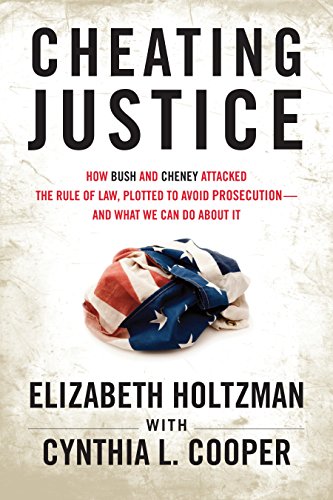
Cheating Justice: How Bush and Cheney Attacked the Rule of Law and Plotted to Avoid Prosecution- and What We Can Do about It - Hardcover
Inhaltsangabe
While the debate continues about impeaching President Trump, whether we're in a full blown Constitutional crisit, and which Trump administration officials should be prosecuted for illegal actions, Cheating Justice serves as useful background for how we got here by examining how the Bush-Cheney administration broke the law—and how the people can bring them to justice.
Despite the many misdeeds of and abuses of criminal law by the Bush administration, there has been no accountability. Former U.S. representative Elizabeth Holtzman pairs with lawyer and journalist Cynthia L. Cooper to explain why we can’t “just move on.” They lay bare how the Bush-Cheney administration broke a multitude of laws and betrayed American values, and exactly why and precisely how we, the people, must bring them to justice for their crimes, their cover-ups, and their deceit.
Backed by strong evidence gleaned from “astounding”* research, Holtzman and Cooper argue that the Bush administration not only violated various U.S. laws but also changed many laws to escape prosecution for their crimes later. The authors demonstrate how a failure to hold George W. Bush and Dick Cheney accountable would set a dangerous precedent for the future leadership of America.
Bush and Cheney deceived Congress and the people to drive us into a war in Iraq; they claimed the right to wiretap illegally and to eavesdrop on citizens; and they authorized torture, upending laws and breaching international treaty obligations. Yet, both Bush and Cheney are boldly unabashed about their offenses. In his memoir, President Bush makes no apologies for his decision to start a war in Iraq, though no weapons of mass destruction, the ostensible reason for the war, were found there. And once out of office, Bush proudly said, “Damn right,” about his approval of waterboarding, a clear violation of the Geneva Conventions and U.S. law. Recent revelations about the extent and depth of their crimes, catalogued in detail here, make the need for accountability imperative.
As a member of Congress and part of the committee that investigated and held hearings on the conduct of President Richard Nixon in the Watergate scandal, Elizabeth Holtzman condemns Bush’s adoption of Nixon’s claim that he acted in the interest of national security. Using Watergate-era reforms as a model, Holtzman details the steps necessary to undo the damage that the Bush-Cheney administration inflicted and explains how we can establish new protections to block future presidents from similarly abusing the law. Cheating Justice is not only a call to empower the American people, and a firm insistence that the nation’s leaders are not above the law; it is also a blueprint by one of America’s top legal minds for bringing Bush to justice and protecting the future of our democracy.
*Publishers Weekly
Die Inhaltsangabe kann sich auf eine andere Ausgabe dieses Titels beziehen.
Über die Autorin bzw. den Autor
Elizabeth Holtzman is a practicing lawyer in New York and a former U.S. congresswoman.
Cynthia L. Cooper is a journalist and former practicing lawyer.
Auszug. © Genehmigter Nachdruck. Alle Rechte vorbehalten.
From the Introduction: Why We Shouldn’t Simply Move on
Before President George W. Bush left office, many people speculated that he would pardon himself as protection against possible future prosecution for crimes. People assumed he would do the same for Vice President Richard B. Cheney and his top cabinet officials, advisors, and aides. There was a good deal of discussion on cable TV news, blogs, opinion columns, and political talk shows: How extensive is the pardon power? Had self- pardons been tried before? When would it happen?
“In Bush Final Days, Are Pardons in the Works?” asked NPR’s All Things Considered on November 23, 2008. “Will Bush Pardon Himself ?” wrote Human Rights Watch director Kenneth Roth in the Daily Beast. “Get ready for mass pardons,” headlined a pundit in the Hill’s blog.
The president did nothing of the sort. Instead, he retired without a seeming ruffle of tension, helicoptering out of Washington, D.C., and heading to a new home in a Dallas suburb and his ranch in Crawford, Texas. When he publicly emerged, two years later, he was touting a newly published memoir, and proudly proclaiming that he had approved a form of torture, waterboarding—“Damn right,” he said in his memoir, Decision Points. The former president had no apologies for starting a war in Iraq that had taken the lives of thousands and ruined many more: he thought the world was better off for it, even though no weapons of mass destruction, his ostensible reason for the war, were found in Iraq.
The vice president didn’t even wait for his term of office to end before he started burnishing his role in waterboarding, war, and warrantless surveillance. “Those who allege that we’ve been involved in torture or that somehow we violated the Constitution or laws with the terrorist surveillance program simply don’t know what they’re talking about,” he said in an ABC News interview on December 15, 2008.
Neither seemed perturbed by the prospect of prosecution. Now we know why.
While in office, they had already created walls of protection to prevent the sting of the law from reaching them. Behind the scenes, President Bush and Vice President Cheney worked—tirelessly, it seems—to inoculate themselves against every manner and form of accountability for misdeeds.
They passed provisions changing the laws that they had violated, then giving the changes retroactive application. They made existing laws so convoluted and confusing that probably no prosecutor could enforce them. E-mails in their computers conveniently disappeared, and the retention systems failed. They stamped “state secrets” on legal actions that might open their misdeeds to scrutiny. They set up straw facades and fake justifications, and even slipped them in the law as pop-up defenses.
In short, in an unprecedented way in American history, they engineered and fixed the system from the inside, building buffers of protection for themselves—behind a moat, on a hill, locked and gated, seemingly above the law. This book explores how the Bush administration used its power to manipulate the system, cheat justice, and get away with crimes.
Except . . . they had a lot of ground to cover. Their transgressions were so vast that they left open some small keyholes where the law can still reach them. This book is also about how to hold them accountable for the crimes they committed.
In the years since they departed, more information has emerged about their actions—documents have been declassified, investigative reporters and authors have probed, nonprofit groups have filed Freedom of Information actions; in some areas, Congress has conducted inquiries. Former White House personnel have stepped forward; whistleblowers have revealed secrets and leaked documents; lawsuits have pried open hidden truths. Bit by bit, the record is unfolding. The president and vice president have even incriminated themselves.
This book describes the multifarious ways in which President Bush and his team violated America’s criminal laws and the sophisticated counter- measures they took to avoid being held liable for these violations. Showing a breathtaking contempt for the rule of law, they disregarded laws that got in their way and, when exposed, rushed to Congress to push through a rewritten version of those laws to their specifications to get off the hook. They did this while much of the nation was still absorbing and rebounding from the attacks of 9/11.
Understanding the depth of their crimes highlights one thing—it is even more important for our democracy that we refuse to let them get away with it.
A president and vice president who have committed serious misdeeds in office must be held accountable. Fortunately, this is a situation that the framers of the Constitution anticipated. The founders were wise enough to know that presidents would be fallible and, as such, might commit a variety of crimes. The presidency, the founders knew, was not always going to be held by people who did the right thing or acted honorably; they explicitly provided for impeachment while presidents held office and prosecution of presidents after they left office, too.
Thus far, President Bush, Vice President Cheney, and their team seem to have gotten away with their misdeeds. Their motto seems to be “Catch me if you can,” and they remain unindicted, unprosecuted, and unaccountable.
Why do we need accountability at all? To ignore the misdeeds of the president and vice president is to signal to the American people that their crimes are of no importance. To give them a free pass for their illegal activities and violations is to send a message to future presidents—do what you will break any law, don’t worry. To turn our backs and look away is to say that we, the people, are oblivious, blinded, unaware of their deceits and destruction—or, worse yet, that we are nodding in agreement and giving our consent. Without strong action holding them responsible, the precedent of a runaway lawless administration will continue to haunt us. Have we celebrated 220 years of our Constitution to reach a point where, like a banana republic, our highest elected leaders can engage in crimes of illegal surveillance, lying to take the nation into war, torture, disappearance and degradation with impunity? Let’s hope not. Failing to hold the most powerful among us accountable is the sign of a democracy that is losing its way.
In order for a movement for accountability to rise and for the sake of generations to follow, it’s important to say that some of us were not blind, that some of us were willing to act.
It may be a difficult path to follow, but the alternative is more difficult to imagine—an America without accountability and justice.
The Bush-Cheney Administration: Disaster for Democracy
As someone who witnessed Watergate up close—I was on the House Judiciary Committee that voted for the articles of impeachment against President Richard Nixon in 1973—I became increasingly concerned about...
„Über diesen Titel“ kann sich auf eine andere Ausgabe dieses Titels beziehen.
Suchergebnisse für Cheating Justice: How Bush and Cheney Attacked the...

Beispielbild für diese ISBN
Cheating Justice : How Bush and Cheney Attacked the Rule of Law and Plotted to Avoid Prosecution- and What We Can Do about It
Anbieter: Better World Books, Mishawaka, IN, USA
Verkäuferbewertung 5 von 5 Sternen

Zustand: Good. Former library copy. Pages intact with minimal writing/highlighting. The binding may be loose and creased. Dust jackets/supplements are not included. Includes library markings. Stock photo provided. Product includes identifying sticker. Better World Books: Buy Books. Do Good. Artikel-Nr. GRP94913201
Gebraucht kaufen
EUR 6,05
Versand gratis
Versand innerhalb von USA
Versand innerhalb von USA
Anzahl: 1 verfügbar
Beispielbild für diese ISBN
Cheating Justice : How Bush and Cheney Attacked the Rule of Law and Plotted to Avoid Prosecution- and What We Can Do about It
Anbieter: Better World Books, Mishawaka, IN, USA
Verkäuferbewertung 5 von 5 Sternen
Zustand: Good. Pages intact with minimal writing/highlighting. The binding may be loose and creased. Dust jackets/supplements are not included. Stock photo provided. Product includes identifying sticker. Better World Books: Buy Books. Do Good. Artikel-Nr. 8285819-6
Gebraucht kaufen
EUR 6,05
Versand gratis
Versand innerhalb von USA
Versand innerhalb von USA
Anzahl: 1 verfügbar
Beispielbild für diese ISBN
Cheating Justice: How Bush and Cheney Attacked the Rule of Law and Plotted to Avoid Prosecution- and What We Can Do about It
Anbieter: Wonder Book, Frederick, MD, USA
Verkäuferbewertung 5 von 5 Sternen
Zustand: As New. Like New condition. Like New dust jacket. A near perfect copy that may have very minor cosmetic defects. Artikel-Nr. Q14F-00674
Gebraucht kaufen
EUR 6,28
Versand gratis
Versand innerhalb von USA
Versand innerhalb von USA
Anzahl: 1 verfügbar
Beispielbild für diese ISBN
Cheating Justice: How Bush and Cheney Attacked the Rule of Law and Plotted to Avoid Prosecution- and What We Can Do about It
Anbieter: Wonder Book, Frederick, MD, USA
Verkäuferbewertung 5 von 5 Sternen
Zustand: Very Good. Very Good condition. Very Good dust jacket. A copy that may have a few cosmetic defects. May also contain light spine creasing or a few markings such as an owner's name, short gifter's inscription or light stamp. Artikel-Nr. L14C-08030
Gebraucht kaufen
EUR 6,28
Versand gratis
Versand innerhalb von USA
Versand innerhalb von USA
Anzahl: 1 verfügbar
Beispielbild für diese ISBN
Cheating Justice: How Bush and Cheney Attacked the Rule of Law and Plotted to Avoid Prosecution- And What We Can Do about It
Anbieter: ThriftBooks-Dallas, Dallas, TX, USA
Verkäuferbewertung 5 von 5 Sternen
Hardcover. Zustand: Very Good. No Jacket. May have limited writing in cover pages. Pages are unmarked. ~ ThriftBooks: Read More, Spend Less. Artikel-Nr. G0807003212I4N00
Gebraucht kaufen
EUR 7,17
Versand gratis
Versand innerhalb von USA
Versand innerhalb von USA
Anzahl: 1 verfügbar
Beispielbild für diese ISBN
Cheating Justice: How Bush and Cheney Attacked the Rule of Law and Plotted to Avoid Prosecution- And What We Can Do about It
Anbieter: ThriftBooks-Dallas, Dallas, TX, USA
Verkäuferbewertung 5 von 5 Sternen
Hardcover. Zustand: Good. No Jacket. Missing dust jacket; Pages can have notes/highlighting. Spine may show signs of wear. ~ ThriftBooks: Read More, Spend Less. Artikel-Nr. G0807003212I3N01
Gebraucht kaufen
EUR 7,17
Versand gratis
Versand innerhalb von USA
Versand innerhalb von USA
Anzahl: 1 verfügbar
Foto des Verkäufers
Cheating Justice: How Bush and Cheney Attacked the Rule of Law and Plotted to Avoid Prosecution- and What We Can Do about It
Verlag:
Beacon Press, 2012
ISBN 10: 0807003212
ISBN 13: 9780807003213
Gebraucht
Hardcover
Erstausgabe
Signiert
Anbieter: Southampton Books, Sag Harbor, NY, USA
Verkäuferbewertung 5 von 5 Sternen
Hardcover. Zustand: Like New. First Edition. First Edition, First Printing. Published by Beacon Press, 2012. Octavo. Hardcover. Book is like new. Dust jacket is like new. Signed and inscribed by author on flyleaf. Artikel-Nr. 532251
Gebraucht kaufen
EUR 8,98
EUR 4,35 Versand
Versand innerhalb von USA
Versand innerhalb von USA
Anzahl: 1 verfügbar
Beispielbild für diese ISBN
Cheating Justice: How Bush and Cheney Attacked the Rule of Law, Plotted to Avoid Prosecution, and What We Can Do about It: How Bush and Cheney . . Prosecution- and What We Can Do about It
Anbieter: Pearlydewdrops, Streat, Vereinigtes Königreich
Verkäuferbewertung 5 von 5 Sternen
hardcover. Zustand: Very Good. New and unread, however has a moderate amount of edge wear as well as slight creasig and tearing Shipped from the UK within 2 business days of order being placed. Artikel-Nr. mon0000237772
Gebraucht kaufen
EUR 13,50
EUR 25,66 Versand
Versand von Vereinigtes Königreich nach USA
Versand von Vereinigtes Königreich nach USA
Anzahl: 2 verfügbar