
Verwandte Artikel zu Sacred Trash: The Lost and Found World of the Cairo...
Sacred Trash: The Lost and Found World of the Cairo Geniza (Jewish Encounters Series) - Hardcover
Buch 1 von 17: Jewish Encounters Series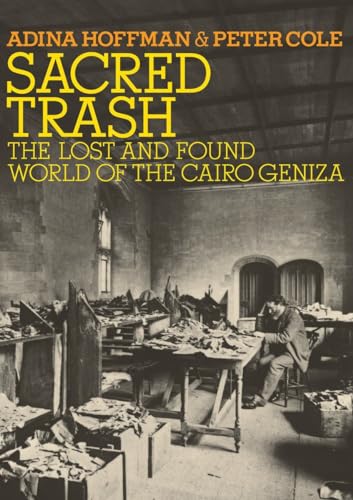
Inhaltsangabe
NATIONAL JEWISH BOOK AWARD FINALIST
Part of the Jewish Encounter series
One May day in 1896, at a dining-room table in Cambridge, England, a meeting took place between a Romanian-born maverick Jewish intellectual and twin learned Presbyterian Scotswomen, who had assembled to inspect several pieces of rag paper and parchment. It was the unlikely start to what would prove a remarkable, continent-hopping, century-crossing saga, and one that in many ways has revolutionized our sense of what it means to lead a Jewish life.
In Sacred Trash, MacArthur-winning poet and translator Peter Cole and acclaimed essayist Adina Hoffman tell the story of the retrieval from an Egyptian geniza, or repository for worn-out texts, of the most vital cache of Jewish manuscripts ever discovered. This tale of buried scholarly treasure weaves together unforgettable portraits of Solomon Schechter and the other heroes of this drama with explorations of the medieval documents themselves—letters and poems, wills and marriage contracts, Bibles, money orders, fiery dissenting tracts, fashion-conscious trousseaux lists, prescriptions, petitions, and mysterious magical charms. Presenting a panoramic view of nine hundred years of vibrant Mediterranean Judaism, Hoffman and Cole bring modern readers into the heart of this little-known trove, whose contents have rightly been dubbed “the Living Sea Scrolls.” Part biography and part meditation on the supreme value the Jewish people has long placed on the written word, Sacred Trash is above all a gripping tale of adventure and redemption.
Die Inhaltsangabe kann sich auf eine andere Ausgabe dieses Titels beziehen.
Über die Autorin bzw. den Autor
Adina Hoffman is the author of House of Windows: Portraits from a Jerusalem Neighborhood and My Happiness Bears No Relation to Happiness: A Poet’s Life in the Palestinian Century, which was named a best book of 2009 by the Barnes & Noble Review.
Peter Cole’s most recent book of poems is Things on Which I’ve Stumbled. His many volumes of award-winning translations include The Dream of the Poem: Hebrew Poetry from Muslim and Christian Spain, 950––1492. He was named a MacArthur Fellow in 2007.
Hoffman and Cole live, together, in Jerusalem and New Haven.
Auszug. © Genehmigter Nachdruck. Alle Rechte vorbehalten.
1
Hidden Wisdom
Cambridge, May 1896
When the self-taught Scottish scholar of Arabic and Syriac Agnes Lewis and her no-less-learned twin sister, Margaret Gibson, hurried down a street or a hallway, they moved—as a friend later described them—“like ships in full sail.” Their plump frames, thick lips, and slightly hawkish eyes made them, theoretically, identical. And both were rather vain about their dainty hands, which on special occasions they “weighed down with antique rings.” In a poignant and peculiar coincidence, each of the sisters had been widowed after just a few years of happy marriage to a clergyman.
But Mrs. Lewis and Mrs. Gibson were distinct to those who knew them. Older by an entire twenty minutes, Agnes was the more ambitious, colorful, and domineering of the two; Margaret had a quieter intelligence and was, it was said, “more normal.” By age fifty, Agnes had written three travel books and three novels, and had translated a tourist guide from the Greek; Margaret had contributed amply to and probably helped write her sister’s nonfiction books, edited her husband’s translation of Cervantes’ Journey to Parnassus, and grown adept at watercolors. They were, meanwhile, exceptionally close—around Cambridge they came to be known as a single unit, the “Giblews”—and after the deaths of their husbands they devoted themselves and their sizable inheritance to a life of travel and study together.
This followed quite naturally from the maverick manner in which they’d been raised in a small town near Glasgow by their forward-thinking lawyer father, a widower, who subscribed to an educational philosophy that was equal parts Bohemian and Calvinist—as far-out as it was firm. Eschewing the fashion for treating girls’ minds like fine china, he assumed his daughters were made of tougher stuff and schooled them as though they were sons, teaching them to think for themselves, to argue and ride horses. Perhaps most important, he had instilled in them early on a passion for philology, promising them that they could travel to any country on condition that they first learned its language. French, Spanish, German, and Italian followed, as did childhood trips around the Continent. He also encouraged the girls’ nearly familial friendship with their church’s progressive and intellectually daring young preacher, who had once been a protégé of the opium-eating Romantic essayist Thomas de Quincy.
After their father’s sudden death when they were twenty-three, Agnes and Margaret sought consolation in strange alphabets and in travel to still more distant climes: Egypt, Palestine, Greece, and Cyprus. By middle age they had learned, between them, some nine languages—adding to their European repertoire Hebrew, Persian, and Syriac written in Estrangelo script. Having also studied the latest photographic techniques, they journeyed extensively throughout the East, taking thousands of pictures of ancient manuscript pages and buying piles of others, the most interesting of which they then set out to transcribe and translate.
As women, and as devout (not to mention eccentric and notoriously party-throwing) Presbyterians, they lived and worked on the margins of mostly Anglican, male-centered Cambridge society—women were not granted degrees at the town’s illustrious university until 1948—and they counted as their closest friends a whole host of Quakers, freethinkers, and Jews. Yet Agnes’s 1892 discovery at St. Catherine’s Monastery in Sinai of one of the oldest Syriac versions of the New Testament had brought the sisters respect in learned circles: their multiple books on the subject ranged from the strictly scholarly A Translation of the Four Gospels from the Syriac of the Sinai Palimpsest to the more talky and popular How the Codex Was Found. Somehow the rumor spread that Mrs. Lewis had just happened to recognize a fragment of the ancient manuscript in the monastery dining hall, where it was being used as a butter dish. In fact, the codex was kept under tight lock and key, and its very fragile condition—to say nothing of its sacred status—certainly precluded its use by the monks as mere tableware. It took serious erudition and diplomacy for the twins to gain access to the manuscript in the monastery library; they then worked painstakingly over a period of years to decode the codex, as it were. “The leaves,” wrote Agnes, “are deeply stained, and in parts ready to crumble. One and all of them were glued together, until the librarian of the Convent and I separated them with our fingers.” She and Margaret proceeded to photograph each of its 358 pages and, on their return to Cambridge, processed the film themselves and labored over the text’s decipherment. Later they arranged for an expedition of several distinguished Cambridge scholars to travel with them to Sinai, where they worked as a team, transcribing the codex as a whole.
All these far-flung intellectual adventures had been exciting but also exhausting. And although the twins had resolved to spend a quiet season in Cambridge, immersed in the proofs of the various texts they had lately copied from manuscript, they set out in the early spring of 1896 on still another Middle Eastern trip—their third in almost as many years—bound for Palestine and Egypt. The reason for the journey was reported later in what sounds like deliberately vague terms: “News we received from Cairo,” Agnes wrote enigmatically, “seemed to indicate that there might be some chance of our finding something there.” Weary as they were from their previous travels, they had not been eager to take this particular trip, “and yet,” as she would admit in retrospect, “it had not been the least fruitful in results.”
This understatement was typical of Agnes, and gives little sense of the startling events that had come to pass one historic May day in 1896, soon after the twins’ return. Suffering from what her sister, Margaret, described as “a severe rheumatic illness, caused by undue exposure on the night when we had lost our tents in the valley of Elah,” Agnes had decided that morning to stretch her legs. While out strolling in downtown Cambridge, she was especially glad to bump into a good friend— and, strangely, another twin who also took great pride in his beautiful hands—the Romanian-born Talmud scholar, Solomon Schechter.
Even more of an oddball in the donnish context of Cambridge than Agnes and Margaret, the very Jewish, very blustery Schechter must, too, have cut a remarkable figure as he strode down King’s Parade. With his bushy, red-tinted beard, unruly hair, and tendency to gesticulate broadly as he spoke, Schechter had been known to set off in the broiling heat of midsummer wrapped up in a winter coat and several yards of scarf. An acquaintance remembered first meeting Schechter, with “his dirty black coat, smudged all over with snuff and ashes from his cigar, hands unwashed, nails as black as ink, but rather nice fingers, beard and hair unkempt, a ruddy complexion... One ear was stuffed full of wool, hanging out, and he was always very abrupt in his speech.” Another recalled that his socks never matched. His resemblance to a bag lady apart, there was, as another colleague put it, “the magic of prophecy about the man.” He also had, his wife would write years later, “a genius for friendship; he loved people and they loved him.” Since his 1890 arrival in Cambridge, where he was...
„Über diesen Titel“ kann sich auf eine andere Ausgabe dieses Titels beziehen.
Suchergebnisse für Sacred Trash: The Lost and Found World of the Cairo...

Beispielbild für diese ISBN
Sacred Trash: The Lost and Found World of the Cairo Geniza
Anbieter: ThriftBooks-Dallas, Dallas, TX, USA
Verkäuferbewertung 5 von 5 Sternen

Hardcover. Zustand: Fair. No Jacket. Readable copy. Pages may have considerable notes/highlighting. ~ ThriftBooks: Read More, Spend Less. Artikel-Nr. G0805242589I5N00
Gebraucht kaufen
EUR 7,02
Versand gratis
Versand innerhalb von USA
Versand innerhalb von USA
Anzahl: 1 verfügbar
Beispielbild für diese ISBN
Sacred Trash: The Lost and Found World of the Cairo Geniza
Anbieter: ThriftBooks-Atlanta, AUSTELL, GA, USA
Verkäuferbewertung 5 von 5 Sternen
Hardcover. Zustand: Very Good. No Jacket. May have limited writing in cover pages. Pages are unmarked. ~ ThriftBooks: Read More, Spend Less. Artikel-Nr. G0805242589I4N00
Gebraucht kaufen
EUR 7,02
Versand gratis
Versand innerhalb von USA
Versand innerhalb von USA
Anzahl: 1 verfügbar
Beispielbild für diese ISBN
Sacred Trash: The Lost and Found World of the Cairo Geniza
Anbieter: ThriftBooks-Atlanta, AUSTELL, GA, USA
Verkäuferbewertung 5 von 5 Sternen
Hardcover. Zustand: Fair. No Jacket. Readable copy. Pages may have considerable notes/highlighting. ~ ThriftBooks: Read More, Spend Less. Artikel-Nr. G0805242589I5N00
Gebraucht kaufen
EUR 7,02
Versand gratis
Versand innerhalb von USA
Versand innerhalb von USA
Anzahl: 1 verfügbar
Beispielbild für diese ISBN
Sacred Trash : The Lost and Found World of the Cairo Geniza
Verlag:
Knopf Doubleday Publishing Group, 2011
ISBN 10: 0805242589
ISBN 13: 9780805242584
Gebraucht
Hardcover
Anbieter: Better World Books, Mishawaka, IN, USA
Verkäuferbewertung 5 von 5 Sternen
Zustand: Good. Pages intact with minimal writing/highlighting. The binding may be loose and creased. Dust jackets/supplements are not included. Stock photo provided. Product includes identifying sticker. Better World Books: Buy Books. Do Good. Artikel-Nr. 4817542-6
Gebraucht kaufen
EUR 8,48
Versand gratis
Versand innerhalb von USA
Versand innerhalb von USA
Anzahl: 1 verfügbar
Beispielbild für diese ISBN
Sacred Trash : The Lost and Found World of the Cairo Geniza
Verlag:
Knopf Doubleday Publishing Group, 2011
ISBN 10: 0805242589
ISBN 13: 9780805242584
Gebraucht
Hardcover
Anbieter: Better World Books, Mishawaka, IN, USA
Verkäuferbewertung 5 von 5 Sternen
Zustand: Good. Former library copy. Pages intact with minimal writing/highlighting. The binding may be loose and creased. Dust jackets/supplements are not included. Includes library markings. Stock photo provided. Product includes identifying sticker. Better World Books: Buy Books. Do Good. Artikel-Nr. 4612235-6
Gebraucht kaufen
EUR 8,48
Versand gratis
Versand innerhalb von USA
Versand innerhalb von USA
Anzahl: 2 verfügbar
Beispielbild für diese ISBN
Sacred Trash The Lost and Foun
Anbieter: World of Books (was SecondSale), Montgomery, IL, USA
Verkäuferbewertung 5 von 5 Sternen
Zustand: Good. Item in good condition. Textbooks may not include supplemental items i.e. CDs, access codes etc. Artikel-Nr. 00110826116
Gebraucht kaufen
EUR 9,64
Versand gratis
Versand innerhalb von USA
Versand innerhalb von USA
Anzahl: 1 verfügbar
Beispielbild für diese ISBN
Sacred Trash The Lost and Foun
Anbieter: World of Books (was SecondSale), Montgomery, IL, USA
Verkäuferbewertung 5 von 5 Sternen
Zustand: Very Good. Item in very good condition! Textbooks may not include supplemental items i.e. CDs, access codes etc. Artikel-Nr. 00110415488
Gebraucht kaufen
EUR 9,64
Versand gratis
Versand innerhalb von USA
Versand innerhalb von USA
Anzahl: 1 verfügbar
Beispielbild für diese ISBN
Sacred Trash: The Lost and Found World of the Cairo Geniza
Anbieter: Books End Bookshop, Syracuse, NY, USA
Verkäuferbewertung 4 von 5 Sternen

Hardcover. Zustand: Very Good. Zustand des Schutzumschlags: Very Good-. Edgewear to DJ, heavier at corners. Sticker remains on back of DJ fmc2%262D. Artikel-Nr. 1060892
Gebraucht kaufen
EUR 6,82
EUR 5,30 Versand
Versand innerhalb von USA
Versand innerhalb von USA
Anzahl: 1 verfügbar
Beispielbild für diese ISBN
Sacred Trash: The Lost and Found World of the Cairo Geniza
Verlag:
Nextbook / Schocken, New York, 2010
ISBN 10: 0805242589
ISBN 13: 9780805242584
Gebraucht
Hardcover
Anbieter: Abacus Bookshop, Pittsford, NY, USA
Verkäuferbewertung 5 von 5 Sternen
hardcover. Zustand: Fine copy in fine dust jacket. Illus. with photos (illustrator). Later prt. 8vo, 284 pp., Jewish Encounters series. Artikel-Nr. 092100
Gebraucht kaufen
EUR 9,09
EUR 3,53 Versand
Versand innerhalb von USA
Versand innerhalb von USA
Anzahl: 1 verfügbar
Foto des Verkäufers
Sacred Trash: The Lost and Found World of the Cairo Geniza
Verlag:
Schocken Books Inc, 2011
ISBN 10: 0805242589
ISBN 13: 9780805242584
Gebraucht
Hardcover
Erstausgabe
Anbieter: Southampton Books, Sag Harbor, NY, USA
Verkäuferbewertung 5 von 5 Sternen
Hardcover. Zustand: Very Good. First Edition. First Edition, 4thPrinting. Not price-clipped. Published by Schocken Books Inc, 2011. Octavo. Hardcover. Book is very good. Dust jacket is very good with warped front from water damage and sticker residue on back.100% positive feedback. 30 day money back guarantee. NEXT DAY SHIPPING! Excellent customer service. Please email with any questions. All books packed carefully and ship with free delivery confirmation/tracking. All books come with free bookmarks. Ships from Sag Harbor, New York. Artikel-Nr. 454493
Gebraucht kaufen
EUR 13,64
EUR 4,41 Versand
Versand innerhalb von USA
Versand innerhalb von USA
Anzahl: 1 verfügbar