
Verwandte Artikel zu When Bad Things Happen to Good People
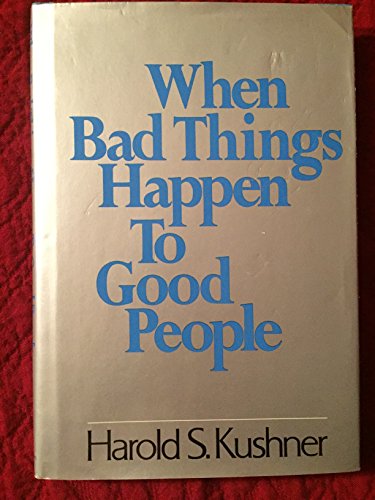
Inhaltsangabe
Offers a moving and humane approach to understanding life's windstorms.Raises many questions that will challenge your mind and test your faith regarding the ultimate questions of life and death.
Die Inhaltsangabe kann sich auf eine andere Ausgabe dieses Titels beziehen.
Über die Autorin bzw. den Autor
Harold S. Kushner is the author of several bestselling books on coping with life's challenges. He has been honored by the Christophers as one of the fifty people who have made the world a better place. He is Rabbi Laureate of Temple Israel in Natick, Massachusetts.
Auszug. © Genehmigter Nachdruck. Alle Rechte vorbehalten.
One
Why Do the Righteous Suffer?
There is only one question which really matters: why do bad things happen to good people? All other theological conversation is intellectually diverting; somewhat like doing the crossword puzzle in the Sunday paper and feeling very satisfied when you have made the words fit; but ultimately without the capacity to reach people where they really care. Virtually every meaningful conversation I have ever had with people on the subject of God and religion has either started with this question, or gotten around to it before long. Not only the troubled man or woman who has just come from a discouraging diagnosis at the doctor’s office, but the college student who tells me that he has decided there is no God, or the total stranger who comes up to me at a party just when I am ready to ask the hostess for my coat, and says, “I hear you’re a rabbi; how can you believe that . . .” —they all have one thing in common. They are all troubled by the unfair distribution of suffering in the world.
The misfortunes of good people are not only a prob- lem to the people who suffer and to their families. They are a problem to everyone who wants to believe in a just and fair and livable world. They inevitably raise questions about the goodness, the kindness, even the existence of God.
I am the rabbi of a congregation of six hundred families, or about twenty-five hundred people. I visit them in the hospital, I officiate at their funerals, I try to help them through the wrenching pain of their divorces, their business failures, their unhappiness with their children. I sit and listen to them pour out their stories of terminally ill husbands or wives, of senile parents for whom a long life is a curse rather than a blessing, of seeing people whom they love contorted with pain or buried by frustration. And I find it very hard to tell them that life is fair, that God gives people what they deserve and need. Time after time, I have seen families and even whole communities unite in prayer for the recovery of a sick person, only to have their hopes and prayers mocked. I have seen the wrong people get sick, the wrong people be hurt, the wrong people die young.
Like every reader of this book, I pick up the daily paper and fresh challenges to the idea of the world’s goodness assault my eyes: senseless murders, fatal practical jokes, young people killed in automobile accidents on the way to their wedding or coming home from their high school prom. I add these stories to the personal tragedies I have known, and I have to ask myself: Can I, in good faith, continue to teach people that the world is good, and that a kind and loving God is responsible for what happens in it?
People don’t have to be unusual, saintly human beings to make us confront this problem. We may not often find ourselves wondering, “why do totally unselfish people suffer, people who never do anything wrong?” because we come to know very few such individuals. But we often find ourselves asking why ordinary people, nice friendly neighbors, neither extraordinarily good nor extraordinarily bad, should suddenly have to face the agony of pain and tragedy. If the world were fair, they would not seem to deserve it. They are neither very much better nor very much worse than most people we know; why should their lives be so much harder? To ask “Why do the righteous suffer?” or “Why do bad things happen to good people?” is not to limit our concern to the martyrdom of saints and sages, but to try to understand why ordinary people—ourselves and people around us—should have to bear extraordinary burdens of grief and pain.
I was a young rabbi just starting out in my profession, when I was called on to try to help a family through an unexpected and almost unbearable tragedy. This middle-aged couple had one daughter, a bright nineteen-year-old girl who was in her freshman year at an out-of-state college. One morning at breakfast, they received a phone call from the university infirmary. “We have some bad news for you. Your daughter collapsed while walking to class this morning. It seems a blood vessel burst in her brain. She died before we could do anything for her. We’re terribly sorry.”
Stunned, the parents asked a neighbor to come in to help them decide what steps to take next. The neighbor notified the synagogue, and I went over to see them that same day. I entered their home, feeling very inadequate, not knowing any words that could ease their pain. I anticipated anger, shock, grief, but I didn’t expect to hear the first words they said to me: “You know, Rabbi, we didn’t fast last Yom Kippur.”
Why did they say that? Why did they assume that they were somehow responsible for this tragedy? Who taught them to believe in a God who would strike down an attractive, gifted young woman without warning as punishment for someone else’s ritual infraction?
One of the ways in which people have tried to make sense of the world’s suffering in every generation has been by assuming that we deserve what we get, that somehow our misfortunes come as punishment for our sins:
Tell the righteous it shall be well with them, for they shall eat the fruit of their deeds. Woe to the wicked, it shall be ill with him, for what his hands have done shall be done to him. (Isaiah 3:10–11)
But Er, Judah’s first-born, was wicked in the sight of the Lord, and the Lord slew him. (Genesis 38:7)
No ills befall the righteous, but the wicked are filled with trouble. (Proverbs 12:21)
Consider, what innocent ever perished, or where have the righteous been destroyed? (Job 14:7)
This is an attitude we will meet later in the book when we discuss the whole question of guilt. It is tempting at one level to believe that bad things happen to people (especially other people) because God is a righteous judge who gives them exactly what they deserve. By believing that, we keep the world orderly and understandable. We give people the best possible reason for being good and for avoiding sin. And by believing that, we can maintain an image of God as all-loving, all-powerful, and totally in control. Given the reality of human nature, given the fact that none of us is perfect and that each of us can, without too much difficulty, think of things he has done which he should not have done, we can always find grounds for justifying what happens to us. But how comforting, how religiously adequate, is such an answer?
The couple whom I tried to comfort, the parents who had lost their only child at age nineteen with no warning, were not profoundly religious people. They were not active in the synagogue; they had not even fasted on Yom Kippur, a tradition which even many otherwise nonobservant Jews maintain. But when they were stunned by tragedy, they reverted back to the basic belief that God punishes people for their sins. They sat there feeling that their daughter’s death had been their fault; had they been less selfish and less lazy about the Yom Kippur fast some six months earlier, she might still be alive. They sat there angry at God for having exacted His pound of flesh so strictly, but afraid to admit their anger for fear that He would punish them again. Life had hurt them, and religion could not comfort them. Religion was making them feel worse.
The idea that God gives people what they deserve, that our misdeeds cause our misfortune, is a neat and attrac- tive solution to the problem of evil at several levels, but it has a number of serious limitations. As we have seen, it teaches people to blame themselves. It creates guilt even where there is no basis for guilt. It makes people hate God, even as it makes them hate...
„Über diesen Titel“ kann sich auf eine andere Ausgabe dieses Titels beziehen.
Suchergebnisse für When Bad Things Happen to Good People

Beispielbild für diese ISBN
When Bad Things Happen to Good People
Anbieter: World of Books (was SecondSale), Montgomery, IL, USA
Verkäuferbewertung 5 von 5 Sternen

Hardback. Zustand: Fair. When Harold Kushner's three-year-old son was diagnosed with a degenerative disease and that he would only live until his early teens, he was faced with one of life's most difficult questions: Why, God? Years later, Rabbi Kushner wrote this straightforward, elegant contemplation of the doubts and fears that arise when tragedy strikes. Kushner shares his wisdom as a rabbi, a parent, a reader, and a human being. Often imitated but never superseded, When Bad Things Happen to Good People is a classic that offers clear thinking and consolation in times of sorrow.Since its original publication in 1981, When Bad Things Happen to Good People has brought solace and hope to millions of readers and its author has become a nationally known spiritual leader. Artikel-Nr. 00098419795
Gebraucht kaufen
EUR 4,31
Versand gratis
Versand innerhalb von USA
Versand innerhalb von USA
Anzahl: 16 verfügbar
Beispielbild für diese ISBN
When Bad Things Happen to Good People
Anbieter: World of Books (was SecondSale), Montgomery, IL, USA
Verkäuferbewertung 5 von 5 Sternen
Hardback. Zustand: Good. When Harold Kushner's three-year-old son was diagnosed with a degenerative disease and that he would only live until his early teens, he was faced with one of life's most difficult questions: Why, God? Years later, Rabbi Kushner wrote this straightforward, elegant contemplation of the doubts and fears that arise when tragedy strikes. Kushner shares his wisdom as a rabbi, a parent, a reader, and a human being. Often imitated but never superseded, When Bad Things Happen to Good People is a classic that offers clear thinking and consolation in times of sorrow.Since its original publication in 1981, When Bad Things Happen to Good People has brought solace and hope to millions of readers and its author has become a nationally known spiritual leader. Artikel-Nr. 00108835970
Gebraucht kaufen
EUR 4,31
Versand gratis
Versand innerhalb von USA
Versand innerhalb von USA
Anzahl: 2 verfügbar
Beispielbild für diese ISBN
When Bad Things Happen to Good People
Verlag:
Schocken (edition First Edition), 1987
ISBN 10: 0805237739
ISBN 13: 9780805237733
Gebraucht
Hardcover
Erstausgabe
Anbieter: BooksRun, Philadelphia, PA, USA
Verkäuferbewertung 5 von 5 Sternen
Hardcover. Zustand: Fair. First Edition. With dust jacket. The item might be beaten up but readable. May contain markings or highlighting, as well as stains, bent corners, or any other major defect, but the text is not obscured in any way. Artikel-Nr. 0805237739-7-1-29
Gebraucht kaufen
EUR 5,23
Versand gratis
Versand innerhalb von USA
Versand innerhalb von USA
Anzahl: 2 verfügbar
Beispielbild für diese ISBN
When Bad Things Happen to Good People
Anbieter: ThriftBooks-Dallas, Dallas, TX, USA
Verkäuferbewertung 5 von 5 Sternen
Hardcover. Zustand: Very Good. No Jacket. Former library book; Missing dust jacket; May have limited writing in cover pages. Pages are unmarked. ~ ThriftBooks: Read More, Spend Less. Artikel-Nr. G0805237739I4N11
Gebraucht kaufen
EUR 5,96
Versand gratis
Versand innerhalb von USA
Versand innerhalb von USA
Anzahl: 1 verfügbar
Beispielbild für diese ISBN
When Bad Things Happen to Good People
Anbieter: ThriftBooks-Dallas, Dallas, TX, USA
Verkäuferbewertung 5 von 5 Sternen
Hardcover. Zustand: Very Good. No Jacket. Missing dust jacket; May have limited writing in cover pages. Pages are unmarked. ~ ThriftBooks: Read More, Spend Less. Artikel-Nr. G0805237739I4N01
Gebraucht kaufen
EUR 5,96
Versand gratis
Versand innerhalb von USA
Versand innerhalb von USA
Anzahl: 3 verfügbar
Beispielbild für diese ISBN
When Bad Things Happen to Good People
Anbieter: ThriftBooks-Phoenix, Phoenix, AZ, USA
Verkäuferbewertung 5 von 5 Sternen
Hardcover. Zustand: Very Good. No Jacket. Missing dust jacket; May have limited writing in cover pages. Pages are unmarked. ~ ThriftBooks: Read More, Spend Less. Artikel-Nr. G0805237739I4N01
Gebraucht kaufen
EUR 5,96
Versand gratis
Versand innerhalb von USA
Versand innerhalb von USA
Anzahl: 2 verfügbar
Beispielbild für diese ISBN
When Bad Things Happen to Good People
Anbieter: ThriftBooks-Dallas, Dallas, TX, USA
Verkäuferbewertung 5 von 5 Sternen
Hardcover. Zustand: Very Good. No Jacket. May have limited writing in cover pages. Pages are unmarked. ~ ThriftBooks: Read More, Spend Less. Artikel-Nr. G0805237739I4N00
Gebraucht kaufen
EUR 5,96
Versand gratis
Versand innerhalb von USA
Versand innerhalb von USA
Anzahl: 1 verfügbar
Beispielbild für diese ISBN
When Bad Things Happen to Good People
Anbieter: ThriftBooks-Atlanta, AUSTELL, GA, USA
Verkäuferbewertung 5 von 5 Sternen
Hardcover. Zustand: Very Good. No Jacket. Former library book; Missing dust jacket; May have limited writing in cover pages. Pages are unmarked. ~ ThriftBooks: Read More, Spend Less. Artikel-Nr. G0805237739I4N11
Gebraucht kaufen
EUR 5,96
Versand gratis
Versand innerhalb von USA
Versand innerhalb von USA
Anzahl: 1 verfügbar
Beispielbild für diese ISBN
When Bad Things Happen to Good People
Anbieter: ThriftBooks-Atlanta, AUSTELL, GA, USA
Verkäuferbewertung 5 von 5 Sternen
Hardcover. Zustand: Very Good. No Jacket. Former library book; May have limited writing in cover pages. Pages are unmarked. ~ ThriftBooks: Read More, Spend Less. Artikel-Nr. G0805237739I4N10
Gebraucht kaufen
EUR 5,96
Versand gratis
Versand innerhalb von USA
Versand innerhalb von USA
Anzahl: 1 verfügbar
Beispielbild für diese ISBN
When Bad Things Happen to Good People
Anbieter: ThriftBooks-Reno, Reno, NV, USA
Verkäuferbewertung 5 von 5 Sternen
Hardcover. Zustand: Very Good. No Jacket. Missing dust jacket; May have limited writing in cover pages. Pages are unmarked. ~ ThriftBooks: Read More, Spend Less. Artikel-Nr. G0805237739I4N01
Gebraucht kaufen
EUR 5,96
Versand gratis
Versand innerhalb von USA
Versand innerhalb von USA
Anzahl: 2 verfügbar