
Verwandte Artikel zu How to Raise a Jewish Child: A Practical Handbook for...
Inhaltsangabe
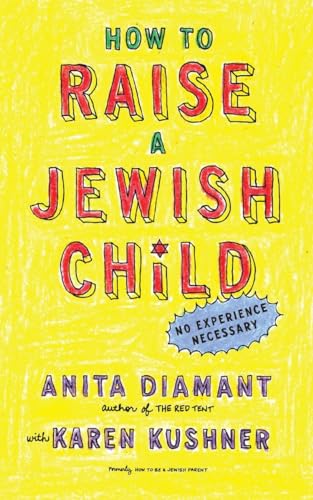
From the New York Times bestselling author of The Red Tent—a classic parenting book that combines insights from Jewish tradition with contemporary thinking about how children learn and grow.
In this updated edition, you will discover the practices, customs, and values that go into creating a Jewish home and raising joyful children within the rich traditions of Judaism.
Die Inhaltsangabe kann sich auf eine andere Ausgabe dieses Titels beziehen.
Über die Autorin bzw. den Autor
ANITA DIAMANT is the author of six books about Jewish life, including The New Jewish Wedding, Living a Jewish Life, and Saying Kaddish. She is also the author of three novels, including The Red Tent. She lives in Newton, Massachusetts.
KAREN KUSHNER is the director of Project Welcome, a San Francisco outreach initiative welcoming interfaith families, unaffiliated Jews, and spiritual seekers into synagogues. The co-author of four children's books, including Because Nothing Looks Like God, she lives in San Francisco.
Auszug. © Genehmigter Nachdruck. Alle Rechte vorbehalten.
From Chapter 1
Values
and Goals
Jewish parents celebrate the birth of children with delight, with food, and with an ancient promise called brit--covenant. Brit is the way Jews conceive of their relationship with God: it is a contract renewed in every generation when parents gather family, friends, and community to say, "This child is now part of the Jewish people."
This covenant is "sealed" with rituals and celebrations (explained in Chapter 6). But the ceremonies are only the beginning of this "bargain." At virtually every brit milah (covenant of circumcision) or brit bat (covenant for a daughter), parents and friends recite a prayerwishpromise that constitutes the "fine print" of the brit:
As heshe has been brought into the covenant, so may heshe enter into Torah, huppah [the wedding canopy] and ma'asim tovim [good deeds].
This ancient three-fold wish gives voice to the dreams and hopes of Jewish parents. Generations understand and interpret these terms differently, but the fundamental principles transcend history, because they express universal wishes that children reach their full potential--intellectually, emotionally, morally, and spiritually.
Torah, huppah, ma'asim tovim. Each of these ideas is both metaphor and goal, each implies traditional values and demands authentic standards. And though they may seem like nouns, they are really imperative verbs. Torah means "Learn." Huppah means "Love." Ma'asim tovim means "Live righteously."
These principles are not abstractions, because each of them is a mitzvah. Mitzvah is the Hebrew word for "commandment" or "good deed," or "Jewish obligation." There really is no English term that captures the complexity of this concept. Mitzvah is simultaneously value and goal, concept and action. Mitzvah is praxis--it is how you "do" Judaism, which is an activist tradition, passionately concerned with the details of how life should be lived. Matters of faith are, by comparison, left unspoken, which is why it's no accident that the three-fold prayer for babies does not mention God.
Of course, for many Jews, "commandments" imply a divine Commander, which means that mitzvot (the plural of mitzvah), laid out in the revealed scripture, called Torah, must be obeyed. But there are other ways to understand mitzvot and to feel commanded or directed by Jewish tradition.
The Hasidic teacher Rabbi Yehuda Aryeh-Lieb of Ger discerned a relationship between the Hebrew mitzvah and an Aramaic word that means "together," and taught that a mitzvah could be seen as an act that unites people, and connects people with the divine.2 Thus, teaching and modeling mitzvot to your children becomes a way to unite them with the Jewish people throughout history and around the world, and also to unite their lives with such sacred purposes as shalom (peace) and tzedek (justice).
Merle Feld, a contemporary Jewish feminist, recasts the word in a different light. "I can't honestly say we are 'commanded' to rest--it's not my language--I don't think I've ever felt 'commanded' to observe Shabbat or anything else for that matter. 'Invited' feels like a more accurate verb for me."
Being a Jewish parent means forging your own understanding of and connection to these mitzvot, and then teaching and showing your children how to learn, love, and do good--as Jews.
Torah
Torah is a complicated word. "The Torah" refers to the first five books of the Hebrew Bible*, also called the Pentateuch, or the Five Books of Moses.
* The word for "Bible" comes from the Greek biblia, meaning "books." The Hebrew Bible includes the Five Books of Moses, the Prophets, and the Writings. This is what Christians call the "Old Testament," believing that Jesus announced a new covenant between God and humanity, which was spelled out in a "New Testament."
"A Torah" is the handwritten scroll from which Jews read in an annual cycle of Genesis, Exodus, Leviticus, Numbers, and Deuteronomy.
"Torah" means "teaching," and can refer to much more than the Five Books of Moses. It may be applied to the entire Bible--as well as to Jewish commentaries, starting with the Talmud and embracing contemporary theology.
Finally, since every person is unique and every person has something to contribute to the on-going conversation about Jewish texts and Jewish life, everyone can be said to be in possession of his or her own "Torah."The Talmud, the great collection of Jewish thought compiled between 200 b.c.e. and 500 c.e, places Torah study at the apex of all human endeavor: These are the obligations without measure, whose reward, too, is without measure: To honor mother and father, to perform acts of lovingkindness, to attend the house of study daily, to welcome the stranger, to visit the sick, to rejoice with the bride and bridegroom, to comfort the bereaved, to pray with sincerity, to make peace when there is strife. And the study of Torah is equal to them all.
Torah study is considered a delight and one of life's great pleasures, yet it is not entirely its own reward. As the Talmud points out, it is meant to lead to all forms of righteous behavior: offering hospitality, making peace where there is strife, participating in all of life's pleasures (weddings) and sorrows (funerals)--in other words, Torah study is the path to doing mitzvot.
A life of Torah may also be understood as an on-going engagement with others in a lively reading and re-reading of Jewish texts. Torah study is not accomplished through memorization and recitation, nor can it ever be "mastered," since Torah is an on-going, dynamic, and essentially creative process.
Nevertheless, the process of Jewish learning does yield intellectual rewards. The back-and-forth dialectic that is the essence of classical Torah study, encourages curiosity, diligence, intellectual precision. It rewards hard questions and honors new ideas. Students of Torah are expected to disagree with each other and even with their teachers--respectfully but forcefully.
Torah celebrates context--the warmth of community--as well as content--the light of insight. Or, in more traditional language:
It is a tree of life to those who hold fast to it
And all of its supporters are happy.
Teaching "Torah"
Universal literacy among Jews is a long-standing tradition. Even in times and places when reading and writing were the privilege of aristocracies and their minions, Jews taught their sons to read. The most sought-after groom was not a rich man but a promising scholar. And even though literacy was considered less important for women, fathers in every generation saw to it that their daughters learned to read, though often in a vernacular, such as Yiddish, rather than the sacred language of Hebrew.
The American Jewish community is famous for academic attainment. In any given year, 20 to 40 percent of students at Ivy League schools are Jewish, as are nearly 40 percent of America's recent Nobel laureates.7 But Jewish literacy is another matter. While most American Jews are familiar with the works of Shakespeare, the writings of Maimonides are known to a much smaller number. Only a minority can read Hebrew.
Jewish parents are becoming less tolerant of this discrepancy between general and Judaic knowledge and are working to provide their children with a solid understanding of...
„Über diesen Titel“ kann sich auf eine andere Ausgabe dieses Titels beziehen.
Suchergebnisse für How to Raise a Jewish Child: A Practical Handbook for...

Beispielbild für diese ISBN
How to Raise a Jewish Child: A Practical Handbook for Family Life
Anbieter: World of Books (was SecondSale), Montgomery, IL, USA
Verkäuferbewertung 5 von 5 Sternen

Paperback. Zustand: Good. This updated edition of the classic parenting book combines insights from Jewish tradition with contemporary thinking about how children learn and grow. And it describes the practices, customs, and values that go into creating a Jewish home and raising joyful children within the rich traditions of Judaism. Artikel-Nr. 00092506763
Gebraucht kaufen
EUR 4,00
Versand gratis
Versand innerhalb von USA
Versand innerhalb von USA
Anzahl: 7 verfügbar
Beispielbild für diese ISBN
How to Raise a Jewish Child: A Practical Handbook for Family Life
Verlag:
Knopf Doubleday Publishing Group (edition Reprint), 2008
ISBN 10: 0805212213
ISBN 13: 9780805212211
Gebraucht
Paperback
Anbieter: BooksRun, Philadelphia, PA, USA
Verkäuferbewertung 5 von 5 Sternen
Paperback. Zustand: Very Good. Reprint. It's a well-cared-for item that has seen limited use. The item may show minor signs of wear. All the text is legible, with all pages included. It may have slight markings and/or highlighting. Artikel-Nr. 0805212213-8-1
Gebraucht kaufen
EUR 4,44
Versand gratis
Versand innerhalb von USA
Versand innerhalb von USA
Anzahl: 1 verfügbar
Beispielbild für diese ISBN
How to Raise a Jewish Child: A Practical Handbook for Family Life
Verlag:
Knopf Doubleday Publishing Group, 2008
ISBN 10: 0805212213
ISBN 13: 9780805212211
Gebraucht
Paperback
Anbieter: ThriftBooks-Reno, Reno, NV, USA
Verkäuferbewertung 5 von 5 Sternen
Paperback. Zustand: Good. No Jacket. Pages can have notes/highlighting. Spine may show signs of wear. ~ ThriftBooks: Read More, Spend Less. Artikel-Nr. G0805212213I3N00
Gebraucht kaufen
EUR 6,12
Versand gratis
Versand innerhalb von USA
Versand innerhalb von USA
Anzahl: 1 verfügbar
Beispielbild für diese ISBN
How to Raise a Jewish Child: A Practical Handbook for Family Life
Verlag:
Knopf Doubleday Publishing Group, 2008
ISBN 10: 0805212213
ISBN 13: 9780805212211
Gebraucht
Paperback
Anbieter: ThriftBooks-Dallas, Dallas, TX, USA
Verkäuferbewertung 5 von 5 Sternen
Paperback. Zustand: Fair. No Jacket. Readable copy. Pages may have considerable notes/highlighting. ~ ThriftBooks: Read More, Spend Less. Artikel-Nr. G0805212213I5N00
Gebraucht kaufen
EUR 6,12
Versand gratis
Versand innerhalb von USA
Versand innerhalb von USA
Anzahl: 1 verfügbar
Beispielbild für diese ISBN
How to Raise a Jewish Child: A Practical Handbook for Family Life
Verlag:
Knopf Doubleday Publishing Group, 2008
ISBN 10: 0805212213
ISBN 13: 9780805212211
Gebraucht
Paperback
Anbieter: ThriftBooks-Phoenix, Phoenix, AZ, USA
Verkäuferbewertung 5 von 5 Sternen
Paperback. Zustand: Good. No Jacket. Pages can have notes/highlighting. Spine may show signs of wear. ~ ThriftBooks: Read More, Spend Less. Artikel-Nr. G0805212213I3N00
Gebraucht kaufen
EUR 6,12
Versand gratis
Versand innerhalb von USA
Versand innerhalb von USA
Anzahl: 1 verfügbar
Beispielbild für diese ISBN
How to Raise a Jewish Child: A Practical Handbook for Family Life
Verlag:
Knopf Doubleday Publishing Group, 2008
ISBN 10: 0805212213
ISBN 13: 9780805212211
Gebraucht
Paperback
Anbieter: ThriftBooks-Dallas, Dallas, TX, USA
Verkäuferbewertung 5 von 5 Sternen
Paperback. Zustand: Good. No Jacket. Pages can have notes/highlighting. Spine may show signs of wear. ~ ThriftBooks: Read More, Spend Less. Artikel-Nr. G0805212213I3N00
Gebraucht kaufen
EUR 6,12
Versand gratis
Versand innerhalb von USA
Versand innerhalb von USA
Anzahl: 2 verfügbar
Beispielbild für diese ISBN
How to Raise a Jewish Child: A Practical Handbook for Family Life
Verlag:
Knopf Doubleday Publishing Group, 2008
ISBN 10: 0805212213
ISBN 13: 9780805212211
Gebraucht
Paperback
Anbieter: ThriftBooks-Atlanta, AUSTELL, GA, USA
Verkäuferbewertung 5 von 5 Sternen
Paperback. Zustand: Good. No Jacket. Pages can have notes/highlighting. Spine may show signs of wear. ~ ThriftBooks: Read More, Spend Less. Artikel-Nr. G0805212213I3N00
Gebraucht kaufen
EUR 6,14
Versand gratis
Versand innerhalb von USA
Versand innerhalb von USA
Anzahl: 2 verfügbar
Beispielbild für diese ISBN
How to Raise a Jewish Child: A Practical Handbook for Family Life
Verlag:
Knopf Doubleday Publishing Group, 2008
ISBN 10: 0805212213
ISBN 13: 9780805212211
Gebraucht
Paperback
Anbieter: ThriftBooks-Dallas, Dallas, TX, USA
Verkäuferbewertung 5 von 5 Sternen
Paperback. Zustand: Very Good. No Jacket. May have limited writing in cover pages. Pages are unmarked. ~ ThriftBooks: Read More, Spend Less. Artikel-Nr. G0805212213I4N00
Gebraucht kaufen
EUR 6,14
Versand gratis
Versand innerhalb von USA
Versand innerhalb von USA
Anzahl: 1 verfügbar
Beispielbild für diese ISBN
How to Raise a Jewish Child: A Practical Handbook for Family Life
Verlag:
Knopf Doubleday Publishing Group, 2008
ISBN 10: 0805212213
ISBN 13: 9780805212211
Gebraucht
Paperback
Anbieter: ThriftBooks-Atlanta, AUSTELL, GA, USA
Verkäuferbewertung 5 von 5 Sternen
Paperback. Zustand: Fair. No Jacket. Readable copy. Pages may have considerable notes/highlighting. ~ ThriftBooks: Read More, Spend Less. Artikel-Nr. G0805212213I5N00
Gebraucht kaufen
EUR 6,14
Versand gratis
Versand innerhalb von USA
Versand innerhalb von USA
Anzahl: 1 verfügbar
Beispielbild für diese ISBN
How to Raise a Jewish Child: A Practical Handbook for Family Life
Verlag:
Knopf Doubleday Publishing Group, 2008
ISBN 10: 0805212213
ISBN 13: 9780805212211
Gebraucht
Softcover
Anbieter: Wonder Book, Frederick, MD, USA
Verkäuferbewertung 5 von 5 Sternen
Zustand: Very Good. Very Good condition. A copy that may have a few cosmetic defects. May also contain light spine creasing or a few markings such as an owner's name, short gifter's inscription or light stamp. Artikel-Nr. H09A-03039
Gebraucht kaufen
EUR 6,35
Versand gratis
Versand innerhalb von USA
Versand innerhalb von USA
Anzahl: 2 verfügbar