
Verwandte Artikel zu One People, Two Worlds: A Reform Rabbi and an Orthodox...
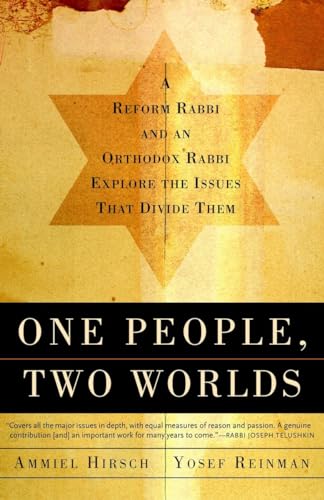
One People, Two Worlds: A Reform Rabbi and an Orthodox Rabbi Explore the Issues That Divide Them - Softcover
Inhaltsangabe
For Jews and non-Jews: An honest, intelligent, no-holds-barred discussion of virtually every “hot button” issue on which Reform and Orthodox Jews differ.
After being introduced by a mutual friend in the winter of 2000, Reform Rabbi Ammiel Hirsch and Orthodox Rabbi Yosef Reinman embarked on an unprecedented eighteen-month email correspondence on the fundamental principles of Jewish faith and practice. What resulted is this book: among the discussions the existence of a Supreme Being, the origins and authenticity of the Bible and the Oral Law, the role of women, assimilation, the value of secular culture, and Israel.
Sometimes they agree; more often than not they disagree—and quite sharply, too. But the important thing is that, as they keep talking to each other, they discover that they actually like each other, and, above all, they respect each other. Their journey from mutual suspicion to mutual regard is an extraordinary one; from it, both Jews and non-Jews of all backgrounds can learn a great deal about the practice of Judaism today and about the continuity of the Jewish people into the future.
Die Inhaltsangabe kann sich auf eine andere Ausgabe dieses Titels beziehen.
Über die Autorin bzw. den Autor
AMMIEL HIRSCH is Executive Director of the Association of Reform Zionists of America/World Union for Progressive Judaism, North America. His editorials, essays, and sermons appear in newspapers and magazines around the world. He lives in New York City.
YOSEF REINMAN is an Orthodox writer, historian, and scholar of international renown. His monographs and articles have appeared in many Jewish periodicals and his study of Talmudic contractual law is a standard text in yeshivas throughout the world. He lives in Lakewood, New Jersey.
Von der hinteren Coverseite
After being introduced by a mutual friend in the winter of 2000, Reform Rabbi Ammiel Hirsch and Orthodox Rabbi Yosef Reinman embarked on an unprecedented eighteen-month e-mail correspondence on the fundamental principles of Jewish faith and practice. What resulted is this book: an honest, intelligent, no-holds-barred discussion of virtually every "hot button" issue on which Reform and Orthodox Jews differ, among them the existence of a Supreme Being, the origins and authenticity of the Bible and the Oral Law, the role of women, assimilation, the value of secular culture, and Israel.
Sometimes they agree; more often than not they disagree--and quite sharply, too. But the important thing is that, as they keep talking to each other, they discover that they actually like each other, and, above all, they respect each other. Their journey from mutual suspicion to mutual regard is an extraordinary one; from it, both Jews and non-Jews of all backgrounds can learn a great deal about the practice of Judaism today and about the continuity of the Jewish people into the future.
"From the Hardcover edition.
Aus dem Klappentext
After being introduced by a mutual friend in the winter of 2000, Reform Rabbi Ammiel Hirsch and Orthodox Rabbi Yosef Reinman embarked on an unprecedented eighteen-month e-mail correspondence on the fundamental principles of Jewish faith and practice. What resulted is this book: an honest, intelligent, no-holds-barred discussion of virtually every hot button issue on which Reform and Orthodox Jews differ, among them the existence of a Supreme Being, the origins and authenticity of the Bible and the Oral Law, the role of women, assimilation, the value of secular culture, and Israel.
Sometimes they agree; more often than not they disagree and quite sharply, too. But the important thing is that, as they keep talking to each other, they discover that they actually like each other, and, above all, they respect each other. Their journey from mutual suspicion to mutual regard is an extraordinary one; from it, both Jews and non-Jews of all backgrounds can learn a great deal about the practice of Judaism today and about the continuity of the Jewish people into the future.
From the Hardcover edition.
Auszug. © Genehmigter Nachdruck. Alle Rechte vorbehalten.
PART ONE
January 21, 2000
Dear Ammi (if I may take the liberty),
Since this is my first communication directly to you, I suppose it should begin with something clever and profound, but nothing comes to mind.
I understand that our shadchan (a seasoned matchmaker named Richard Curtis) has arranged a dinner meeting as an icebreaker. As far as I'm concerned, there is no ice to be broken, just a little unfamiliarity.
I look forward to meeting you for a number of reasons--the book, the project, the contact with a Jewish world that is quite alien to me at this point, as is mine to you, no doubt. But there is also a personal reason. Over the last month, Ammi Hirsch, of whom I had never heard, has materialized for me as an individual, a fellow Jew with a past and a future, someone who is a little apprehensive about meeting me (which is endearing but unnecessary)--just as I have materialized for you as a real person. Doesn't it therefore behoove us, two Jews passing in the night, to stop and say hello to each other? So, no matter what comes of this, I wish you shalom aleichem, and I am happy to make your acquaintance. Perhaps some day it will develop into a friendship. I hope so.
Yosef Reinman
January 26, 2000
Yosef:
I just returned from Israel and was delighted to receive your note. February 2 at 6 p.m. is perfect.
See you then.
Ammi
February 9, 2000
Dear Ammi,
It was a pleasure meeting you in person last week. The setting was good, and the two and a half hours flew by quickly. I'm sure we could have continued talking for several hours more had the maître d' not pointed to the long line of people waiting for tables.
I wonder what the staff and the other patrons thought about the two of us sitting there, me with my beard, peyot, and long caftan and you beardless and bareheaded. What could two people like us have in common? Perhaps they thought we were discussing a real estate venture. I'm sure it never occurred to them that we were discussing some of the fundamental issues that divide the Jewish people and how those chasms can be bridged.
But the truth is we do have a lot in common. We are bound together by blood, history, and some shared religious beliefs. We both carry the burdens of the same thousands of years of Jewish experience, although we may choose to shoulder them differently. We share a bond that is sometimes forgotten when we deal with each other in the impersonal abstract, but when we encounter each other in the living, breathing flesh, that bond is instantly manifested. Whatever differences we may have, ideological or political, we are brothers, and we should care about each other. One of the greatest Jewish values is Ahavat Yisrael, instinctive love for another Jew. I believe this is an ideal we both embrace passionately, and it certainly would make a good foundation for what we are about to undertake here.
I am sure that, as we go on, the discussion will reach scorching temperatures, and that is a good thing. If we pull our punches, we will be defeating our purpose. But those punches must never be thrown with anger or malice, only to convince and clarify. After all, we are already brothers, and I am confident that, as we continue along this adventure together, we will also become good friends.
Over dinner, we touched on numerous thorny issues, and there is nothing that is not open to merciless scrutiny and discussion. It would be premature, however, to address some of these issues, especially the hot political ones, without first exploring who we are, what we believe, and what we stand for. How can we deal with solutions to political differences when we don't even understand each other? Should we try to beat each other into submission regardless of the human cost to the other side?
I admit that we may never find an accommodation that will satisfy both sides. I admit that after all our correspondence we may just agree to disagree. I admit that there may be no choice but to fight it out in the political arena and let the better fighter win. But let us be aware of the fears, hopes, and concerns of the other side. Let us be aware that we may inflict pain on our brothers and do our best to minimize that pain. At the very least, let us be saddened by it.
So let us begin at the beginning. Let us talk about truth. Over dinner, you quoted the philosopher Isaiah Berlin as saying that the greatest danger to the world is when people believe there is only one truth and that they have it, and you applied this concept to Orthodoxy. Berlin made this statement with regard to the proponents of communism and fascism who believed they had discovered a single, overarching truth that justified the sacrifice of individual humans to grand abstractions. He was speaking about the outlook that "you are either with us or against us." Do you believe that applies to the Orthodox view?
Orthodox Judaism is without question about the search for absolute truth. We believe without question that there is an absolute truth, and that it is contained in our holy Torah. Does that make us dangerous? I don't think so. We have never sought to impose our beliefs on other people. We actually discourage conversion. We believe in the election of the Jewish people to live by a higher standard, to be a "light unto the nations," to teach by example. Our daughter religions, Christianity and Islam, are a different story, of course. But that is an entire discussion in itself.
I would, therefore, like to begin our correspondence by discussing the concept of truth. Do you really believe that there is no absolute truth? That there are many truths? In one of the articles you sent me, you wrote that you accept "the authenticity and validity of Orthodoxy." At the same time, you obviously accept the authenticity and validity of Reform. How do you reconcile these views when Orthodoxy by its very nature rejects the authenticity and validity of Reform? You also told me over dinner that "Reform needs the continued existence of Orthodoxy." I find this intriguing, but I don't really know what you mean by it. Let us use these questions as a springboard to our correspondence.
Yosef
February 16, 2000
Dear Yosef:
Thank you for your initial comments. I entirely agree with you regarding your sentiments on Ahavat Yisrael. At its core, Judaism is about the covenant in action. This covenant binds the Jewish people to God and to each other. Thus, the notion of love for fellow Jews is at the heart of the Jewish experience. "All Jews are responsible one for the other" is no mere slogan for me. It constitutes the very essence of my understanding of Judaism. (Hence my disappointment with the rhetoric and actions of many Orthodox Jews and their spokesmen, who so often convey not unconditional love, but intolerant antagonism.)
You mention the concept of absolute truth. Great evil has been perpetrated by people who were convinced that they possessed absolute truth. The implication of this belief is that all other beliefs are, by definition, not true. Taken seriously, this leads to terrible consequences.
Sooner or later, the belief that you possess absolute truth and others do not leaves you essentially alone at the pinnacle of piety.
You skirted the fundamental issue in your letter to me. You write that [Orthodox Jews] "believe without question that there is an absolute truth and that it is contained in our holy Torah." At the same time, you write: "Orthodox Judaism is without question about the search for truth."
What is it? Are you in possession of truth, or are you searching for truth?
If you are searching for truth, then I am with you. It is not Orthodox Judaism alone that is about the search for truth....
„Über diesen Titel“ kann sich auf eine andere Ausgabe dieses Titels beziehen.
Suchergebnisse für One People, Two Worlds: A Reform Rabbi and an Orthodox...

Beispielbild für diese ISBN
One People, Two Worlds: A Reform Rabbi and an Orthodox Rabbi Explore the Issues That Divide Them
Anbieter: World of Books (was SecondSale), Montgomery, IL, USA
Verkäuferbewertung 5 von 5 Sternen

Paperback. Zustand: Very Good. For Jews and non-Jews: An honest, intelligent, no-holds-barred discussion of virtually every "hot button" issue on which Reform and Orthodox Jews differ. After being introduced by a mutual friend in the winter of 2000, Reform Rabbi Ammiel Hirsch and Orthodox Rabbi Yosef Reinman embarked on an unprecedented eighteen-month email correspondence on the fundamental principles of Jewish faith and practice. What resulted is this book: among the discussions the existence of a Supreme Being, the origins and authenticity of the Bible and the Oral Law, the role of women, assimilation, the value of secular culture, and Israel. Sometimes they agree; more often than not they disagree--and quite sharply, too. But the important thing is that, as they keep talking to each other, they discover that they actually like each other, and, above all, they respect each other. Their journey from mutual suspicion to mutual regard is an extraordinary one; from it, both Jews and non-Jews of all backgrounds can learn a great deal about the practice of Judaism today and about the continuity of the Jewish people into the future. Artikel-Nr. 00104965566
Gebraucht kaufen
EUR 4,85
Versand gratis
Versand innerhalb von USA
Versand innerhalb von USA
Anzahl: 2 verfügbar
Beispielbild für diese ISBN
One People, Two Worlds: A Reform Rabbi and an Orthodox Rabbi Explore the Issues That Divide Them
Anbieter: World of Books (was SecondSale), Montgomery, IL, USA
Verkäuferbewertung 5 von 5 Sternen
Paperback. Zustand: Good. For Jews and non-Jews: An honest, intelligent, no-holds-barred discussion of virtually every "hot button" issue on which Reform and Orthodox Jews differ. After being introduced by a mutual friend in the winter of 2000, Reform Rabbi Ammiel Hirsch and Orthodox Rabbi Yosef Reinman embarked on an unprecedented eighteen-month email correspondence on the fundamental principles of Jewish faith and practice. What resulted is this book: among the discussions the existence of a Supreme Being, the origins and authenticity of the Bible and the Oral Law, the role of women, assimilation, the value of secular culture, and Israel. Sometimes they agree; more often than not they disagree--and quite sharply, too. But the important thing is that, as they keep talking to each other, they discover that they actually like each other, and, above all, they respect each other. Their journey from mutual suspicion to mutual regard is an extraordinary one; from it, both Jews and non-Jews of all backgrounds can learn a great deal about the practice of Judaism today and about the continuity of the Jewish people into the future. Artikel-Nr. 00109343798
Gebraucht kaufen
EUR 4,85
Versand gratis
Versand innerhalb von USA
Versand innerhalb von USA
Anzahl: 1 verfügbar
Beispielbild für diese ISBN
One People, Two Worlds: A Reform Rabbi and an Orthodox Rabbi Explore the Issues That Divide Them
ISBN 10: 0805211403
ISBN 13: 9780805211405
Gebraucht
Paperback
Anbieter: BooksRun, Philadelphia, PA, USA
Verkäuferbewertung 5 von 5 Sternen
Paperback. Zustand: Very Good. First Paperback Printing. It's a well-cared-for item that has seen limited use. The item may show minor signs of wear. All the text is legible, with all pages included. It may have slight markings and/or highlighting. Artikel-Nr. 0805211403-11-1
Gebraucht kaufen
EUR 4,86
Versand gratis
Versand innerhalb von USA
Versand innerhalb von USA
Anzahl: 1 verfügbar
Beispielbild für diese ISBN
One People, Two Worlds: A Reform Rabbi and an Orthodox Rabbi Explore the Issues That Divide Them
Anbieter: ThriftBooks-Atlanta, AUSTELL, GA, USA
Verkäuferbewertung 5 von 5 Sternen
Paperback. Zustand: Very Good. No Jacket. May have limited writing in cover pages. Pages are unmarked. ~ ThriftBooks: Read More, Spend Less. Artikel-Nr. G0805211403I4N00
Gebraucht kaufen
EUR 6,29
Versand gratis
Versand innerhalb von USA
Versand innerhalb von USA
Anzahl: 1 verfügbar
Beispielbild für diese ISBN
One People, Two Worlds : A Reform Rabbi and an Orthodox Rabbi Explore the Issues That Divide Them
Verlag:
Knopf Doubleday Publishing Group, 2003
ISBN 10: 0805211403
ISBN 13: 9780805211405
Gebraucht
Softcover
Anbieter: Better World Books, Mishawaka, IN, USA
Verkäuferbewertung 5 von 5 Sternen
Zustand: Good. Former library copy. Pages intact with minimal writing/highlighting. The binding may be loose and creased. Dust jackets/supplements are not included. Includes library markings. Stock photo provided. Product includes identifying sticker. Better World Books: Buy Books. Do Good. Artikel-Nr. 5657416-20
Gebraucht kaufen
EUR 9,99
Versand gratis
Versand innerhalb von USA
Versand innerhalb von USA
Anzahl: 1 verfügbar
Beispielbild für diese ISBN
One People, Two Worlds: A Reform Rabbi and an Orthodox Rabbi Explore the Issues That Divide Them
Verlag:
Random House USA Inc, United States, New York, 2003
ISBN 10: 0805211403
ISBN 13: 9780805211405
Gebraucht
Paperback
Anbieter: WorldofBooks, Goring-By-Sea, WS, Vereinigtes Königreich
Verkäuferbewertung 5 von 5 Sternen
Paperback. Zustand: Very Good. The book has been read, but is in excellent condition. Pages are intact and not marred by notes or highlighting. The spine remains undamaged. Artikel-Nr. GOR002605484
Gebraucht kaufen
EUR 8,66
EUR 6,53 Versand
Versand von Vereinigtes Königreich nach USA
Versand von Vereinigtes Königreich nach USA
Anzahl: 2 verfügbar
Beispielbild für diese ISBN
One People, Two Worlds: A Reform Rabbi and an Orthdox Rabbi Explore the Issues That Divide Them
Anbieter: Revaluation Books, Exeter, Vereinigtes Königreich
Verkäuferbewertung 5 von 5 Sternen
Paperback. Zustand: Brand New. 336 pages. 8.00x4.75x0.10 inches. In Stock. Artikel-Nr. x-0805211403
Neu kaufen
EUR 26,79
EUR 11,67 Versand
Versand von Vereinigtes Königreich nach USA
Versand von Vereinigtes Königreich nach USA
Anzahl: 2 verfügbar
Beispielbild für diese ISBN
One People, Two Worlds: A Reform Rabbi and an Orthodox Rabbi Explore the Issues That Divide Them
Anbieter: Majestic Books, Hounslow, Vereinigtes Königreich
Verkäuferbewertung 4 von 5 Sternen

Zustand: New. pp. 336. Artikel-Nr. 7988597
Neu kaufen
EUR 37,57
EUR 7,58 Versand
Versand von Vereinigtes Königreich nach USA
Versand von Vereinigtes Königreich nach USA
Anzahl: 1 verfügbar