
Verwandte Artikel zu Days of Awe: A Treasury of Jewish Wisdom for Reflection,...
Days of Awe: A Treasury of Jewish Wisdom for Reflection, Repentance, and Renewal on the High Holy Days - Softcover
Inhaltsangabe
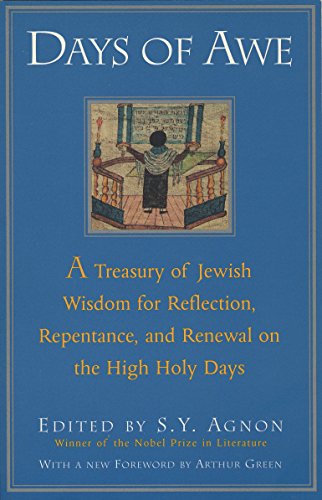
Compiled by S.Y. Agnon, one of the greatest Hebrew writers of the twentieth century and winner of the 1966 Nobel Prize in Literature, Days of Awe is the long-acknowledged classic companion to the High Holy Days prayerbook. Here in one volume are readings from the meditations from the Bible, the Talmud, the Midrash, and the Zohar, to deepen the spiritual experience of the holiest days of the Jewish year. More than three hundred texts. selected from the vast storehouse of Jewish literature from ancient to modern times, are arranged to follow the order of the synagogue service for the High Holy Days. "From the moment of its appearance," writes Judah Goldin in the Introduction, "[this] volume seemed as though it had always been here, as though it had always been the companion of the holiday prayerbook."
Die Inhaltsangabe kann sich auf eine andere Ausgabe dieses Titels beziehen.
Über die Autorin bzw. den Autor
SHMUEL YOSEF AGNON was a Nobel Prize laureate writer and was one of the central figures of modern Hebrew fiction. Agnon was born in Galicia, Austro-Hungarian Empire (today Ukraine). He later immigrated to the British Mandate of Palestine, and died in Jerusalem, Israel. His works deal with the conflict between the traditional Jewish life and language and the modern world. They also attempt to recapture the fading traditions of the European shtetl. In a wider context, he contributed to broadening the characteristic conception of the narrator's role in literature. Agnon shared the Nobel Prize with the poet Nelly Sachs in 1966.
Von der hinteren Coverseite
Compiled by one of the greatest Hebrew writers of the 20th century and first published in 1948, "Days of Awe is the long-acknowledged classic companion to the High Holy Days prayer book. Here in one volume are readings and meditations from the Bible, the Talmud, the Midrash, and the Zohar, to deepen the spiritual experience of the holiest days of the Jewish year.
Aus dem Klappentext
one of the greatest Hebrew writers of the 20th century and first published in 1948, Days of Awe is the long-acknowledged classic companion to the High Holy Days prayer book. Here in one volume are readings and meditations from the Bible, the Talmud, the Midrash, and the Zohar, to deepen the spiritual experience of the holiest days of the Jewish year.
Auszug. © Genehmigter Nachdruck. Alle Rechte vorbehalten.
The Motive of Rosh ha-Shanah
A Holy Convocation
And the Lord spoke unto Moses, saying: Speak unto the children of Israel, saying:
In the seventh month, in the first day of the month, shall be a solemn rest unto you, a memorial proclaimed with the blast of horns, a holy convocation. Ye shall do no manner of servile work; it is a day of blowing the horn unto you. And ye shall prepare a burnt-offering for a sweet savour unto the Lord: one young bullock, one ram, seven he-lambs of the first year without blemish; and their meal-offering, fine flour mingled with oil, three tenth parts for the bullock, two tenth parts for the ram, and one tenth part for every lamp of the seven lambs; and one he-goat for a sin-offering, to make atonement for you; beside the burnt offering of the new moon, and the meal-offering therefor, and their drink offerings, according unto their ordinance, for a sweet savour, an offering made by fire until the Lord. [Num. 29:1-6]
And when the seventh month was come, and the children of Israel were in the cities, the people gathered themselves together as one man to Jerusalem. Then stood up Jeshua the son of Jozadek, and his brethren the priests, and Zerubbabel the son of Shealtiel, and his brethren, and builded the altar of the God of Israel, to offer burnt-offerings thereon, as it is written in the Law of Moses the man of God. And they set the altar upon its bases, for fear was upon them because of the people of the countries, and they offered burnt-offerings thereon unto the Lord, even burnt-offerings morning and evening. [Ezra 3:1-3]
And when the seventh month was come, and the children of Israel were in their cities, all the people gathered themselves together as one man into the broad place that was before the water gate; and they spoke unto Ezra the scribe to bring the book of the Law of Moses, which the Lord had commanded to Israel. And Ezra the priest brought the Law before the congregation, both men and women, and all that could hear with understanding, upon the first day of the seventh month. And he read therein before the broad place that was before the water gate from the early morning until midday, in the presence of the men and the women, and of those that could understand; and the ears of all the people were attentive upon the book of the Law. And Ezra the scribe stood upon a pulpit of wood, which they has made for the purpose; and beside him stood Mattithiah, and Shema, and Anaiah, and Uriah, and Hilkiah, and Maaseiah, on his right hand; and on his left hand, Pedaiah, and Mishael, and Malchijah, and Hashum, and Hashbaddanah, Zechariah, and Meshullam. And Ezra opened the book in the sight of all the people—for he was above the people—and when he opened it, all the people stood up. And Ezra blessed the Lord with their faces to the ground. Also Jeshua, and Bani, and Sherebiah, Jamin, Akkub, Shabbethai, Hodiah, Maaseiah, Kelita, Azariah, Jozabad, Hanan, Pelaia, even the Levites, cause the people to understand the Law; and the people stood in their place. And they read in the book, in the Law of God, distinctly; and they gave the sense, and caused them to understand the reading.
And Nehemiah, who was the Tirshatha, and Ezra the priest the scribe, and the Levites that taught the people, said unto all the people: ‘This day is holy unto the Lord your God; mourn not, nor weep.’ For all the people wept, when they heard the words of the Law. Then he said until them: ‘Go your way, eat the far, and drink the sweet, and send portions unto him for whom nothing is prepared; for this day is holy unto our Lord; neither be ye grieved; for the joy of the Lord is your strength.’ So the Levites stilled all the people, saying: ‘Hold your peace, for the day is holy; neither be ye grieved.’ [Neh. 8:1-11]
THE DAY OF JUDGMENTS
“Blow the horn at the new moon, at the full moon for our feast-day” (Ps. 81:4). Rabbi Phineas and Rabbi Hilkiah said in the name of Rabbi Simon: All the ministering angels assemble before the Holy One, blessed be he, and say, “Master of the universe, when is the New Year’s Day?” And he says to them, “Is it me you are asking? Let us both of us ask the Court below!” Because of the verse (ibid.): “For it is a statute for Israel, an ordinance of the God of Jacob.” [Midrash Tehillim]
It has been taught: Rabbi Eliezer says, In the month of Tishri the world was created, in Tishri the patriarchs were born, in Tishri the patriarchs died. On Rosh ha-Shanah Sarah, Rachel, and Hannah were remembered on high and conceived, on Rosh ha-Shanah Joseph left prison, on Rosh ha-Shanah the bondage of our ancestors ceased in Egypt. In the month of Nisan they were redeemed, and in Tishri they will be redeemed in time to come. [Rosh ha-Shanah I0b-11a]
The world is judged at four season: at Passover, in regard to grain; on the Feast of Weeks, in regard to the fruit of the tree; on Rosh ha-Shanah, all the inhabitants of this world file before Him. As it is said, “He that fashioneth the hearts of them all, that considereth all their doings” (Ps. 33:15). On the Feast of Booths, the world is judged in regard to rain. [Mishnah Rosh ha-Shanah I.2]
All things are judged on Rosh ha-Shanah, and their fate is sealed on Yom Kippur, are the worlds of Rabbi Meir. Rabbi Judah, in the name of Rabbi Akiba, says: All things judged on Rosh ha-Shanah, but the fate of each and every one of them is sealed in its proper season; at Passover, the fate of the grain, at the Feast of Weeks, that of the fruit of the tree, and at the Feast of Booths, that of rain. [Tosefta Rosh ha-Shanah I.13]
„Über diesen Titel“ kann sich auf eine andere Ausgabe dieses Titels beziehen.
Suchergebnisse für Days of Awe: A Treasury of Jewish Wisdom for Reflection,...

Beispielbild für diese ISBN
Days of Awe: A Treasury of Jewish Wisdom for Reflection, Repentance, and Renewal on the High Holy Days
Anbieter: World of Books (was SecondSale), Montgomery, IL, USA
Verkäuferbewertung 5 von 5 Sternen

Paperback. Zustand: Fair. Compiled by S.Y. Agnon, one of the greatest Hebrew writers of the twentieth century and winner of the 1966 Nobel Prize in Literature, Days of Awe is the long-acknowledged classic companion to the High Holy Days prayerbook. Here in one volume are readings from the meditations from the Bible, the Talmud, the Midrash, and the Zohar, to deepen the spiritual experience of the holiest days of the Jewish year. More than three hundred texts. selected from the vast storehouse of Jewish literature from ancient to modern times, are arranged to follow the order of the synagogue service for the High Holy Days. "From the moment of its appearance," writes Judah Goldin in the Introduction, " this volume seemed as though it had always been here, as though it had always been the companion of the holiday prayerbook.". Artikel-Nr. 00109213372
Gebraucht kaufen
EUR 5,03
Versand gratis
Versand innerhalb von USA
Versand innerhalb von USA
Anzahl: 1 verfügbar
Beispielbild für diese ISBN
Days of Awe: A Treasury of Jewish Wisdom for Reflection, Repentance, and Renewal on the High Holy Days
Anbieter: World of Books (was SecondSale), Montgomery, IL, USA
Verkäuferbewertung 5 von 5 Sternen
Paperback. Zustand: Good. Compiled by S.Y. Agnon, one of the greatest Hebrew writers of the twentieth century and winner of the 1966 Nobel Prize in Literature, Days of Awe is the long-acknowledged classic companion to the High Holy Days prayerbook. Here in one volume are readings from the meditations from the Bible, the Talmud, the Midrash, and the Zohar, to deepen the spiritual experience of the holiest days of the Jewish year. More than three hundred texts. selected from the vast storehouse of Jewish literature from ancient to modern times, are arranged to follow the order of the synagogue service for the High Holy Days. "From the moment of its appearance," writes Judah Goldin in the Introduction, " this volume seemed as though it had always been here, as though it had always been the companion of the holiday prayerbook.". Artikel-Nr. 00101239218
Gebraucht kaufen
EUR 5,03
Versand gratis
Versand innerhalb von USA
Versand innerhalb von USA
Anzahl: 6 verfügbar
Beispielbild für diese ISBN
Days of Awe : A Treasury of Jewish Wisdom for Reflection, Repentance, and Renewal on the High Holy Days
Verlag:
Knopf Doubleday Publishing Group, 1995
ISBN 10: 0805210482
ISBN 13: 9780805210484
Gebraucht
Softcover
Anbieter: Better World Books, Mishawaka, IN, USA
Verkäuferbewertung 5 von 5 Sternen
Zustand: Good. New Ed. Pages intact with minimal writing/highlighting. The binding may be loose and creased. Dust jackets/supplements are not included. Stock photo provided. Product includes identifying sticker. Better World Books: Buy Books. Do Good. Artikel-Nr. 4570276-6
Gebraucht kaufen
EUR 7,00
Versand gratis
Versand innerhalb von USA
Versand innerhalb von USA
Anzahl: 1 verfügbar
Beispielbild für diese ISBN
Days of Awe: A Treasury of Jewish Wisdom for Reflection, Repentance, and Renewal on the High Holy Days
Verlag:
Knopf Doubleday Publishing Group, 1995
ISBN 10: 0805210482
ISBN 13: 9780805210484
Gebraucht
Paperback
Anbieter: ThriftBooks-Atlanta, AUSTELL, GA, USA
Verkäuferbewertung 5 von 5 Sternen
Paperback. Zustand: Fair. No Jacket. Readable copy. Pages may have considerable notes/highlighting. ~ ThriftBooks: Read More, Spend Less. Artikel-Nr. G0805210482I5N00
Gebraucht kaufen
EUR 7,27
Versand gratis
Versand innerhalb von USA
Versand innerhalb von USA
Anzahl: 1 verfügbar
Beispielbild für diese ISBN
Days of Awe: A Treasury of Jewish Wisdom for Reflection, Repentance, and Renewal on the High Holy Days
Verlag:
Knopf Doubleday Publishing Group, 1995
ISBN 10: 0805210482
ISBN 13: 9780805210484
Gebraucht
Paperback
Anbieter: ThriftBooks-Dallas, Dallas, TX, USA
Verkäuferbewertung 5 von 5 Sternen
Paperback. Zustand: Good. No Jacket. Pages can have notes/highlighting. Spine may show signs of wear. ~ ThriftBooks: Read More, Spend Less. Artikel-Nr. G0805210482I3N00
Gebraucht kaufen
EUR 7,27
Versand gratis
Versand innerhalb von USA
Versand innerhalb von USA
Anzahl: 1 verfügbar
Beispielbild für diese ISBN
Days of Awe: A Treasury of Jewish Wisdom for Reflection, Repentance, and Renewal on the High Holy Days
Verlag:
Knopf Doubleday Publishing Group, 1995
ISBN 10: 0805210482
ISBN 13: 9780805210484
Gebraucht
Paperback
Anbieter: ThriftBooks-Phoenix, Phoenix, AZ, USA
Verkäuferbewertung 5 von 5 Sternen
Paperback. Zustand: Good. No Jacket. Pages can have notes/highlighting. Spine may show signs of wear. ~ ThriftBooks: Read More, Spend Less. Artikel-Nr. G0805210482I3N00
Gebraucht kaufen
EUR 7,27
Versand gratis
Versand innerhalb von USA
Versand innerhalb von USA
Anzahl: 1 verfügbar
Beispielbild für diese ISBN
Days of Awe: A Treasury of Jewish Wisdom for Reflection, Repentance, and Renewal on the High Holy Days
Verlag:
Knopf Doubleday Publishing Group, 1995
ISBN 10: 0805210482
ISBN 13: 9780805210484
Gebraucht
Paperback
Anbieter: ThriftBooks-Phoenix, Phoenix, AZ, USA
Verkäuferbewertung 5 von 5 Sternen
Paperback. Zustand: Very Good. No Jacket. May have limited writing in cover pages. Pages are unmarked. ~ ThriftBooks: Read More, Spend Less. Artikel-Nr. G0805210482I4N00
Gebraucht kaufen
EUR 7,27
Versand gratis
Versand innerhalb von USA
Versand innerhalb von USA
Anzahl: 1 verfügbar
Beispielbild für diese ISBN
Days of Awe: A Treasury of Jewish Wisdom for Reflection, Repentance, and Renewal on the High Holy Days
Verlag:
Knopf Doubleday Publishing Group, 1995
ISBN 10: 0805210482
ISBN 13: 9780805210484
Gebraucht
Paperback
Anbieter: ThriftBooks-Atlanta, AUSTELL, GA, USA
Verkäuferbewertung 5 von 5 Sternen
Paperback. Zustand: Very Good. No Jacket. May have limited writing in cover pages. Pages are unmarked. ~ ThriftBooks: Read More, Spend Less. Artikel-Nr. G0805210482I4N00
Gebraucht kaufen
EUR 7,27
Versand gratis
Versand innerhalb von USA
Versand innerhalb von USA
Anzahl: 1 verfügbar
Beispielbild für diese ISBN
Days of Awe: A Treasury of Jewish Wisdom for Reflection, Repentance, and Renewal on the High Holy Days
Verlag:
Knopf Doubleday Publishing Group, 1995
ISBN 10: 0805210482
ISBN 13: 9780805210484
Gebraucht
Paperback
Anbieter: ThriftBooks-Dallas, Dallas, TX, USA
Verkäuferbewertung 5 von 5 Sternen
Paperback. Zustand: Good. No Jacket. Former library book; Pages can have notes/highlighting. Spine may show signs of wear. ~ ThriftBooks: Read More, Spend Less. Artikel-Nr. G0805210482I3N10
Gebraucht kaufen
EUR 7,27
Versand gratis
Versand innerhalb von USA
Versand innerhalb von USA
Anzahl: 1 verfügbar
Foto des Verkäufers
Days of Awe: A Treasury of Jewish Wisdom for Reflection, Repentance, and Renewal on the High Holy Days
Verlag:
Knopf Doubleday Publishing Group, 1995
ISBN 10: 0805210482
ISBN 13: 9780805210484
Gebraucht
paperback
Anbieter: WeBuyBooks, Rossendale, LANCS, Vereinigtes Königreich
Verkäuferbewertung 5 von 5 Sternen
paperback. Zustand: Like New. Most items will be dispatched the same or the next working day. An apparently unread copy in perfect condition. Dust cover is intact with no nicks or tears. Spine has no signs of creasing. Pages are clean and not marred by notes or folds of any kind. Artikel-Nr. rev6957884199
Gebraucht kaufen
EUR 10,89
EUR 6,59 Versand
Versand von Vereinigtes Königreich nach USA
Versand von Vereinigtes Königreich nach USA
Anzahl: 1 verfügbar