
Verwandte Artikel zu The Finest Hours (Young Readers Edition): The True...
The Finest Hours (Young Readers Edition): The True Story of a Heroic Sea Rescue: The True Story of a Heroic Rescue - Hardcover
Buch 1 von 6: True Rescue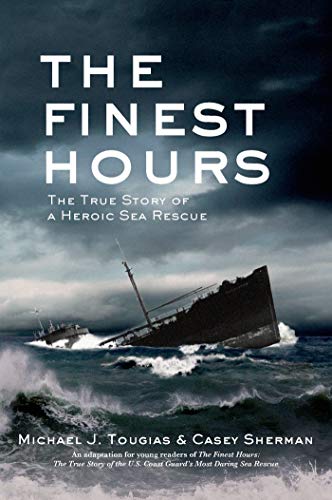
Inhaltsangabe
"An action-packed account of rescue at sea.” —Kirkus Reviews
This young readers adaptation tells the story of the shipwreck of two oil tankers and the harrowing Coast Guard rescue when four men in a tiny lifeboat overcame insurmountable odds and saved more than 30 stranded sailors. Now a major motion picture from Disney, starring Chris Pine and Casey Affleck.
On the night of February 18, 1952, during one of the worst winter storms that New England has ever seen, two oil tankers just off the shore of Cape Cod were torn in half. With the storm in full force and waves up to 70 feet high, four coast guardsmen headed out to sea in a tiny lifeboat to come to the rescue. They were the only hope for the stranded sailors. Despite incredible obstacles, these brave men risked their lives, remembering the unofficial Coast Guard motto: You have to go out, but you do not have to come back.
This is a fast-paced, uplifting story that puts young readers in the middle of the action. It's a gripping true tale of heroism and survival in the face of the elements.
New York Times bestselling author Michael J. Tougias adapts his histories of real life stories for young readers in his True Rescue Series, capturing the heroism and humanity of people on life-saving missions during maritime disasters.
More Thrilling True Rescue Books:
A Storm Too Soon (Young Readers Edition)
Into the Blizzard (Young Readers Edition)
Attacked at Sea (Young Readers Edition)
In Harm's Way (Young Readers Edition)
Rescue on the Bounty (Young Readers Edition)
Die Inhaltsangabe kann sich auf eine andere Ausgabe dieses Titels beziehen.
Über die Autorin bzw. den Autor
Michael J. Tougias is the author of many award-winning true rescue stories, including the New York Times-bestseller The Finest Hours, A Storm Too Soon, Into the Blizzard, and Attacked at Sea. He also published a memoir, The Waters Between Us: A Boy, A Father, Outdoor Misadventures and the Healing Power of Nature. A frequent lecturer on his work, Tougias splits his time between Massachusetts and Florida.
Casey Sherman is an award-winning journalist and bestselling author of The Finest Hours, Bad Blood, Black Irish, and Black Dragon. He received the Edward R. Murrow Award for Journalistic Excellence as a member of the CBS Boston news team, and has been nominated for an Emmy Award. A featured guest on major television networks and news programs, Sherman has lectured at The National Press Club and the US Coast Guard Command Center in Washington, D.C. He lives in Marshfield, Massachusetts.
Auszug. © Genehmigter Nachdruck. Alle Rechte vorbehalten.
1
CHATHAM LIFEBOAT STATION
Chatham, Massachusetts: February 18, 1952
Boatswain’s mate first class Bernie Webber held a mug of hot coffee in his large hands as he stared out the foggy window of the mess hall. He watched with growing curiosity and concern as the storm continued to strengthen outside. A midwinter nor’easter had stalled over New England for the last two days, and Bernie wondered if the worst was yet to come. Windswept snow danced over the shifting sands as large drifts piled up in the front yard of the Chatham Lifeboat Station.
Taking a sip of his coffee, Bernie thought of his young wife, Miriam, in bed with a bad case of the flu at their cottage on Sea View Street. What if there was an emergency? What if she needed help? Would the doctor be able to reach her in this kind of weather? These questions were fraying his nerves, and Bernie fought to put them out of his mind. Instead he tried to picture the local fishermen all huddled around the old wood stove at the Chatham Fish Pier. They would be calling for his help soon as their vessels bobbed up and down on the waves in Old Harbor, straining their lines. If the storm is this bad now, what will it be like in a few hours when it really gets going? he thought.
Bernie, however, wouldn’t complain about the tough day he was facing. The boatswain’s mate first class was only 24 years old, but he had been working at sea for nearly a decade, having first served with the U.S. Maritime Service during WWII. Bernie had followed his brother Bob into the Coast Guard; it was not the kind of life his parents had planned for him. From early childhood, Bernie’s father, the associate pastor at the Tremont Temple Baptist Church in Boston, had steered him toward a life in the ministry. The church deacon had even paid for Bernie to attend the Mount Hermon School for Boys, which was 105 miles away from their home in Milton.
Bernie was an outcast in the prep school crowd. He arrived in Greenfield, Massachusetts, a small town hugging the Connecticut River, with serious doubts and wearing his brother’s hand-me-down clothes. He was not a strong student, and he privately questioned why he was there. Bernie knew in his heart that he did not want to follow in his father’s footsteps. He was thinking about running away from school when fate intervened; a childhood friend who had crashed his father’s car came looking for a place to hide out. Bernie snuck his friend into one of the dorm rooms and swiped food from the school cafeteria for the boy to eat. The two were caught after just a few days, but they did not stick around long enough to face the consequences. Instead they fled to the hills and cornfields surrounding the school before eventually making it back to Milton.
Reverend Bernard A. Webber struggled to understand the actions of his wayward son as young Bernie quit school and continued to drift. A year later, at the age of 16, when World War II was under way, Bernie got an idea that would change the course of his rudderless life. He heard that the U.S. Maritime Service was looking for young men to train. If Bernie could complete the arduous training camp, he could then serve the war effort on a merchant ship. He quickly joined up after his father reluctantly signed his enlistment papers, and he learned the fundamentals of seamanship at the Sheepshead Bay Maritime School in New York.
When he was finished with maritime school, Bernie shipped out on a T2 oil tanker in the South Pacific. During this time, he realized that he would not spend his life in the ministry or at any other job on dry land. Bernie Webber had been born to the sea. He enlisted in the U.S. Coast Guard on February 26, 1946, and was sent to its training station in Maryland. In letters to recruits at the time, the commanding officer of the coast guard training station summed up the life of a coast guardsman this way:
HARD JOBS ARE ROUTINE IN THIS SERVICE. IN A WAY, THE COAST GUARD IS ALWAYS AT WAR; IN WARTIME, AGAINST ARMED ENEMIES OF THE NATION; AND IN PEACETIME, AGAINST ALL ENEMIES OF MANKIND AT SEA; FIRE, COLLISION, LAWLESSNESS, GALES, ICE, DERELICTS, AND MANY MORE. THE COAST GUARD, THEREFORE, IS NO PLACE FOR A QUITTER, OR FOR A CRYBABY, OR ANYONE WHO CANNOT KEEP HIS EYE ON THE BALL. IT IS UP TOYOU, AS AN INDIVIDUAL TO PROVE YOUR WORTH.
* * *
Ten years had passed, and Bernie was now on duty in Chatham, a tiny outpost at the elbow of Cape Cod. His worth and his mettle had been tested many times in the unforgiving waters off the Cape. It was one of the most dangerous places on the sea, because of the shifting sandbars and enormous waves. In fact, seamen referred to the area as “the graveyard of the Atlantic,” and for good reason. The sunken skeletons of more than 3,000 shipwrecks were scattered across the ocean floor from Chatham to Provincetown.
Bernie Webber’s first challenge had come during an evening in 1949, when he responded to a distress call at the Chatham Lifeboat Station. The USSLivermore had run aground on Bearse’s Shoal, off Monomoy Island. Bernie and a crew took a 38-foot boat over the treacherous shallow area known as Chatham Bar to where theLivermore lay with a navy crew stranded on board. The ship rested high up on the shoal and was leaning dangerously on its side. Bernie and the men stayed with the destroyer for the rest of the night as salvage tugs were called in. The next morning, the coast guardsmen assisted in several failed attempts to free the warship before finally achieving success and sending theLivermore safely on its way. Bernie smiled as the Livermore’s crew cheered him and his crew. The sailors had given him a different reception several hours earlier when they pelted him with apples and oranges because, in their eyes, the rescue mission was taking too long. It was all part of a friendly rivalry between the navy and the coasties.
Yes, the life of a coast guardsman was oftentimes a thankless one, but Bernie would not have traded it for any other job in the world. And now, just after dawn, he gazed out the window of the mess hall, listened to the wind howl, and wondered what the day would bring.
2
THE PENDLETON
Captain John J. Fitzgerald Jr. was new to the Pendleton, but he was not new to the unpredictability of the New England weather. Fitzgerald, the son of a sea captain, had taken over command of the 503-foot, 10,448-ton T2 tanker just one month prior. The square-jawed resident of Roslindale, Massachusetts, was familiar with these waters and had a healthy respect for the dangers of the North Atlantic.
The Pendleton had departed Baton Rouge, Louisiana, on February 12, bound for Boston. The tanker was fully loaded, carrying 122,000 barrels of kerosene and home heating oil from Texas. Like most tanker crews, the men aboard thePendleton were a mixed lot of old buddies and total strangers. It was also a classic melting pot of races, creeds, and colors.
From the very beginning, it had been a difficult voyage for Fitzgerald and his crew of 40 men. ThePendleton had run into a severe storm off Cape Hatteras, North Carolina, and the bad weather had stayed with them like a dark omen on the journey up the coast. Now, five days after their departure, the crew faced its toughest challenge yet, a blizzard that showed no sign of weakening. Nine inches of snow had already fallen in Boston, where an army of 500 city workers used 200 trucks and 35 snow loaders to clear the downtown area and the narrow streets of Beacon Hill. The South Shore of Massachusetts was also taking a pounding as huge waves ripped down 30 feet of seawall in the coastal town of Scituate. Farther south on Cape Cod, more than 4,000 telephones had been knocked out as thick ice and...
CHATHAM LIFEBOAT STATION
Chatham, Massachusetts: February 18, 1952
Boatswain’s mate first class Bernie Webber held a mug of hot coffee in his large hands as he stared out the foggy window of the mess hall. He watched with growing curiosity and concern as the storm continued to strengthen outside. A midwinter nor’easter had stalled over New England for the last two days, and Bernie wondered if the worst was yet to come. Windswept snow danced over the shifting sands as large drifts piled up in the front yard of the Chatham Lifeboat Station.
Taking a sip of his coffee, Bernie thought of his young wife, Miriam, in bed with a bad case of the flu at their cottage on Sea View Street. What if there was an emergency? What if she needed help? Would the doctor be able to reach her in this kind of weather? These questions were fraying his nerves, and Bernie fought to put them out of his mind. Instead he tried to picture the local fishermen all huddled around the old wood stove at the Chatham Fish Pier. They would be calling for his help soon as their vessels bobbed up and down on the waves in Old Harbor, straining their lines. If the storm is this bad now, what will it be like in a few hours when it really gets going? he thought.
Bernie, however, wouldn’t complain about the tough day he was facing. The boatswain’s mate first class was only 24 years old, but he had been working at sea for nearly a decade, having first served with the U.S. Maritime Service during WWII. Bernie had followed his brother Bob into the Coast Guard; it was not the kind of life his parents had planned for him. From early childhood, Bernie’s father, the associate pastor at the Tremont Temple Baptist Church in Boston, had steered him toward a life in the ministry. The church deacon had even paid for Bernie to attend the Mount Hermon School for Boys, which was 105 miles away from their home in Milton.
Bernie was an outcast in the prep school crowd. He arrived in Greenfield, Massachusetts, a small town hugging the Connecticut River, with serious doubts and wearing his brother’s hand-me-down clothes. He was not a strong student, and he privately questioned why he was there. Bernie knew in his heart that he did not want to follow in his father’s footsteps. He was thinking about running away from school when fate intervened; a childhood friend who had crashed his father’s car came looking for a place to hide out. Bernie snuck his friend into one of the dorm rooms and swiped food from the school cafeteria for the boy to eat. The two were caught after just a few days, but they did not stick around long enough to face the consequences. Instead they fled to the hills and cornfields surrounding the school before eventually making it back to Milton.
Reverend Bernard A. Webber struggled to understand the actions of his wayward son as young Bernie quit school and continued to drift. A year later, at the age of 16, when World War II was under way, Bernie got an idea that would change the course of his rudderless life. He heard that the U.S. Maritime Service was looking for young men to train. If Bernie could complete the arduous training camp, he could then serve the war effort on a merchant ship. He quickly joined up after his father reluctantly signed his enlistment papers, and he learned the fundamentals of seamanship at the Sheepshead Bay Maritime School in New York.
When he was finished with maritime school, Bernie shipped out on a T2 oil tanker in the South Pacific. During this time, he realized that he would not spend his life in the ministry or at any other job on dry land. Bernie Webber had been born to the sea. He enlisted in the U.S. Coast Guard on February 26, 1946, and was sent to its training station in Maryland. In letters to recruits at the time, the commanding officer of the coast guard training station summed up the life of a coast guardsman this way:
HARD JOBS ARE ROUTINE IN THIS SERVICE. IN A WAY, THE COAST GUARD IS ALWAYS AT WAR; IN WARTIME, AGAINST ARMED ENEMIES OF THE NATION; AND IN PEACETIME, AGAINST ALL ENEMIES OF MANKIND AT SEA; FIRE, COLLISION, LAWLESSNESS, GALES, ICE, DERELICTS, AND MANY MORE. THE COAST GUARD, THEREFORE, IS NO PLACE FOR A QUITTER, OR FOR A CRYBABY, OR ANYONE WHO CANNOT KEEP HIS EYE ON THE BALL. IT IS UP TOYOU, AS AN INDIVIDUAL TO PROVE YOUR WORTH.
* * *
Ten years had passed, and Bernie was now on duty in Chatham, a tiny outpost at the elbow of Cape Cod. His worth and his mettle had been tested many times in the unforgiving waters off the Cape. It was one of the most dangerous places on the sea, because of the shifting sandbars and enormous waves. In fact, seamen referred to the area as “the graveyard of the Atlantic,” and for good reason. The sunken skeletons of more than 3,000 shipwrecks were scattered across the ocean floor from Chatham to Provincetown.
Bernie Webber’s first challenge had come during an evening in 1949, when he responded to a distress call at the Chatham Lifeboat Station. The USSLivermore had run aground on Bearse’s Shoal, off Monomoy Island. Bernie and a crew took a 38-foot boat over the treacherous shallow area known as Chatham Bar to where theLivermore lay with a navy crew stranded on board. The ship rested high up on the shoal and was leaning dangerously on its side. Bernie and the men stayed with the destroyer for the rest of the night as salvage tugs were called in. The next morning, the coast guardsmen assisted in several failed attempts to free the warship before finally achieving success and sending theLivermore safely on its way. Bernie smiled as the Livermore’s crew cheered him and his crew. The sailors had given him a different reception several hours earlier when they pelted him with apples and oranges because, in their eyes, the rescue mission was taking too long. It was all part of a friendly rivalry between the navy and the coasties.
Yes, the life of a coast guardsman was oftentimes a thankless one, but Bernie would not have traded it for any other job in the world. And now, just after dawn, he gazed out the window of the mess hall, listened to the wind howl, and wondered what the day would bring.
2
THE PENDLETON
Captain John J. Fitzgerald Jr. was new to the Pendleton, but he was not new to the unpredictability of the New England weather. Fitzgerald, the son of a sea captain, had taken over command of the 503-foot, 10,448-ton T2 tanker just one month prior. The square-jawed resident of Roslindale, Massachusetts, was familiar with these waters and had a healthy respect for the dangers of the North Atlantic.
The Pendleton had departed Baton Rouge, Louisiana, on February 12, bound for Boston. The tanker was fully loaded, carrying 122,000 barrels of kerosene and home heating oil from Texas. Like most tanker crews, the men aboard thePendleton were a mixed lot of old buddies and total strangers. It was also a classic melting pot of races, creeds, and colors.
From the very beginning, it had been a difficult voyage for Fitzgerald and his crew of 40 men. ThePendleton had run into a severe storm off Cape Hatteras, North Carolina, and the bad weather had stayed with them like a dark omen on the journey up the coast. Now, five days after their departure, the crew faced its toughest challenge yet, a blizzard that showed no sign of weakening. Nine inches of snow had already fallen in Boston, where an army of 500 city workers used 200 trucks and 35 snow loaders to clear the downtown area and the narrow streets of Beacon Hill. The South Shore of Massachusetts was also taking a pounding as huge waves ripped down 30 feet of seawall in the coastal town of Scituate. Farther south on Cape Cod, more than 4,000 telephones had been knocked out as thick ice and...
„Über diesen Titel“ kann sich auf eine andere Ausgabe dieses Titels beziehen.
Suchergebnisse für The Finest Hours (Young Readers Edition): The True...

Foto des Verkäufers
The Finest Hours (Young Readers Edition): The True Story of a Heroic Sea Rescue (True Rescue Series)
Anbieter: Dream Books Co., Denver, CO, USA
Verkäuferbewertung 5 von 5 Sternen

Zustand: acceptable. This copy has clearly been enjoyedâ"expect noticeable shelf wear and some minor creases to the cover. Binding is strong, and all pages are legible. May contain previous library markings or stamps. Artikel-Nr. DBV.0805097643.A
Gebraucht kaufen
EUR 3,79
Versand gratis
Versand innerhalb von USA
Versand innerhalb von USA
Anzahl: 1 verfügbar
Beispielbild für diese ISBN
The Finest Hours The True Stor
Anbieter: World of Books (was SecondSale), Montgomery, IL, USA
Verkäuferbewertung 5 von 5 Sternen
Zustand: Good. Item in good condition. Textbooks may not include supplemental items i.e. CDs, access codes etc. Artikel-Nr. 00105156938
Gebraucht kaufen
EUR 4,14
Versand gratis
Versand innerhalb von USA
Versand innerhalb von USA
Anzahl: 1 verfügbar
Foto des Verkäufers
The Finest Hours (Young Readers Edition): The True Story of a Heroic Sea Rescue (True Rescue Series)
Anbieter: Dream Books Co., Denver, CO, USA
Verkäuferbewertung 5 von 5 Sternen
Zustand: good. Gently used with minimal wear on the corners and cover. A few pages may contain light highlighting or writing, but the text remains fully legible. Dust jacket may be missing, and supplemental materials like CDs or codes may not be included. May be ex-library with library markings. Ships promptly! Artikel-Nr. DBV.0805097643.G
Gebraucht kaufen
EUR 4,70
Versand gratis
Versand innerhalb von USA
Versand innerhalb von USA
Anzahl: 2 verfügbar
Beispielbild für diese ISBN
The Finest Hours (Young Readers Edition): The True Story of a Heroic Sea Rescue (True Rescue Series)
Verlag:
Henry Holt (edition First Edition), 2014
ISBN 10: 0805097643
ISBN 13: 9780805097641
Gebraucht
Hardcover
Erstausgabe
Anbieter: BooksRun, Philadelphia, PA, USA
Verkäuferbewertung 5 von 5 Sternen
Hardcover. Zustand: Fair. First Edition. With dust jacket. The item might be beaten up but readable. May contain markings or highlighting, as well as stains, bent corners, or any other major defect, but the text is not obscured in any way. Artikel-Nr. 0805097643-7-1-29
Gebraucht kaufen
EUR 4,80
Versand gratis
Versand innerhalb von USA
Versand innerhalb von USA
Anzahl: 1 verfügbar
Beispielbild für diese ISBN
The Finest Hours (Young Readers Edition) : The True Story of a Heroic Sea Rescue
Verlag:
Holt & Company, Henry, 2014
ISBN 10: 0805097643
ISBN 13: 9780805097641
Gebraucht
Hardcover
Erstausgabe
Anbieter: Better World Books, Mishawaka, IN, USA
Verkäuferbewertung 5 von 5 Sternen
Zustand: Good. 1st. Former library copy. Pages intact with minimal writing/highlighting. The binding may be loose and creased. Dust jackets/supplements are not included. Includes library markings. Stock photo provided. Product includes identifying sticker. Better World Books: Buy Books. Do Good. Artikel-Nr. 4774111-6
Gebraucht kaufen
EUR 6,03
Versand gratis
Versand innerhalb von USA
Versand innerhalb von USA
Anzahl: 2 verfügbar
Beispielbild für diese ISBN
The Finest Hours (Young Readers Edition): The True Story of a Heroic Sea Rescue
Anbieter: ThriftBooks-Dallas, Dallas, TX, USA
Verkäuferbewertung 5 von 5 Sternen
Hardcover. Zustand: Good. No Jacket. Pages can have notes/highlighting. Spine may show signs of wear. ~ ThriftBooks: Read More, Spend Less. Artikel-Nr. G0805097643I3N00
Gebraucht kaufen
EUR 6,70
Versand gratis
Versand innerhalb von USA
Versand innerhalb von USA
Anzahl: 1 verfügbar
Beispielbild für diese ISBN
The Finest Hours (Young Readers Edition): The True Story of a Heroic Sea Rescue
Anbieter: ThriftBooks-Atlanta, AUSTELL, GA, USA
Verkäuferbewertung 5 von 5 Sternen
Hardcover. Zustand: Very Good. No Jacket. Former library book; May have limited writing in cover pages. Pages are unmarked. ~ ThriftBooks: Read More, Spend Less. Artikel-Nr. G0805097643I4N10
Gebraucht kaufen
EUR 6,70
Versand gratis
Versand innerhalb von USA
Versand innerhalb von USA
Anzahl: 1 verfügbar
Beispielbild für diese ISBN
The Finest Hours (Young Readers Edition): The True Story of a Heroic Sea Rescue
Anbieter: ThriftBooks-Reno, Reno, NV, USA
Verkäuferbewertung 5 von 5 Sternen
Hardcover. Zustand: Very Good. No Jacket. Former library book; May have limited writing in cover pages. Pages are unmarked. ~ ThriftBooks: Read More, Spend Less. Artikel-Nr. G0805097643I4N10
Gebraucht kaufen
EUR 6,70
Versand gratis
Versand innerhalb von USA
Versand innerhalb von USA
Anzahl: 1 verfügbar
Beispielbild für diese ISBN
The Finest Hours (Young Readers Edition): The True Story of a Heroic Sea Rescue
Anbieter: ThriftBooks-Reno, Reno, NV, USA
Verkäuferbewertung 5 von 5 Sternen
Hardcover. Zustand: Good. No Jacket. Pages can have notes/highlighting. Spine may show signs of wear. ~ ThriftBooks: Read More, Spend Less. Artikel-Nr. G0805097643I3N00
Gebraucht kaufen
EUR 6,70
Versand gratis
Versand innerhalb von USA
Versand innerhalb von USA
Anzahl: 1 verfügbar
Beispielbild für diese ISBN
The Finest Hours (Young Readers Edition): The True Story of a Heroic Sea Rescue
Anbieter: ThriftBooks-Dallas, Dallas, TX, USA
Verkäuferbewertung 5 von 5 Sternen
Hardcover. Zustand: Very Good. No Jacket. Missing dust jacket; May have limited writing in cover pages. Pages are unmarked. ~ ThriftBooks: Read More, Spend Less. Artikel-Nr. G0805097643I4N01
Gebraucht kaufen
EUR 6,70
Versand gratis
Versand innerhalb von USA
Versand innerhalb von USA
Anzahl: 1 verfügbar