
Verwandte Artikel zu Lit Up: One Reporter. Three Schools. Twenty-Four Books...
Inhaltsangabe
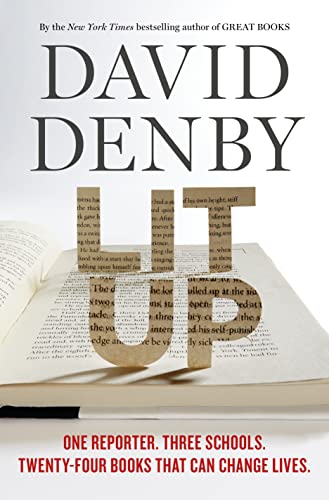
A bestselling author and distinguished critic goes back to high school to find out whether books can shape lives
It's no secret that millions of American teenagers, caught up in social media, television, movies, and games, don't read seriously-they associate sustained reading with duty or work, not with pleasure. This indifference has become a grievous loss to our standing as a great nation--and a personal loss, too, for millions of teenagers who may turn into adults with limited understanding of themselves and the world.
Can teenagers be turned on to serious reading? What kind of teachers can do it, and what books? To find out, Denby sat in on a tenth-grade English class in a demanding New York public school for an entire academic year, and made frequent visits to a troubled inner-city public school in New Haven and to a respected public school in Westchester county. He read all the stories, poems, plays, and novels that the kids were reading, and creates an impassioned portrait of charismatic teachers at work, classroom dramas large and small, and fresh and inspiring encounters with the books themselves, including The Scarlet Letter, Brave New World, 1984, Slaughterhouse-Five, Notes From Underground, Long Way Gone and many more. Lit Up is a dramatic narrative that traces awkward and baffled beginnings but also exciting breakthroughs and the emergence of pleasure in reading. In a sea of bad news about education and the fate of the book, Denby reaffirms the power of great teachers and the importance and inspiration of great books.
Die Inhaltsangabe kann sich auf eine andere Ausgabe dieses Titels beziehen.
Über die Autorin bzw. den Autor
David Denby is the author of Great Books, an acclaimed account of returning to college and reading the Western classics during the curriculum wars; American Sucker, Snark, and Do the Movies Have a Future? He is a staff writer and former film critic for The New Yorker, and his reviews and essays have appeared in The New Republic, The Atlantic, and New York magazine, among other places. He lives in New York City with his wife, writer Susan Rieger.
Auszug. © Genehmigter Nachdruck. Alle Rechte vorbehalten.
Lit Up
One Reporter. Three Schools. Twenty-Four Books That Can Change Lives.
By David DenbyHenry Holt and Company
Copyright © 2016 David Denby
All rights reserved.
ISBN: 978-0-8050-9585-2All rights reserved.
Contents
Title Page,
Copyright Notice,
Dedication,
Epigraph,
INTRODUCTION,
CHAPTER ONE BEACON, SEPTEMBER: THE FIRST DAYS OF ENGLISH 10G,
CHAPTER TWO BEACON, OCTOBER: FAULKNER AND HAWTHORNE,
CHAPTER THREE BEACON, OCTOBER: SYLVIA PLATH AND CONFESSIONS,
CHAPTER FOUR BEACON, NOVEMBER: NUTS MATTER, AND BOLTS, TOO,
CHAPTER FIVE BEACON, NOVEMBER: HUXLEY,
CHAPTER SIX BEACON, DECEMBER AND JANUARY: ORWELL,
CHAPTER SEVEN MAMARONECK, ALL YEAR: PERSONAL CHOICE,
CHAPTER EIGHT BEACON, JANUARY: SATIRE,
CHAPTER NINE BEACON, FEBRUARY: COELHO AND HESSE,
CHAPTER TEN BEACON, FEBRUARY: VONNEGUT,
CHAPTER ELEVEN BEACON, MARCH: VIKTOR E. FRANKL,
CHAPTER TWELVE HILLHOUSE: THE YEAR,
CHAPTER THIRTEEN MAMARONECK, SPRING: TENTH-GRADE ENGLISH,
CHAPTER FOURTEEN BEACON, APRIL AND MAY: DOSTOEVSKY,
CHAPTER FIFTEEN BEACON, MAY AND JUNE: SARTRE AND BECKETT,
NOTE,
AFTERWORD,
Appendix 1: Reading Lists,
Appendix 2: Beacon Students' College List,
Bibliography,
Acknowledgments,
Index of Authors and Works,
About the Author,
Also by David Denby,
Copyright,
CHAPTER 1
BEACON, SEPTEMBER: THE FIRST DAYS OF ENGLISH 10G
* Naming
* Everywhere in Chains
* The Beacon School
* Azar Nafisi on the Strengths and Pleasures of Literature
* Themes Are Brought Up
A teacher was speaking.
"As we develop a community here, and I see you thinking about a text, your voice is as important as my voice. What you say is as important as what I say. I'm standing above you. You have to sit there quietly as I fill the receptacle — you. That's how it goes in large parts of the world. That's not how it goes here. Nino, I'm interested in what you have to say about the text, but back up your points with evidence. And when you refer to each other" — he looked at the others — "don't say 'him.' Say Nino."
Nino looked up. He was a handsome boy with curly black hair, a good smile, and large hands. It turned out he was a carpenter, a catcher, and did magic tricks. He liked doing things with his hands. Nino was a nickname. He was Antonio Ferrante, with an Italian American father, a legal proofreader, and a Jewish mother who had been a teacher.
The teacher went on: "When someone is talking, you will look at him or her, because not looking is a lack of respect. I will not tolerate any disrespect. I will push you hard, but I will not disrespect you. Do not disrespect me. I will take it as a personal affront if you are late."
It was the first class of the year, on September 9, at the Beacon School, on West 61st Street in Manhattan, and the teacher, Sean Leon, seemed to know everyone's name. How was that possible? It was an ordinary tenth-grade English class, not an "elective," a special class that students signed up for (Mr. Leon taught such a class in twelfth grade). Their pictures were on the school website, and he may have scanned the faces. Or perhaps he was just very quick. A few minutes earlier, he had gone through the class list and asked the students to introduce themselves. It's possible he remembered the names from one glance. Later he told me, "It's really important to them that you know who they are."
Clear enough. Identity was the first step toward respect and self-respect. A teacher needed to fix a student's identity, for himself, for the entire class. They would know one another and address one another personally. He did some cold-calling, asking students to name other students. Most of them stumbled and guessed wrong. For some reason, no one remembered the name of Lauren, a girl of mixed Latino and Asian background with long dark hair and a soft smile, who was sitting on the side of the room.
In English 10G, there were eighteen girls and fourteen boys — not an unusual breakdown for Beacon or, for that matter, for many American schools. Girls were generally doing better than boys and staying in school longer. In any case, thirty-two students were a lot, I thought, for an English class. They were ethnically mixed and members of every economic class in the city — from poor families in East Harlem and the Lower East Side; from middle-class families in Queens; from such upper-middle-class precincts as Park Slope in Brooklyn and the Upper West Side of Manhattan. Every social class but the rich, who often sent their kids to private schools. At the moment, they were more than a little abashed.
"How are you feeling right now?" he asked.
"Shy and a little nervous."
"Curious and a little excited."
"Anxious, excited — you seem like a great teacher."
"By the way," he said to the Hispanic girl who blurted this out, "I've heard great things about you as well." Had he really? I wondered. There was a pause. "I know I sound like a suck-up," she went on, and he stopped her. "How long have you been in class already?" — "Twenty minutes" — "Okay, I know you, I can read you already. I know you are not a suck-up." — "I'm not," she said.
That's the way English 10G began, with command, with candor, with embarrassment and reassurance. We were to be introduced to the difficulties and ardors of literature. The class would be a cross between boot camp for readers and the anteroom of paradise. Our teacher was a slender man in his late thirties, about five feet ten inches, taut and trim in a pink, long-sleeved shirt rolled up on his forearms, a brown vest, a dark gold tie. He had thinning brown hair, a short, pointed beard. Sean Leon smiled a great deal. His voice was dry, a little hard in tone, penetrating, and he said what he wanted to say, without hesitations or false starts. The accent, however, was hard to place. He had been born in Northern Ireland — a member of the Catholic minority in the city of Derry. His father was an American — a navy guy — his mother Irish, and the family had moved to Louisiana, near New Orleans, where he grew up. But his accent was neutral, certainly not Irish, and I couldn't hear a trace of the American South in it.
Mr. Leon's classroom, room 332, was located on an inner corridor at Beacon. A room without windows, good-sized but closed in on itself. The desks were nothing like the separate oak units with black iron frames, arranged in parallel rows, that I remembered from my own high school decades ago. They weren't really desks at all. They were dark brown rectangular wooden tables, with room for six students, and they could be moved about, arranged into any configuration. At that moment, they were arranged in a squared-off U-shape with an opening in the front. Mr. Leon would step forward into the opening at times, but he was restless, and he moved around to the sides of the room or to the back, standing behind the students as he talked. On the walls of his classroom there were pictures of his favorite writers, including a large poster-photo of Franz Kafka, eyes wide open, looking haunted, as if he had seen a ghost (his own, no doubt). Old student projects hung on one side of the room — collages, mostly, with pieces of cellophane and string, maybe some glitter, all mounted on wooden boards or construction paper. The style was student Chagall — everything seemed upside down, determinedly antirealistic, symbolic. Pop culture and...
„Über diesen Titel“ kann sich auf eine andere Ausgabe dieses Titels beziehen.
Suchergebnisse für Lit Up: One Reporter. Three Schools. Twenty-Four Books...

Beispielbild für diese ISBN
Lit Up: One Reporter. Three Schools. Twenty-four Books That Can Change Lives.
Anbieter: World of Books (was SecondSale), Montgomery, IL, USA
Verkäuferbewertung 5 von 5 Sternen

Zustand: Good. Item in good condition. Textbooks may not include supplemental items i.e. CDs, access codes etc. Artikel-Nr. 00105190777
Gebraucht kaufen
EUR 3,92
Versand gratis
Versand innerhalb von USA
Versand innerhalb von USA
Anzahl: 5 verfügbar
Beispielbild für diese ISBN
Lit Up: One Reporter. Three Schools. Twenty-four Books That Can Change Lives.
Anbieter: World of Books (was SecondSale), Montgomery, IL, USA
Verkäuferbewertung 5 von 5 Sternen
Zustand: Acceptable. Item in acceptable condition! Textbooks may not include supplemental items i.e. CDs, access codes etc. Artikel-Nr. 00108442037
Gebraucht kaufen
EUR 3,92
Versand gratis
Versand innerhalb von USA
Versand innerhalb von USA
Anzahl: 1 verfügbar
Beispielbild für diese ISBN
Lit Up: One Reporter. Three Schools. Twenty-four Books That Can Change Lives.
Anbieter: World of Books (was SecondSale), Montgomery, IL, USA
Verkäuferbewertung 5 von 5 Sternen
Zustand: Good. Good condition ex-library book with usual library markings and stickers. Artikel-Nr. 00104992788
Gebraucht kaufen
EUR 4,14
Versand gratis
Versand innerhalb von USA
Versand innerhalb von USA
Anzahl: 1 verfügbar
Beispielbild für diese ISBN
Lit Up: One Reporter. Three Schools. Twenty-four Books That Can Change Lives.
Verlag:
Henry Holt and Co. (edition ), 2016
ISBN 10: 0805095853
ISBN 13: 9780805095852
Gebraucht
Hardcover
Anbieter: BooksRun, Philadelphia, PA, USA
Verkäuferbewertung 5 von 5 Sternen
Hardcover. Zustand: Fair. The item might be beaten up but readable. May contain markings or highlighting, as well as stains, bent corners, or any other major defect, but the text is not obscured in any way. Artikel-Nr. 0805095853-7-1-13
Gebraucht kaufen
EUR 5,02
Versand gratis
Versand innerhalb von USA
Versand innerhalb von USA
Anzahl: 1 verfügbar
Beispielbild für diese ISBN
Lit Up: One Reporter. Three Schools. Twenty-Four Books That Can Change Lives.
Anbieter: ThriftBooks-Dallas, Dallas, TX, USA
Verkäuferbewertung 5 von 5 Sternen
Hardcover. Zustand: As New. No Jacket. Pages are clean and are not marred by notes or folds of any kind. ~ ThriftBooks: Read More, Spend Less. Artikel-Nr. G0805095853I2N00
Gebraucht kaufen
EUR 6,95
Versand gratis
Versand innerhalb von USA
Versand innerhalb von USA
Anzahl: 1 verfügbar
Beispielbild für diese ISBN
Lit Up: One Reporter. Three Schools. Twenty-Four Books That Can Change Lives.
Anbieter: ThriftBooks-Dallas, Dallas, TX, USA
Verkäuferbewertung 5 von 5 Sternen
Hardcover. Zustand: Very Good. No Jacket. May have limited writing in cover pages. Pages are unmarked. ~ ThriftBooks: Read More, Spend Less. Artikel-Nr. G0805095853I4N00
Gebraucht kaufen
EUR 6,95
Versand gratis
Versand innerhalb von USA
Versand innerhalb von USA
Anzahl: 1 verfügbar
Beispielbild für diese ISBN
Lit Up: One Reporter. Three Schools. Twenty-Four Books That Can Change Lives.
Anbieter: ThriftBooks-Atlanta, AUSTELL, GA, USA
Verkäuferbewertung 5 von 5 Sternen
Hardcover. Zustand: Very Good. No Jacket. May have limited writing in cover pages. Pages are unmarked. ~ ThriftBooks: Read More, Spend Less. Artikel-Nr. G0805095853I4N00
Gebraucht kaufen
EUR 6,95
Versand gratis
Versand innerhalb von USA
Versand innerhalb von USA
Anzahl: 1 verfügbar
Beispielbild für diese ISBN
Lit Up : One Reporter. Three Schools. Twenty-Four Books That Can Change Lives
Anbieter: Better World Books, Mishawaka, IN, USA
Verkäuferbewertung 5 von 5 Sternen
Zustand: Very Good. Former library copy. Pages intact with possible writing/highlighting. Binding strong with minor wear. Dust jackets/supplements may not be included. Includes library markings. Stock photo provided. Product includes identifying sticker. Better World Books: Buy Books. Do Good. Artikel-Nr. 11764576-75
Gebraucht kaufen
EUR 6,95
Versand gratis
Versand innerhalb von USA
Versand innerhalb von USA
Anzahl: 2 verfügbar
Beispielbild für diese ISBN
Lit Up: One Reporter. Three Schools. Twenty-four Books That Can Change Lives.
Anbieter: Roundabout Books, Greenfield, MA, USA
Verkäuferbewertung 4 von 5 Sternen

hardcover. Zustand: Near Fine. Condition Notes: Excellent, unmarked copy with little wear and tight binding. We ship in recyclable American-made mailers. 100% money-back guarantee on all orders. Artikel-Nr. 1656691
Gebraucht kaufen
EUR 14,63
Versand gratis
Versand innerhalb von USA
Versand innerhalb von USA
Anzahl: 1 verfügbar
Beispielbild für diese ISBN
Lit Up: One Reporter. Three Schools. Twenty-four Books That Can Change Lives.
Anbieter: WorldofBooks, Goring-By-Sea, WS, Vereinigtes Königreich
Verkäuferbewertung 5 von 5 Sternen
Paperback. Zustand: Very Good. The book has been read, but is in excellent condition. Pages are intact and not marred by notes or highlighting. The spine remains undamaged. Artikel-Nr. GOR007802183
Gebraucht kaufen
EUR 12,06
EUR 6,53 Versand
Versand von Vereinigtes Königreich nach USA
Versand von Vereinigtes Königreich nach USA
Anzahl: 1 verfügbar