
Verwandte Artikel zu Bottom of the Ninth: Branch Rickey, Casey Stengel,...
Bottom of the Ninth: Branch Rickey, Casey Stengel, and the Daring Scheme to Save Baseball from Itself - Softcover
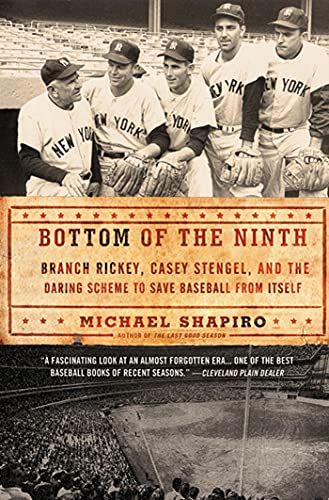
Inhaltsangabe
In Bottom of the Ninth, Michael Shapiro brings to life a watershed moment in baseball history, when the sport was under siege in the late 1950s
"A fascinating look at an almost forgotten era . . . One of the best baseball books of recent seasons." -Cleveland Plain Dealer
Shapiro reveals how the legendary executive Branch Rickey saw the game's salvation in two radical ideas: the creation of a third major league-the Continental League-and the pooling of television revenues for the benefit of all. And Shapiro captures the audacity of Casey Stengel, the manager of the Yankees, who believed that he could remake how baseball was played.
The story of their ingenious schemes-and of the powerful men who tried to thwart them-is interwoven with the on-field drama of pennant races and clutch performances, culminating in the stunning climax of the seventh game of the 1960 World Series, when one swing of the bat heralds baseball's eclipse as America's number-one sport.
Die Inhaltsangabe kann sich auf eine andere Ausgabe dieses Titels beziehen.
Über die Autorin bzw. den Autor
Michael Shapiro is the author of Bottom of the Ninth and The Last Good Season: Brooklyn, the Dodgers, and Their Final Pennant Race Together. A professor at the Columbia School of Journalism, he is the author of several additional books, and his articles have appeared in The New York Times, Sports Illustrated, Esquire, The Wall Street Journal, and The New Yorker. He lives in New York City with his wife and two children.
Auszug. © Genehmigter Nachdruck. Alle Rechte vorbehalten.
Bottom of the Ninth
Branch Rickey, Casey Stengel, and the Daring Scheme to Save Baseball from Itself
By Michael ShapiroHenry Holt and Company
Copyright © 2009 Michael Shapiro
All rights reserved.
ISBN: 978-0-8050-9236-3All rights reserved.
Contents
INTRODUCTION OCTOBER 13, 1960,
CHAPTER ONE: Fall 1958,
October: Lamentations,
November: Dawn,
December: Restoration,
CHAPTER TWO: Winter 1959,
January: Immortality,
February: Allies,
March: Casey in Clover,
CHAPTER THREE-Spring 1959,
April: The Crisis of the Old Order,
May: Fall from Grace,
June: The Temptation of Charlie Weeghman,
CHAPTER FOUR: Summer 1959,
July: Beware the Ides of March,
August: Big Ed's Dilemma,
September: O'Malley in Bloom,
CHAPTER FIVE: Fall 1959,
October: Days of Reckoning,
November: Calling the Bluff,
December: Three's a Crowd,
CHAPTER SIX: Winter 1960,
January: Members Only,
February: Three Perils,
March: The Pitchman,
CHAPTER SEVEN: Spring 1960,
April: A Path to Redemption,
May: Showdown,
June: Reversal of Fortune,
CHAPTER EIGHT: Summer 1960,
July: Last Chances,
August: Kindred Spirits,
September: Indian Summer,
CHAPTER NINE: October 1960,
EPILOGUE,
Sources,
Acknowledgments,
Index,
CHAPTER 1
FALL 1958
OCTOBER: Lamentations
Warren Spahn was shutting out the Yankees, and all Casey Stengel could do by the bottom of the eighth inning of Game Four of the World Series was march up and down his dugout barking, "Let's go. Let's go." He might just as well have saved himself the exertion. The Yankees were going quietly, as they had all afternoon — strikeout, pop to second, strikeout, the last by Norm Siebern, who had lost four fly balls in the sun in left field, making gifts of two of Milwaukee's three runs. Mickey Mantle's grounder to short an inning later brought the day to a close and the Braves to within a victory of repeating as world champions.
Nothing had gone right for Stengel all week, with the exception of Game Three at Yankee Stadium, his team's only victory, when all the cruel things that had happened in Games One and Two in Milwaukee seemed forgotten, and Stengel was back in chatty form. "Now let me ask ya why I shouldn't be glad," he said. He spoke as he studied himself in front of a mirror, adjusting his ten-gallon hat. "We win a game and I'm glad, which is what I'd rather be than nervous, which is what I was after they win the first two games."
He had not helped himself strategically, and his players knew it — and for once said so. Hank Bauer had opened Game One by singling against Spahn, and Stengel, never one to leave things solely to the discretion and talents of his men, promptly called for a hit-and-run. Spahn possessed one of the finest pickoff moves in the game and caught Bauer leaning. "When they gave me the sign I had to go," Bauer later said, "even though I didn't agree with the old man." The writers picked up where Bauer left off, questioning Stengel's decision in the eighth to pitch to a power hitter, Wes Covington, with a man on third and one out, rather than walking him and setting up a potential double play. Covington's fly ball scored Eddie Matthews, tying the game, which Milwaukee won in the tenth. Game Two was a 13–5 drubbing in which Stengel's primary function was to make six trips to the mound to change pitchers. "This could be a shambles," said the former Dodgers and Giants manager Leo Durocher, who stopped by the press box after the rout to offer his views. Durocher may have been between teams but was never shy about his opinions. "You can see the signs."
What do you see, Leo? someone asked.
"It's not just the two defeats," he replied. "The Yankees are playing lousy baseball."
A writer shared Durocher's diagnosis with Stengel, who snapped, "Hell, you're telling me? Ain't I been saying that for a month and a half?"
He'd been saying that, and more. He had berated his players publicly. After losing three out of four at Fenway Park in mid-August he first locked his men in their clubhouse for a heated forty-five-minute lecture and then docked them a rare off-day by holding a two-hour practice, even though they were in first place by eleven and a half games. He was seeing too many mistakes and insisted that his men needed drilling on the fundamentals rather than a day of rest after playing thirty games in twenty-eight days. His players rebelled, cautiously, grousing to the beat reporters but insisting that their names not appear: "He just wants to flaunt his authority" and "Is he going to give his brain a workout, too?" and "I never seen him get on guys as bad as he's been lately." Stengel did not much care. "If they don't like it they can read their contracts," he said. "I'm the manager and as long as I'm here they'll do what I tell them to do."
But Stengel had been unable to roust the Yankees from their torpor; they finished the season by going 17–18 in their last thirty-five games, and their rowdiness off the field had prompted management to hire private detectives to tail them. Even clinching the American League pennant came with a cloud: on the train back from Kansas City, Ralph Houk, a coach, and reliever Ryne Duren got into a nasty fistfight. The game had gone late and the players had already begun to celebrate by the time they arrived at the station. Duren, who could be a mean drunk, smashed Houk's unlit cigar into his mouth and ended up kicking another pitcher, Don Larsen, in the mouth when his teammates tried to get him into his berth. "You get whiskey drunk and then you fight with your own," snapped Stengel as he stormed into the car. Houk, ten years Duren's senior, was judged the winner, leaving Duren with a gash over his right eye.
Still, the oddsmakers favored the Yankees to win the World Series against the Braves, a choice that reflected the powerful tug of nostalgia rather than a cool assessment of the prospects: never mind that Milwaukee had dethroned the Yankees in the 1957 series; New York owned so many other Octobers. Then came the first two games, which brought a change of heart among the bookmakers. The Yankees returned to the Bronx from Milwaukee talking comeback, as they had done in 1956, when they dropped the first two games in Brooklyn, only to win in seven. But Stengel seemed oblivious to good omens and silver linings. A television crew approached as the Yankees took their warm-ups, and the reporter, apparently unschooled in the lexicon of the game, made the grievous mistake of asking Stengel to assess his players' mettle by invoking the word most damning to an athlete's soul.
"Is your team choking?" he asked.
"Do you choke on the fucking microphone?" said Stengel. He turned and scratched his behind for the camera.
Game Three's 4–0 Yankees victory brought a day's respite. But Spahn held the Yankees to two hits in Game Four, and afterward Jimmy Cannon of the New York Post wrote as if he were preparing the earth to receive the remains for the team he used to know: "They have lost what they once had alone and they won't be the Yankees until they get it back. It will take a long time because this team has to be torn apart and put together again."
Cannon had known and admired the Yankees of Charlie Keller, Tommy Henrich, Bill Dickey, and above all, Joe DiMaggio. "They were the greatest hitting teams in all the seasons of baseball," he wrote. And then he offered his grim conclusion. "This is the...
„Über diesen Titel“ kann sich auf eine andere Ausgabe dieses Titels beziehen.
Suchergebnisse für Bottom of the Ninth: Branch Rickey, Casey Stengel,...

Beispielbild für diese ISBN
Bottom of the Ninth
Anbieter: World of Books (was SecondSale), Montgomery, IL, USA
Verkäuferbewertung 5 von 5 Sternen

Zustand: Good. Item in good condition. Textbooks may not include supplemental items i.e. CDs, access codes etc. Artikel-Nr. 00108011169
Gebraucht kaufen
EUR 5,37
Versand gratis
Versand innerhalb von USA
Versand innerhalb von USA
Anzahl: 1 verfügbar
Beispielbild für diese ISBN
Bottom of the Ninth: Branch Rickey, Casey Stengel, and the Daring Scheme to Save Baseball from Itself
Anbieter: ThriftBooks-Atlanta, AUSTELL, GA, USA
Verkäuferbewertung 5 von 5 Sternen
Paperback. Zustand: Good. No Jacket. Pages can have notes/highlighting. Spine may show signs of wear. ~ ThriftBooks: Read More, Spend Less. Artikel-Nr. G0805092366I3N00
Gebraucht kaufen
EUR 5,98
Versand gratis
Versand innerhalb von USA
Versand innerhalb von USA
Anzahl: 1 verfügbar
Beispielbild für diese ISBN
Bottom of the Ninth: Branch Rickey, Casey Stengel, and the Daring Scheme to Save Baseball from Itself
Anbieter: ThriftBooks-Reno, Reno, NV, USA
Verkäuferbewertung 5 von 5 Sternen
Paperback. Zustand: Very Good. No Jacket. May have limited writing in cover pages. Pages are unmarked. ~ ThriftBooks: Read More, Spend Less. Artikel-Nr. G0805092366I4N00
Gebraucht kaufen
EUR 5,98
Versand gratis
Versand innerhalb von USA
Versand innerhalb von USA
Anzahl: 1 verfügbar
Beispielbild für diese ISBN
Bottom of the Ninth: Branch Rickey, Casey Stengel, and the Daring Scheme to Save Baseball from Itself
Anbieter: ThriftBooks-Phoenix, Phoenix, AZ, USA
Verkäuferbewertung 5 von 5 Sternen
Paperback. Zustand: Good. No Jacket. Pages can have notes/highlighting. Spine may show signs of wear. ~ ThriftBooks: Read More, Spend Less. Artikel-Nr. G0805092366I3N00
Gebraucht kaufen
EUR 5,98
Versand gratis
Versand innerhalb von USA
Versand innerhalb von USA
Anzahl: 1 verfügbar
Beispielbild für diese ISBN
Bottom of the Ninth: Branch Rickey, Casey Stengel, and the Daring Scheme to Save Baseball from Itself
Anbieter: ThriftBooks-Dallas, Dallas, TX, USA
Verkäuferbewertung 5 von 5 Sternen
Paperback. Zustand: Very Good. No Jacket. May have limited writing in cover pages. Pages are unmarked. ~ ThriftBooks: Read More, Spend Less. Artikel-Nr. G0805092366I4N00
Gebraucht kaufen
EUR 5,98
Versand gratis
Versand innerhalb von USA
Versand innerhalb von USA
Anzahl: 1 verfügbar
Beispielbild für diese ISBN
Bottom of the Ninth: Branch Rickey, Casey Stengel, and the Daring Scheme to Save Baseball from Itself
Anbieter: ThriftBooks-Atlanta, AUSTELL, GA, USA
Verkäuferbewertung 5 von 5 Sternen
Paperback. Zustand: Fair. No Jacket. Readable copy. Pages may have considerable notes/highlighting. ~ ThriftBooks: Read More, Spend Less. Artikel-Nr. G0805092366I5N00
Gebraucht kaufen
EUR 5,98
Versand gratis
Versand innerhalb von USA
Versand innerhalb von USA
Anzahl: 1 verfügbar
Beispielbild für diese ISBN
Bottom of the Ninth: Branch Rickey, Casey Stengel, and the Daring Scheme to Save Baseball from Itself
Anbieter: ThriftBooks-Atlanta, AUSTELL, GA, USA
Verkäuferbewertung 5 von 5 Sternen
Paperback. Zustand: Very Good. No Jacket. May have limited writing in cover pages. Pages are unmarked. ~ ThriftBooks: Read More, Spend Less. Artikel-Nr. G0805092366I4N00
Gebraucht kaufen
EUR 5,98
Versand gratis
Versand innerhalb von USA
Versand innerhalb von USA
Anzahl: 1 verfügbar
Beispielbild für diese ISBN
Bottom of the Ninth: Branch Rickey, Casey Stengel, and the Daring Scheme to Save Baseball from Itself
Anbieter: Wonder Book, Frederick, MD, USA
Verkäuferbewertung 5 von 5 Sternen
Zustand: Very Good. Very Good condition. A copy that may have a few cosmetic defects. May also contain light spine creasing or a few markings such as an owner's name, short gifter's inscription or light stamp. Artikel-Nr. Q02A-02891
Gebraucht kaufen
EUR 6,27
Versand gratis
Versand innerhalb von USA
Versand innerhalb von USA
Anzahl: 1 verfügbar
Beispielbild für diese ISBN
Bottom of the Ninth: Branch Rickey, Casey Stengel, and the Daring Scheme to Save Baseball from Itself
Verlag:
St. Martin's Griffin, 2010
ISBN 10: 0805092366
ISBN 13: 9780805092363
Gebraucht
Softcover
Signiert
Anbieter: Wonder Book, Frederick, MD, USA
Verkäuferbewertung 5 von 5 Sternen
Zustand: Good. Signed Copy . Signed by author on half title page. Artikel-Nr. N01OS-00053
Gebraucht kaufen
EUR 6,27
Versand gratis
Versand innerhalb von USA
Versand innerhalb von USA
Anzahl: 1 verfügbar
Beispielbild für diese ISBN
Bottom of the Ninth : Branch Rickey, Casey Stengel, and the Daring Scheme to Save Baseball from Itself
Verlag:
St. Martin's Press, 2010
ISBN 10: 0805092366
ISBN 13: 9780805092363
Gebraucht
Softcover
Erstausgabe
Anbieter: Better World Books, Mishawaka, IN, USA
Verkäuferbewertung 5 von 5 Sternen
Zustand: Good. 1st Edition. Pages intact with minimal writing/highlighting. The binding may be loose and creased. Dust jackets/supplements are not included. Stock photo provided. Product includes identifying sticker. Better World Books: Buy Books. Do Good. Artikel-Nr. 5353589-6
Gebraucht kaufen
EUR 6,84
Versand gratis
Versand innerhalb von USA
Versand innerhalb von USA
Anzahl: 2 verfügbar