
Inhaltsangabe
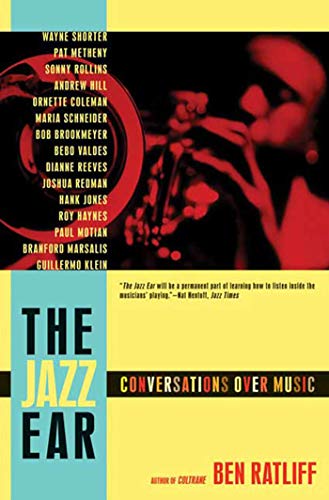
"The Jazz Ear will be a permanent part of learning how to listen inside the musicians playing."-Nat Hentoff, Jazz Times
Jazz is conducted almost wordlessly: John Coltrane rarely told his quartet what to do, and Miles Davis famously gave his group only the barest instructions before recording his masterpiece Kind of Blue. Musicians often avoid discussing their craft for fear of destroying its improvisational essence, rendering jazz among the most ephemeral and least transparent of the performing arts.
In The Jazz Ear, acclaimed music critic Ben Ratliff discusses with jazz greats the recordings that most influenced them and skillfully coaxes out a profound understanding of the men and women themselves, the context of their work, and how jazz-from horn blare to drum riff-is conceptualized. Ratliff speaks with Sonny Rollins, Ornette Coleman, Branford Marsalis, Dianne Reeves, Wayne Shorter, Joshua Redman, and others about the subtle variations in generation and attitude that define their music.
Playful and keenly insightful, The Jazz Ear is a revelatory exploration of a unique way of making and hearing music.
Die Inhaltsangabe kann sich auf eine andere Ausgabe dieses Titels beziehen.
Über die Autorin bzw. den Autor
Ben Ratliff
Auszug. © Genehmigter Nachdruck. Alle Rechte vorbehalten.
The Jazz Ear
Conversations Over Music
By Ben RatliffHenry Holt and Company
Copyright © 2008 Ben Ratliff
All rights reserved.
ISBN: 978-0-8050-9086-4All rights reserved.
Contents
Introduction,
1. Behold, the Sea! Wayne Shorter,
2. Street Music Pat Metheny,
3. Jazz Means Freedom Sonny Rollins,
4. As Good as You Think Andrew Hill,
5. I Know Who You Are Ornette Coleman,
6. The Flying Modulation Maria Schneider,
7. You've Got to Finish Your Thought Bob Brookmeyer,
8. Head of a Dog Bebo Valdés,
9. It's Your Spirit Dianne Reeves,
10. This Is My Point Joshua Redman,
11. Labor History Hank Jones,
12. Dancing from Up Here Roy Haynes,
13. Head to Toes Paul Motian,
14. A Million Just Like It Branford Marsalis,
15. You Don't Look for Style Guillermo Klein,
Recommended Listening,
Photography Credits,
Acknowledgments,
Index,
CHAPTER 1
Behold, the Sea! Wayne Shorter
There's a story I like about Wayne Shorter. It's told in Footprints, Michelle Mercer's biography of Shorter, a book that folded in his voice and which may have to serve as his autobiography, unless he writes a proper one. It is told by Hal Miller, a jazz historian who sometimes traveled on tour with Weather Report, the band Shorter played saxophone with from 1971 to 1985.
"I remember once I asked Wayne for the time," Miller told Mercer. "He started talking to me about the cosmos and how time is relative." Miller and Shorter were waiting somewhere — an airport, a train station, a hotel. The band's keyboardist, Joe Zawinul, who took charge of such matters as what the road crew was supposed to do and when, set Miller straight. "You don't ask Wayne shit like that," he snapped. "It's 7:06 p.m."
I have had similar conversations with Shorter over the years. Not long after I read that book, I got in touch with him, hoping we could listen to some music that he admired, as a way into having a conversation about music and, ultimately, about his own work. I figured that the exchange might be one ballooned 7:06 p.m., but I also figured that as long as we were listening to the same music at the same time, the conversation wouldn't break down. After he finished a European tour with his quartet, we got together on a December afternoon at his home in Aventura, Florida, less a town than a thicket of tall condominium towers near the ocean.
Since he went back on the road with an acoustic jazz quartet in 2001, after an extended period of fits and starts following the breakup of Weather Report, Shorter's shows have built up a consensus of awe seldom encountered in the splintered world of jazz. He has been playing his own compositions — from his days with the mid-1960s Miles Davis Quintet to pieces from later solo records — and establishing that there is a way of writing tunes for a hard-core jazz group that are not codified by style as soon as they hit the music paper. The pieces are open-ended, a function of his temperament, as a few hours in his company makes clear.
Shorter, born and raised in Newark, New Jersey, has a cast of mind that makes his jazz almost zenlike. His songs are succinct, clever, sometimes even cute, but they also pose unanswerable questions. Many of his songs from the mid-1960s, when he was turning out one small masterpiece after another — "Fall," "Limbo," "Nefertiti," "Et Cetera," "Orbits" — are dressed in odd phrase lengths and rarefied harmonies. They can seem too fragile to be bruised in a nightclub.
A test of jazz musicians and composers is whether their writing can succeed outside their own creators' preferred context: a trio, a quartet, a big band, or whatever. Wayne Shorter's "Footprints," "Speak No Evil," and "Infant Eyes" have been common standards for a long time now, played in many different types of bands, with other compositions of his approaching that level. Likewise, it's not just with his quartet that he can slay audiences. I once saw him walk on stage for a single solo, on a version of Antonio Carlos Jobim's "Dindi," with the singer Flora Purim. It was spectacular, a grainy, evocative, playful thing that kept striking earthy and far-out patterns. He had just turned seventy-one at the time and gave no indication of having decided that he could rely on a boilerplate version of his own sound.
Standing at the windows of his apartment tower, Shorter pointed out the nearby buildings where Whitney Houston and Sophia Loren lived, then showed me a catalog of new work by his wife's cousin, a sculptor from São Paulo. (In 1999 he married Carolina dos Santos, a singer and actress, his third wife.) Finally, he produced a box set of music by Ralph Vaughan Williams, conducted by Sir Adrian Boult. "I got something good for you," he said.
I had been expecting classical music. Some of his recent works have been rearrangements, for orchestra and jazz quartet, of Villa-Lobos and Sibelius. I thought he might pick Stravinsky, the bebopper's idol. But this choice made sense, too; the English composer Vaughan Williams, directly or indirectly, influenced many postwar film composers, and if there's one artistic stimulus that Shorter always seems open to, it is the movies.
Small and cheery, dressed in I'm-not-going-outside-today clothes and bedroom slippers, he spent some time struggling to set the Krell home-theater preamp so that it could play a CD. I was forming a suspicion that he didn't listen to music much.
"Hey, man, the Krell. You ever see the movie Forbidden Planet?" he asked. "There was this planet full of people called the Krells. And nobody had been there from Earth — the explorers from Earth didn't see anybody when they arrived. But they all went to sleep one night in their spacecraft, and you hear the first sound of special effects that really came to the fore in movies — this chrrmmm! Chroooom! And you see the ground that's been depressed by huge footprints, not human ..."
He first chose the opening of Vaughan Williams's Symphony no. 1: "A Song for All Seas, All Ships," composed in 1910, with orchestra and choir singing lines taken from a poem by Walt Whitman. After the fanfare, twenty seconds into the piece, as the strings begin to rise dramatically, Shorter smiled. "Life, that's what he's saying," he said. "It's a metaphor for life."
It is superhero music. (Shorter, who is not cagey about his enthusiasms, wore a blue Superman T-shirt that day.) "Behold," the chorus sang out again, "the sea!" The cymbals crashed, illustrating a wave, and then the tempo fell off, the sound dispersing like spray.
"I like that," he said. "It's almost saying, 'Look at your life.' If anybody wants to commit suicide, just take a look at your life. Look in the mirror. Because we are the ship." The brass lines grew denser. "I like that, the little line in the bass going down, the contrary motion. It's like describing a thing that you don't need to worry about. It's like, life should be awesome. The lyrics are saying something else, but there are some things that lyrics cannot express." The chorus came back again. "Power!" he said, grinning.
"I only heard this piece eight or nine months ago," he explained, motioning to the box set we were listening to, which he had just unwrapped. "But Ralph Vaughan Williams, I've been tracking him since I was about sixteen or seventeen. I used to listen to a program called New Ideas in Music, which came on every Saturday at noon on the radio."
Shorter's mother worked for a furrier...
„Über diesen Titel“ kann sich auf eine andere Ausgabe dieses Titels beziehen.
Weitere beliebte Ausgaben desselben Titels

Suchergebnisse für The Jazz Ear: Conversations Over Music

Beispielbild für diese ISBN
The Jazz Ear : Conversations over Music
Verlag:
St. Martin's Press, 2009
ISBN 10: 080509086X
ISBN 13: 9780805090864
Gebraucht
Softcover
Erstausgabe
Anbieter: Better World Books, Mishawaka, IN, USA
Verkäuferbewertung 5 von 5 Sternen

Zustand: Good. First Edition. Pages intact with minimal writing/highlighting. The binding may be loose and creased. Dust jackets/supplements are not included. Stock photo provided. Product includes identifying sticker. Better World Books: Buy Books. Do Good. Artikel-Nr. 11580523-6
Gebraucht kaufen
EUR 5,67
Versand gratis
Versand innerhalb von USA
Versand innerhalb von USA
Anzahl: 1 verfügbar
Beispielbild für diese ISBN
The Jazz Ear Conversations Ove
Anbieter: World of Books (was SecondSale), Montgomery, IL, USA
Verkäuferbewertung 5 von 5 Sternen
Zustand: Very Good. Item in very good condition! Textbooks may not include supplemental items i.e. CDs, access codes etc. Artikel-Nr. 00103407415
Gebraucht kaufen
EUR 5,76
Versand gratis
Versand innerhalb von USA
Versand innerhalb von USA
Anzahl: 1 verfügbar
Beispielbild für diese ISBN
The Jazz Ear: Conversations Ov
Anbieter: World of Books (was SecondSale), Montgomery, IL, USA
Verkäuferbewertung 5 von 5 Sternen
Zustand: Good. Item in good condition. Textbooks may not include supplemental items i.e. CDs, access codes etc. Artikel-Nr. 00100799859
Gebraucht kaufen
EUR 5,76
Versand gratis
Versand innerhalb von USA
Versand innerhalb von USA
Anzahl: 1 verfügbar
Beispielbild für diese ISBN
The Jazz Ear: Conversations over Music
Verlag:
St. Martin's Griffin (edition First Edition), 2009
ISBN 10: 080509086X
ISBN 13: 9780805090864
Gebraucht
Paperback
Erstausgabe
Anbieter: BooksRun, Philadelphia, PA, USA
Verkäuferbewertung 5 von 5 Sternen
Paperback. Zustand: Very Good. First Edition. It's a well-cared-for item that has seen limited use. The item may show minor signs of wear. All the text is legible, with all pages included. It may have slight markings and/or highlighting. Artikel-Nr. 080509086X-11-1
Gebraucht kaufen
EUR 6,81
Versand gratis
Versand innerhalb von USA
Versand innerhalb von USA
Anzahl: 1 verfügbar
Beispielbild für diese ISBN
The Jazz Ear: Conversations over Music
Anbieter: Wonder Book, Frederick, MD, USA
Verkäuferbewertung 5 von 5 Sternen
Zustand: Good. Good condition. A copy that has been read but remains intact. May contain markings such as bookplates, stamps, limited notes and highlighting, or a few light stains. Artikel-Nr. M03G-06216
Gebraucht kaufen
EUR 6,99
Versand gratis
Versand innerhalb von USA
Versand innerhalb von USA
Anzahl: 1 verfügbar
Beispielbild für diese ISBN
The Jazz Ear: Conversations Over Music
Anbieter: ThriftBooks-Reno, Reno, NV, USA
Verkäuferbewertung 5 von 5 Sternen
Paperback. Zustand: Very Good. No Jacket. May have limited writing in cover pages. Pages are unmarked. ~ ThriftBooks: Read More, Spend Less. Artikel-Nr. G080509086XI4N00
Gebraucht kaufen
EUR 7,35
Versand gratis
Versand innerhalb von USA
Versand innerhalb von USA
Anzahl: 1 verfügbar
Beispielbild für diese ISBN
The Jazz Ear: Conversations Over Music
Anbieter: ThriftBooks-Dallas, Dallas, TX, USA
Verkäuferbewertung 5 von 5 Sternen
Paperback. Zustand: Good. No Jacket. Pages can have notes/highlighting. Spine may show signs of wear. ~ ThriftBooks: Read More, Spend Less. Artikel-Nr. G080509086XI3N00
Gebraucht kaufen
EUR 7,38
Versand gratis
Versand innerhalb von USA
Versand innerhalb von USA
Anzahl: 1 verfügbar
Beispielbild für diese ISBN
The Jazz Ear: Conversations Over Music
Anbieter: ThriftBooks-Atlanta, AUSTELL, GA, USA
Verkäuferbewertung 5 von 5 Sternen
Paperback. Zustand: Good. No Jacket. Pages can have notes/highlighting. Spine may show signs of wear. ~ ThriftBooks: Read More, Spend Less. Artikel-Nr. G080509086XI3N00
Gebraucht kaufen
EUR 7,38
Versand gratis
Versand innerhalb von USA
Versand innerhalb von USA
Anzahl: 1 verfügbar
Beispielbild für diese ISBN
The Jazz Ear: Conversations Over Music
Anbieter: ThriftBooks-Atlanta, AUSTELL, GA, USA
Verkäuferbewertung 5 von 5 Sternen
Paperback. Zustand: Very Good. No Jacket. May have limited writing in cover pages. Pages are unmarked. ~ ThriftBooks: Read More, Spend Less. Artikel-Nr. G080509086XI4N00
Gebraucht kaufen
EUR 7,38
Versand gratis
Versand innerhalb von USA
Versand innerhalb von USA
Anzahl: 1 verfügbar
Beispielbild für diese ISBN
The Jazz Ear: Conversations Over Music
Anbieter: ThriftBooks-Dallas, Dallas, TX, USA
Verkäuferbewertung 5 von 5 Sternen
Paperback. Zustand: Fair. No Jacket. Readable copy. Pages may have considerable notes/highlighting. ~ ThriftBooks: Read More, Spend Less. Artikel-Nr. G080509086XI5N00
Gebraucht kaufen
EUR 7,38
Versand gratis
Versand innerhalb von USA
Versand innerhalb von USA
Anzahl: 1 verfügbar