
Verwandte Artikel zu Samuel Johnson: A Life
Inhaltsangabe
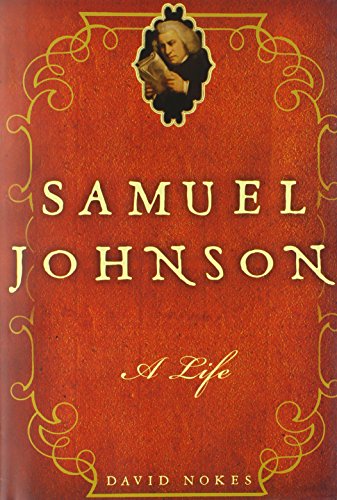
In this portrait of Samuel Johnson, David Nokes positions the great thinker in his rightful place as an active force in the Enlightenment, not a mere recorder or performer, and demonstrates how his interaction with life impacted his work. This biography addresses his life and action through the hitherto unexplored perspectives of such major players as Johnson's wife, Tetty; Hester Thrale, in whose household he resided for seventeen years while working on his annotated Shakespeare; and Frances Barber, theblack manservant who in many ways was like a son to Johnson. --from publisher description
Die Inhaltsangabe kann sich auf eine andere Ausgabe dieses Titels beziehen.
Über die Autorin bzw. den Autor
David Nokes is the author of a biography of Jane Austen published in 1997. A professor of English literature at King's College, London, Nokes also teaches creative writing at the university. He has previously written a novel and a television drama and adapted classics for the screen. His reviews appear often in The Times Literary Supplement.
Auszug. © Genehmigter Nachdruck. Alle Rechte vorbehalten.
Samuel Johnson
PART ONE
The Midlander
1
Lichfield
Lichfield, the field of the dead, a city in Staffordshire, so named from martyred Christians. Salve magna parens.
September 7, 1709, I was born at Lichfield.
Johnson, Annals
Lichfield has changed little in appearance in the past fifty years, though possibly it is more pleasant to explore on foot than formerly. James Clifford, in his biography of Johnson, described 'thundering trucks and streams of motor-cars' making the market-place a scene of noise and danger, but now that the city centre has been pedestrianised the walk from Bird Street, along Bore Street and down to Tamworth Street is an agreeable saunter.1 St Mary's Church, opposite the Birthplace, where young Samuel should have been christened (he was not expected to live and it was done hurriedly, in his mother's bedroom), is no longer a complete church; three-quarters of it has been transformed into the Lichfield Heritage Centre offering local history, tea and coffee. On the corner of Sadler and Breadmarket Streets is the Birthplace Museum, opposite the squat statue of the Doctor presented to the city by its citizens in August 1838. 'Every man has a lurking wish to appear considerable in his native place', proclaims its plinth, though often lost in the market throng of greengrocers, jewellery and pastry stalls.
Lichfield is a city of commemoration. Along Dam Street, leading to Minster Pool and the cathedral, is Dame Oliver's School with, above it, a neat metal plaque to commemorate the spot where Lord Brooke, leader of the besieging parliamentary forces, was killed by a bullet fired by a local royalist sharpshooter high up in the cathedral. In Breadmarket Street, just past the Johnson Birthplace a plaquecommemorates Elias Ashmole, antiquarian and founder of the Ashmolean Museum, born there in 1617; outside the George Hotel in Bird Street another commemorates the residence of the playwright George Farquhar; further down the street yet another points out Garrick's house, and along Cathedral Close is where Joseph Addison lived when his father was the Dean. High up on the wall outside old St Mary's Church a small tablet commemorates three martyrs 'burnt at the stake in this market place' in the 1550s. Another signifies that George Fox, founder of the Quakers, stood 'without shoes' in the market in the winter of 1651, after his release from prison in Derby, 'and denounced the City of Lichfield'.2
Michael Johnson lived virtually his whole life in Lichfield, rising to become, in the year of Samuel's birth, its sheriff. It was a notable achievement for a man whose start had not been easy. In later years Samuel refused to be drawn on the subject of his forebears, informing Boswell he 'could scarcely tell' who his grandfather had been. Quite possibly he felt a sense of shame acknowledging William Johnson, born in Cubley, Derbyshire, about whose status there is a certain ambiguity; some documents describe him as a 'gentleman', others merely as a 'yeoman'. He first appears in Lichfield records in 1664, living in Tamworth Street with his wife Catherine and four children of whom Michael was the eldest.3 The family found life in Lichfield unrewarding and were forced to scuttle round from place to place with little money until eventually William died in 1671, whereupon Catherine threw herself on local charity and was granted 'a waistcoat' to keep her warm. Apart from the physical benefit this gift conferred, it also indicated she was a perfectly respectable person for the Smith Charity to support. It was another charitable donation, this time from the Conduit Lands Trust, which provided Michael with an apprenticeship to a stationer in London, something he never forgot.4 Once the eight-year term of his indenture was completed he returned to Lichfield and took up residence in Sadler Street in a substantial property with room both for his mother and a handsome bookshop. Soon he was not only selling books but publishing them; the title page of one boasts of 'shops at Litchfield and Uttoxiter, in Staffordshire; and Ashby-de-la-Zouch, in Leicestershire', while he also maintained stallsat Abbots Bromley, Birmingham and Burton.5 A file of letters between him and a trusted client, Sir William Boothby of Ashbourne, reveals the baronet complaining of his 'hurry at Uttoxiter', grumbling that 'the paper booke was not goode paper will not beare ink well'. In December 1684 Sir William, who was very free with objections, lamented that 'Xinophon is misplaced in the binding (a great fault you must be careful to prevent)'; but he was considerably less forthcoming when it came to settling his account. In October 1684 he sent Michael £10 by the bearer 'wh: is all I can spare at present'; in February he wrote: 'I cannot yet help you to money', and in December complained again of Michael's charges; although he lacked time to examine the books, he thought 'many of them to deare'.6
In 1691 Michael published The Happy Sinner; or the Penitent Malefactor, a collection of last prayers by the army surgeon Richard Cromwell, executed on 3 July in Lichfield for murder. Cromwell left behind him only his 'seven sovereign remedies for the ills of the flesh', the ingredients of which might be had from apothecaries 'except the Queen of Hungarie's Water', which, Michael noted, he retailed himself. The following year, when his mother died, Michael was a churchwarden of St Mary's, had purchased a 'sitting' in the church, was employing apprentices of his own and, by 1697, was even wealthy enough to advance £80 to the Corporation of Lichfield.7
Sir William Boothby's criticisms still rankled in Michael's mind. At one point the baronet had complained that 'most of yr books ... are so ill Bund that I cannot open them to reade without much difficulty'. This was, he said, 'a great fault'. By the middle of the decade this was a fault Michael planned to correct by setting up as a manufacturer of parchment, vellum and leather and publishing his own books. So assiduous was he in his new enterprise that he obtained a summons against Jonathan Drayton, a tanner and potential rival. Michael travelled throughout the Midlands selling and repairing books, becoming a success and building up his trade, apparently reconciled to allowing the more personal side of life to take care of itself. But in June 1706, almost fifty and anxious for the future of his flourishing business, he negotiated a lengthy marriage contract between himself and Sarah Ford of King's Norton. Within the week they weremarried.8 He drew up a further contract assigning his several mortgages into one deed and spent a great deal both of time and money planning a grand new house for them to live in, on the corner of Sadler and Breadmarket Streets, on four floors with at least fifteen rooms, overlooking the market. So grand was his new edifice that it encroached on all the neighbouring properties, for which he had to pay an annual indemnity of 2s 6d for forty years.9 But it was worth it; Michael Johnson had finally arrived and it was in this house that, on 7 September 1709, his son Samuel was born.
Sarah, forty and bearing her first child, had 'a very difficult and dangerous labour', but it was a difficulty in which young Samuel, when he heard of it, took pride. 'I was born almost dead', he announced, 'and could not cry for some time.' Sarah Johnson was attended by the notable man-midwife George Hector, by whose efforts Johnson was safely delivered and celebrated in the words, 'Here is a brave boy.' The next day, Rogation Sunday, his father, who had risen that year to be sheriff of Lichfield, was due to ride the circuit of the city, a ceremony which was then performed with considerable solemnity. Asked by his wife 'whom he...
„Über diesen Titel“ kann sich auf eine andere Ausgabe dieses Titels beziehen.
Suchergebnisse für Samuel Johnson: A Life

Beispielbild für diese ISBN
Samuel Johnson: A Life
Anbieter: ThriftBooks-Atlanta, AUSTELL, GA, USA
Verkäuferbewertung 5 von 5 Sternen

Hardcover. Zustand: Good. No Jacket. Former library book; Pages can have notes/highlighting. Spine may show signs of wear. ~ ThriftBooks: Read More, Spend Less. Artikel-Nr. G080508651XI3N10
Gebraucht kaufen
EUR 8,01
Versand gratis
Versand innerhalb von USA
Versand innerhalb von USA
Anzahl: 1 verfügbar
Beispielbild für diese ISBN
Samuel Johnson: A Life
Anbieter: ThriftBooks-Dallas, Dallas, TX, USA
Verkäuferbewertung 5 von 5 Sternen
Hardcover. Zustand: Very Good. No Jacket. May have limited writing in cover pages. Pages are unmarked. ~ ThriftBooks: Read More, Spend Less. Artikel-Nr. G080508651XI4N00
Gebraucht kaufen
EUR 8,01
Versand gratis
Versand innerhalb von USA
Versand innerhalb von USA
Anzahl: 1 verfügbar
Beispielbild für diese ISBN
Samuel Johnson: A Life
Anbieter: ThriftBooks-Atlanta, AUSTELL, GA, USA
Verkäuferbewertung 5 von 5 Sternen
Hardcover. Zustand: Very Good. No Jacket. May have limited writing in cover pages. Pages are unmarked. ~ ThriftBooks: Read More, Spend Less. Artikel-Nr. G080508651XI4N00
Gebraucht kaufen
EUR 8,01
Versand gratis
Versand innerhalb von USA
Versand innerhalb von USA
Anzahl: 1 verfügbar
Beispielbild für diese ISBN
Samuel Johnson: A Life
Anbieter: WorldofBooks, Goring-By-Sea, WS, Vereinigtes Königreich
Verkäuferbewertung 5 von 5 Sternen
Paperback. Zustand: Very Good. The book has been read, but is in excellent condition. Pages are intact and not marred by notes or highlighting. The spine remains undamaged. Artikel-Nr. GOR008548413
Gebraucht kaufen
EUR 3,68
EUR 6,62 Versand
Versand von Vereinigtes Königreich nach USA
Versand von Vereinigtes Königreich nach USA
Anzahl: 1 verfügbar
Beispielbild für diese ISBN
Samuel Johnson: a Life; - 1st Edition/1st Printing
Verlag:
Henry Holt and Company, New York, 2010
ISBN 10: 080508651X
ISBN 13: 9780805086515
Gebraucht
Hardcover
Erstausgabe
Anbieter: Books Tell You Why - ABAA/ILAB, Summerville, SC, USA
Verkäuferbewertung 2 von 5 Sternen

Hardcover. Zustand: Fine. Zustand des Schutzumschlags: Fine. First Edition; First Printing. A Fine first Printing of the First Edition in a like dust-jacket; David Nokes's biography of Samuel Johnson is compelling and insightful. It covers Johnson's life from his birth in 1709 to his death in 1784, and includes a wealth of biographical detail. Nokes's writing is lively and readable, and he provides a clear and concise overview of Johnson's life and accomplishments. This is the definitive biography of Samuel Johnson, and would make an excellent addition to any library.; 8vo; 419 pages. Artikel-Nr. 58963
Gebraucht kaufen
EUR 27,60
Versand gratis
Versand innerhalb von USA
Versand innerhalb von USA
Anzahl: 1 verfügbar
Beispielbild für diese ISBN
Samuel Johnson: a Life; - 1st Edition/1st Printing
Verlag:
Henry Holt and Company, New York, 2010
ISBN 10: 080508651X
ISBN 13: 9780805086515
Gebraucht
Hardcover
Erstausgabe
Anbieter: Books Tell You Why - ABAA/ILAB, Summerville, SC, USA
Verkäuferbewertung 2 von 5 Sternen
Hardcover. Zustand: Fine. Zustand des Schutzumschlags: Fine. First Edition; First Printing. A Fine first Printing of the First Edition that has a small bump to the lower front board edge in a like dust-jacket that has some mild wear to the rear corner; Samuel Johnson is one of the most celebrated and influential writers in English history. This biography tells the story of Johnson's life and work, from his early years in the north of England to his years as a London printer and lexicographer. David Nokes provides an engaging and comprehensive account of Johnson's life and work, drawing on a wealth of new sources.; 8vo; 419 pages. Artikel-Nr. 58964
Gebraucht kaufen
EUR 27,60
Versand gratis
Versand innerhalb von USA
Versand innerhalb von USA
Anzahl: 1 verfügbar
Foto des Verkäufers
Samuel Johnson: A Life
Verlag:
Henry Holt & Company, 2010,, 2010
ISBN 10: 080508651X
ISBN 13: 9780805086515
Gebraucht
Hardcover
Erstausgabe
Anbieter: BRIMSTONES, Lewes, Vereinigtes Königreich
Verkäuferbewertung 5 von 5 Sternen
Hardcover. Zustand: Very Good. Dust Jacket Included. 1st Edition. 1st edition, hardback, large 8vo, xxiv,419pp, illustrated, owner's gift inscription on endpaper, text clean and tight, Very Good / Very Good dustwrapper; ISBN: 080508651X. Artikel-Nr. 661940
Gebraucht kaufen
EUR 9,14
EUR 23,64 Versand
Versand von Vereinigtes Königreich nach USA
Versand von Vereinigtes Königreich nach USA
Anzahl: 1 verfügbar
Beispielbild für diese ISBN
Samuel Johnson: A Life
Anbieter: Revaluation Books, Exeter, Vereinigtes Königreich
Verkäuferbewertung 5 von 5 Sternen
Hardcover. Zustand: Brand New. 1st edition. 419 pages. 9.50x6.50x1.50 inches. In Stock. Artikel-Nr. 080508651X
Neu kaufen
EUR 34,21
EUR 14,77 Versand
Versand von Vereinigtes Königreich nach USA
Versand von Vereinigtes Königreich nach USA
Anzahl: 1 verfügbar