
Verwandte Artikel zu The Party of the First Part: The Curious World of Legalese
Inhaltsangabe
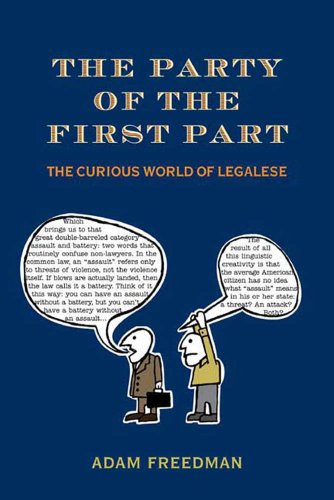
The Eats, Shoots & Leaves of legalese, this witty narrative journey through the letter of the law offers something for language lovers and legal eagles alike
This clever, user-friendly discourse exposes the simple laws lurking behind decorative, unnecessary, and confusing legal language. For better or for worse, the instruction manual for today’s world is written by lawyers. Everyone needs to understand this manual—but lawyers persist in writing it in language no one can possibly decipher.
Why accuse someone of making “material misstatements of fact,” when you could just call them a liar? What’s the point of a “last” will and testament if, presumably, every will is your last? Did you know that “law” derives from a Norse term meaning “that which is laid down”? So tell your boss to stop laying down the law—it already is.
The debate over Plain vs. Precision English rages on in courtrooms, boardrooms, and, yes, even bedrooms. Here, Adam Freedman explores the origins of legalese, interprets archaic phrasing (witnesseth!), explains obscure and oddly named laws, and disputes the notion that lawyers are any smarter than the rest of us when judged solely on their briefs. (A brief, by the way, is never so.)
Die Inhaltsangabe kann sich auf eine andere Ausgabe dieses Titels beziehen.
Über die Autorinnen und Autoren
Adam Freedman writes the “Legal Lingo” column for the New York Law Journal Magazine, and was a litigator before joining a major investment bank where he earns his living decoding policies and procedures into plain English. He holds degrees from Yale, Oxford, and the University of Chicago and has written for Newsweek International and Slate.com, among others. He lives in Brooklyn, New York.
Adam Freedman writes the "Legal Lingo" column for the New York Law Journal Magazine, and was a litigator before joining a major investment bank where he earns his living decoding policies and procedures into plain English. He holds degrees from Yale, Oxford, and the University of Chicago and has written for Newsweek International and Slate.com, among others. He lives in Brooklyn, New York.
Auszug. © Genehmigter Nachdruck. Alle Rechte vorbehalten.
The Party of the First Part
1
THE GLORY OF LEGALESE
"Incorporeal" means "without a body." However, when a company is "incorporated" it is given a body.
--CENTRE FOR PLAIN LEGAL LANGUAGE, 1995
At 2:30 A.M. on March 22, 1997, a convicted felon named Anthony Dye was racing his Corvette through the streets of Elkhart, Indiana. The police were in hot pursuit. Dye pulled into his mother's driveway, got out of the car, and made a run for it. When the police caught up with him, Dye took a semiautomatic pistol from his waistband and opened fire. At that critical moment, a valiant police dog named Frei leapt into action, fastened onto Dye's leg, and, as it were, took a bite out of crime. Dye was arrested.
Having been injured in the course of his arrest, Dye did what any red-blooded American would do. He brought a lawsuit--against Frei the police dog. Dye argued that dogs are "persons" who can be sued, at least when they work for the police. Dye fought his way to the second highest court in the land, the United States Court of Appeals, which dismissed his claim.
Dye's theory that a dog is a person is not as far-fetched as you might think. In fact, he wasn't even the first person to sue a police dog. And some very respectable lawyers have argued that the legal definition of person ought to be expanded, at least to include other primates. Laurence Tribe, Harvard's leading constitutional scholar, has maintained for years that chimpanzees should be considered persons under the Constitution.
That the country's best legal minds can be consumed with questions about whether the word "person" includes dogs or chimpanzees tells us a lot about lawyers. But it also tells us something about the language of the law. Nothing in the realm of legalese is quite what it seems.
Consider the fact that Congress once passed legislation declaring that "September 16, 1940 means June 27, 1950." In New Zealand, the law says that a "day" means a period of seventy-two hours, while an Australian statute defines "citrus fruit" to include eggs. To American lawyers, a twenty-year-old document is "ancient," while a seventeen-year-old person is an "infant." At one time or another, the law has defined "dead person" to include nuns, "daughter" to include son, and "cow" to include horse; it has even declared white to be black.
At times, legalese appears to be almost willfully perverse. Standard legal agreements, for example, typically contain some version of the following clause:
The masculine shall include the feminine, the singular shall include the plural, and the present tense shall include the past and future tenses.
In other words, the law sees absolutely no difference between "the boy becomes a man" and "girls will be girls."
Well, then. All this would be of purely academic interest if it weren't for the fact that legal documents are part of the basic infrastructure of life. Isn't it odd that the most important events in our lives require slogging through language that almost nobody understands?
Think about it: getting married or divorced, buying or renting property, investing a nest egg, making a will, serving on a jury, declaring bankruptcy, taking out insurance, borrowing money, getting sued, undergoing surgery--each one of these transactions involves lengthy documents that we are expected to sign, usually without having had sufficient time to read them. Indeed, a person who insistson reading everything that he signs is regarded as a crank of the first order.
And yet, if you ask an educated person, he will often tell you, in self-satisfied tones, that he would never sign a document that he hadn't read. "Wouldn't dream of it," he'll say, perhaps tugging at his bow tie and straightening his horn-rimmed glasses, "I won't agree to anything unless I have time to read it over."
Not to put too fine a point on it, but I don't believe this hypothetical educated person. Does he actually read every car rental contract in full? Does he pore over every agreement sent to him by a credit card company, and the warranty on every product that he buys? Does he read every software licensing agreement before clicking "I agree"? If the answer to all of these is "yes," then I dare say he also lines his hat with aluminum foil.
Consider the case of Justin Noe, a British motorist who was pulled over by the police in 1999 and asked to submit to a Breathalyzer test. He agreed, but on the condition that he first be allowed to consult the Police and Criminal Evidence Act; that is, the very law that explains a citizen's rights when taking Breathalyzer tests. A court later decided that Noe's request was so patently unreasonable as to constitute a refusal to submit to the test, the implication being that he was probably drunk. Clearly, anybody who asks to read a statute must be intoxicated.
When nonlawyers do manage to read legal documents, they typically end up more confused than they were before they started. Any language in which libel can mean either a disparaging remark or a lawsuit against a ship is obviously a disaster waiting to happen. In legalese, when you executean agreement, you bring it into existence; but when you execute a person, you do just the opposite. A layman is often surprised to learn that only land and buildings count as real property, as though things like cars and furniture were somehow unreal property. Actually, the "real" in real property comes from the French word for "royal," because all land used to be held by the king. There, doesn't that make you feel better?
The double and triple meanings of legal language account for many of the odd newspaper headlines that make the rounds on the Internet--"Man struck by lightning faces battery charge," for example. Or "Juvenile court to try shooting defendant." Now there's an idea.
MIND THE GAP
In 2001, the Economist magazine reported on a "worrying gap" between the language of the public and that of the legal profession. That gap grows wider every day, as legal English staunchly resists the changes rippling through everyday English. On the bright side, this means that the law is less susceptible to silly fads--lawyers don't write things like "gr8--cu 18r!"--but it also means that the law is less and less accessible to each new generation.
Legalese could even evolve into a foreign language in the not-too-distant future. Already, many linguists refer to the language of law as a "sublanguage," meaning that it's more than just a collection of jargon, but also has its own specialized rules of grammar and syntax. How many ordinary English speakers understand the common mortgage term that asks you to promise that you are "lawfully seisedof the estate to be conveyed"? Or the promissory note that makes you waive your right to "interpose any counterclaim"? Sublanguage indeed.
The fact that legalese is drifting away from everyday language is especially sad since the story of legal English is, in many ways, the story of the English language itself. There are statutes recorded in English going back to the Laws of Ine, the Anglo-Saxon king of Wessex, in the late seventh century A.D. Ine's laws were admirably straightforward. For example:
If anyone steals so that his wife and children do not know, let him pay sixty shillings fine. If he should steal with the knowledge of his family, then they should all go into slavery.
What could be clearer? For centuries, legal language played a decisive role in the development of English. The very first dictionary printed in England (in 1523) was a law dictionary written by John Rastell, a true Renaissance man who at various times was a playwright, theatrical producer, printer, translator,...
„Über diesen Titel“ kann sich auf eine andere Ausgabe dieses Titels beziehen.
Suchergebnisse für The Party of the First Part: The Curious World of Legalese

Beispielbild für diese ISBN
The Party of the First Part: The Curious World of Legalese
Verlag:
Henry Holt and Co. (edition First Edition), 2007
ISBN 10: 0805082239
ISBN 13: 9780805082234
Gebraucht
Hardcover
Erstausgabe
Anbieter: BooksRun, Philadelphia, PA, USA
Verkäuferbewertung 5 von 5 Sternen

Hardcover. Zustand: Very Good. First Edition. With dust jacket. It's a well-cared-for item that has seen limited use. The item may show minor signs of wear. All the text is legible, with all pages included. It may have slight markings and/or highlighting. Artikel-Nr. 0805082239-11-1-29
Gebraucht kaufen
EUR 5,40
Versand gratis
Versand innerhalb von USA
Versand innerhalb von USA
Anzahl: 1 verfügbar
Beispielbild für diese ISBN
The Party of the First Part : The Curious World of Legalese
Anbieter: Better World Books, Mishawaka, IN, USA
Verkäuferbewertung 5 von 5 Sternen
Zustand: Good. Former library copy. Pages intact with minimal writing/highlighting. The binding may be loose and creased. Dust jackets/supplements are not included. Includes library markings. Stock photo provided. Product includes identifying sticker. Better World Books: Buy Books. Do Good. Artikel-Nr. 4697533-6
Gebraucht kaufen
EUR 6,16
Versand gratis
Versand innerhalb von USA
Versand innerhalb von USA
Anzahl: 1 verfügbar
Beispielbild für diese ISBN
The Party of the First Part : The Curious World of Legalese
Anbieter: Better World Books, Mishawaka, IN, USA
Verkäuferbewertung 5 von 5 Sternen
Zustand: Very Good. Former library copy. Pages intact with possible writing/highlighting. Binding strong with minor wear. Dust jackets/supplements may not be included. Includes library markings. Stock photo provided. Product includes identifying sticker. Better World Books: Buy Books. Do Good. Artikel-Nr. 9728418-6
Gebraucht kaufen
EUR 6,16
Versand gratis
Versand innerhalb von USA
Versand innerhalb von USA
Anzahl: 1 verfügbar
Beispielbild für diese ISBN
The Party of the First Part : The Curious World of Legalese
Anbieter: Better World Books: West, Reno, NV, USA
Verkäuferbewertung 5 von 5 Sternen
Zustand: Good. Pages intact with minimal writing/highlighting. The binding may be loose and creased. Dust jackets/supplements are not included. Stock photo provided. Product includes identifying sticker. Better World Books: Buy Books. Do Good. Artikel-Nr. 5379920-6
Gebraucht kaufen
EUR 6,16
Versand gratis
Versand innerhalb von USA
Versand innerhalb von USA
Anzahl: 1 verfügbar
Beispielbild für diese ISBN
The Party of the First Part: The Curious World of Legalese
Anbieter: ThriftBooks-Atlanta, AUSTELL, GA, USA
Verkäuferbewertung 5 von 5 Sternen
Hardcover. Zustand: Good. No Jacket. Former library book; Pages can have notes/highlighting. Spine may show signs of wear. ~ ThriftBooks: Read More, Spend Less. Artikel-Nr. G0805082239I3N10
Gebraucht kaufen
EUR 7,21
Versand gratis
Versand innerhalb von USA
Versand innerhalb von USA
Anzahl: 1 verfügbar
Beispielbild für diese ISBN
The Party of the First Part: The Curious World of Legalese
Anbieter: ThriftBooks-Dallas, Dallas, TX, USA
Verkäuferbewertung 5 von 5 Sternen
Hardcover. Zustand: As New. No Jacket. Pages are clean and are not marred by notes or folds of any kind. ~ ThriftBooks: Read More, Spend Less. Artikel-Nr. G0805082239I2N00
Gebraucht kaufen
EUR 7,21
Versand gratis
Versand innerhalb von USA
Versand innerhalb von USA
Anzahl: 1 verfügbar
Beispielbild für diese ISBN
The Party of the First Part: The Curious World of Legalese
Anbieter: ThriftBooks-Dallas, Dallas, TX, USA
Verkäuferbewertung 5 von 5 Sternen
Hardcover. Zustand: Very Good. No Jacket. May have limited writing in cover pages. Pages are unmarked. ~ ThriftBooks: Read More, Spend Less. Artikel-Nr. G0805082239I4N00
Gebraucht kaufen
EUR 7,21
Versand gratis
Versand innerhalb von USA
Versand innerhalb von USA
Anzahl: 1 verfügbar
Beispielbild für diese ISBN
The Party of the First Part: The Curious World of Legalese
Anbieter: ThriftBooks-Atlanta, AUSTELL, GA, USA
Verkäuferbewertung 5 von 5 Sternen
Hardcover. Zustand: Very Good. No Jacket. Missing dust jacket; May have limited writing in cover pages. Pages are unmarked. ~ ThriftBooks: Read More, Spend Less. Artikel-Nr. G0805082239I4N01
Gebraucht kaufen
EUR 7,21
Versand gratis
Versand innerhalb von USA
Versand innerhalb von USA
Anzahl: 1 verfügbar
Beispielbild für diese ISBN
The Party of the First Part: The Curious World of Legalese
Anbieter: ThriftBooks-Dallas, Dallas, TX, USA
Verkäuferbewertung 5 von 5 Sternen
Hardcover. Zustand: Good. No Jacket. Former library book; Pages can have notes/highlighting. Spine may show signs of wear. ~ ThriftBooks: Read More, Spend Less. Artikel-Nr. G0805082239I3N10
Gebraucht kaufen
EUR 7,21
Versand gratis
Versand innerhalb von USA
Versand innerhalb von USA
Anzahl: 1 verfügbar
Foto des Verkäufers
The Party of the First Part: The Curious World of Legalese
Verlag:
Henry Holt and Co, 2007
ISBN 10: 0805082239
ISBN 13: 9780805082234
Gebraucht
Hardcover
Erstausgabe
Anbieter: Southampton Books, Sag Harbor, NY, USA
Verkäuferbewertung 5 von 5 Sternen
Hardcover. Zustand: Like New. First Edition. First Edition, First Printing. Published by Henry Holt and Co, 2007. Octavo. Hardcover. Book is like new. Dust jacket is like new, with some shelf/edgewear. Artikel-Nr. 547711
Gebraucht kaufen
EUR 18,30
EUR 4,43 Versand
Versand innerhalb von USA
Versand innerhalb von USA
Anzahl: 1 verfügbar