
Verwandte Artikel zu Why Darwin Matters: The Case Against Intelligent Design
Inhaltsangabe
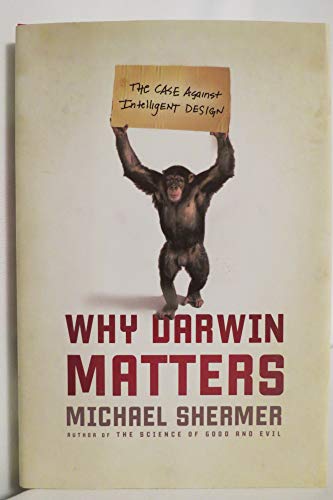
A creationist-turned-scientist demonstrates the facts of evolution and exposes Intelligent Design’s real agenda
Science is on the defensive. Half of Americans reject the theory of evolution and “Intelligent Design” campaigns are gaining ground. Classroom by classroom, creationism is overthrowing biology.
In Why Darwin Matters, bestselling author Michael Shermer explains how the newest brand of creationism appeals to our predisposition to look for a designer behind life’s complexity. Shermer decodes the scientific evidence to show that evolution is not “just a theory” and illustrates how it achieves the design of life through the bottom-up process of natural selection. Shermer, once an evangelical Christian and a creationist, argues that Intelligent Design proponents are invoking a combination of bad science, political antipathy, and flawed theology. He refutes their pseudoscientific arguments and then demonstrates why conservatives and people of faith can and should embrace evolution. He then appraises the evolutionary questions that truly need to be settled, building a powerful argument for science itself.
Cutting the politics away from the facts, Why Darwin Matters is an incisive examination of what is at stake in the debate over evolution.
Die Inhaltsangabe kann sich auf eine andere Ausgabe dieses Titels beziehen.
Über die Autorinnen und Autoren
Michael Shermer is one of the best-known public intellectuals defending evolutionary theory today. The author of eight previous books, he is a columnist for Scientific American, the publisher of Skeptic magazine, and the founder of the international Skeptics Society. He lives in Southern California.
Michael Shermer is the author of The Believing Brain, Why People Believe Weird Things, The Science of Good and Evil, The Mind Of The Market, Why Darwin Matters, Science Friction, How We Believe and other books on the evolution of human beliefs and behavior. He is the founding publisher of Skeptic magazine, the editor of Skeptic.com, a monthly columnist for Scientific American, and an adjunct professor at Claremont Graduate University. He lives in Southern California.
Auszug. © Genehmigter Nachdruck. Alle Rechte vorbehalten.
Prologue
Why Evolution Matters
Hence both in space and time, we seem to be brought somewhat near to that great fact--that mystery of mysteries--the first appearance of new beings on this earth.
--Charles Darwin, Journal of Researches, 1845
In June 2004, the science historian Frank Sulloway and I began a month-long expedition to retrace Charles Darwin's footsteps in the Galápagos Islands. It turned out to be one of the most physically grueling experiences of my life, and as I have raced a bicycle across America five times, that is saying something special about what the young British naturalist was able to accomplish in 1835. Charles Darwin was not only one sagacious scientist; he was also one tenacious explorer.1
I fully appreciated Darwin's doggedness when we hit the stark and barren lava fields on the island of San Cristóbal, the first place Darwin explored in the archipelago. With a sweltering equatorial sun and almost no fresh water, it is not long before water-loaded seventy-pound packs begin to buckle your knees and strain your back. Add hours of daily bushwhacking through dense, scratchy vegetation, and the romance of fieldwork quickly fades. At the end of one three-day excursion my water supply was so dangerously low that Frank and I collected the dew that had accumulated on the tents the night before. One day I sliced my left shin on a chunk of a'a lava. Another day I was stung by a wasp and one side of my face nearly doubled in size. At the end of one particularly grueling climb through a moonscapelike area Darwin called the "craterized district," we collapsed in utter exhaustion, muscles quivering and sweat pouring off our hands and faces, after which we read from Darwin's diary, in which the naturalist described a similar excursion as "a long walk."
Death permeates these islands. Animal carcasses are scattered everywhere. The vegetation is coarse and scrappy. Dried and shriveled cactus trunks dot the bleak landscape. The lava terrain is so broken with razor-sharp edges that progress across it is glacially slow. Many people have died there, from stranded sailors of centuries past to wanderlust-driven tourists in recent years. Within days I had a deep sense of isolation and fragility. Without the protective blanket of civilization none of us are far from death. With precious little water and even less edible foliage, organisms eke out a precarious living, their adaptations to this harsh environment selected over millions of years. A lifelong observer of and participant in the evolution-creation controversy, I was struck by how clear it is in these islands: Creation by intelligent design is absurd. So how then did Darwin depart the Galápagos a creationist?
This is the question that Frank Sulloway went there to answer. Sulloway has spent a lifetime reconstructing how Darwin pieced together the theory of evolution. The iconic myth is that Darwin became an evolutionist in the Galápagos, discovering natural selection as he itemized finch beaks and tortoise carapaces, as he observed how each species had uniquely adapted to the available food and the island ecology. The legend endures, Sulloway notes, because it fits elegantly into a Joseph Campbell-like tripartite myth of the hero who (1) leaves home on a great adventure, (2) endures immeasurable hardship in the quest for noble truths, and (3) returns to deliver a deep message--in Darwin's case, evolution. The myth is ubiquitous, appearing in everything from biology textbooks to travel brochures, the latter of which inveigle potential customers to see what Darwin saw.
The Darwin Galápagos legend is emblematic of a broader myth that science proceeds by select eureka discoveries followed by sudden revolutionary revelations, as old theories fall before new facts. Not quite. Theories power perceptions. Nine months after departing the Galápagos, Darwin made the following entry in his ornithological catalogue about his mockingbird collection: "When I see these Islands in sight of each other, & possessed of but a scanty stock of animals, tenanted by these birds, but slightly differing in structure & filling the same place in Nature, I must suspect they are only varieties." He was seeing similar varieties of fixed kinds, not an evolution of separate species. Darwin did not even bother to record the island locations of the few finches he collected (and in some cases mislabeled), and these now-famous birds were never specifically mentioned in the Origin of Species. Darwin was still a creationist.2
Through careful analysis of Darwin's notes and journals, Sulloway dates Darwin's acceptance of evolution to the second week of March, 1837, after a meeting Darwin had with the eminent ornithologist John Gould, who had been studying Darwin's Galápagos bird specimens. With access to museum ornithological collections from areas of South America that Darwin had not visited, Gould corrected a number of taxonomic errors Darwin had made (such as labeling two finch species a "Wren" and an "Icterus"), and pointed out to him that although the land birds in the Galápagos were endemic to the islands, they were notably South American in character.
Darwin left the meeting with Gould, Sulloway concludes, convinced "beyond a doubt that transmutation must be responsible for the presence of similar but distinct species on the different islands of the Galápagos group." In Darwin's mind, the allegedly immutable "species barrier" had been shattered. That July, 1837, Darwin began his first notebook on Transmutation of Species. By 1844 he was confident enough to write in a letter to his botanist friend and colleague Joseph Hooker, "I was so struck with distribution of Galapagos organisms &c &c, & with the character of the American fossil mammifers &c &c, that I determined to collect blindly every sort of fact which cd bear any way on what are species." Five years at sea and nine years at home poring through "heaps" of books led Darwin to admit that, for him, "at last gleams of light have come, & I am almost convinced, (quite contrary to opinion I started with) that species are not (it is like confessing a murder) immutable."3
Like confessing a murder. Dramatic words for something as seemingly innocuous as a technical problem in biology: the immutability of species. But it doesn't take a rocket scientist--or an English naturalist--to understand why the theory of the origin of species by means of natural selection would be so controversial: If new species are created naturally, what place, then, for God? No wonder Darwin waited twenty years before publishing his theory.4
From the time of Plato and Aristotle in ancient Greece to the time of Darwin and his fellow naturalist Alfred Russel Wallace in the nineteenth century, nearly everyone believed that a species retained a fixed and immutable "essence." A species, in fact, was defined by its very essence--the characteristics that made it like no other species. The theory of evolution by means of natural selection, then, is the theory of how kinds can become other kinds, and that upset not only the scientific cart, but the cultural horse pulling it. The great Harvard evolutionary biologist Ernst Mayr stressed just how radical was Darwin's theory: "The fixed, essentialistic species was the fortress to be stormed and destroyed; once this had been accomplished, evolutionary thinking rushed through the breach like a flood through a break in a dike."5
The dike, however, was slow to crumble. Darwin's close friend, the geologist Charles Lyell, withheld his support for a full nine years, and even then hinted at a providential design behind the whole scheme. The astronomer John Herschel called natural selection the "law of higgledy-piggledy." And Adam Sedgwick, a...
„Über diesen Titel“ kann sich auf eine andere Ausgabe dieses Titels beziehen.
Suchergebnisse für Why Darwin Matters: The Case Against Intelligent Design

Beispielbild für diese ISBN
Why Darwin Matters The Case Ag
Anbieter: World of Books (was SecondSale), Montgomery, IL, USA
Verkäuferbewertung 5 von 5 Sternen

Zustand: Very Good. Item in very good condition! Textbooks may not include supplemental items i.e. CDs, access codes etc. Artikel-Nr. 00108329293
Gebraucht kaufen
EUR 5,21
Versand gratis
Versand innerhalb von USA
Versand innerhalb von USA
Anzahl: 2 verfügbar
Beispielbild für diese ISBN
Why Darwin Matters The Case Ag
Anbieter: World of Books (was SecondSale), Montgomery, IL, USA
Verkäuferbewertung 5 von 5 Sternen
Zustand: Good. Item in good condition. Textbooks may not include supplemental items i.e. CDs, access codes etc. Artikel-Nr. 00082136065
Gebraucht kaufen
EUR 5,21
Versand gratis
Versand innerhalb von USA
Versand innerhalb von USA
Anzahl: 4 verfügbar
Beispielbild für diese ISBN
Why Darwin Matters The Case Ag
Anbieter: World of Books (was SecondSale), Montgomery, IL, USA
Verkäuferbewertung 5 von 5 Sternen
Zustand: Acceptable. Item in acceptable condition! Textbooks may not include supplemental items i.e. CDs, access codes etc. Artikel-Nr. 00107566443
Gebraucht kaufen
EUR 5,21
Versand gratis
Versand innerhalb von USA
Versand innerhalb von USA
Anzahl: 2 verfügbar
Beispielbild für diese ISBN
Why Darwin Matters: The Case Against Intelligent Design
Verlag:
Times Books (edition First Edition), 2006
ISBN 10: 0805081216
ISBN 13: 9780805081213
Gebraucht
Hardcover
Erstausgabe
Anbieter: BooksRun, Philadelphia, PA, USA
Verkäuferbewertung 5 von 5 Sternen
Hardcover. Zustand: Very Good. First Edition. With dust jacket. It's a well-cared-for item that has seen limited use. The item may show minor signs of wear. All the text is legible, with all pages included. It may have slight markings and/or highlighting. Artikel-Nr. 0805081216-11-6-29
Gebraucht kaufen
EUR 5,22
Versand gratis
Versand innerhalb von USA
Versand innerhalb von USA
Anzahl: 1 verfügbar
Beispielbild für diese ISBN
Why Darwin Matters: The Case Against Intelligent Design
Anbieter: Wonder Book, Frederick, MD, USA
Verkäuferbewertung 5 von 5 Sternen
Zustand: Very Good. Very Good condition. Very Good dust jacket. A copy that may have a few cosmetic defects. May also contain light spine creasing or a few markings such as an owner's name, short gifter's inscription or light stamp. Artikel-Nr. K02L-00212
Gebraucht kaufen
EUR 6,40
Versand gratis
Versand innerhalb von USA
Versand innerhalb von USA
Anzahl: 1 verfügbar
Beispielbild für diese ISBN
Why Darwin Matters : The Case Against Intelligent Design
Anbieter: Better World Books: West, Reno, NV, USA
Verkäuferbewertung 5 von 5 Sternen
Zustand: Very Good. Pages intact with possible writing/highlighting. Binding strong with minor wear. Dust jackets/supplements may not be included. Stock photo provided. Product includes identifying sticker. Better World Books: Buy Books. Do Good. Artikel-Nr. 4349751-6
Gebraucht kaufen
EUR 6,54
Versand gratis
Versand innerhalb von USA
Versand innerhalb von USA
Anzahl: 1 verfügbar
Beispielbild für diese ISBN
Why Darwin Matters : The Case Against Intelligent Design
Anbieter: Better World Books, Mishawaka, IN, USA
Verkäuferbewertung 5 von 5 Sternen
Zustand: Good. Pages intact with minimal writing/highlighting. The binding may be loose and creased. Dust jackets/supplements are not included. Stock photo provided. Product includes identifying sticker. Better World Books: Buy Books. Do Good. Artikel-Nr. 4501109-75
Gebraucht kaufen
EUR 6,54
Versand gratis
Versand innerhalb von USA
Versand innerhalb von USA
Anzahl: 1 verfügbar
Beispielbild für diese ISBN
Why Darwin Matters : The Case Against Intelligent Design
Anbieter: Better World Books, Mishawaka, IN, USA
Verkäuferbewertung 5 von 5 Sternen
Zustand: Good. Former library copy. Pages intact with minimal writing/highlighting. The binding may be loose and creased. Dust jackets/supplements are not included. Includes library markings. Stock photo provided. Product includes identifying sticker. Better World Books: Buy Books. Do Good. Artikel-Nr. GRP73179296
Gebraucht kaufen
EUR 6,54
Versand gratis
Versand innerhalb von USA
Versand innerhalb von USA
Anzahl: 3 verfügbar
Beispielbild für diese ISBN
Why Darwin Matters : The Case Against Intelligent Design
Anbieter: Better World Books: West, Reno, NV, USA
Verkäuferbewertung 5 von 5 Sternen
Zustand: Good. Former library copy. Pages intact with minimal writing/highlighting. The binding may be loose and creased. Dust jackets/supplements are not included. Includes library markings. Stock photo provided. Product includes identifying sticker. Better World Books: Buy Books. Do Good. Artikel-Nr. GRP73179296
Gebraucht kaufen
EUR 6,54
Versand gratis
Versand innerhalb von USA
Versand innerhalb von USA
Anzahl: 2 verfügbar
Beispielbild für diese ISBN
Why Darwin Matters : The Case Against Intelligent Design
Anbieter: Better World Books: West, Reno, NV, USA
Verkäuferbewertung 5 von 5 Sternen
Zustand: Very Good. Former library copy. Pages intact with possible writing/highlighting. Binding strong with minor wear. Dust jackets/supplements may not be included. Includes library markings. Stock photo provided. Product includes identifying sticker. Better World Books: Buy Books. Do Good. Artikel-Nr. 5380169-6
Gebraucht kaufen
EUR 6,54
Versand gratis
Versand innerhalb von USA
Versand innerhalb von USA
Anzahl: 1 verfügbar