
Verwandte Artikel zu The Buried Book: The Loss and Rediscovery of the Great...
Inhaltsangabe
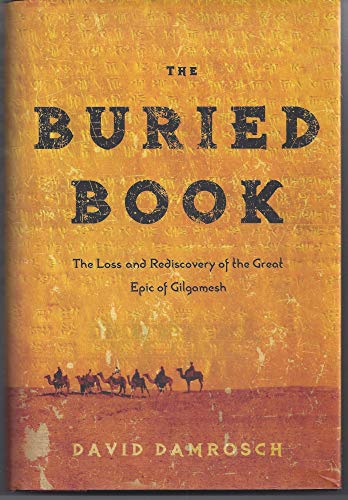
Adventurers, explorers, kings, gods, and goddesses come to life in this riveting story of the first great epic--lost to the world for 2,000 years, and rediscovered in the nineteenth century
Composed by a poet and priest in Middle Babylonia around 1200 bce, The Epic of Gilgamesh foreshadowed later stories that would become as fundamental as any in human history, The Odyssey and the Bible. But in 600 bce, the clay tablets that bore the story were lost--buried beneath ashes and ruins when the library of the wild king Ashurbanipal was sacked in a raid.
The Buried Book begins with the rediscovery of the epic and its deciphering in 1872 by George Smith, a brilliant self-taught linguist who created a sensation when he discovered Gilgamesh among the thousands of tablets in the British Museum's collection. From there the story goes backward in time, all the way to Gilgamesh himself. Damrosch reveals the story as a literary bridge between East and West: a document lost in Babylonia, discovered by an Iraqi, decoded by an Englishman, and appropriated in novels by both Philip Roth and Saddam Hussein. This is an illuminating, fast-paced tale of history as it was written, stolen, lost, and--after 2,000 years, countless battles, fevered digs, conspiracies, and revelations--finally found.
Die Inhaltsangabe kann sich auf eine andere Ausgabe dieses Titels beziehen.
Über die Autorin bzw. den Autor
David Damrosch is a professor of English and comparative literature at Columbia University. He is the general editor of The Longman Anthology of World Literature and the founding general editor of The Longman Anthology of British Literature. He lives in New York City.
Rezensionen
Starred Review. In the tradition of Edmund Wilson, Columbia literature professor Damrosch unearths the first great masterpiece of world literature: the ancient epic of the legendary Sumerian king Gilgamesh. Several copies of a largely complete version of the 4,000-year-old poem, which follows Gilgamesh on a heroic quest for immortality as he seeks out a survivor of a major deluge, were part of the great library assembled at the palace of Nineveh by the Assyrian king Ashurbanipal, who ruled from 669 B.C. and sought ancient texts to guide him in ruling after his brother's disastrous rebellion. After Nineveh was sacked in 612 B.C., the Gilgamesh epic was forgotten for more than 2,000 years until archeologists Austen Henry Layard and Hormuzd Rassam uncovered the library and shipped 100,000 clay tablets and fragments to the British Museum in the 1840s and '50s. There, in 1872, assistant curator George Smith decoded the cuneiform writing and Akkadian language and discovered that the epic offered a controversial earlier version of the biblical flood account. Damrosch's fascinating literary sleuthing will appeal to scholars and lay readers alike as they ponder the intricacies of cuneiform, the abuses heaped on the Iraqi Rassam and the working-class Smith by the Victorian class system, and recent Gilgamesh-inspired novels by Philip Roth (The Great American Novel) and Saddam Hussein. (Mar.)
Copyright © Reed Business Information, a division of Reed Elsevier Inc. All rights reserved.
Reviewed by Michael Dirda
The oldest surviving fragments of the Babylonian epic we now call Gilgamesh date back to the 18th century -- the 18th century before the Christian era, that is, more than 3,700 years ago. Etched in the wedge-shaped letters known as cuneiform on clay tablets, Gilgamesh stands as the earliest classic of world literature. Surprisingly, it is a classic still in the making, for scholars continue to discover and piece together shards -- in Akkadian, Sumerian, Hittite and other ancient languages -- that occasionally add a few more lines to this story of an ancient Middle Eastern king's quest for immortality and his coming to terms with the inevitability of death.
In The Buried Book, David Damrosch, a Columbia professor of comparative literature, organizes his text as an archaeological dig, opening with a prefatory account of Austen Henry Layard's discovery and excavation of the ruins of Nineveh in the 1840s, then gradually working his way back from the Victorian era into ancient times. His first and second chapters describe the career of George Smith, a self-taught Assyriologist, who one momentous afternoon in 1872 was working at the British Museum, going through a pile of Layard's clay tablets. Suddenly, Smith realized that he was reading about "a flood storm, a ship caught on a mountain, and a bird sent out in search of dry land."
The discovery of this "Chaldean account of the Deluge" so electrified the young scholar that he danced around the museum and actually began to "undress himself." (No one is quite sure if that meant anything more than loosening his collar.) Smith had stumbled across an episode (in Akkadian) from Gilgamesh, becoming the first person to read a portion of the epic in more than 2,000 years. But stumbled is hardly the word, for Smith was nothing less than a linguistic genius, the unexpected man in the right place. As Damrosch writes:
"He became the world's leading expert in the ancient Akkadian language and its fiendishly difficult script, wrote the first true history of the long-lost Assyrian Empire, and published pathbreaking translations of the major Babylonian literary texts, in between expeditions to find more tablets in Iraq. Though this would have been the lifework of an eminent scholar at Oxford or the Sorbonne, Smith's active career instead lasted barely ten years, from his mid-twenties to his mid-thirties. Far from holding a distinguished professorship, he had never been to high school, much less college. His formal education had ended at age fourteen."
Smith's career -- cut short by his death in the Middle East from dysentery -- was heroic, but so was that of his older colleague Henry Rawlinson (to whom Smith dedicated his 1875 book The Chaldean Account of Genesis). Rawlinson was a figure in the classic Victorian mold -- a military officer in India and Persia with a flair for languages, possessed of exceptional courage and stamina, both physical (he once rode 750 miles on horseback in 150 consecutive hours) and scholarly: He spent 15 years patiently working out the meaning of Akkadian cuneiform, then later produced one of those daunting monuments of Victorian scholarship, the five-volume Cuneiform Inscriptions of Western Asia.
The third great figure in Damrosch's story of the rediscovery of Gilgamesh is Hormuzd Rassam, a Chaldean Christian who served as Layard's second-in-command, attended Oxford and later headed up archaeological expeditions for the British Museum. According to Andrew George, a leading modern figure in Babylonian studies, Rassam is "an unsung hero of Assyriology." Why unsung? Damrosch -- no doubt rightly, if somewhat tendentiously -- points to racial, i.e. "Orientalist," prejudice as the reason for his neglect. Rassam wasn't really, you know, quite the right sort, even though he grew to be more English than the English, serving in the diplomatic corps and living long enough to see his daughter become a star of the Gilbert and Sullivan operettas. But Damrosch makes clear that the man's wide-ranging archaeological discoveries were consistently undervalued or callously ascribed to others. At the end of his life, Rassam was even compelled to bring a suit against the Egyptologist E.A. Wallis Budge, who falsely accused him of selling artifacts.
At this point in his book, Damrosch turns to the excavation of the library of Ashurbanipal, an Assyrian king of the 7th century B.C. who valued poetry as well as power. Here, we are introduced to the court life of ancient Mesopotamia, in particular the priests, sorcerers and secret agents who formed the inner circle of such rulers as Sargon II, Sennacherib, Esarhaddon and Ashurbanipal himself. Damrosch neatly conveys the immense antiquity of the Gilgamesh epic by noting that the poem "was already ancient in Ashurbanipal's day, copied and recopied for more than a thousand years before the young crown prince studied it in the Temple of Nabu."
In the last third of The Buried Book, Damrosch zeroes in on the poem itself, noting that "Gilgamesh is often read today as an existential tale of the fear of death and the quest for immortality, but the epic is equally a tale of tyranny and its consequences." It also reflects on "the limits of culture . . . presented in contrast to the world of nature." This is its plot:
The young Gilgamesh is a "wild bull" of a man, restless of heart, full of unfocused energy. He conducts his life with seigniorial abandon, abusing his subjects and even flagrantly exercising his right to sleep with girls on their wedding nights. The women of his capital city of Uruk complain to the gods, who decide to fashion Enkidu, a true wild man, to defeat Gilgamesh in combat. At first the hairy Enkidu lives in a state of nature, literally running with the gazelles, until he is sexually initiated by a temple prostitute, after which the animals of the forest will have nothing to do with him. When he eventually confronts Gilgamesh, en route to deflower another virgin, the pair wrestle and nearly demolish the surrounding buildings, before becoming fast friends (and even perhaps lovers).
In due course, accompanied by his new buddy, the restless Gilgamesh goes adventuring, defeats an ogre who guards a sacred cedar wood, spurns the sexual invitations of the goddess Ishtar and kills the monstrous bull she then sends to avenge her honor. But Gilgamesh and Enkidu have now deeply angered the gods, and one of them must pay with his life. After Enkidu suffers a series of dream visions of the nether world, he finally dies, as Gilgamesh is racked with both grief and the fearful knowledge that the same end waits for him. Can nothing be done? He resolves to journey to the ends of the earth to confront Uta-napishtim, a Noah-like figure who alone of mankind survived the great Deluge and has been given the gift of immortality. In due course, Gilgamesh crosses the Ocean of Death but learns that no one can alter his mortal destiny. Nonetheless, a fragment -- outside the so-called "standard" version of the epic -- informs us that Gilgamesh is ultimately allowed to become the godlike judge of the underworld.
In his last chapter, Damrosch discusses some later uses of the Gilgamesh story, focusing on Philip Roth's The Great American Novel (in which a major character is a baseball pitcher named Gil Gamesh) and Saddam Hussein's novel Zabibah wal-Malik, a kind of love story-cum-allegory of the first Gulf War. In particular, the comparatist Damrosch urges his readers to understand that they are part of an "Islamo-Christian civilization." "Gilgamesh and The Iliad, the Bible and the Qur'an were not products of isolated, eternally opposed civilizations; they are mutually related outgrowths of the rich cultural matrix of western Asia and the eastern Mediterranean world. Isaac and Ishmael are half brothers, and Uta-napishtiM and Noah are closer still: they are two versions of one and the same character."
Though useful, entertaining and informative, The Buried Book may bother some readers with its lack of a strong narrative line, its tendency to overemphasize irrelevant details (why include so many pages on Rassam's diplomatic mission in Abyssinia?) and its well-meaning political correctness: Damrosch can sometimes seem as condescending to the narrow-minded Victorians as they so often were to "Orientals." Despite these blemishes, The Buried Book should help introduce new readers to an ancient classic that has really come into its own in the 21st century. Whether enjoyed in the brilliant (but very loose) version of David Ferry or the scholarly transcription of Andrew George, this Babylonian epic remains a very human story about wisdom painfully acquired. Appropriately, its hero is called, in the memorable first line, "He who saw the Deep." And what does Gilgamesh learn? Before the end that awaits each of us -- "a man's life is snapped off like a reed in a canebrake" -- we should perform good deeds, love our families and enjoy simple pleasures. As Uta-napishtim says, in Andrew George's translation:
But you, Gilgamesh, let your belly be full, Enjoy yourself always by day and by night!
Make merry each day,
Dance and play day and night!
Let your clothes be clean,
Let your head be washed, may you bathe in water!
Gaze on the child who holds your hand,
Let your wife enjoy your repeated embrace!
For such is the destiny [of mortal men].
Copyright 2007, The Washington Post. All Rights Reserved.
*Starred Review* As astounding as the content of the Epic of Gilgamesh in which the questing hero travels to the underworld and back, is the manner of its discovery and recovery. The clay tablets on which its text was impressed lay beneath the rubble of the Assyrian city of Nineveh, destroyed in 612 BCE, until they were excavated in the 1850s. The tablets still were mute until a British scholar cracked the cuneiform script and translated the Epic to sensational acclaim in the 1870s. These are just two of Damrosch's approaches to this ur-work of world literature. Others are the reign of the Assyrian king Ashurbanipal, assembler of the library in which Gilgamesh was preserved; archaeological hints about the real-life Gilgamesh, a Sumerian king from about 2750 BCE; and a vivid retelling of the epic itself. Literature professor Damrosch's summary narrative of the epic excels both in dramatization and thematic explanation, and he's no slouch either when it comes to relaying the adventures of translator George Smith and archaeologist-diplomat Hormuzd Rassam, the central figures in bringing Gilgamesh to modern light. Combining acuity about cultural contexts with wide-ranging knowledge, Damrosch's account is a superb and engrossing popular presentation. Gilbert Taylor
Copyright © American Library Association. All rights reserved
Auszug. © Genehmigter Nachdruck. Alle Rechte vorbehalten.
Introduction
Early in April of 1840, a young British traveler arrived in the dusty provincial capital of Mosul in what is now northern Iraq. Restless, ambitious, and completely unsure of what he should do with his life, Austen Henry Layard had just spent several months wandering around Greece, Turkey, and the Levant, admiring the monumental ruins left by the Greeks and Romans throughout the eastern Mediterranean. Now he was venturing into unsettled regions rarely visited by European travelers, for it was said that uncharted sites around Mosul held imposing remains of Nineveh and other ancient Assyrian cities. The reports Layard had heard were both true and false: the sites were there, yet when Layard went out to them, he was astonished to discover that there was nothing to see. All that remained of the great Mesopotamian civilizations were formless mounds of earth, forty or fifty feet high and up to a mile wide, with not one temple, not one pillar, not one sculpture in sight.
Far from disappointing him, the desolation of the Assyrian sites only fired Layard’s imagination. As he later wrote, a traveler crossing the Euphrates would seek in vain for “the graceful column rising above the thick foliage of the myrtle” or the elegant curves of an amphitheater above a sparkling bay. “He is now at a loss to give any form to the rude heaps upon which he is gazing,” Layard continued. “The more he conjectures, the more vague the results appear. The scene around is worthy of the ruin he is contemplating; desolation meets desolation; a feeling of awe succeeds to wonder; for there is nothing to relieve the mind, to lead to hope, or to tell of what has gone by.” Then and there, Layard resolved that he would be the one to uncover the history buried in the bleak mounds before him.
Layard and a handful of other archaeological explorers soon embarked on one of the most dramatic intellectual adventures of modern times: the opening up of three thousand years of history in the cradle of civilization. Layard led the way with spectacular discoveries at two different sites. At a site south of Mosul, he uncovered beautifully carved reliefs and a set of magnificent, human-headed winged bulls that became centerpieces of the British Museum’s collection; across the Tigris from Mosul he found the long-buried ruins of Nineveh. There he discovered the vast palace built by the Assyrian king Sennacherib, its endless corridors and seventy rooms lined with two full miles’ worth of carved reliefs; not for nothing had Sennacherib named it “Palace Without Rival.”
As spectacular as the carvings were, Layard’s most important find was literary: he and his Iraqi friend and assistant Hormuzd Rassam uncovered the major library assembled by Sennacherib’s grandson, Ashurbanipal. Layard and Rassam shipped a hundred thousand clay tablets and fragments back to the British Museum, and these proved to be keys to uncovering the region’s ancient history and its rich literature. The greatest of the thousands of texts that Layard and Rassam brought to light is The Epic of Gilgamesh, the first great masterpiece of world literature.
This book tells the story of that long-buried book, a history of imperial conflict and of cross-cultural cooperation. During the epic’s varied life, it has cut across many of the divides that arose during the long history of the intertwined civilizations that flourished in Mesopotamia and the eastern Mediterranean. Gilgamesh links East and West, antiquity and modernity, poetry and history, and its echoes can be found in the Bible, in Homer, and in The Thousand and One Nights. At the same time the epic illuminates the profound conflicts that persist within each culture, and within the human heart itself. “Why,” Gilgamesh’s divine mother Ninsun asks the sun god, “did you afflict my son Gilgamesh with so restless a spirit?”
As it unfolds, The Epic of Gilgamesh becomes a searching meditation on the nature of culture. After ill-advised adventures lead to the sudden death of his beloved friend Enkidu, Gilgamesh is overwhelmed with despair and a deep fear of death. He abandons his city and goes in search of immortality, whose secret he believes he can learn from his ancestor Uta-napishtim, miraculous survivor of the Flood that swept over the earth centuries before. After a long and perilous journey Gilgamesh finally meets Uta-napishtim, only to find that he cannot transcend the human condition after all. Gilgamesh’s quest may have failed, but along the way he learns lessons about just and unjust rule, political seductions and sexual politics, and the vexed relations among humanity, the gods, and the world of nature.
Though it is one of the earliest explorations of these perennial themes, this haunting poem isn’t a timeless classic, in the sense in which Ben Jonson spoke of Shakespeare’s works as “not of an age, but for all time.” Instead, Gilgamesh has lived in two very different ages, the ancient and the modern, and only in these. A story of the fragile triumph of culture in the face of death, the epic strangely came to illustrate its own theme through its turbulent history. It was widely read in the Near East for a thousand years, until it vanished amid the eclipse of the region’s ancient cultures, buried under successive waves of empire, from the Persians to the Romans and their successors. The epic was buried in ruin mounds along with Mesopotamia’s entire written production, as people stopped speaking the region’s older languages and lost even the ability to read the cuneiform script in which the works were written. Unexpectedly, the epic reemerged in the nineteenth century into a scene of renewed imperial conflict, involving Arabs, Turks, Persians, Kurds, Chechens, Jews, Englishmen, Russians, and others in the waning years of the Ottoman Empire. The choices these rivals made in the nineteenth century set the stage for the conflicts being played out in Iraq today.
Layard and Rassam uncovered Ashurbanipal’s great library, but they had no way to know what it contained, for no one in the world could read the intricate cuneiform characters inscribed on the clay tablets. A group of gifted linguists worked during the next two decades to unlock the secrets of cuneiform writing and to decode the ancient language of Akkadian, in which most of the tablets were written. Finally, in 1872, a young assistant curator named George Smith came upon the Gilgamesh epic as he worked his way through the myriad of tablets and fragments in the British Museum’s collection. The epic aroused intense interest and controversy from the moment Smith began to translate it, as his readers realized that this distant text had much to tell them about a work at the heart of Western culture: the Bible. Smith found that Gilgamesh’s ancestor Uta-napishtim was an early version of Noah, and his tale of the Flood broadly agreed with the biblical account but differed in some significant details.
Within days of this discovery, sermons and newspaper editorials began to engage in sharp debate: What did the Babylonian version prove, the truth of biblical history or its falsity? As the New York Times noted in a front-page article, “For the present the orthodox people are in great delight, and are very much prepossessed by the corroboration which it affords to Biblical history. It is possible, however, as has been pointed out, that the Chaldean inscription, if genuine, may be regarded as a confirmation of the statement that there are various traditions of the deluge apart from the Biblical one, which is perhaps legendary like the rest.” Smith’s scholarly detective work brought the ancient epic squarely into the middle of the heated Victorian controversy over creation and evolution, religion and science, a debate that continues today.
Some further detective work is required today, though, to get the full benefit of the epic’s rich history. Layard, Rassam, and Smith wrote voluminous books about their adventures, but they rarely told the whole story in print: as proper Victorians, they could be irritatingly discreet just when they approached the heart of the conflicts in which they were involved, and like all memoirists they shaped their tale for public ends. To get a three-dimensional picture, it is necessary to supplement their books with other sources. Fortunately, the British Museum and the British Library have preserved many of their private letters and journals, which are fresh, lively, and often surprisingly candid. Most of these papers have been buried for a century in these archives, never published or even discussed. These materials give a vivid picture of what was going on behind the scenes, and at important points they correct received ideas that are flat-out wrong.
Archival research sometimes becomes almost its own branch of urban archaeology. Whereas the British Library’s holdings have been comprehensively catalogued and cross-indexed, the British Museum’s departments have much more informal archives, consisting of yellowing file folders, masses of correspondence going back two hundred years, and stacks of old account books. The museum’s curators have the most precise knowledge of every artistic artifact in their care, but departmental records can be stored in rather haphazard ways. In a small field like Assyriology, everyone knows their discipline’s history in a general way, but it is rarely studied in depth. Documents concerning the early days of archaeology are scattered, and finding key sources can be a chancy affair, following an uncertain trail from one informant to another.
I had this experience in talking with two curators in the British Museum’s Department of Near Eastern Antiquities, Susan Collins and Irving Finkel. They generously took time away from their curatorial work on several occasions to supply me with cuneiform tablets, old letters, and Victorian newspaper clippings, yet I drew a blank when I asked for sources on a crucial episode involving Hormuzd Rassam. He had gone on to a distinguished career after discovering Ashurbanipal’s palace but late in life had become embroiled in disputes with the museum’s rising young Egyptologist, E. A. Wallis Budge. The conflict had culminated in a disastrous lawsuit that Rassam filed against Budge in 1893, and I was sure that the museum must have records of this suit. Dr. Collins was able to find some newspaper reports and a few unrelated letters from Budge, but nothing more. Dr. Finkel, too, was at a loss, but just as I was about to leave, some stray remark prompted him to pause, thoughtfully stroking his bushy white beard. There was, he suggested, another archivist I could talk to, at the museum’s little-visited Central Archive, and perhaps I might find something there.
So I made my way to the Central Archive, which is reached, oddly, through an unmarked door at the back of the British Museum gift shop. Once through that door, I walked through a series of darkened, echoing rooms filled with empty bookshelves (the books having been transferred to the recently constructed British Library), then came to a warren of small offices, among which is the Central Archive. Of the seven days of the week, it is open to the public for five hours on Tuesdays. In the archive I found a trove of information: an entire folio scrapbook labeled “Rassam v. Budge, 1893.” It contained extensive records of the pivotal lawsuit, including the pleadings and the actual transcript of the judge’s detailed summation to the jury. Turning the musty pages of this volume, I experienced the archaeologist’s sense of discovery as a long-lost drama unfolded, day by day, in the summer of 1893.
Archaeologists work their way down through time, from the present-day surface back through layer after layer of the ever more distant past. This book proceeds in the same way into “the dark backward and abysm of time,” in Prospero’s phrase. The following chapters will go from what is known to what is unknown, from what is near in space and time to what is far away. The account begins with the lives of the two people who played decisive roles in the epic’s modern recovery: George Smith, who found the epic in the British Museum only to lose his life in Syria a few years later; and Hormuzd Rassam, discoverer of Ashurbanipal’s palace, whose major contributions to archaeology were long suppressed by his English rivals. Starting in the Victorian period, we will then work down in time to explore the ancient era of the tablets’ burial in the burning ruins of Ashurbanipal’s palaces in Nineveh; to examine the mature epic and the early cycle of songs from which it grew; and, finally, to reach Gilgamesh himself at the threshold of history nearly five thousand years ago, architect of Uruk’s independence and builder of its magnificent wall.
This journey into antiquity has parallels in the ancient text itself, when Gilgamesh leaves his city in search of the secret of eternal life, making the dangerous journey to find his ancestor, “Uta-napishtim the Faraway.” Journeys ideally end with a return home—in this case, back to the present—and the epilogue of this book will look at Gilgamesh’s renewed life in the present. It has come to figure in the literary work and the political musings of figures as disparate as Philip Roth and Saddam Hussein, and even as a point of reference in the first and second Gulf Wars. The most ancient masterpiece of world literature has become bound up with the most current of events today.
Copyright © 2006 by David Damrosch. All rights reserved.
„Über diesen Titel“ kann sich auf eine andere Ausgabe dieses Titels beziehen.
Weitere beliebte Ausgaben desselben Titels

Suchergebnisse für The Buried Book: The Loss and Rediscovery of the Great...

Beispielbild für diese ISBN
The Buried Book The Loss and R
Anbieter: World of Books (was SecondSale), Montgomery, IL, USA
Verkäuferbewertung 5 von 5 Sternen

Zustand: Very Good. Item in very good condition! Textbooks may not include supplemental items i.e. CDs, access codes etc. Artikel-Nr. 00106124199
Gebraucht kaufen
EUR 4,45
Versand gratis
Versand innerhalb von USA
Versand innerhalb von USA
Anzahl: 1 verfügbar
Beispielbild für diese ISBN
The Buried Book The Loss and R
Anbieter: World of Books (was SecondSale), Montgomery, IL, USA
Verkäuferbewertung 5 von 5 Sternen
Zustand: Good. Item in good condition. Textbooks may not include supplemental items i.e. CDs, access codes etc. Artikel-Nr. 00108024812
Gebraucht kaufen
EUR 4,45
Versand gratis
Versand innerhalb von USA
Versand innerhalb von USA
Anzahl: 1 verfügbar
Beispielbild für diese ISBN
The Buried Book: The Loss and Rediscovery of the Great Epic of Gilgamesh
Verlag:
Henry Holt and Co. (edition First Edition), 2007
ISBN 10: 0805080295
ISBN 13: 9780805080292
Gebraucht
Hardcover
Erstausgabe
Anbieter: BooksRun, Philadelphia, PA, USA
Verkäuferbewertung 5 von 5 Sternen
Hardcover. Zustand: Very Good. First Edition. It's a well-cared-for item that has seen limited use. The item may show minor signs of wear. All the text is legible, with all pages included. It may have slight markings and/or highlighting. Artikel-Nr. 0805080295-11-1
Gebraucht kaufen
EUR 6,30
Versand gratis
Versand innerhalb von USA
Versand innerhalb von USA
Anzahl: 1 verfügbar
Beispielbild für diese ISBN
The Buried Book: The Loss and Rediscovery of the Great Epic of Gilgamesh
Anbieter: Wonder Book, Frederick, MD, USA
Verkäuferbewertung 5 von 5 Sternen
Zustand: Very Good. Very Good condition. Very Good dust jacket. A copy that may have a few cosmetic defects. May also contain light spine creasing or a few markings such as an owner's name, short gifter's inscription or light stamp. Artikel-Nr. J05R-01187
Gebraucht kaufen
EUR 6,57
Versand gratis
Versand innerhalb von USA
Versand innerhalb von USA
Anzahl: 1 verfügbar
Beispielbild für diese ISBN
The Buried Book: The Loss and Rediscovery of the Great Epic of Gilgamesh
Anbieter: ThriftBooks-Atlanta, AUSTELL, GA, USA
Verkäuferbewertung 5 von 5 Sternen
Hardcover. Zustand: Very Good. No Jacket. May have limited writing in cover pages. Pages are unmarked. ~ ThriftBooks: Read More, Spend Less. Artikel-Nr. G0805080295I4N00
Gebraucht kaufen
EUR 7,47
Versand gratis
Versand innerhalb von USA
Versand innerhalb von USA
Anzahl: 1 verfügbar
Beispielbild für diese ISBN
The Buried Book: The Loss and Rediscovery of the Great Epic of Gilgamesh
Anbieter: ThriftBooks-Phoenix, Phoenix, AZ, USA
Verkäuferbewertung 5 von 5 Sternen
Hardcover. Zustand: Very Good. No Jacket. May have limited writing in cover pages. Pages are unmarked. ~ ThriftBooks: Read More, Spend Less. Artikel-Nr. G0805080295I4N00
Gebraucht kaufen
EUR 7,47
Versand gratis
Versand innerhalb von USA
Versand innerhalb von USA
Anzahl: 1 verfügbar
Beispielbild für diese ISBN
The Buried Book: The Loss and Rediscovery of the Great Epic of Gilgamesh
Anbieter: ThriftBooks-Atlanta, AUSTELL, GA, USA
Verkäuferbewertung 5 von 5 Sternen
Hardcover. Zustand: Very Good. No Jacket. Former library book; May have limited writing in cover pages. Pages are unmarked. ~ ThriftBooks: Read More, Spend Less. Artikel-Nr. G0805080295I4N10
Gebraucht kaufen
EUR 7,47
Versand gratis
Versand innerhalb von USA
Versand innerhalb von USA
Anzahl: 1 verfügbar
Beispielbild für diese ISBN
The Buried Book: The Loss and Rediscovery of the Great Epic of Gilgamesh
Anbieter: ThriftBooks-Reno, Reno, NV, USA
Verkäuferbewertung 5 von 5 Sternen
Hardcover. Zustand: Very Good. No Jacket. Former library book; May have limited writing in cover pages. Pages are unmarked. ~ ThriftBooks: Read More, Spend Less. Artikel-Nr. G0805080295I4N10
Gebraucht kaufen
EUR 7,47
Versand gratis
Versand innerhalb von USA
Versand innerhalb von USA
Anzahl: 1 verfügbar
Beispielbild für diese ISBN
The Buried Book: The Loss and Rediscovery of the Great Epic of Gilgamesh
Anbieter: ThriftBooks-Reno, Reno, NV, USA
Verkäuferbewertung 5 von 5 Sternen
Hardcover. Zustand: Good. No Jacket. Former library book; Pages can have notes/highlighting. Spine may show signs of wear. ~ ThriftBooks: Read More, Spend Less. Artikel-Nr. G0805080295I3N10
Gebraucht kaufen
EUR 7,47
Versand gratis
Versand innerhalb von USA
Versand innerhalb von USA
Anzahl: 1 verfügbar
Beispielbild für diese ISBN
The Buried Book: The Loss and Rediscovery of the Great Epic of Gilgamesh
Anbieter: ThriftBooks-Dallas, Dallas, TX, USA
Verkäuferbewertung 5 von 5 Sternen
Hardcover. Zustand: Very Good. No Jacket. May have limited writing in cover pages. Pages are unmarked. ~ ThriftBooks: Read More, Spend Less. Artikel-Nr. G0805080295I4N00
Gebraucht kaufen
EUR 7,47
Versand gratis
Versand innerhalb von USA
Versand innerhalb von USA
Anzahl: 1 verfügbar