
Verwandte Artikel zu Deep Economy: The Wealth of Communities and the Durable...
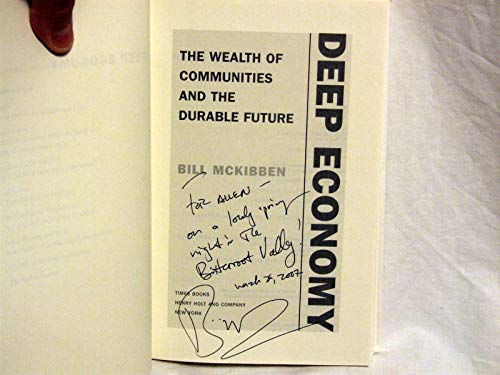
Inhaltsangabe
In a thought-provoking manifesto, the best-selling author of The End of Nature challenges the current view of our economy to call for a dramatic shift in focus from growth to prosperity that promotes environmental awareness, emphasizes the individual as a member of a larger community, and offers a new way to think about our food, energy, money, purchases, and values. 75,000 first printing.
Die Inhaltsangabe kann sich auf eine andere Ausgabe dieses Titels beziehen.
Über die Autorinnen und Autoren
Bill McKibben is the author of ten books, including The End of Nature, The Age of Missing Information, and Enough: Staying Human in an Engineered Age. A former staff writer for The New Yorker, he writes regularly for Harper's, The Atlantic Monthly, and The New York Review of Books, among other publications. He is a scholar in residence at Middlebury College and lives in Vermont with his wife, the writer Sue Halpern, and their daughter.
Bill McKibben is the author of ten books, including The End of Nature, The Age of Missing Information, and Enough: Staying Human in an Engineered Age. A former staff writer for The New Yorker, he writes regularly for Harper’s, The Atlantic Monthly, and The New York Review of Books, among other publications. He is a scholar in residence at Middlebury College and lives in Vermont with his wife, the writer Sue Halpern, and their daughter.
Bill McKibben is the author of ten books, including The End of Nature, The Age of Missing Information, and Enough: Staying Human in an Engineered Age. A former staff writer for The New Yorker, he writes regularly for Harper's, The Atlantic Monthly, and The New York Review of Books, among other publications. He is a scholar in residence at Middlebury College and lives in Vermont with his wife, the writer Sue Halpern, and their daughter.
Aus dem Klappentext
In this powerful and provocative manifesto, Bill McKibben offers the biggest challenge in a generation to the prevailing view of our economy. For the first time in human history, he observes, "more" is no longer synonymous with "better" -- indeed, for many of us, they have become almost opposites. McKibben puts forward a new way to think about the things we buy, the food we eat, the energy we use, and the money that pays for it all. Our purchases, he says, need not be at odds with the things we truly value.
Auszug. © Genehmigter Nachdruck. Alle Rechte vorbehalten.
Chapter One
After Growth
For almost all of human history, said the great economist John Maynard Keynes, from "say, two thousand years before Christ down to the beginning of the eighteenth century, there was really no great change in the standard of living of the average man in the civilized centers of the earth. Ups and downs, certainly visitations of plague, famine and war, golden intervals, but no progressive violent change." At the utmost, Keynes calculated, the standard of living had increased 100 percent over those four thousand years. The reason was, basically, that we didn't learn how to do anything new. Before history began we'd learned about fire, language, cattle, the wheel, the plow, the sail, the pot. We had banks and governments and mathematics and religion.1
And then, in 1712, something new finally happened. A British inventor named Thomas Newcomen developed the first practical steam engine. He burned coal, and used the steam pressure built up in his boiler to drive a pump that, in turn, drained water from coal mines, allowing them to operate far more cheaply and efficiently. How much more efficiently? His engine replaced a team of five hundred horses walking in a circle.2 And from there--well, things accelerated. In the words of the economist Jeffrey Sachs, "The steam engine marked the decisive turning point of human history." Suddenly, instead of turning handles and cranks with their own muscles or with the muscles of their animals (which had in turn to be fed by grain that required hard labor in the fields), men and women could exploit the earth's storehouse of fossilized energy to do the turning for them. First coal, then oil, then natural gas allowed for everything we consider normal and obvious about the modern world, from making fertilizer to making steel to making electricity. These in turn fed all the subsidiary revolutions in transportation and chemistry and communications, right down to the electron-based information age we now inhabit. Suddenly, one-hundred-percent growth in the standard of living could be accomplished in a few decades, not a few millennia.
In some ways, the invention of the idea of economic growth was almost as significant as the invention of fossil fuel power. It also took a little longer. It's true that by 1776 Adam Smith was noting in The Wealth of Nations that "it is not the actual greatness of national wealth, but its continued increase" which raises wages. But, as the economist Benjamin Friedman points out in The Moral Consequences of Economic Growth, his recent and compelling argument for economic expansion, it's "unclear whether the thinkers of the mid-18th century even understood the concept of economic growth in the modern sense of sustained increase over time," or whether they thought the transition to modern commerce was a onetime event--that they'd soon hit a new plateau.3 The theorists didn't control affairs, though; and the dynamic entrepreneurial actors unleashed by the new economic revolution soon showed that businesses could keep improving their operations, apparently indefinitely. By the early twentieth century, increasing efficiency had become very nearly a religion, especially in the United States, where stopwatch-wielding experts like Frederick Taylor broke every task into its smallest parts, wiping out inefficiencies with all the zeal of a pastor hunting sins, and with far more success. (Indeed, as many historians have noted, religious belief and economic expansion were soon firmly intertwined: "economic effort, and the material progress that it brought, were central to the vision of moral progress," notes Friedman.)4 Soon, as Jeremy Rifkin observes, the efficiency revolution encompassed everything, not just factory work but homemaking, schoolteaching, and all the other tasks of modern life: "efficiency became the ultimate tool for exploiting both the earth's resources in order to advance material wealth and human progress." As the nation's school superintendents were warned at a meeting in 1912, "the call for efficiency is felt everywhere throughout the length and breadth of the land, and the demand is becoming more insistent every day." As a result, "the schools as well as other business institutions, must submit to the test of efficiency."5 It was a god from whom there was no appeal.
Even so, policy makers and economists didn't really become fixated on growing the total size of the economy until after World War II. An economic historian named Robert Collins recently described the rise of what he called "growthmanship" in the United States. During the Great Depression, he pointed out, mainstream economists thought the American economy was "mature." In the words of President Franklin D. Roosevelt, "our industrial plant is built. . . . Our last frontier has long since been reached. . . . Our task now is not discovery or exploitation of natural resources, or necessarily producing more goods. It is the soberer, less dramatic business of administering resources and plants already in hand . . . of adapting economic organizations to the service of the people." It was left to former president Herbert Hoover to protest that "we are yet but on the frontiers of development," that there were "a thousand inventions in the lockers of science . . . which have not yet come to light." And Hoover, of course, did not carry the day. Even a decade later, as the country began to emerge from hardship with the boom that followed Pearl Harbor, many businessmen--the steelmakers, the utility executives, the oilmen--were reluctant to build new plants, fearing that overproduction might bring on another depression.
But they were wrong. Mobilization for war proved just how fast the economy could grow; by 1943, even in the midst of battle, the National Resources Planning Board sent this report to Roosevelt: "Our expanding economy is likely to surpass the wildest estimates of a few years back and is capable of bringing to all of our people freedom, security and adventure in richer measure than ever before in history." From that point on, growth became America's mantra, and then the world's. Hoover had been right--there were all kinds of technological advances to come. Plastics. Cars that kept dropping in price. Television. Cheap air-conditioning that opened whole regions of the country to masses of people.
Per capita gross national product grew 24 percent between 1947 and 1960, and during that year's presidential election John F. Kennedy insisted he could speed it up if the voters would only reject "those who have held back the growth of the U.S." Indeed, he proved correct: between 1961 and 1965, GNP grew more than 5 percent a year while the percentage of Americans living in poverty dropped by nearly half. Economists scrambled to catch up, and in doing so they built the base for modern growth theory. The general mood was captured by Lyndon Johnson, who, not long after moving into the White House, told an aide: "I'm sick of all the people who talk about the things we can't do. Hell, we're the richest country in the world, the most powerful. We can do it all. . . . We can do it if we believe it." And he wasn't the only one. From Moscow Nikita Khrushchev thundered, "Growth of industrial and agricultural production is the battering ram with which we shall smash the capitalist system."
There were hiccups along the way, as Robert Collins points out in his account. LBJ's belief that we could do anything led us deep into Vietnam, which in turn led us into inflation and recession. The oil shocks of the 1970s and the spectacles of burning rivers and smoggy cities led some, even outside what was then called the counterculture, to question the idea of endless expansion. In 1972, a trio of MIT...
„Über diesen Titel“ kann sich auf eine andere Ausgabe dieses Titels beziehen.
Suchergebnisse für Deep Economy: The Wealth of Communities and the Durable...

Beispielbild für diese ISBN
Deep Economy: The Wealth of Communities and the Durable Future
Verlag:
Henry Holt & Company Inc, 2007
ISBN 10: 0805076263
ISBN 13: 9780805076264
Gebraucht
Hardcover
Anbieter: World of Books (was SecondSale), Montgomery, IL, USA
Verkäuferbewertung 5 von 5 Sternen

Hardback. Zustand: Fair. Puts forward a different way to think about the things we buy, the food we eat, the energy we use, and the money that pays for it all. The author shows that the more we nurture the essential humanity of our economy, the more we will recapture our own. Artikel-Nr. 00106770863
Gebraucht kaufen
EUR 4,54
Versand gratis
Versand innerhalb von USA
Versand innerhalb von USA
Anzahl: 3 verfügbar
Beispielbild für diese ISBN
Deep Economy: The Wealth of Communities and the Durable Future
Verlag:
Henry Holt & Company Inc, 2007
ISBN 10: 0805076263
ISBN 13: 9780805076264
Gebraucht
Hardcover
Anbieter: World of Books (was SecondSale), Montgomery, IL, USA
Verkäuferbewertung 5 von 5 Sternen
Hardback. Zustand: Good. Puts forward a different way to think about the things we buy, the food we eat, the energy we use, and the money that pays for it all. The author shows that the more we nurture the essential humanity of our economy, the more we will recapture our own. Artikel-Nr. 00102739102
Gebraucht kaufen
EUR 4,54
Versand gratis
Versand innerhalb von USA
Versand innerhalb von USA
Anzahl: 10 verfügbar
Beispielbild für diese ISBN
Deep Economy: The Wealth of Communities and the Durable Future
Verlag:
Henry Holt & Company Inc, 2007
ISBN 10: 0805076263
ISBN 13: 9780805076264
Gebraucht
Hardcover
Anbieter: World of Books (was SecondSale), Montgomery, IL, USA
Verkäuferbewertung 5 von 5 Sternen
Hardback. Zustand: Very Good. Puts forward a different way to think about the things we buy, the food we eat, the energy we use, and the money that pays for it all. The author shows that the more we nurture the essential humanity of our economy, the more we will recapture our own. Artikel-Nr. 00108546356
Gebraucht kaufen
EUR 4,54
Versand gratis
Versand innerhalb von USA
Versand innerhalb von USA
Anzahl: 1 verfügbar
Beispielbild für diese ISBN
Deep Economy: The Wealth of Communities and the Durable Future
Verlag:
Times Books (edition First Edition), 2007
ISBN 10: 0805076263
ISBN 13: 9780805076264
Gebraucht
Hardcover
Erstausgabe
Anbieter: BooksRun, Philadelphia, PA, USA
Verkäuferbewertung 5 von 5 Sternen
Hardcover. Zustand: Fair. First Edition. The item might be beaten up but readable. May contain markings or highlighting, as well as stains, bent corners, or any other major defect, but the text is not obscured in any way. Artikel-Nr. 0805076263-7-1
Gebraucht kaufen
EUR 6,04
Versand gratis
Versand innerhalb von USA
Versand innerhalb von USA
Anzahl: 1 verfügbar
Beispielbild für diese ISBN
Deep Economy: The Wealth of Communities and the Durable Future
Anbieter: Wonder Book, Frederick, MD, USA
Verkäuferbewertung 5 von 5 Sternen
Zustand: Good. Good condition. Good dust jacket. A copy that has been read but remains intact. May contain markings such as bookplates, stamps, limited notes and highlighting, or a few light stains. Artikel-Nr. B14B-02110
Gebraucht kaufen
EUR 6,41
Versand gratis
Versand innerhalb von USA
Versand innerhalb von USA
Anzahl: 1 verfügbar
Foto des Verkäufers
Deep Economy: The Wealth of Communities and the Durable Future
Verlag:
Times Books, 2007
ISBN 10: 0805076263
ISBN 13: 9780805076264
Gebraucht
Hardcover
Erstausgabe
Anbieter: Redux Books, Grand Rapids, MI, USA
Verkäuferbewertung 5 von 5 Sternen
Hardcover. Zustand: Very Good. First Edition. Hardcover with dust jacket. Pages show very few instances of underlining, are mostly clean and unmarked. Very slightly foxed. Dust jacket shows light edge wear. Binding is tight, hinges strong.; 100% Satisfaction Guaranteed! Ships same or next business day! Artikel-Nr. 142310310011
Gebraucht kaufen
EUR 6,44
Versand gratis
Versand innerhalb von USA
Versand innerhalb von USA
Anzahl: 1 verfügbar
Beispielbild für diese ISBN
Deep Economy: The Wealth of Communities and the Durable Future
Anbieter: ThriftBooks-Atlanta, AUSTELL, GA, USA
Verkäuferbewertung 5 von 5 Sternen
Hardcover. Zustand: Very Good. No Jacket. May have limited writing in cover pages. Pages are unmarked. ~ ThriftBooks: Read More, Spend Less. Artikel-Nr. G0805076263I4N00
Gebraucht kaufen
EUR 6,66
Versand gratis
Versand innerhalb von USA
Versand innerhalb von USA
Anzahl: 1 verfügbar
Beispielbild für diese ISBN
Deep Economy: The Wealth of Communities and the Durable Future
Anbieter: ThriftBooks-Atlanta, AUSTELL, GA, USA
Verkäuferbewertung 5 von 5 Sternen
Hardcover. Zustand: Good. No Jacket. Pages can have notes/highlighting. Spine may show signs of wear. ~ ThriftBooks: Read More, Spend Less. Artikel-Nr. G0805076263I3N00
Gebraucht kaufen
EUR 6,66
Versand gratis
Versand innerhalb von USA
Versand innerhalb von USA
Anzahl: 1 verfügbar
Beispielbild für diese ISBN
Deep Economy: The Wealth of Communities and the Durable Future
Anbieter: ThriftBooks-Atlanta, AUSTELL, GA, USA
Verkäuferbewertung 5 von 5 Sternen
Hardcover. Zustand: Very Good. No Jacket. Former library book; May have limited writing in cover pages. Pages are unmarked. ~ ThriftBooks: Read More, Spend Less. Artikel-Nr. G0805076263I4N10
Gebraucht kaufen
EUR 6,66
Versand gratis
Versand innerhalb von USA
Versand innerhalb von USA
Anzahl: 1 verfügbar
Beispielbild für diese ISBN
Deep Economy: The Wealth of Communities and the Durable Future
Anbieter: ThriftBooks-Dallas, Dallas, TX, USA
Verkäuferbewertung 5 von 5 Sternen
Hardcover. Zustand: Very Good. No Jacket. May have limited writing in cover pages. Pages are unmarked. ~ ThriftBooks: Read More, Spend Less. Artikel-Nr. G0805076263I4N00
Gebraucht kaufen
EUR 6,66
Versand gratis
Versand innerhalb von USA
Versand innerhalb von USA
Anzahl: 1 verfügbar