
Verwandte Artikel zu The Courage to Write: How Writers Transcend Fear
Inhaltsangabe
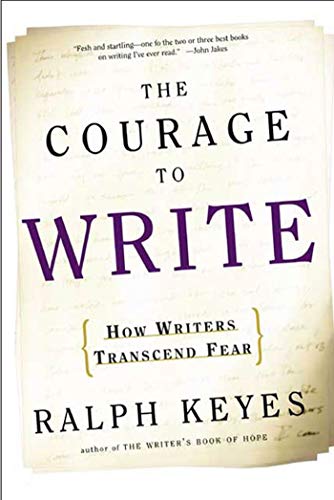
The Courage to Write is an invaluable book and essential reading for anyone who wishes to learn how to write well.
Katherine Anne Porter called courage "the first essential" for a writer. "I have to talk myself into bravery with every sentence," agreed Cynthia Ozick, "sometimes every syllable." E. B. White said he admired anyone who "has the guts to write anything at all."An author who has taught writing for more than thirty years,
In The Courage to Write, Ralph Keyes, an author who has taught writing for more than thirty years, assures us that anxiety is felt by writers at every level, especially when they dare to do their best. He describes the sequence of "courage points" through which all writers must pass, from the challenge of identifying a worthwhile project to the mixture of pride and panic they feel when examining a newly published book or article.
Keyes also offers specifics on how to root out dread of public "performance" and of the judgment of family and friends, make the best use of writers' workshops and conferences, and handle criticism of works in progress. Throughout, he includes the comments of many accomplished writers -- Pat Conroy, Amy Tan, Rita Dove, Isabel Allende, and others -- on how they transcended their own fears to produce great works.
Die Inhaltsangabe kann sich auf eine andere Ausgabe dieses Titels beziehen.
Über die Autorin bzw. den Autor
Ralph Keyes is the co-author of Whoever Makes the Most Mistakes Wins: Managing Innovation in a Changing Economy. His many other books include The Wit and Wisdom of Oscar Wilde, and The Wit and Wisdom of Harry Truman.
Auszug. © Genehmigter Nachdruck. Alle Rechte vorbehalten.
The Courage to Write
How Writers Transcend FearBy Ralph KeyesHolt Paperbacks
Copyright © 2003 Ralph KeyesAll right reserved.
ISBN: 9780805074673
The Courage to Write
{I}
THE ELEMENTS OF COURAGE
· 1 ·
Writing as an Act of Courage
If we had to say what writing is, we would have to define it essentially as an act of courage.
--Cynthia Ozick
E. B. White was the most graceful of writers. A generation of imitators tried, but seldom succeeded, to match his casual self-assurance. We like to imagine White on his New England farm dashing off lighthearted essays and charming books for children when he wasn't slopping hogs or chopping wood. In fact, White worried over every word. He rewrote pieces twenty times or more and sometimes pleaded with the postmaster of North Brooklin, Maine, to return a just-mailed manuscript so he could punch up its ending or rewrite the lead.
In addition to being a consummate rewriter, White was a gifted procrastinator. By writing long letters and puttering about his farm, he often managed to avoid the trauma of writing altogether. When the Paris Review wanted to interview him for its Writers at Work series, White said he'd be better qualified for one on Writers Not at Work. White later toldhis friend James Thurber that he considered himself "the second most inactive writer living, and the third most discouraged."
This would have surprised readers of his essays. To them, E. B. White was a courageous interpreter of the world's vagaries. That wasn't how he saw himself. After the president of Dartmouth College paid tribute to his "literary bravery," White thought, "He little knew." Dartmouth's president made that remark while conferring an honorary degree on the nation's favorite essayist. This was a rare occasion in which White had been lured from his farm onto a public platform. As he sat there, White later wrote his wife, "the old emptiness and dizziness and vapors seized hold of me ... . Nobody who has never suffered my peculiar kind of disability can understand the sheer hell of such moments."
Elwyn Brooks White had a lifelong fear of making public appearances. In his elementary school, students were called on to recite in alphabetical order of their last names. White spent long, agonizing hours dreading his fate as classmates whose names began with the alphabet's first twenty-two letters strode to the front of the room. Recitation wasn't his only childhood fear. Other things that scared White included darkness, girls, lavatories, the future, and the "fear that I was unknowing about things I should know about." Although he outgrew some of these anxieties, others took their place. White's fear of school bathrooms was replaced by concern that the brakes would fail on a trolley taking him up or down a hill. When he no longer needed to fret about reciting in class, White worried about collapsing on the street. By adding and subtracting fears this way, he kept himself in a steady state of anxiety. "Much of the story of the life of E. B. White,"wrote biographer Scott Elledge, "is the story of how he has come to terms with his fears."
The most effective strategy of all was to turn them into stories. White's books for children conveyed a tone of apprehension with the sure voice of an expert. Stuart Little found Manhattan no less frightening than his creator did. Wilbur the pig, in Charlotte's Web, was as scared of dying as his literary parent (though with more justification). The best of White's work had an edgy flavor that demanded readers pay attention. Joseph Epstein has pointed out the many anxious, almost macabre elements in White's deceptively "light" essays: a henhouse consumed with "contagious hysteria and fear"; "faces desperate in the rain"; "the fierce bewildering night." One of E. B. White's best essays--"The Second Tree from the Corner"--describes a Whitelike man named Trexler who consults a psychiatrist about his crippling anxieties. Unable to answer the psychiatrist's questions, Trexler nonetheless leaves his office feeling unburdened, "unembarrassed at being afraid; and in the jungle of his fear he glimpsed (as he had so often glimpsed them before) the flashy tail feathers of the bird courage."
White personified courage by being so willing to sail boldly into the squall of his own fears, commenting on the trip as he went. That's why we took to him. This man seemed at least as anxious as we were, but more willing to own up to it. "I am not inclined to apologize for my anxieties," he once said, "because I have lived with them long enough to respect them." When it came to his calling, White wrote eloquently about how much courage it took to write. "A writer's courage can easily fail him," he observed while accepting the National Medal for Literature. "I feel this daily."
In his simplest testament of all, White said, "I admire anybody who has the guts to write anything at all."
A Dangerous Career
The saga of E. B. White tells us something about writing fears and the courage to write. On the one hand, anxiety is inevitable among those who put words on paper for others to read. On the other hand, fear can be transcended, can even be made part of the writing process itself. Doing this takes courage. Few authors would dispute that. In talking with writers on this subject and reading about them, I discovered that their attitude differs little from E. B. White's. John Cheever called the attempt to write seriously "quite a dangerous career." Katherine Anne Porter thought that for writers, courage was "the first essential."
Before I began writing for a living, it hadn't occurred to me that courage was part of the job description. I knew this calling took skill, imagination, and persistence, and hoped I had these qualities. By working at a newspaper I'd learned some basics of my craft. With savings and a few contacts among editors, I set out to be a freelance writer. I outfitted myself with a thesaurus, a style manual, and a brand-new Smith-Corona typewriter. Now it was just a matter of getting down to business. Or so I thought.
Only after my tenth sleepless night did it dawn on me that there might be more to this business than recording good words on paper. By the time I started my first book, there was no escaping the fact that anxiety had elbowed its way into my office to sit beside me, scrutinizing every word I wrote. Much of this anxiety showed up in disguise. It expressed itself as stomach trouble, irritability, and restlessness. Duringtoss-and-turn nights I'd jot notes on a pad beside my bed. (Like marijuana-inspired brilliance, such notes were seldom of any use in the light of day.) Seven-day workweeks became routine as I tried to build walls of research and rhetoric strong enough to protect me from marauding critics. When a friend offered me a relaxing massage to ease my obvious tension, I turned the offer down out of fear that getting too relaxed might keep me from finishing my book. I had trouble even thinking about anything other than getting the book done. Taking a weekend off or even spending an evening with friends might break the writing spell forever, I feared. Then I might never return to my desk. I would be revealed as an impostor: someone who said he could write a book but couldn't.
I did finish that book (We, the Lonely...
„Über diesen Titel“ kann sich auf eine andere Ausgabe dieses Titels beziehen.
Suchergebnisse für The Courage to Write: How Writers Transcend Fear

Beispielbild für diese ISBN
The Courage to Write: How Writers Transcend Fear
Anbieter: World of Books (was SecondSale), Montgomery, IL, USA
Verkäuferbewertung 5 von 5 Sternen

Paperback. Zustand: Fair. The Courage to Write is an invaluable book and essential reading for anyone who wishes to learn how to write well. Katherine Anne Porter called courage "the first essential" for a writer. "I have to talk myself into bravery with every sentence," agreed Cynthia Ozick, "sometimes every syllable." E. B. White said he admired anyone who "has the guts to write anything at all."An author who has taught writing for more than thirty years, In The Courage to Write, Ralph Keyes, an author who has taught writing for more than thirty years, assures us that anxiety is felt by writers at every level, especially when they dare to do their best. He describes the sequence of "courage points" through which all writers must pass, from the challenge of identifying a worthwhile project to the mixture of pride and panic they feel when examining a newly published book or article. Keyes also offers specifics on how to root out dread of public "performance" and of the judgment of family and friends, make the best use of writers' workshops and conferences, and handle criticism of works in progress. Throughout, he includes the comments of many accomplished writers -- Pat Conroy, Amy Tan, Rita Dove, Isabel Allende, and others -- on how they transcended their own fears to produce great works. Artikel-Nr. 00107701328
Gebraucht kaufen
EUR 4,24
Versand gratis
Versand innerhalb von USA
Versand innerhalb von USA
Anzahl: 2 verfügbar
Beispielbild für diese ISBN
The Courage to Write: How Writers Transcend Fear
Anbieter: World of Books (was SecondSale), Montgomery, IL, USA
Verkäuferbewertung 5 von 5 Sternen
Paperback. Zustand: Good. The Courage to Write is an invaluable book and essential reading for anyone who wishes to learn how to write well. Katherine Anne Porter called courage "the first essential" for a writer. "I have to talk myself into bravery with every sentence," agreed Cynthia Ozick, "sometimes every syllable." E. B. White said he admired anyone who "has the guts to write anything at all."An author who has taught writing for more than thirty years, In The Courage to Write, Ralph Keyes, an author who has taught writing for more than thirty years, assures us that anxiety is felt by writers at every level, especially when they dare to do their best. He describes the sequence of "courage points" through which all writers must pass, from the challenge of identifying a worthwhile project to the mixture of pride and panic they feel when examining a newly published book or article. Keyes also offers specifics on how to root out dread of public "performance" and of the judgment of family and friends, make the best use of writers' workshops and conferences, and handle criticism of works in progress. Throughout, he includes the comments of many accomplished writers -- Pat Conroy, Amy Tan, Rita Dove, Isabel Allende, and others -- on how they transcended their own fears to produce great works. Artikel-Nr. 00107234686
Gebraucht kaufen
EUR 4,24
Versand gratis
Versand innerhalb von USA
Versand innerhalb von USA
Anzahl: 8 verfügbar
Foto des Verkäufers
The Courage to Write: How Writers Transcend Fear
Anbieter: Dream Books Co., Denver, CO, USA
Verkäuferbewertung 5 von 5 Sternen
Zustand: acceptable. This copy has clearly been enjoyedâ"expect noticeable shelf wear and some minor creases to the cover. Binding is strong, and all pages are legible. May contain previous library markings or stamps. Artikel-Nr. DBV.0805074678.A
Gebraucht kaufen
EUR 4,25
Versand gratis
Versand innerhalb von USA
Versand innerhalb von USA
Anzahl: 2 verfügbar
Beispielbild für diese ISBN
The Courage to Write : How Writers Transcend Fear
Anbieter: Better World Books, Mishawaka, IN, USA
Verkäuferbewertung 5 von 5 Sternen
Zustand: Very Good. 2 Reprint. Pages intact with possible writing/highlighting. Binding strong with minor wear. Dust jackets/supplements may not be included. Stock photo provided. Product includes identifying sticker. Better World Books: Buy Books. Do Good. Artikel-Nr. 4074787-6
Gebraucht kaufen
EUR 6,19
Versand gratis
Versand innerhalb von USA
Versand innerhalb von USA
Anzahl: 1 verfügbar
Beispielbild für diese ISBN
The Courage to Write : How Writers Transcend Fear
Anbieter: Better World Books, Mishawaka, IN, USA
Verkäuferbewertung 5 von 5 Sternen
Zustand: Good. 2 Reprint. Pages intact with minimal writing/highlighting. The binding may be loose and creased. Dust jackets/supplements are not included. Stock photo provided. Product includes identifying sticker. Better World Books: Buy Books. Do Good. Artikel-Nr. 2505152-6
Gebraucht kaufen
EUR 6,19
Versand gratis
Versand innerhalb von USA
Versand innerhalb von USA
Anzahl: 2 verfügbar
Beispielbild für diese ISBN
The Courage to Write : How Writers Transcend Fear
Anbieter: Better World Books, Mishawaka, IN, USA
Verkäuferbewertung 5 von 5 Sternen
Zustand: Good. 2 Reprint. Former library copy. Pages intact with minimal writing/highlighting. The binding may be loose and creased. Dust jackets/supplements are not included. Includes library markings. Stock photo provided. Product includes identifying sticker. Better World Books: Buy Books. Do Good. Artikel-Nr. 4293383-6
Gebraucht kaufen
EUR 6,19
Versand gratis
Versand innerhalb von USA
Versand innerhalb von USA
Anzahl: 1 verfügbar
Beispielbild für diese ISBN
The Courage to Write: How Writers Transcend Fear
Anbieter: ThriftBooks-Atlanta, AUSTELL, GA, USA
Verkäuferbewertung 5 von 5 Sternen
Paperback. Zustand: Fair. No Jacket. Readable copy. Pages may have considerable notes/highlighting. ~ ThriftBooks: Read More, Spend Less. Artikel-Nr. G0805074678I5N00
Gebraucht kaufen
EUR 6,20
Versand gratis
Versand innerhalb von USA
Versand innerhalb von USA
Anzahl: 1 verfügbar
Beispielbild für diese ISBN
The Courage to Write: How Writers Transcend Fear
Anbieter: ThriftBooks-Dallas, Dallas, TX, USA
Verkäuferbewertung 5 von 5 Sternen
Paperback. Zustand: Good. No Jacket. Missing dust jacket; Pages can have notes/highlighting. Spine may show signs of wear. ~ ThriftBooks: Read More, Spend Less. Artikel-Nr. G0805074678I3N01
Gebraucht kaufen
EUR 6,20
Versand gratis
Versand innerhalb von USA
Versand innerhalb von USA
Anzahl: 1 verfügbar
Beispielbild für diese ISBN
The Courage to Write: How Writers Transcend Fear
Anbieter: ThriftBooks-Dallas, Dallas, TX, USA
Verkäuferbewertung 5 von 5 Sternen
Paperback. Zustand: Good. No Jacket. Pages can have notes/highlighting. Spine may show signs of wear. ~ ThriftBooks: Read More, Spend Less. Artikel-Nr. G0805074678I3N00
Gebraucht kaufen
EUR 6,20
Versand gratis
Versand innerhalb von USA
Versand innerhalb von USA
Anzahl: 2 verfügbar
Beispielbild für diese ISBN
The Courage to Write: How Writers Transcend Fear
Anbieter: ThriftBooks-Atlanta, AUSTELL, GA, USA
Verkäuferbewertung 5 von 5 Sternen
Paperback. Zustand: Good. No Jacket. Pages can have notes/highlighting. Spine may show signs of wear. ~ ThriftBooks: Read More, Spend Less. Artikel-Nr. G0805074678I3N00
Gebraucht kaufen
EUR 6,20
Versand gratis
Versand innerhalb von USA
Versand innerhalb von USA
Anzahl: 3 verfügbar