
Verwandte Artikel zu Ivan's War: Life and Death in the Red Army, 1939-1945
Inhaltsangabe
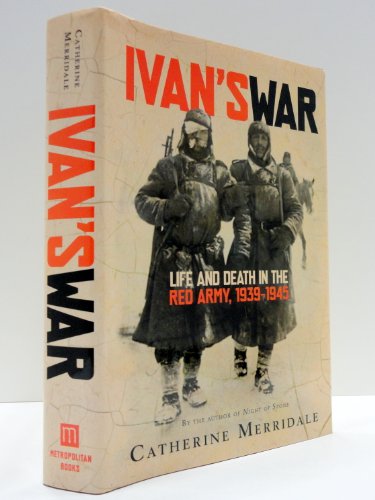
A powerful, groundbreaking narrative of the ordinary Russian soldier’s experience of the worst war in history, based on newly revealed sources
Of the thirty million who fought, eight million died, driven forward in suicidal charges, shattered by German shells and tanks. They were the men and women of the Red Army, a ragtag mass of soldiers who confronted Europe’s most lethal fighting force and by 1945 had defeated it. Sixty years have passed since their epic triumph, but the heart and mind of Ivan—as the ordinary Russian soldier was called—remain a mystery. We know something about hoe the soldiers died, but nearly nothing about how they lived, how they saw the world, or why they fought.
Drawing on previously closed military and secret police archives, interviews with veterans, and private letters and diaries, Catherine Merridale presents the first comprehensive history of the Red Army rank and file. She follows the soldiers from the shock of the German invasion to their costly triumph in Stalingrad, where life expectancy was often a mere twenty-four hours. Through the soldiers’ eyes, we witness their victorious arrival in Berlin, where their rage and suffering exact an awful toll, and accompany them as they return home full of hope, only to be denied the new life they had been fighting to secure.
A tour de force of original research and a gripping history, Ivan’s War reveals the singular mixture of courage, patriotism, anger, and fear that made it possible for these underfed, badly led troops to defeat the Nazi army. In the process Merridale restores to history the invisible millions who sacrificed the most to win the war.
Drawing on previously closed military and secret police archives, interviews with veterans, and private letters and diaries, Catherine Merridale presents the first comprehensive history of the Red Army rank and file. She follows the soldiers from the shock of the German invasion to their costly triumph in Stalingrad, where life expectancy was often a mere twenty-four hours. Through the soldiers’ eyes, we witness their victorious arrival in Berlin, where their rage and suffering exact an awful toll, and accompany them as they return home full of hope, only to be denied the new life they had been fighting to secure.
A tour de force of original research and a gripping history, Ivan’s War reveals the singular mixture of courage, patriotism, anger, and fear that made it possible for these underfed, badly led troops to defeat the Nazi army. In the process Merridale restores to history the invisible millions who sacrificed the most to win the war.
Die Inhaltsangabe kann sich auf eine andere Ausgabe dieses Titels beziehen.
Über die Autorinnen und Autoren
Catherine Merridale is the author of the critically acclaimed Night of Stone, winner of Britain’s Heinemann Award for Literature. A professor of contemporary history at the University of London, she also writes for the London Review of Books, the New Statesman, and The Independent and regularly presents history features for the BBC.
Catherine Merridale is the author of the critically acclaimed Night of Stone, winner of Britain's Heinemann Award for Literature. A professor of contemporary history at the University of London, she also writes for the London Review of Books, the New Statesman, and The Independent and regularly presents history features for the BBC.
Auszug. © Genehmigter Nachdruck. Alle Rechte vorbehalten.
Ivan's War
ONE
MARCHING WITH REVOLUTIONARY STEP
Whenever people think that they will have to fight a war, they try to picture what it will be like. Their stories seldom correspond to reality, but forecasting is not the purpose. Instead, the idea that the boys will soon be back or that the enemy will be destroyed with surgical precision, like the myth that it will all be over by Christmas, serves to foster a confident, even optimistic, mood at times when gloom might be more natural. In 1938, as the momentum for large-scale war gathered, the citizens of Stalin's empire, like Europeans everywhere, attempted to allay their fears with comforting tales. The Soviet vision of future conflict was destined to inspire a generation of wartime volunteers, but the images were created deliberately, by a clique of leaders whose ideology had set them on the path to international hostilities. The favored medium of communication was the cinema. The epic struggle of utopia and backwardness played out in moving pictures, black and white, with stirring music swelling on the soundtrack. At other moments, Soviet people opened their newspapers to columns of portentous diplomatic reportage; their country was preparing for battle. Butthough the news available to citizens was full of threat, films were designed to inculcate the view that the people's vanguard, the Red Army, was certain to triumph, and very quickly, too.
The greatest epic of the time was Sergei Eisenstein's Alexander Nevsky, an anti-Fascist parable of Russian victory over German invaders. Although it is set in the thirteenth century, in the age of Slavic princes and Teutonic knights, Eisenstein's great spectacle, released in 1938, makes direct reference to the politics of the 1930s, even to the point of adding swastikas to some of the Teutonic knights' shields and standards. The message was not one that Soviet audiences, attuned to every nuance of state-controlled propaganda, would miss. For all its deliberate sermonizing, however, the film, which boasted a musical score by Sergei Prokofiev, endured as a classic of Soviet cinema. Inferior productions with similar themes stood the test of time less well. But in the 1930s their audiences were rapt. And while, on the surface at least, Alexander Nevsky was set in the deep past, for moviegoers who preferred to look forward, another film, Efim Dzigan's If There Is War Tomorrow, also released in 1938, foretold Russia's victory in the face of a future invasion, the one that kept people awake at nights.
Efim Dzigan set out to reassure. The impact of his hour-long film was created by blending fictitious action with clips of genuine newsreel, splicing documentary footage into an unfolding fantasy of effortless victory. The message--resolute and stoical but also full of hope--was strengthened by the repetition of a musical refrain with words by the popular songwriter Vasily Lebedev-Kumach.1 If There Is War Tomorrow struck so live a chord with Soviet audiences that they went on watching it even after the real war began. By the winter of 1941, the invader had overrun a third of Soviet territory. The planes that droned across Dzigan's black-and-white screen had been destroyed, the tanks burned out, the brave soldiers corralled in prison camps. It was no longer possible to dream that this war would be over soon. That winter, the audiences crowding into old schoolrooms and empty huts included evacuees from Ukraine and Smolensk, people whose homes were now in German hands. Huddled together, relying on one another's breath for warmth, they needed patience as the hand-cranked dynamo was turned. All the same, a spell seemed to be cast.2 This film was not about the war butabout faith. That faith, and the images that sustained it, was part of what defined the generations that would bear the brunt of Russia's war. In the terrible years ahead, people would hum the music from the film to keep their spirits up. As they marched across dusty steppe, as they strummed guitars by the light of a campfire, it would be Lebedev-Kumach's song that soldiers often sang.
The film's action begins in a fairground, probably the newly opened Gorky Park, Moscow's Park of Culture and Rest. The Kremlin towers are visible in the distance, each topped with a glowing electric star. It is night, but the city is full of jollity, with Ferris wheels and fireworks and young people strolling about with ice creams in their hands. This is the socialist paradise, and it is a place of well-earned leisure, happy couples, brightly colored food. There is an innocence about it, crimeless, sexless, blandly without sin. In this land, Stalin and his loyal aides do all the worrying so that the children of the revolution can be free. But their freedom is under threat. The film cuts to the Soviet border, where Fascist troops, antlike, are climbing into tanks. There is no chance that we will sympathize with them. These are not the seductive species of villain but absurd buffoons. Their officers wear large mustaches, look pompous, and move with the bowlegged gait of cavalrymen. The infantrymen crawl, the airmen stoop. Throughout the action, they speak German, but they are more like cartoon Prussians from a children's book than genuine leather-booted Nazis. Even the swastikas on their helmets and collars are slightly eccentric. This is picture-book Fascism, not the real thing.
The invasion takes place at night. It could be frightening, and we may briefly worry for the stout young woman who is making soup a stone's throw from the front, but border guards hold the aggressor at bay. Our housewife joins the men, throwing off her apron and taking her place in the line of skillful gunners, proving that patriots can turn their hands to anything. Unfortunately, this is just the beginning of a series of perfidious attacks. The next comes from the air. The Fascist biplanes buzz with menace, but danger is averted for a second time. Soviet planes, a fleet of shining new machines, take to the skies, and at this point the audience should recognize the aces who have rushed to pilot them. There is Babushkin, the hero of an arctic rescue missionseveral years before, and Vodopyanov and Gromov, star aviators, their names printed across the screen in case we did not manage to identify their faces right away. The 1930s were the age of heroes, and pilots were the true elite. In a scene whose irony would become apparent three years later, when the Luftwaffe mounted its devastating attacks of June and July 1941, the famous aces run audacious raids into the Fascists' lair, destroying enemy aircraft on the ground and flying home without a single loss.
And now it is the Red Army's own turn. The volunteers stream in from every corner of the Soviet land. There is an old man with a gray beard in the line for recruitment. He fought against the White general Anton Denikin in the civil war and he wants another crack at the enemy. He holds a fist toward the screen, assuring us that the villains "will remember this from last time." The Fascists, like the Whites, have become the sworn enemies of right-thinking citizens everywhere. But not all citizens are fit to fight, and we now learn that front-line service is to be regarded as a privilege. Working and waiting are the lot of older people and the very young. Some women will remain at home, too, but others, every bit as trained and warlike as the men, line up in uniform, jaws set, prepared to do great deeds. It is not just Russians who come forward. The commissar for defense, Kliment Voroshilov, appears in his best uniform and appeals to the peoples of the east, the Uzbeks in particular. Hard-bitten men in sheepskin hats respond at once. Voroshilov's speech becomes a turning point for everyone. Soon Soviet troops will attack, driving the Fascists from...
„Über diesen Titel“ kann sich auf eine andere Ausgabe dieses Titels beziehen.
Suchergebnisse für Ivan's War: Life and Death in the Red Army, 1939-1945

Beispielbild für diese ISBN
Ivan's War: Life and Death in the Red Army, 1939-1945
Anbieter: World of Books (was SecondSale), Montgomery, IL, USA
Verkäuferbewertung 5 von 5 Sternen

Zustand: Good. Item in good condition. Textbooks may not include supplemental items i.e. CDs, access codes etc. Artikel-Nr. 00109596351
Gebraucht kaufen
EUR 3,98
Versand gratis
Versand innerhalb von USA
Versand innerhalb von USA
Anzahl: 1 verfügbar
Beispielbild für diese ISBN
Ivan's War : Life and Death in the Red Army, 1939-1945
Anbieter: Better World Books, Mishawaka, IN, USA
Verkäuferbewertung 5 von 5 Sternen
Zustand: Good. Pages intact with minimal writing/highlighting. The binding may be loose and creased. Dust jackets/supplements are not included. Stock photo provided. Product includes identifying sticker. Better World Books: Buy Books. Do Good. Artikel-Nr. 5292544-6
Gebraucht kaufen
EUR 6,69
Versand gratis
Versand innerhalb von USA
Versand innerhalb von USA
Anzahl: 1 verfügbar
Beispielbild für diese ISBN
Ivan's War : Life and Death in the Red Army, 1939-1945
Anbieter: Better World Books, Mishawaka, IN, USA
Verkäuferbewertung 5 von 5 Sternen
Zustand: Good. Former library copy. Pages intact with minimal writing/highlighting. The binding may be loose and creased. Dust jackets/supplements are not included. Includes library markings. Stock photo provided. Product includes identifying sticker. Better World Books: Buy Books. Do Good. Artikel-Nr. 5212827-6
Gebraucht kaufen
EUR 6,69
Versand gratis
Versand innerhalb von USA
Versand innerhalb von USA
Anzahl: 4 verfügbar
Beispielbild für diese ISBN
Ivan's War: Life and Death in the Red Army, 1939-1945
Anbieter: Wonder Book, Frederick, MD, USA
Verkäuferbewertung 5 von 5 Sternen
Zustand: Good. Good condition. Good dust jacket. A copy that has been read but remains intact. May contain markings such as bookplates, stamps, limited notes and highlighting, or a few light stains. Artikel-Nr. Q04N-00564
Gebraucht kaufen
EUR 9,18
Versand gratis
Versand innerhalb von USA
Versand innerhalb von USA
Anzahl: 1 verfügbar
Beispielbild für diese ISBN
Ivan's War: Life and Death in the Red Army, 1939-1945
Anbieter: Wonder Book, Frederick, MD, USA
Verkäuferbewertung 5 von 5 Sternen
Zustand: Very Good. Very Good condition. Good dust jacket. A copy that may have a few cosmetic defects. May also contain light spine creasing or a few markings such as an owner's name, short gifter's inscription or light stamp. Artikel-Nr. K11R-01223
Gebraucht kaufen
EUR 10,24
Versand gratis
Versand innerhalb von USA
Versand innerhalb von USA
Anzahl: 1 verfügbar
Beispielbild für diese ISBN
Ivan's War: Life and Death in the Red Army, 1939-1945
Anbieter: Browse Awhile Books, Tipp City, OH, USA
Verkäuferbewertung 5 von 5 Sternen
Hardcover. Zustand: Near Fine. Book Club Edition. Artikel-Nr. 1150381
Gebraucht kaufen
EUR 7,99
EUR 6,03 Versand
Versand innerhalb von USA
Versand innerhalb von USA
Anzahl: 1 verfügbar
Beispielbild für diese ISBN
Ivan's War: Life and Death in the Red Army, 1939-1945
Anbieter: GridFreed, San Diego, CA, USA
Verkäuferbewertung 5 von 5 Sternen
hardcover. Zustand: New. In shrink wrap. Artikel-Nr. 100-29499
Neu kaufen
EUR 16,83
EUR 5,99 Versand
Versand innerhalb von USA
Versand innerhalb von USA
Anzahl: 1 verfügbar
Beispielbild für diese ISBN
Ivan's War: Life and Death in the Red Army, 1939-1945
Anbieter: Revaluation Books, Exeter, Vereinigtes Königreich
Verkäuferbewertung 5 von 5 Sternen
Hardcover. Zustand: Brand New. 480 pages. 9.75x6.50x1.50 inches. In Stock. Artikel-Nr. 0805074554
Neu kaufen
EUR 38,82
EUR 14,58 Versand
Versand von Vereinigtes Königreich nach USA
Versand von Vereinigtes Königreich nach USA
Anzahl: 1 verfügbar