
Verwandte Artikel zu A Perfect Union: Dolley Madison And the Creation of...
Inhaltsangabe
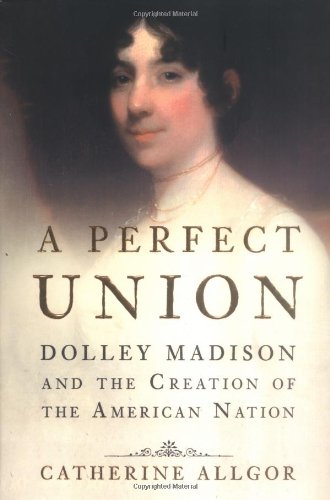
An in-depth study of the early days of the American republic offers an intriguing portrait of the life of a remarkable American woman, profiling the seminal role played by Dolley Madison amid the turbulent and complex political, social, and cultural world of the early nineteenth century. 75,000 first printing.
Die Inhaltsangabe kann sich auf eine andere Ausgabe dieses Titels beziehen.
Über die Autorin bzw. den Autor
A professor of history at the University of California-Riverside, Catherine Allgor has received the George Washington Egleston Prize from Yale, the Lerner-Scott Prize from the Organization of American Historians, and the James H. Broussard First Book Prize from the Society for Historians of the Early American Republic for Parlor Politics. She was awarded a Bunting Fellowship for her work on Dolley Madison. Allgor lives in Riverside, California.
Auszug. © Genehmigter Nachdruck. Alle Rechte vorbehalten.
Prologue
On Wednesday, August 24, 1814, Dolley Madison stood at the window of the White House and watched thousands of Washingtonians, rich and poor, white and black, pouring down Pennsylvania Avenue. News and rumors of the approach of British troops had thrown the city into confusion, and the population had been evacuating for days. Vehicles were at a premium, and any conveyance with wheels was pressed into service by the fleeing throngs. It had not rained for three weeks, and the clouds of dust raised by the people, horses, carriages, and carts lingered ominously on the horizon.1
With chaos at her door, Dolley sat down at her desk to continue a letter to her sister Lucy, which she had begun the previous day. “My husband left me yesterday morng to join General Winder,” Dolley had written on Tuesday. “He enquired anxiously whether I had courage, or firmness to remain in the President’s house until his return, on the morrow, or succeeding day, and on my assurance that I had no fear but for him and the success of our army, he left me, beseeching me to take care of myself, and of the cabinet papers, public and private.”2 James had gone to review the troops stationed in nearby Maryland, hoping to discern, if he could, the intentions of a small force of British soldiers who had landed on the banks of the Patuxent River in June. He had sent Dolley two messages, framing the confusion as comfort: “The reports as to the enemy have varied every hour. The last & probably truest information is that they are not very strong, and are without cavilry and artillery, and of course that they are not in a condition to strike at Washington.” But, James had to admit, “it is possible, however they may have a greater force or expect one, than has been represented or that their timerity may be greater than their strength.” His second letter was “alarming,” Dolley admitted, “because he desires I should be ready at a moment’s warning to enter my carriage and leave the city.”3
By midday on Wednesday, Dolley had packed, “press[ing] as many cabinet papers into trunks as to fill one carriage; our private property must be sacrificed,” but she was also determined to wait for her husband. From time to time, she went onto the roof of the executive mansion, anxiously casting her spyglass in every direction. By this point, 90 percent of the populace had fled, even the men guarding the city. The mayor of Washington, James H. Blake, came twice to plead with her to evacuate, but Dolley would not leave until James returned.4
This disastrous state of affairs—the capital city under threat and the president in physical jeopardy—had taken Americans by surprise. Though there certainly had been signs that the British were targeting Washington, the country had for the most part denied the danger. As recently as early August, Dolley had assured her own son that “the British on our shore’s are stealing & destroying private property, rarely comeing to battle but when they do, are allways beaten,” yet the truth was far less rosy. Over the course of the two-year war with Great Britain, victories on the American side had been few, and the losses significant and frustrating. American troops had repeatedly tried to invade Canada, across the Niagara frontier, from Lake Champlain toward Montreal, and from Detroit into upper Canada. Though American forces had won two decisive battles in 1813—led by Oliver Hazard Perry at the battle of Lake Erie, and under William Henry Harrison’s command at the battle of the Thames—Canada remained under British control. And despite several widely heralded victories by the American ships Constitution and United States, the powerful British navy blockaded the east coast, leaving coastal towns from the Penobscot River in Maine to the Chesapeake Bay vulnerable to hit-and-run raids. Now the papers and commanders could deny it no longer: the British had landed at Benedict, Maryland, and were heading, four thousand men strong, for the capital of the United States.5
Dolley feared not only marauding British soldiers but also nearer enemies. “Mr. Madison’s War,” as his detractors dubbed it, had divided the country, inflaming an already combustible political climate. Treachery filled the air, and on the eve of invasion Dolley had American foes in mind when she darkly hinted to her sister: “Disaffection stalks around us.” Indeed, she wanted to leave the city with James as much for his safety as her own: “I hear of much hostility towards him.”
Even as she was deciding whether she should wait for the president, Dolley was overseeing the preparations for that day’s dinner party, supervising the table setting for forty guests, ordering the wines, ale, and cider to be brought from the cellar. This occasion was one of many she had hosted in the past months, designed to reassure government officials and local gentry alike that all was well.6 By three o’clock, however, she received word of a devastating rout near Bladensburg, Maryland, during which the Americans turned tail and ran so quickly that the episode would come to be known as the Bladensburg Races.
Now “within sound of the cannon,” Dolley “lived a lifetime,” waiting for her husband to return, but “Mr. Madison comes not; may God protect him!” She was in an “agony” of fear that the British would take James prisoner. Urged on by friends, she organized herself and her slaves to leave the house. Charles Carroll, a wealthy Maryland landowner and Madison supporter “has come to hasten my departure, and is in a very bad humor with me because I insist on waiting until the large picture of Gen. Washington is secured.” The full-length portrait of the beloved Washington hung in the presidential portrait gallery in the state dining room. Unfortunately, there was no time to unscrew the frame from the wall. “I have ordered the frame to be broken, and the canvass taken out,” Dolley related to Lucy, “it is done.” She entrusted the precious painting to “two gentlemen of New York” for safe passage.7
Dolley’s departure could not be much longer delayed. James Smith, a free black man who had accompanied the president to Bladensburg, came galloping down the street, warning Dolley and the remaining capital residents to flee, as the American forces were in retreat. Clearly, James would not come now; if Dolley lingered any longer, she risked capture as a political prisoner or death as a casualty of war. It was time to end her missive. “And now, dear sister, I must leave this house, or the retreating army will make me a prisoner in it, by filling up the road I am directed to take. When I shall again write you, or where I shall be tomorrow, I cannot tell!!”
That day the British did indeed invade Washington City. They looted and burned only the public buildings, taking particular relish in consigning the “president’s palace” to the flames. Before they did so, however, they sat down and enjoyed the elegant meal that had been set out.8 Given the effort Dolley Madison had put into establishing her White House as the capital’s social and political center, it seems fitting that a dinner party, even one attended by uninvited guests, occupied the last moments of the executive mansion.
This is how most Americans know Dolley Madison, as the heroine who saved the portrait of George Washington. In fact, next to the tale of Fort McHenry and the writing of “The Star-Spangled Banner,” the story of Dolley and the White House is the only one Americans typically associate with the ill-fated War of 1812. To be sure, very few have the story right—for...
„Über diesen Titel“ kann sich auf eine andere Ausgabe dieses Titels beziehen.
Weitere beliebte Ausgaben desselben Titels

Suchergebnisse für A Perfect Union: Dolley Madison And the Creation of...

Beispielbild für diese ISBN
A Perfect Union: Dolley Madison and the Creation of the American Nation
Anbieter: ThriftBooks-Reno, Reno, NV, USA
Verkäuferbewertung 5 von 5 Sternen

Hardcover. Zustand: Good. No Jacket. Former library book; Pages can have notes/highlighting. Spine may show signs of wear. ~ ThriftBooks: Read More, Spend Less. Artikel-Nr. G0805073272I3N10
Gebraucht kaufen
EUR 5,99
Versand gratis
Versand innerhalb von USA
Versand innerhalb von USA
Anzahl: 1 verfügbar
Beispielbild für diese ISBN
A Perfect Union: Dolley Madison and the Creation of the American Nation
Anbieter: ThriftBooks-Atlanta, AUSTELL, GA, USA
Verkäuferbewertung 5 von 5 Sternen
Hardcover. Zustand: Good. No Jacket. Former library book; Pages can have notes/highlighting. Spine may show signs of wear. ~ ThriftBooks: Read More, Spend Less. Artikel-Nr. G0805073272I3N10
Gebraucht kaufen
EUR 6,01
Versand gratis
Versand innerhalb von USA
Versand innerhalb von USA
Anzahl: 1 verfügbar
Beispielbild für diese ISBN
A Perfect Union: Dolley Madison and the Creation of the American Nation
Anbieter: ThriftBooks-Dallas, Dallas, TX, USA
Verkäuferbewertung 5 von 5 Sternen
Hardcover. Zustand: Fair. No Jacket. Former library book; Readable copy. Pages may have considerable notes/highlighting. ~ ThriftBooks: Read More, Spend Less. Artikel-Nr. G0805073272I5N10
Gebraucht kaufen
EUR 6,01
Versand gratis
Versand innerhalb von USA
Versand innerhalb von USA
Anzahl: 1 verfügbar
Beispielbild für diese ISBN
A Perfect Union: Dolley Madison and the Creation of the American Nation
Anbieter: ThriftBooks-Atlanta, AUSTELL, GA, USA
Verkäuferbewertung 5 von 5 Sternen
Hardcover. Zustand: Good. No Jacket. Pages can have notes/highlighting. Spine may show signs of wear. ~ ThriftBooks: Read More, Spend Less. Artikel-Nr. G0805073272I3N00
Gebraucht kaufen
EUR 6,01
Versand gratis
Versand innerhalb von USA
Versand innerhalb von USA
Anzahl: 1 verfügbar
Beispielbild für diese ISBN
A Perfect Union Dolley Madison
Anbieter: World of Books (was SecondSale), Montgomery, IL, USA
Verkäuferbewertung 5 von 5 Sternen
Zustand: Good. Good condition ex-library book with usual library markings and stickers. Artikel-Nr. 00104164112
Gebraucht kaufen
EUR 6,12
Versand gratis
Versand innerhalb von USA
Versand innerhalb von USA
Anzahl: 1 verfügbar
Beispielbild für diese ISBN
A Perfect Union: Dolley Madison and the Creation of the American Nation
Anbieter: Wonder Book, Frederick, MD, USA
Verkäuferbewertung 5 von 5 Sternen
Zustand: Very Good. Very Good condition. Very Good dust jacket. A copy that may have a few cosmetic defects. May also contain light spine creasing or a few markings such as an owner's name, short gifter's inscription or light stamp. Bundled media such as CDs, DVDs, floppy disks or access codes may not be included. Artikel-Nr. O08A-00491
Gebraucht kaufen
EUR 6,25
Versand gratis
Versand innerhalb von USA
Versand innerhalb von USA
Anzahl: 1 verfügbar
Beispielbild für diese ISBN
A Perfect Union : Dolley Madison and the Creation of the American Nation
Anbieter: Better World Books: West, Reno, NV, USA
Verkäuferbewertung 5 von 5 Sternen
Zustand: Very Good. Former library copy. Pages intact with possible writing/highlighting. Binding strong with minor wear. Dust jackets/supplements may not be included. Includes library markings. Stock photo provided. Product includes identifying sticker. Better World Books: Buy Books. Do Good. Artikel-Nr. 939290-6
Gebraucht kaufen
EUR 7,18
Versand gratis
Versand innerhalb von USA
Versand innerhalb von USA
Anzahl: 1 verfügbar
Beispielbild für diese ISBN
A Perfect Union : Dolley Madison and the Creation of the American Nation
Anbieter: Better World Books, Mishawaka, IN, USA
Verkäuferbewertung 5 von 5 Sternen
Zustand: Good. Former library copy. Pages intact with minimal writing/highlighting. The binding may be loose and creased. Dust jackets/supplements are not included. Includes library markings. Stock photo provided. Product includes identifying sticker. Better World Books: Buy Books. Do Good. Artikel-Nr. GRP104734349
Gebraucht kaufen
EUR 7,18
Versand gratis
Versand innerhalb von USA
Versand innerhalb von USA
Anzahl: 2 verfügbar
Beispielbild für diese ISBN
A Perfect Union: Dolley Madison and the Creation of the American Nation
Anbieter: Books From California, Simi Valley, CA, USA
Verkäuferbewertung 4 von 5 Sternen

hardcover. Zustand: Good. minor wear and creasing stickered cover. Artikel-Nr. mon0003489043
Gebraucht kaufen
EUR 3,57
EUR 4,33 Versand
Versand innerhalb von USA
Versand innerhalb von USA
Anzahl: 1 verfügbar
Beispielbild für diese ISBN
A Perfect Union : Dolley Madison and the Creation of the American Nation
Anbieter: Better World Books Ltd, Dunfermline, Vereinigtes Königreich
Verkäuferbewertung 5 von 5 Sternen
Zustand: Good. Former library copy. Pages intact with minimal writing/highlighting. The binding may be loose and creased. Dust jackets/supplements are not included. Includes library markings. Stock photo provided. Product includes identifying sticker. Better World Books: Buy Books. Do Good. Artikel-Nr. GRP104734349
Gebraucht kaufen
EUR 5,89
EUR 5,84 Versand
Versand von Vereinigtes Königreich nach USA
Versand von Vereinigtes Königreich nach USA
Anzahl: 1 verfügbar