
Verwandte Artikel zu Democracy Reborn: The Fourteenth Amendment and the...
Democracy Reborn: The Fourteenth Amendment and the Fight for Civil Rights in Post-civil War America - Softcover
Inhaltsangabe
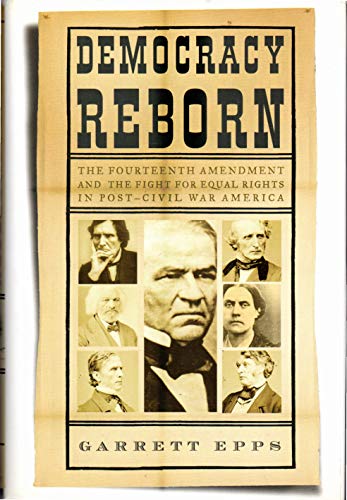
A riveting narrative of the adoption of the Fourteenth Amendment, an act which revolutionized the U.S. constitution and shaped the nation’s destiny in the wake of the Civil War
Though the end of the Civil War and Lincoln’s Emancipation Proclamation inspired optimism for a new, happier reality for blacks, in truth the battle for equal rights was just beginning. Andrew Johnson, Lincoln’s successor, argued that the federal government could not abolish slavery. In Johnson’s America, there would be no black voting, no civil rights for blacks.
When a handful of men and women rose to challenge Johnson, the stage was set for a bruising constitutional battle. Garrett Epps, a novelist and constitutional scholar, takes the reader inside the halls of the Thirty-ninth Congress to witness the dramatic story of the Fourteenth Amendment’s creation. At the book’s center are a cast of characters every bit as fascinating as the Founding Fathers. Thaddeus Stevens, Charles Sumner, Frederick Douglass, Susan B. Anthony, among others, understood that only with the votes of freed blacks could the American Republic be saved.
Democracy Reborn offers an engrossing account of a definitive turning point in our nation’s history and the significant legislation that reclaimed the democratic ideal of equal rights for all U.S. citizens.
Die Inhaltsangabe kann sich auf eine andere Ausgabe dieses Titels beziehen.
Über die Autorin bzw. den Autor
Garrett Epps is the author of The Shad Treatment and The Floating Island: A Tale of Washington. He is the Orlando John and Marian H. Hollis Professor at the University of Oregon School of Law. He lives in Eugene, Oregon.
Auszug. © Genehmigter Nachdruck. Alle Rechte vorbehalten.
Prologue
Philadelphia 1787: Red Sky at Morning
From his vantage point in Paris, Thomas Jefferson had hailed the makeup of the Constitutional Convention of 1787 in characteristic hyperbole. "It really is an assembly of demi-gods," he wrote to John Adams.
Perhaps. But by August 1787, the demigods were feeling tired and distinctly mortal. Since May 25, they had spent day after day in the small assembly room of the Pennsylvania statehouse, dressed in wool and broadcloth finery amid the humid swelter of Philadelphia--the new nation's cosmopolis, to be sure, but still in summer something of a fever port. To make the room even hotter, they had barred the windows, lest the revolutionary plan they were hatching--to scrap the entire American political system and replace it with a powerful national government--leak out before their work was completed. Day after day, they had marched through agonizing problems. Would the new government have no executive, multiple executives, or only one? That dilemma was solved by creating a powerful presidency custom-tailored for the convention's presiding officer, George Washington. Would there be a new system of federal courts? That one they finessed, by creating a Supreme Court and leaving the question of lower courts to the discretion of future Congresses. How would the new Congress be selected? The large and small states had compromised on this, creating a House apportioned by population and a Senate in which each state would be equal. Who could veto laws passed by Congress? They lodged this power solely in the president, just as the British reposed it in their king. What powers would Congress have? Nationalist delegates like James Madison wanted the Constitution to state that Congress would have the power to "legislate in all cases to which the separate States are incompetent, or in which the harmony of the United States may be interrupted by the exercise of individual Legislation [and] to negate all laws passed by the several States." But delegates jealous of the powers of the states had forced a retreat, giving Congress a set of enumerated powers that were designed to keep it out of local matters.
What we know about what went on in that small hot room is mostly revealed in handwritten notes taken by Madison, the strongest advocate of a powerful new national government. Many delegates took lengthy leaves of absence during the summer, drawn away by their own business affairs or the deliberations of the Continental Congress, meeting in New York. Not Madison. Day after day this earnest, brilliant little man was in his seat, scribbling in his odd abbreviated style what each delegate had to say about each part of the proposed new government. Night after night, while other delegates relaxed amid the pleasures of a city known for fine wine, sophisticated conversation, and beautiful women, Madison stayed at his desk, revising his notes and reviewing the historical record of federal republics, beginning with the Amphictionic League of ancient Greece and moving forward to the contemporaneous Dutch Republic. Madison's gifts to the new country include the plan of both the Constitution and the Bill of Rights; but even set against those triumphs, his handwritten notes represent an important legacy to the future.
Those notes spark many feelings in Americans today. There is exhilaration and pride, to be sure. These fifty-five men, who came from states with radically different interests and wildly divergent social systems, were patient, practical, and often eloquent. They were willing to listen to those who differed with them and to change their most profound ideas if the arguments on the other side seemed good--or the disagreement so profound that it might threaten the convention with failure.
The debates, however, also spark dismay and even shame. The demigods did not see how inequality of wealth and status, of sex and race, would poison the new republic they were building. A reader feels compassion, too, for men who were racing against chaos in the new country to build a structure for a future they could only dimly foresee. And finally, from time to time, there is puzzlement. Because amid the true debate--the cut and thrust of brilliant minds with differing views--there were repeated moments of reticence, when important questions about the future were floated by one speaker or another, only to fall dead without any response in the still dusty air of the hall. Such a moment came on September 12, after the convention had, with great labor, produced an all-but-final draft of the document to be adopted. Without warning, George Mason of Virginia (who would eventually refuse to sign the Constitution because he viewed it as a blueprint for "monarchy, or a tyrannical aristocracy") popped up to suggest that the convention should now produce a Bill of Rights. "It would give great quiet to the people," Madison records Mason saying, "and with the aid of the State declarations, a bill might be prepared in a few hours."
Like marathon runners hearing that the finish line might be moved a couple of miles farther back, the convention received this idea in sullen silence. Not a single state delegation voted to proceed with drafting a Bill of Rights. It was a mistake; the lack of a Bill of Rights outraged many Americans, and came close to dooming the new Constitution to rejection.
But of all the lost voices of Philadelphia 1787, the one that should most haunt modern ears is that of Gouverneur Morris of New York, who rose on August 8 to say what many of the delegates knew in their heart, but deeply wished not to acknowledge or discuss.
Crowded as the delegates were in the small meeting room in the East Wing, there was something huge in it with them--an ill omen that no one truly wanted to acknowledge. As Philadelphia spring turned to summer, most of those present had come to realize that the infant republic carried within it the seeds of its own destruction, flaws that might strangle the child in the cradle, or destroy it years or even decades later.
When the delegates gathered, they had expected friction between the large powerful states like Virginia and New York on the one hand and the small states like New Jersey and Georgia on the other. That divide surfaced quickly and shaped the schemes for electing Congress and the president. But another less expected division appeared in Philadelphia--one that never went away again. On June 30, Madison noted that "the States were divided into different interests not by their difference of size, but by other circumstances; the most material of which resulted partly from climate, but principally from their having or not having slaves. These two causes concurred in forming the great division of interests in the U[nited] States. It did not lie between the large & small States; it lay between the Northern and the Southern. . . ."
The divide was not as simple as we might imagine today. There was no gulf between "slave states" and "free states" because in 1787 there was only one free state--Massachusetts, where a court decision had effectively throttled the institution in 1783. (Vermont, which had abolished slavery in 1777, was still an independent republic and...
„Über diesen Titel“ kann sich auf eine andere Ausgabe dieses Titels beziehen.
Suchergebnisse für Democracy Reborn: The Fourteenth Amendment and the...

Beispielbild für diese ISBN
Democracy Reborn : The Fourteenth Amendment and the Fight for Equal Rights in Post-Civil War America
Anbieter: Better World Books, Mishawaka, IN, USA
Verkäuferbewertung 5 von 5 Sternen

Zustand: Good. Former library copy. Pages intact with minimal writing/highlighting. The binding may be loose and creased. Dust jackets/supplements are not included. Includes library markings. Stock photo provided. Product includes identifying sticker. Better World Books: Buy Books. Do Good. Artikel-Nr. 939996-6
Gebraucht kaufen
EUR 13,66
Versand gratis
Versand innerhalb von USA
Versand innerhalb von USA
Anzahl: 2 verfügbar
Beispielbild für diese ISBN
Democracy Reborn : The Fourteenth Amendment and the Fight for Equal Rights in Post-Civil War America
Anbieter: Better World Books, Mishawaka, IN, USA
Verkäuferbewertung 5 von 5 Sternen
Zustand: Very Good. Former library copy. Pages intact with possible writing/highlighting. Binding strong with minor wear. Dust jackets/supplements may not be included. Includes library markings. Stock photo provided. Product includes identifying sticker. Better World Books: Buy Books. Do Good. Artikel-Nr. 4273372-6
Gebraucht kaufen
EUR 13,66
Versand gratis
Versand innerhalb von USA
Versand innerhalb von USA
Anzahl: 1 verfügbar
Beispielbild für diese ISBN
Democracy Reborn : The Fourteenth Amendment and the Fight for Equal Rights in Post-Civil War America
Anbieter: Better World Books: West, Reno, NV, USA
Verkäuferbewertung 5 von 5 Sternen
Zustand: Very Good. Pages intact with possible writing/highlighting. Binding strong with minor wear. Dust jackets/supplements may not be included. Stock photo provided. Product includes identifying sticker. Better World Books: Buy Books. Do Good. Artikel-Nr. 4412037-75
Gebraucht kaufen
EUR 13,66
Versand gratis
Versand innerhalb von USA
Versand innerhalb von USA
Anzahl: 1 verfügbar
Beispielbild für diese ISBN
Democracy Reborn: The Fourteenth Amendment and the Fight for Equal Rights in Post-Civil War America
Anbieter: My Dead Aunt's Books, Hyattsville, MD, USA
Verkäuferbewertung 5 von 5 Sternen
paperback. Zustand: LIKE NEW. Zustand des Schutzumschlags: LIKE NEW. Inscribed by author on title page. Artikel-Nr. 76557C
Gebraucht kaufen
EUR 9,19
EUR 4,91 Versand
Versand innerhalb von USA
Versand innerhalb von USA
Anzahl: 1 verfügbar
Beispielbild für diese ISBN
Democracy Reborn: The Fourteenth Amendment and the Fight for Civil Rights in Post-civil War America
Anbieter: Revaluation Books, Exeter, Vereinigtes Königreich
Verkäuferbewertung 5 von 5 Sternen
Hardcover. Zustand: Brand New. 333 pages. 9.50x6.00x1.25 inches. In Stock. Artikel-Nr. 080507130X
Neu kaufen
EUR 44,47
EUR 14,93 Versand
Versand von Vereinigtes Königreich nach USA
Versand von Vereinigtes Königreich nach USA
Anzahl: 1 verfügbar