
Verwandte Artikel zu Enough: Staying Human in an Engineered Age
Inhaltsangabe
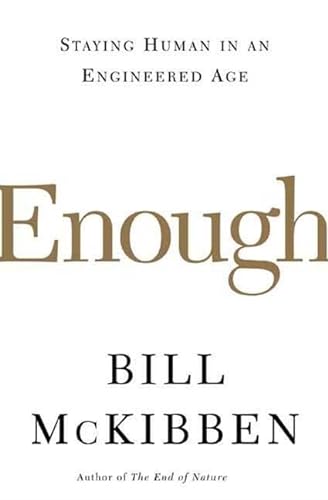
From the bestselling author of The End of Nature comes a passionate plea to limit the technologies that could change the very definition of who we are
We are on the verge of crossing the line from born to made, from created to built. Sometime in the next few years, a scientist will reprogram a human egg or sperm cell, spawning a genetic change that could be passed down into eternity. We are sleepwalking toward the future, argues Bill McKibben, and it’s time to open our eyes.
In The End of Nature, nearly fifteen years ago, McKibben demonstrated that humanity had begun to irrevocably alter—and endanger—our environment on a global scale. Now he turns his eye to an array of technologies that could change our relationship not with the rest of nature but with ourselves. He explores the frontiers of genetic engineering, robotics, and nanotechnology—all of which we are approaching with astonishing speed—and shows that each threatens to take us past a point of no return. We now stand at a critical threshold, poised between the human past and a post-human future.
Ultimately, McKibben offers a celebration of what it means to be human, and a warning that we risk the loss of all meaning if we step across the threshold. His wise and eloquent book argues that we cannot forever grow in reach and power—that we must at last learn how to say, “Enough.”
We are on the verge of crossing the line from born to made, from created to built. Sometime in the next few years, a scientist will reprogram a human egg or sperm cell, spawning a genetic change that could be passed down into eternity. We are sleepwalking toward the future, argues Bill McKibben, and it’s time to open our eyes.
In The End of Nature, nearly fifteen years ago, McKibben demonstrated that humanity had begun to irrevocably alter—and endanger—our environment on a global scale. Now he turns his eye to an array of technologies that could change our relationship not with the rest of nature but with ourselves. He explores the frontiers of genetic engineering, robotics, and nanotechnology—all of which we are approaching with astonishing speed—and shows that each threatens to take us past a point of no return. We now stand at a critical threshold, poised between the human past and a post-human future.
Ultimately, McKibben offers a celebration of what it means to be human, and a warning that we risk the loss of all meaning if we step across the threshold. His wise and eloquent book argues that we cannot forever grow in reach and power—that we must at last learn how to say, “Enough.”
Die Inhaltsangabe kann sich auf eine andere Ausgabe dieses Titels beziehen.
Über die Autorin bzw. den Autor
Bill McKibben writes regularly for The New York Review of Books, The New York Times, Natural History, The New Republic, and many other publications. His first book, The End of Nature, was published in 1989 after being excerpted in The New Yorker and was a national bestseller. His other books include The Age of Missing Information, Maybe One, and Long Distance: A Year of Living Strenuously. He lives with his wife, the writer Sue Halpern, and daughter in Vermont.
Rezensionen
McKibben (The End of Nature, 1989) turns a passionate and revealing spotlight on our headlong rush into technology. He explains an array of procedures--including germline engineering and therapeutic cloning--that represent a slippery slope. For although they hold the promise to cure disease, they also offer the option of "improving" or "perfecting" human beings, providing the ability to choose a child's sex, boost intelligence, or implant a predisposition to music. If we're not careful, we could end up engineering our children to the point that they're no longer human, he cautions. Technological advancements are proceeding so rapidly that we will soon need to make decisions about how much technology is enough. McKibben makes genetic engineering, robotics, and nanotechology understandable even to those readers who are not techno-savvy, and he makes a strong and compelling case for examining the medical, social, ethical, and philosophical arguments against certain technological advancements that come eerily close to leaving behind humanness and, thus, all the intangible irrationalities that make us who we are. This is a disturbing though ultimately optimistic book that explores the possibility of technology replacing humanity and rouses within us the impulse to declare: enough. Vanessa Bush
Copyright © American Library Association. All rights reserved
In 1989, McKibben published The End of Nature, a gorgeously written and galvanizing book about the true cost of global warming, the destruction of the ozone layer and other man-made ills-the loss of wild nature and with it the priceless aspect of our humanity that evolved to listen to and heed it. Now McKibben applies the same passion, scholarship and free-ranging thought to a subject that even committed environmentalists have avoided. Here he tackles what it means to be human. Reporting from the frontiers of genetic research, nanotechnology and robotics, he explores that subtle moral and spiritual boundary that he calls the "enough point." Presenting an overview of what is or may soon be possible, McKibben contends that there is no boundary to human ambition or desire or to what our very inventions may make possible. In an absorbing and horrifying montage of images, he depicts microscopic nanobots consuming the world and children born so genetically enhanced that they will never be able to believe that they reach for the stars as pianists or painters or long-distance runners because there is something unique in them that has a passion to try. Indeed, in the view of the most unbridled "technoutopians," the day of the robotically striving human is already here. What does set a human being apart from other beings, McKibben argues, is our capacity for restraint-and even for finding great meaning in restraint. "We need to do an unlikely thing: We need to survey the world we now inhabit and proclaim it good. Good enough." McKibben presents an uncompromising view, and an essential view. Readers will come away from his latest brilliantly provocative work shaking their heads at the possible future he portrays, yet understanding that becoming a pain-free, all-but-immortal, genetically enhanced semi-robot may be deeply unsatisfactory compared to being an ordinary man or woman who has faced his or her fear of death to relish what is. This is a brilliant book that deserves a wide readership.
Copyright 2003 Reed Business Information, Inc.
Auszug. © Genehmigter Nachdruck. Alle Rechte vorbehalten.
From Enough:
What will you have done to your newborn when you have installed into the nucleus of every one of her billions of cells a purchased code that will pump out proteins designed to change her? You will have robbed her of the last possible chance for creating context—meaning—for her life. Say she finds herself, at the age of sixteen, unaccountably happy. Is it her being happy—finding, perhaps, the boy she will first love—or is it the corporate product inserted within her when she was a small nest of cells, an artificial chromosome now causing her body to produce more serotonin? Don’t think she won’t wonder: at sixteen a sensitive soul questions everything. But perhaps you’ve “increased her intelligence”—and perhaps that’s why she is questioning so hard. She won’t be sure if even the questions are hers.
What will you have done to your newborn when you have installed into the nucleus of every one of her billions of cells a purchased code that will pump out proteins designed to change her? You will have robbed her of the last possible chance for creating context—meaning—for her life. Say she finds herself, at the age of sixteen, unaccountably happy. Is it her being happy—finding, perhaps, the boy she will first love—or is it the corporate product inserted within her when she was a small nest of cells, an artificial chromosome now causing her body to produce more serotonin? Don’t think she won’t wonder: at sixteen a sensitive soul questions everything. But perhaps you’ve “increased her intelligence”—and perhaps that’s why she is questioning so hard. She won’t be sure if even the questions are hers.
„Über diesen Titel“ kann sich auf eine andere Ausgabe dieses Titels beziehen.
Suchergebnisse für Enough: Staying Human in an Engineered Age

Beispielbild für diese ISBN
Enough: Staying Human in an Engineered Age
Anbieter: World of Books (was SecondSale), Montgomery, IL, USA
Verkäuferbewertung 5 von 5 Sternen

Hardback. Zustand: Good. Artikel-Nr. 00106781234
Gebraucht kaufen
EUR 3,27
Versand gratis
Versand innerhalb von USA
Versand innerhalb von USA
Anzahl: 6 verfügbar
Beispielbild für diese ISBN
Enough: Staying Human in an Engineered Age
Anbieter: World of Books (was SecondSale), Montgomery, IL, USA
Verkäuferbewertung 5 von 5 Sternen
Hardback. Zustand: Very Good. Artikel-Nr. 00109611488
Gebraucht kaufen
EUR 3,98
Versand gratis
Versand innerhalb von USA
Versand innerhalb von USA
Anzahl: 2 verfügbar
Beispielbild für diese ISBN
Enough: Staying Human in an Engineered Age
Verlag:
Times Books (edition 1), 2003
ISBN 10: 0805070966
ISBN 13: 9780805070965
Gebraucht
Hardcover
Anbieter: BooksRun, Philadelphia, PA, USA
Verkäuferbewertung 5 von 5 Sternen
Hardcover. Zustand: Fair. 1. The item might be beaten up but readable. May contain markings or highlighting, as well as stains, bent corners, or any other major defect, but the text is not obscured in any way. Artikel-Nr. 0805070966-7-1
Gebraucht kaufen
EUR 5,64
Versand gratis
Versand innerhalb von USA
Versand innerhalb von USA
Anzahl: 1 verfügbar
Beispielbild für diese ISBN
Enough: Staying Human in an Engineered Age
Anbieter: Wonder Book, Frederick, MD, USA
Verkäuferbewertung 5 von 5 Sternen
Zustand: Good. Good condition. Very Good dust jacket. With remainder mark. A copy that has been read but remains intact. May contain markings such as bookplates, stamps, limited notes and highlighting, or a few light stains. Artikel-Nr. O06I-01600
Gebraucht kaufen
EUR 6,42
Versand gratis
Versand innerhalb von USA
Versand innerhalb von USA
Anzahl: 1 verfügbar
Beispielbild für diese ISBN
Enough: Staying Human in an Engineered Age
Anbieter: ThriftBooks-Atlanta, AUSTELL, GA, USA
Verkäuferbewertung 5 von 5 Sternen
Hardcover. Zustand: Very Good. No Jacket. Former library book; May have limited writing in cover pages. Pages are unmarked. ~ ThriftBooks: Read More, Spend Less. Artikel-Nr. G0805070966I4N10
Gebraucht kaufen
EUR 7,64
Versand gratis
Versand innerhalb von USA
Versand innerhalb von USA
Anzahl: 1 verfügbar
Beispielbild für diese ISBN
Enough : Staying Human in an Engineered Age
Verlag:
Holt & Company, Henry, 2003
ISBN 10: 0805070966
ISBN 13: 9780805070965
Gebraucht
Hardcover
Erstausgabe
Anbieter: Better World Books, Mishawaka, IN, USA
Verkäuferbewertung 5 von 5 Sternen
Zustand: Very Good. 1st. Former library copy. Pages intact with possible writing/highlighting. Binding strong with minor wear. Dust jackets/supplements may not be included. Includes library markings. Stock photo provided. Product includes identifying sticker. Better World Books: Buy Books. Do Good. Artikel-Nr. 7882869-75
Gebraucht kaufen
EUR 8,56
Versand gratis
Versand innerhalb von USA
Versand innerhalb von USA
Anzahl: 1 verfügbar
Beispielbild für diese ISBN
Enough : Staying Human in an Engineered Age
Verlag:
Holt & Company, Henry, 2003
ISBN 10: 0805070966
ISBN 13: 9780805070965
Gebraucht
Hardcover
Erstausgabe
Anbieter: Better World Books, Mishawaka, IN, USA
Verkäuferbewertung 5 von 5 Sternen
Zustand: Very Good. 1st. Pages intact with possible writing/highlighting. Binding strong with minor wear. Dust jackets/supplements may not be included. Stock photo provided. Product includes identifying sticker. Better World Books: Buy Books. Do Good. Artikel-Nr. 18382903-6
Gebraucht kaufen
EUR 8,56
Versand gratis
Versand innerhalb von USA
Versand innerhalb von USA
Anzahl: 1 verfügbar
Foto des Verkäufers
Enough: Staying Human in an Engineered Age
Verlag:
Times Books, 2003
ISBN 10: 0805070966
ISBN 13: 9780805070965
Gebraucht
Hardcover
Erstausgabe
Anbieter: Southampton Books, Sag Harbor, NY, USA
Verkäuferbewertung 5 von 5 Sternen
Hardcover. Zustand: Like New. First Edition. First Edition, First Printing. Published by Times Books, 2003. Octavo. Hardcover. Book is like new. Dust jacket is like new. Artikel-Nr. 502758
Gebraucht kaufen
EUR 13,78
EUR 4,45 Versand
Versand innerhalb von USA
Versand innerhalb von USA
Anzahl: 1 verfügbar