
Verwandte Artikel zu Take Charge of Your Breast Cancer
Inhaltsangabe
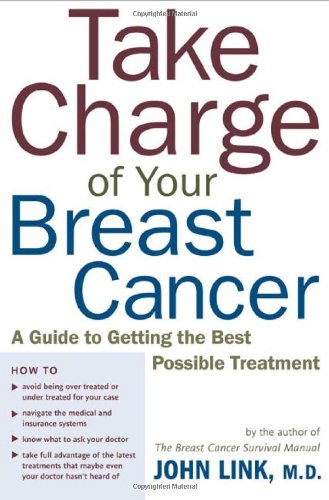
According to Dr John Link, most women diagnosed with breast cancer today are not getting the proper treatment for their disease. Many are being undertreated, while others are being needlessly overtreated. In this follow-up book to his successful THE BREAST CANCER SURVIVAL MANUAL, Link now shows women how to be their own best advocate in getting the proper care. In this empowering book, he gives women the information and resources they need to be proactive about their cancer, and ultimately to help pursue a course of treatment that will leave them with the fewest physical or emotional scars.
Die Inhaltsangabe kann sich auf eine andere Ausgabe dieses Titels beziehen.
Über die Autorin bzw. den Autor
John Link, M.D., is the medical director of one of the leading breast cancer treatment centers in Southern California. He has been honored by the American Cancer Society for his committment to the treatment of and cure for breast cancer. He is the author of The Breast Cancer Survival Manual (0-8050-6400-1). He lives in Southern California.
Auszug. © Genehmigter Nachdruck. Alle Rechte vorbehalten.
Take Charge of Your Breast Cancer
1
You Are in Charge
The idea of taking charge of one's medical program is the single most common practice among survivors. It is the cornerstone of a strategic recovery plan.
--Greg Anderson, author of Cancer: 50 Essential Things to Do
This is a book for women with breast cancer. Its sole purpose is to help you navigate the medical system and receive optimal care. The dictionary defines optimal as "most desirable" or "favorable." I define optimal care as individualized or customized care that is neither undertreatment nor overtreatment for each woman's particular situation. It is a treatment that gives each woman the best chance of being cured with the fewest side effects and disruption to her life. I believe that as many as 40 percent of women in this country with newly diagnosed breast cancer do not receive optimal care. This is due either to misdiagnosis or to inappropriate treatment. Unfortunately, both lead to increased suffering and even, though rarely, death.
How can this happen? I don't believe it is intentional or done out of malice, but instead is due to ignorance, pride, lack of sufficient data, and miscommunication among doctors. In almost every case of mismanagement, a single physician makes recommendations in isolation or without accurate information regarding a woman's unique situation.The recommendations often lack current scientific foundation and usually are financially favorable to the physician or the system under which he or she practices.
How difficult is it for a woman to receive optimal care in our present health care system? My experience as a breast cancer doctor seeing hundreds of women from across the country for second opinions each year is that a significant number of women do not receive optimal care. A significant percentage of women are over- or undertreated, with little consideration about who they are as emotional, spiritual, and sexual human beings.
There is no question that your first priority is survival--optimizing your chances for a cure. Certainly, optimal treatment involves the best chance for cure. Treatment should be based on the nature of the breast cancer--its physical extent and its microscopic and genetic characteristics. With optimal treatment 80 percent of woman today should be cured, and this number is improving each year. These women need to go forth in their lives, feeling good and whole and able to live and love. Unfortunately, for many women, the treatment becomes worse than the disease. A confusing and unsettling paradox is that at the time the breast cancer is discovered, you usually feel normal and have no physical complaints. At the end of treatment, when the cancer is all gone and hoped never to return, many women feel sick and debilitated. Fortunately, their well-being returns once recovery from the side effects of treatment occurs, but some lose confidence in their body. Some women receive treatments that leave them physically, emotionally, and sexually scarred for the remainder of their lives. As you will see, this doesn't have to be the case.
To achieve optimal care, you need to be informed and become your own advocate. If you are the significant other of a woman with breast cancer, you can help your friend or loved one process information and advocate for her. Breast cancer is one of the few diseases that requirea woman to make critical decisions about her own care. She can defer decision making or rely primarily on the advice of her doctors, but this unfortunately does not guarantee the best care.
Breast cancer requires the collaborative care of at least four or five different specialists, including oncologists, surgeons, pathologists, radiologists, radiation oncologists, and psychotherapists. Each of these professionals practices in the context of his or her own specialty and brings to the patient certain biases based on training, experience, ego, and monetary gain. For example, many surgeons believe that the more surgery, the better chance for a cure. This approach stems from the teachings of William Halsted, the father of breast cancer surgery. His operation, the Halsted radical mastectomy, was the only operation for breast cancer for sixty years. Although this operation is rarely performed today, the attitude that more is better persists among many surgeons. I've heard surgeons recommending breast conservation in public forums and in tumor boards (gatherings of various physicians and cancer specialists to discuss individual patient care), and then, behind closed doors, telling a woman, "If you were my wife, I would insist you have a mastectomy." The surgeon's training has focused on local control, and many were trained in an era prior to the use of systemic therapy--treatments such as chemotherapy or hormonal therapy--that impact the tumor cells regardless of whether they are confined to the breast or have migrated beyond the breast. Long-term survival of breast cancer depends on local control, but probably depends even more on controlling and eradicating the spread of the diseased cells.
I believe that the appropriate surgical intervention must take into account the risk of systemic spread and the necessity of systemic therapy. Surgeons often lose sight of the bigger picture, beyond the breast. This type of bias also exists in the other specialties. For example, in medical oncology, my own chosen field, it is common for oncologists to routinely prescribe chemotherapy to a majority of women with little chance of benefit. This advice, often presented as scientifically supported and necessary, frightens women who are in crisis. Many womendon't even realize they have an option. When presented with the statistics of risk and benefit in terms they can understand, many women will decline the chemotherapy because the benefit is not worth the risk. Unfortunately many oncologists don't present women with options, but only with a recommendation. Many women conclude that if chemotherapy is recommended, it must be the standard and necessary. An emerging criticism of screening mammography is that the procedure leads to overtreatment of small cancers that are highly curable with limited surgery alone. Chemotherapists, like surgeons, get caught up in their own domain and forget to see the woman in her entirety.
Radiation oncologists also overprescribe treatment, particularly in older women. The standard is to give all women with breast cancer who have not had a mastectomy radiation for six to seven weeks. But this additional and potentially toxic treatment does not usually increase the cure rate. It does reduce the local recurrence rate, which is significant. Approximately 20 to 30 percent of women who do not receive radiation therapy will have local recurrences. If a local recurrence is discovered early, though, there is little risk of systemic spread. For women over sixty years of age, with completely excised tumors, the risk of local recurrence is approximately 5 percent.
Radiation therapy is usually presented as "absolutely necessary," and women assume it will increase their survival, which is usually not the case. Women need an honest presentation and then should actively participate in the decision to do radiation or not. If they passively accept the recommendation, they have missed an opportunity to decide what is appropriate for them. When a woman actively participates in a decision, I believe, she will feel less victimized by the treatment and will experience fewer side effects.
With this fragmentation of care, it is unusual for a woman to find a physician who will accept her as a partner and help coordinate her care, considering her as a human being who will be cured and go on with her life...
„Über diesen Titel“ kann sich auf eine andere Ausgabe dieses Titels beziehen.
Suchergebnisse für Take Charge of Your Breast Cancer

Beispielbild für diese ISBN
Take Charge of Your Breast Cancer: A Guide to Getting the Best Possible Treatment
Anbieter: World of Books (was SecondSale), Montgomery, IL, USA
Verkäuferbewertung 5 von 5 Sternen

Zustand: Good. Item in good condition. Textbooks may not include supplemental items i.e. CDs, access codes etc. Artikel-Nr. 00103050865
Gebraucht kaufen
EUR 5,73
Versand gratis
Versand innerhalb von USA
Versand innerhalb von USA
Anzahl: 2 verfügbar
Beispielbild für diese ISBN
Take Charge of Your Breast Cancer: A Guide to Getting the Best Possible Treatment
Anbieter: ThriftBooks-Dallas, Dallas, TX, USA
Verkäuferbewertung 5 von 5 Sternen
Paperback. Zustand: Good. No Jacket. Former library book; Pages can have notes/highlighting. Spine may show signs of wear. ~ ThriftBooks: Read More, Spend Less. Artikel-Nr. G0805070567I3N10
Gebraucht kaufen
EUR 6,20
Versand gratis
Versand innerhalb von USA
Versand innerhalb von USA
Anzahl: 1 verfügbar
Beispielbild für diese ISBN
Take Charge of Your Breast Cancer : A Guide to Getting the Best Possible Treatment
Anbieter: Better World Books, Mishawaka, IN, USA
Verkäuferbewertung 5 von 5 Sternen
Zustand: Good. Former library copy. Pages intact with minimal writing/highlighting. The binding may be loose and creased. Dust jackets/supplements are not included. Includes library markings. Stock photo provided. Product includes identifying sticker. Better World Books: Buy Books. Do Good. Artikel-Nr. 39835143-75
Gebraucht kaufen
EUR 6,47
Versand gratis
Versand innerhalb von USA
Versand innerhalb von USA
Anzahl: 1 verfügbar