
Verwandte Artikel zu The Wannsee Conference and the Final Solution: A Reconsidera...
Inhaltsangabe
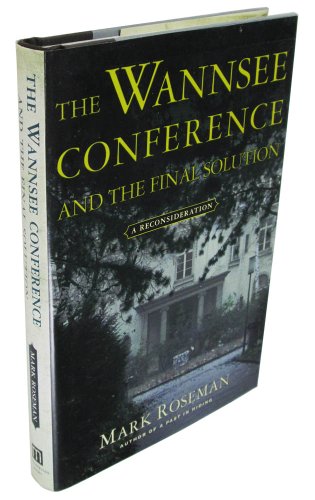
A groundbreaking investigation into the mysterious gathering where the Nazi plan for genocide was reputedly decided.
In early 1947, American officials in Germany stumbled across a document. Entitled "Secret Reich matter," it summarized the results of a meeting of top Nazi officials that took place on January 20, 1942, in a grand villa on the shore of Berlin's Lake Wannsee.
On one level, this document offered clarity: known as the Wannsee Protocol (and included here in full), it tallied up the Jews in Europe, carefully classified half and quarter Jews, and above all laid the groundwork for a "final solution to the Jewish Question." Yet the Protocol, among the most shameful documents in history, remains deeply mysterious. How can we understand this businesslike discussion of genocide? And why was the meeting necessary? Hundreds of thousands of Jews had already been shot in Russia or gassed in the camp at Chelmno. Test murders had been carried out in Auschwitz. Indeed, the most remarkable thing about the Wannsee Conference, is that we do not know why it took place.
Mark Roseman, author of the acclaimed A Past in Hiding, seeks to unravel this double mystery and to explain how it was that on a snowy January day in 1942, a group of educated young men met to discuss the systematic slaughter of a people.
In early 1947, American officials in Germany stumbled across a document. Entitled "Secret Reich matter," it summarized the results of a meeting of top Nazi officials that took place on January 20, 1942, in a grand villa on the shore of Berlin's Lake Wannsee.
On one level, this document offered clarity: known as the Wannsee Protocol (and included here in full), it tallied up the Jews in Europe, carefully classified half and quarter Jews, and above all laid the groundwork for a "final solution to the Jewish Question." Yet the Protocol, among the most shameful documents in history, remains deeply mysterious. How can we understand this businesslike discussion of genocide? And why was the meeting necessary? Hundreds of thousands of Jews had already been shot in Russia or gassed in the camp at Chelmno. Test murders had been carried out in Auschwitz. Indeed, the most remarkable thing about the Wannsee Conference, is that we do not know why it took place.
Mark Roseman, author of the acclaimed A Past in Hiding, seeks to unravel this double mystery and to explain how it was that on a snowy January day in 1942, a group of educated young men met to discuss the systematic slaughter of a people.
Die Inhaltsangabe kann sich auf eine andere Ausgabe dieses Titels beziehen.
Über die Autorin bzw. den Autor
Author of A Past in Hiding and winner of the Fraenkel Prize in contemporary history and Wingate Literary Prize for nonfiction, Mark Roseman teaches at the University of Southampton and has published widely on German history. He lives in Southampton, England.
Rezensionen
In January 1942 a group of top Nazi officials met in a villa on the shore of Lake Wannsee, near Berlin, for the purpose of planning the "final solution" of the "Jewish question." This Wannsee Conference and the document emanating from it, the Wannsee Protocol, are usually regarded as the moment when German policy toward the Jews departed irretrievably from systematic persecution and deportation and turned toward a deliberate policy of genocide. Holocaust deniers and others sometimes contend that, because Hitler was not present at this meeting and because the genocidal nature of the Final Solution was not spelled out explicitly, somehow this means that there was no deliberate policy from the top of genocide against the Jews. In this short, well-reasoned book, Roseman (contemporary history, Univ. of Southampton; A Past in Hiding: Memory and Survival in Nazi Germany) presents a very clear exposition of the reasons behind the Wannsee meeting, what happened there, and its significance in the destruction of the Jews of Europe. Roseman's is the first thorough treatment in English devoted solely to this pivotal event. It should be in all four-year academic and larger public libraries. Libraries may also want to consider a chilling video reenactment, Heinz Schirk's The Wannsee Conference. Barbara Walden, Univ. of Wisconsin, Madison
Copyright 2002 Cahners Business Information, Inc.
Although the publisher promises a "groundbreaking investigation," little if any new light is shed on the overture to the Holocaust by English historian Roseman (A Past in Hiding). The notorious 1942 meeting, in a villa in a posh Berlin suburb overlooking Lake Wannsee, reviewed, rather than approved, the "final solution of the Jewish question." Assent was a given. Heinrich Himmler's chief deputy, Reinhard Heydrich, chaired and dominated the conference, which dealt in coded euphemisms with the genocide already underway in occupied Poland and Russia. The protocol, or minutes, printed here as an appendix the most valuable part of this small book makes clear in a single sentence who bore authoritative responsibility: "Instead of emigration, the F�hrer has now given his approval for a new kind of solution, the evacuation of the Jews to the East." All 15 participants understood what "evacuation" meant, says Roseman. Working Jews to death would not eliminate "the most resistant elements" in the "final remnant," Heydrich coldly told those present, for by "natural selection" these would "form the germ cell of a new Jewish revival." That line more than any other, Roseman feels, mandated the murders without exception. Beyond that, he wanders, page after page and often repetitiously, through the bureaucratic Nazi pseudo-legal arguments about how many Jewish grandparents made one a Jew and how to deal with mixed marriages. Even the absolutist Himmler complained, "We tie our hands with all these stupid definitions." As ultimate Nazi racial policy, the Wannsee minutes, despite chilling ambiguities, were a "rhetorical canopy" behind which Roseman sees Hitler's "licensing." (May 7)Forecast: Because the Wannsee conference has attained iconic status since the protocol was discovered in 1947, a book with Wannsee as its focus may draw many curious readers beyond history specialists.
Copyright 2002 Cahners Business Information, Inc.
In January 1942, 15 high-ranking Nazi officials met in a villa on the shore of Berlin's Lake Wannsee. The purpose of the meeting was to intensify and streamline plans already underway for the "Final Solution," which was designed to exterminate European Jewry. Despite the use of coded terms such as evacuation, the goal of genocide was clear. Yet, the significance of the conference is still disputed by historians. Was this the final irrevocable decision to physically destroy the Jews or simply a meeting to monitor the progress of a policy decision that had already been made? Were the participants fulfilling only the vague sentiments and threats of Hitler or operating under his explicit (but unwritten) instructions? Although historian Roseman cannot provide definitive answers to these questions, he utilizes a variety of sources to support several credible, but still speculative, assertions. The verbatim recounting of the words of such men as Heydrich and Eichmann as they calmly discuss mass murder is riveting and a cogent reminder that evil once embraced easily becomes bureaucratized. Jay Freeman
Copyright © American Library Association. All rights reserved
„Über diesen Titel“ kann sich auf eine andere Ausgabe dieses Titels beziehen.
Suchergebnisse für The Wannsee Conference and the Final Solution: A Reconsidera...

Beispielbild für diese ISBN
The Wannsee Conference and the Final Solution: A Reconsideration
Anbieter: World of Books (was SecondSale), Montgomery, IL, USA
Verkäuferbewertung 5 von 5 Sternen

Zustand: Good. Item in good condition. Textbooks may not include supplemental items i.e. CDs, access codes etc. Artikel-Nr. 00105545860
Gebraucht kaufen
EUR 4,46
Versand gratis
Versand innerhalb von USA
Versand innerhalb von USA
Anzahl: 1 verfügbar
Foto des Verkäufers
The Wannsee Conference and the Final Solution: A Reconsideration
Anbieter: Dream Books Co., Denver, CO, USA
Verkäuferbewertung 5 von 5 Sternen
Zustand: good. Gently used with minimal wear on the corners and cover. A few pages may contain light highlighting or writing, but the text remains fully legible. Dust jacket may be missing, and supplemental materials like CDs or codes may not be included. May be ex-library with library markings. Ships promptly! Artikel-Nr. DBV.0805068104.G
Gebraucht kaufen
EUR 4,47
Versand gratis
Versand innerhalb von USA
Versand innerhalb von USA
Anzahl: 1 verfügbar
Beispielbild für diese ISBN
The Wannsee Conference and the Final Solution: A Reconsideration
Anbieter: ThriftBooks-Dallas, Dallas, TX, USA
Verkäuferbewertung 5 von 5 Sternen
Hardcover. Zustand: Good. No Jacket. Pages can have notes/highlighting. Spine may show signs of wear. ~ ThriftBooks: Read More, Spend Less. Artikel-Nr. G0805068104I3N00
Gebraucht kaufen
EUR 6,02
Versand gratis
Versand innerhalb von USA
Versand innerhalb von USA
Anzahl: 1 verfügbar
Beispielbild für diese ISBN
The Wannsee Conference and the Final Solution: A Reconsideration
Anbieter: ThriftBooks-Dallas, Dallas, TX, USA
Verkäuferbewertung 5 von 5 Sternen
Hardcover. Zustand: Very Good. No Jacket. Missing dust jacket; May have limited writing in cover pages. Pages are unmarked. ~ ThriftBooks: Read More, Spend Less. Artikel-Nr. G0805068104I4N01
Gebraucht kaufen
EUR 6,02
Versand gratis
Versand innerhalb von USA
Versand innerhalb von USA
Anzahl: 1 verfügbar
Beispielbild für diese ISBN
The Wannsee Conference and the Final Solution: A Reconsideration
Anbieter: ThriftBooks-Atlanta, AUSTELL, GA, USA
Verkäuferbewertung 5 von 5 Sternen
Hardcover. Zustand: Good. No Jacket. Pages can have notes/highlighting. Spine may show signs of wear. ~ ThriftBooks: Read More, Spend Less. Artikel-Nr. G0805068104I3N00
Gebraucht kaufen
EUR 6,02
Versand gratis
Versand innerhalb von USA
Versand innerhalb von USA
Anzahl: 1 verfügbar
Beispielbild für diese ISBN
The Wannsee Conference and the Final Solution: A Reconsideration
Anbieter: ThriftBooks-Atlanta, AUSTELL, GA, USA
Verkäuferbewertung 5 von 5 Sternen
Hardcover. Zustand: Very Good. No Jacket. May have limited writing in cover pages. Pages are unmarked. ~ ThriftBooks: Read More, Spend Less. Artikel-Nr. G0805068104I4N00
Gebraucht kaufen
EUR 6,02
Versand gratis
Versand innerhalb von USA
Versand innerhalb von USA
Anzahl: 1 verfügbar
Beispielbild für diese ISBN
The Wannsee Conference and the Final Solution: A Reconsideration
Anbieter: ThriftBooks-Atlanta, AUSTELL, GA, USA
Verkäuferbewertung 5 von 5 Sternen
Hardcover. Zustand: Very Good. No Jacket. Former library book; May have limited writing in cover pages. Pages are unmarked. ~ ThriftBooks: Read More, Spend Less. Artikel-Nr. G0805068104I4N10
Gebraucht kaufen
EUR 6,02
Versand gratis
Versand innerhalb von USA
Versand innerhalb von USA
Anzahl: 1 verfügbar
Beispielbild für diese ISBN
The Wannsee Conference and the Final Solution : A Reconsideration
Verlag:
Holt & Company, Henry, 2002
ISBN 10: 0805068104
ISBN 13: 9780805068108
Gebraucht
Hardcover
Erstausgabe
Anbieter: Better World Books, Mishawaka, IN, USA
Verkäuferbewertung 5 von 5 Sternen
Zustand: Good. 1st ed. Former library copy. Pages intact with minimal writing/highlighting. The binding may be loose and creased. Dust jackets/supplements are not included. Includes library markings. Stock photo provided. Product includes identifying sticker. Better World Books: Buy Books. Do Good. Artikel-Nr. 7743724-6
Gebraucht kaufen
EUR 7,10
Versand gratis
Versand innerhalb von USA
Versand innerhalb von USA
Anzahl: 1 verfügbar
Beispielbild für diese ISBN
Wannsee Conference and the Final Solution: A Reconsideration
Verlag:
Metropolitan Books May 2002, 2002
ISBN 10: 0805068104
ISBN 13: 9780805068108
Gebraucht
Hardcover
Anbieter: The Book Garden, Bountiful, UT, USA
Verkäuferbewertung 5 von 5 Sternen
Hardcover. Zustand: Very Good - Cash. Zustand des Schutzumschlags: Very Good. Light reader wear and rubbing to the edges, corners, covers, and pages. The book is in great condition! Stock photos may not look exactly like the book. Artikel-Nr. 1200039
Gebraucht kaufen
EUR 7,24
EUR 6,37 Versand
Versand innerhalb von USA
Versand innerhalb von USA
Anzahl: 1 verfügbar
Foto des Verkäufers
The Wannsee Conference and the Final Soution: A Reconsideration
Verlag:
New York, NY : Metropolitan Books, 2002
ISBN 10: 0805068104
ISBN 13: 9780805068108
Gebraucht
Hardcover
Anbieter: Barksdale Books, Almere, Niederlande
Verkäuferbewertung 5 von 5 Sternen
Zustand: Good. Original boards, gilt lettered spine, dust jacket, 8vo. Artikel-Nr. 327908-XE7
Gebraucht kaufen
EUR 10,00
EUR 20,00 Versand
Versand von Niederlande nach USA
Versand von Niederlande nach USA
Anzahl: 1 verfügbar