
Verwandte Artikel zu The Bridge at No Gun Ri: A Hidden Nightmare from the...
Inhaltsangabe
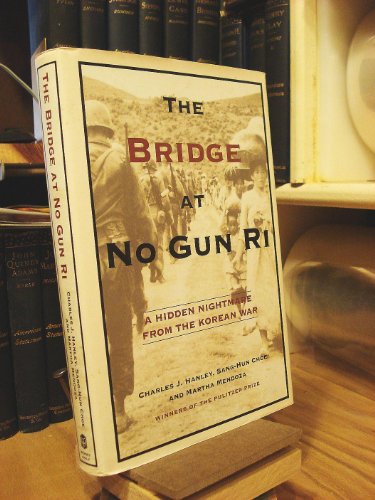
The winners of the 2000 Pulitzer Prize for Investigative Reporting offer an in-depth account of the massacre of Korean civilians by American soldiers during the early days of the Korean War and explore the human story behind the tragedy from both the victims' and perpetrators' perspective. 50,000 first printing.
Die Inhaltsangabe kann sich auf eine andere Ausgabe dieses Titels beziehen.
Über die Autorin bzw. den Autor
Sang-hun Choe, Charles J. Hanley, and Martha Mendoza were awarded the Pulitzer Prize for Investigative Reporting. Choe, whose work received a special award from the Korean Journalists Assocation, is an AP reporter in Seoul, South Korea. Hanley is a special correspondent with the AP International Desk in New York and co-author of two works of nonfiction. Mendoza, the recipient of a John S. Knight Fellowship at Stanford, is an AP national reporter in San Jose, California.
Auszug. © Genehmigter Nachdruck. Alle Rechte vorbehalten.
The following is an excerpt from the book
The Bridge at No Gun Ri
by Charles J. Hanley, Sang-Hun Choe, and Martha Mendoza
Published by Henry Holt
September 2001; $26.00US/$39.95CAN; 0-8050-6658-6
Copyright © 2001 Charles J. Hanley, Sang-Hun Choe, and Martha Mendoza
July 20, 1950
Off Kyushu Island, Japan
Waves raced over the sea in long, broken ranks to batter the port bow of the David C. Shanks. The steel hull shuddered with each blow as the troopship rolled, lifted up, pitched forward and plowed on into the gloom. It held at a steady and stubborn 8 knots.
The four ships of the little westbound convoy, carrying 2,000 men of the 7th U.S. Cavalry Regiment, struggled to stay in sight of one another in thick sheets of rain and foam, their U.S. Navy colors whipping wildly in force 8 winds. On the bridge of the Shanks, the crewmen tugged at the wheel over and over, nosing the bow back on course toward the wide mouth, still distant, of the Osumi Strait.
If all went well, the three lumbering transports -– the Patrick, the Ainsworth and the Shanks -– and their escort, a Navy corvette, would make the strait tomorrow, then skirt around the lighthouse point of rocky Cape Sata, at Japan's southern tip, to emerge among the islands of a stormy East China Sea. The next day, they would turn the corner and bear north toward Korea's southern coast, toward an unexpected war in an unknown land.
Maybe a couple of weeks in Korea, Buddy Wenzel thought. Maybe a couple of months. That's what they say. Private Leonard B. Wenzel, like the rest of the green troops buttoned up inside the Shanks, wanted to believe that his regiment, the famed "Garryowens," could handle anything thrown at them -– once they got through this typhoon.
The U.S. Navy had seen the giant storm coming for days, as it spun toward the sea lanes where the legendary "kamikaze" typhoon, the "divine wind," sank a Chinese-Korean fleet another July day seven centuries earlier, saving Japan from invasion. But heavy weather would not deter the American planners of 1950, at General Headquarters in Tokyo. The need was urgent for the human
f0cargo that had crowded in the hundreds aboard the troopships last Monday at the Yokohama piers. "The situation in Korea is critical," the supreme commander, Gen. Douglas MacArthur, had told Washington. Now the Shanks' crewmen could do little but watch 30-foot seas crash over their bow, hoping to hear the wind's howl drop an octave, glancing nervously at the barometer. It had to bottom out soon.
The difficult passage -– a three-day crossing turned into five days -– was especially hard on one group of passengers. When they boarded days before, forty-five Japanese stevedores had been herded down the main deck to the stern and ordered to settle down on the open fantail. Now these quiet men in rough clothes were fending for themselves, finding shelter where they could on the jam- packed ship. Like other Japanese since the war, the stevedores had grown used to American bosses, and they were uncomplaining. At least they had a few days' work, loading and unloading hardware and food for the soldiers, and knew they'd be returning home when the Americans would not.
Below deck, in stifling quarters beneath the water line, the young Americans, their fresh fatigue uniforms now crumpled and soiled, sat pale-faced amid the reek, stumbled into the head holding stricken stomachs, or curled up weary on fold-down cots, stacked five high, trying to reread letters, mutter conversation, or sleep while bracing themselves against bulkheads or gripping bunk frames, praying for shore or at least an even sea.
For the proud 7th Cavalry, George Armstrong Custer's regiment, it was an inauspicious journey into war.
....
On the appointed wedding day, a date chosen by a fortune teller, it dawned snowy, not a deep snow but enough for the cows to leave hoofprints. Sun-yong's family spread a rice straw mat in the center of the matang, and placed a table on it laden with the Korean symbols of matrimony: a live hen and cock bound in cloth, rice cakes, fruits, candles, alternating red and blue colors representing the bride and groom.
Now she stood before him across the wedding table, hair pulled up into a tight bun, face thickly powdered, a bright red dot placed on each cheek. Her coat and skirt were a rainbow of primary colors. He wore the costume of a court official -– red, black and blue. They performed the solemn rituals -– delicately timed bows, precise postures for sitting and facing each other, she always with head bowed, never talking or smiling, because a smile, it was said, would doom her to bear only girls, a dreadful prospect in a society that tells a wife her sacred duty is to carry on the male family line.
They sealed their marriage with a hapkunlye, a ceremonial sharing of cups of wine. She then retired to her room. He then ate a meal alone, and after sunset joined her. By age-old custom, women of the family gathered outside, to learn what would happen. Inside, according to script, he would blow out the candle, and the eavesdroppers outside were obliged to retreat, with giggles or grumbles.
As a policeman, Chung Eun-yong was exempt from Japan's draft. Having a family would insulate him still further. But the union was even more important to the Parks. Japanese police had been taking away young unmarried Koreans to become "comfort women" –- a euphemism for sex slaves, working in front-line military brothels. The roundups that began in southernmost Korea were now rumored to be moving toward the Yongdong area. To Sun-yong, then, this sober young man was not just a husband. He was a savior.
....
Back in Washington, some U.S. officials expressed misgivings about the ruthless, undemocratic partner they had put in power in Korea, but they were largely ignored in the growing anti-communist fervor in America, especially now that the Soviet Union had exploded its first atom bomb and the communists had triumphed in China's civil war. South Koreans were increasingly viewed as potential front-line shock troops in a global crusade. The U.S. government poured money and American military advisers into strengthening Rhee's 100,000-man army, which was led by men who fought for the Japanese, and in training his police force. The Soviets did the same for the North Koreans.
The Americans kept heavy offensive weapons out of Rhee's hands, since he had told them plainly he wanted to invade and reunite the north with his south. In bloody border skirmishes often provoked by the southern army, the two Koreas had clashed repeatedly along the 38th Parallel in mid-1949. As late as June 19, 1950, Rhee was asking Truman envoy John Foster Dulles for U.S. support for a cross-border invasion. For his part, the north's Kim Il Sung had taken a hostile, if at times vague, public line toward the "Rhee clique," declaring it would be destroyed. The northerners' early hope was that southern guerrillas would do the job.
For despairing southerners, some signs of hope appeared by the spring of 1950. The Americans had finally pushed through a plan for land redistribution, and election results that May promised to undercut Rhee's power. But it was too late.
A Korean proverb has it that "shrimp get broken backs in a whale fight." The anthropologist Osgood, in the timeless villages of a fading Korea, foresaw the catastrophe whose seeds the foreigners had sown. "For better or worse," he wrote, "the Koreans as a whole would have preferred to determine the course of events by themselves. "
On Sunday, June 25, 1950, Sun-yong and the children had come up from the south to visit her husband, the law student, in Seoul. The young mother was dressing four-year-old Koo-pil and two-year-old Koo-hee to take them to church....
The Bridge at No Gun Ri
by Charles J. Hanley, Sang-Hun Choe, and Martha Mendoza
Published by Henry Holt
September 2001; $26.00US/$39.95CAN; 0-8050-6658-6
Copyright © 2001 Charles J. Hanley, Sang-Hun Choe, and Martha Mendoza
July 20, 1950
Off Kyushu Island, Japan
Waves raced over the sea in long, broken ranks to batter the port bow of the David C. Shanks. The steel hull shuddered with each blow as the troopship rolled, lifted up, pitched forward and plowed on into the gloom. It held at a steady and stubborn 8 knots.
The four ships of the little westbound convoy, carrying 2,000 men of the 7th U.S. Cavalry Regiment, struggled to stay in sight of one another in thick sheets of rain and foam, their U.S. Navy colors whipping wildly in force 8 winds. On the bridge of the Shanks, the crewmen tugged at the wheel over and over, nosing the bow back on course toward the wide mouth, still distant, of the Osumi Strait.
If all went well, the three lumbering transports -– the Patrick, the Ainsworth and the Shanks -– and their escort, a Navy corvette, would make the strait tomorrow, then skirt around the lighthouse point of rocky Cape Sata, at Japan's southern tip, to emerge among the islands of a stormy East China Sea. The next day, they would turn the corner and bear north toward Korea's southern coast, toward an unexpected war in an unknown land.
Maybe a couple of weeks in Korea, Buddy Wenzel thought. Maybe a couple of months. That's what they say. Private Leonard B. Wenzel, like the rest of the green troops buttoned up inside the Shanks, wanted to believe that his regiment, the famed "Garryowens," could handle anything thrown at them -– once they got through this typhoon.
The U.S. Navy had seen the giant storm coming for days, as it spun toward the sea lanes where the legendary "kamikaze" typhoon, the "divine wind," sank a Chinese-Korean fleet another July day seven centuries earlier, saving Japan from invasion. But heavy weather would not deter the American planners of 1950, at General Headquarters in Tokyo. The need was urgent for the human
f0cargo that had crowded in the hundreds aboard the troopships last Monday at the Yokohama piers. "The situation in Korea is critical," the supreme commander, Gen. Douglas MacArthur, had told Washington. Now the Shanks' crewmen could do little but watch 30-foot seas crash over their bow, hoping to hear the wind's howl drop an octave, glancing nervously at the barometer. It had to bottom out soon.
The difficult passage -– a three-day crossing turned into five days -– was especially hard on one group of passengers. When they boarded days before, forty-five Japanese stevedores had been herded down the main deck to the stern and ordered to settle down on the open fantail. Now these quiet men in rough clothes were fending for themselves, finding shelter where they could on the jam- packed ship. Like other Japanese since the war, the stevedores had grown used to American bosses, and they were uncomplaining. At least they had a few days' work, loading and unloading hardware and food for the soldiers, and knew they'd be returning home when the Americans would not.
Below deck, in stifling quarters beneath the water line, the young Americans, their fresh fatigue uniforms now crumpled and soiled, sat pale-faced amid the reek, stumbled into the head holding stricken stomachs, or curled up weary on fold-down cots, stacked five high, trying to reread letters, mutter conversation, or sleep while bracing themselves against bulkheads or gripping bunk frames, praying for shore or at least an even sea.
For the proud 7th Cavalry, George Armstrong Custer's regiment, it was an inauspicious journey into war.
....
On the appointed wedding day, a date chosen by a fortune teller, it dawned snowy, not a deep snow but enough for the cows to leave hoofprints. Sun-yong's family spread a rice straw mat in the center of the matang, and placed a table on it laden with the Korean symbols of matrimony: a live hen and cock bound in cloth, rice cakes, fruits, candles, alternating red and blue colors representing the bride and groom.
Now she stood before him across the wedding table, hair pulled up into a tight bun, face thickly powdered, a bright red dot placed on each cheek. Her coat and skirt were a rainbow of primary colors. He wore the costume of a court official -– red, black and blue. They performed the solemn rituals -– delicately timed bows, precise postures for sitting and facing each other, she always with head bowed, never talking or smiling, because a smile, it was said, would doom her to bear only girls, a dreadful prospect in a society that tells a wife her sacred duty is to carry on the male family line.
They sealed their marriage with a hapkunlye, a ceremonial sharing of cups of wine. She then retired to her room. He then ate a meal alone, and after sunset joined her. By age-old custom, women of the family gathered outside, to learn what would happen. Inside, according to script, he would blow out the candle, and the eavesdroppers outside were obliged to retreat, with giggles or grumbles.
As a policeman, Chung Eun-yong was exempt from Japan's draft. Having a family would insulate him still further. But the union was even more important to the Parks. Japanese police had been taking away young unmarried Koreans to become "comfort women" –- a euphemism for sex slaves, working in front-line military brothels. The roundups that began in southernmost Korea were now rumored to be moving toward the Yongdong area. To Sun-yong, then, this sober young man was not just a husband. He was a savior.
....
Back in Washington, some U.S. officials expressed misgivings about the ruthless, undemocratic partner they had put in power in Korea, but they were largely ignored in the growing anti-communist fervor in America, especially now that the Soviet Union had exploded its first atom bomb and the communists had triumphed in China's civil war. South Koreans were increasingly viewed as potential front-line shock troops in a global crusade. The U.S. government poured money and American military advisers into strengthening Rhee's 100,000-man army, which was led by men who fought for the Japanese, and in training his police force. The Soviets did the same for the North Koreans.
The Americans kept heavy offensive weapons out of Rhee's hands, since he had told them plainly he wanted to invade and reunite the north with his south. In bloody border skirmishes often provoked by the southern army, the two Koreas had clashed repeatedly along the 38th Parallel in mid-1949. As late as June 19, 1950, Rhee was asking Truman envoy John Foster Dulles for U.S. support for a cross-border invasion. For his part, the north's Kim Il Sung had taken a hostile, if at times vague, public line toward the "Rhee clique," declaring it would be destroyed. The northerners' early hope was that southern guerrillas would do the job.
For despairing southerners, some signs of hope appeared by the spring of 1950. The Americans had finally pushed through a plan for land redistribution, and election results that May promised to undercut Rhee's power. But it was too late.
A Korean proverb has it that "shrimp get broken backs in a whale fight." The anthropologist Osgood, in the timeless villages of a fading Korea, foresaw the catastrophe whose seeds the foreigners had sown. "For better or worse," he wrote, "the Koreans as a whole would have preferred to determine the course of events by themselves. "
On Sunday, June 25, 1950, Sun-yong and the children had come up from the south to visit her husband, the law student, in Seoul. The young mother was dressing four-year-old Koo-pil and two-year-old Koo-hee to take them to church....
„Über diesen Titel“ kann sich auf eine andere Ausgabe dieses Titels beziehen.
Suchergebnisse für The Bridge at No Gun Ri: A Hidden Nightmare from the...

Beispielbild für diese ISBN
The Bridge at No Gun Ri A Hidd
Anbieter: World of Books (was SecondSale), Montgomery, IL, USA
Verkäuferbewertung 5 von 5 Sternen

Zustand: Very Good. Item in very good condition! Textbooks may not include supplemental items i.e. CDs, access codes etc. Artikel-Nr. 00109540796
Gebraucht kaufen
EUR 5,81
Versand gratis
Versand innerhalb von USA
Versand innerhalb von USA
Anzahl: 1 verfügbar
Beispielbild für diese ISBN
The Bridge at No Gun Ri A Hidd
Anbieter: World of Books (was SecondSale), Montgomery, IL, USA
Verkäuferbewertung 5 von 5 Sternen
Zustand: Acceptable. Item in acceptable condition! Textbooks may not include supplemental items i.e. CDs, access codes etc. Artikel-Nr. 00108478423
Gebraucht kaufen
EUR 5,81
Versand gratis
Versand innerhalb von USA
Versand innerhalb von USA
Anzahl: 1 verfügbar
Beispielbild für diese ISBN
The Bridge at No Gun Ri: A Hidden Nightmare from the Korean War
Anbieter: ThriftBooks-Atlanta, AUSTELL, GA, USA
Verkäuferbewertung 5 von 5 Sternen
Hardcover. Zustand: Good. No Jacket. Missing dust jacket; Pages can have notes/highlighting. Spine may show signs of wear. ~ ThriftBooks: Read More, Spend Less. Artikel-Nr. G0805066586I3N01
Gebraucht kaufen
EUR 5,83
Versand gratis
Versand innerhalb von USA
Versand innerhalb von USA
Anzahl: 1 verfügbar
Beispielbild für diese ISBN
The Bridge at No Gun Ri: A Hidden Nightmare from the Korean War
Anbieter: ThriftBooks-Reno, Reno, NV, USA
Verkäuferbewertung 5 von 5 Sternen
Hardcover. Zustand: Good. No Jacket. Missing dust jacket; Pages can have notes/highlighting. Spine may show signs of wear. ~ ThriftBooks: Read More, Spend Less. Artikel-Nr. G0805066586I3N01
Gebraucht kaufen
EUR 5,83
Versand gratis
Versand innerhalb von USA
Versand innerhalb von USA
Anzahl: 1 verfügbar
Beispielbild für diese ISBN
The Bridge at No Gun Ri: A Hidden Nightmare from the Korean War
Anbieter: ThriftBooks-Dallas, Dallas, TX, USA
Verkäuferbewertung 5 von 5 Sternen
Hardcover. Zustand: Fair. No Jacket. Missing dust jacket; Readable copy. Pages may have considerable notes/highlighting. ~ ThriftBooks: Read More, Spend Less. Artikel-Nr. G0805066586I5N01
Gebraucht kaufen
EUR 5,83
Versand gratis
Versand innerhalb von USA
Versand innerhalb von USA
Anzahl: 1 verfügbar
Beispielbild für diese ISBN
The Bridge at No Gun Ri: A Hidden Nightmare from the Korean War
Anbieter: ThriftBooks-Atlanta, AUSTELL, GA, USA
Verkäuferbewertung 5 von 5 Sternen
Hardcover. Zustand: Fair. No Jacket. Missing dust jacket; Readable copy. Pages may have considerable notes/highlighting. ~ ThriftBooks: Read More, Spend Less. Artikel-Nr. G0805066586I5N01
Gebraucht kaufen
EUR 5,83
Versand gratis
Versand innerhalb von USA
Versand innerhalb von USA
Anzahl: 1 verfügbar
Beispielbild für diese ISBN
The Bridge at No Gun Ri: A Hidden Nightmare from the Korean War
Anbieter: ThriftBooks-Phoenix, Phoenix, AZ, USA
Verkäuferbewertung 5 von 5 Sternen
Hardcover. Zustand: Good. No Jacket. Missing dust jacket; Pages can have notes/highlighting. Spine may show signs of wear. ~ ThriftBooks: Read More, Spend Less. Artikel-Nr. G0805066586I3N01
Gebraucht kaufen
EUR 5,83
Versand gratis
Versand innerhalb von USA
Versand innerhalb von USA
Anzahl: 1 verfügbar
Beispielbild für diese ISBN
The Bridge at No Gun Ri : A Hidden Nightmare from the Korean War
Verlag:
Holt & Company, Henry, 2001
ISBN 10: 0805066586
ISBN 13: 9780805066586
Gebraucht
Hardcover
Erstausgabe
Anbieter: Better World Books: West, Reno, NV, USA
Verkäuferbewertung 5 von 5 Sternen
Zustand: Very Good. 1st. Pages intact with possible writing/highlighting. Binding strong with minor wear. Dust jackets/supplements may not be included. Stock photo provided. Product includes identifying sticker. Better World Books: Buy Books. Do Good. Artikel-Nr. 6195946-6
Gebraucht kaufen
EUR 8,27
Versand gratis
Versand innerhalb von USA
Versand innerhalb von USA
Anzahl: 2 verfügbar
Beispielbild für diese ISBN
The Bridge at No Gun Ri : A Hidden Nightmare from the Korean War
Verlag:
Holt & Company, Henry, 2001
ISBN 10: 0805066586
ISBN 13: 9780805066586
Gebraucht
Hardcover
Erstausgabe
Anbieter: Better World Books, Mishawaka, IN, USA
Verkäuferbewertung 5 von 5 Sternen
Zustand: Very Good. 1st. Pages intact with possible writing/highlighting. Binding strong with minor wear. Dust jackets/supplements may not be included. Stock photo provided. Product includes identifying sticker. Better World Books: Buy Books. Do Good. Artikel-Nr. 6195946-6
Gebraucht kaufen
EUR 8,27
Versand gratis
Versand innerhalb von USA
Versand innerhalb von USA
Anzahl: 1 verfügbar
Beispielbild für diese ISBN
The Bridge at No Gun Ri : A Hidden Nightmare from the Korean War
Verlag:
Holt & Company, Henry, 2001
ISBN 10: 0805066586
ISBN 13: 9780805066586
Gebraucht
Hardcover
Erstausgabe
Anbieter: Better World Books, Mishawaka, IN, USA
Verkäuferbewertung 5 von 5 Sternen
Zustand: Good. 1st. Pages intact with minimal writing/highlighting. The binding may be loose and creased. Dust jackets/supplements are not included. Stock photo provided. Product includes identifying sticker. Better World Books: Buy Books. Do Good. Artikel-Nr. 4390270-6
Gebraucht kaufen
EUR 8,27
Versand gratis
Versand innerhalb von USA
Versand innerhalb von USA
Anzahl: 1 verfügbar