
Verwandte Artikel zu Yoga Mind, Body & Spirit: A Return to Wholeness
Inhaltsangabe
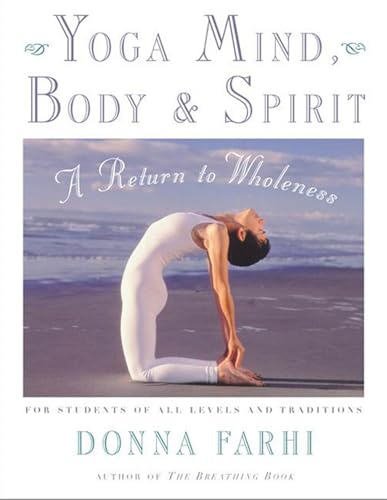
The author of Yoga Journal's most-read column presents the first holistic guide to yoga.
A user-friendly guide illustrated with 240 two-color photographs and illustrations, Yoga Mind, Body & Spirit sets forth the tenets of this gentle yet rigorous exercise as no other book has. Integrating the teachings of every tradition, internationally renowned yoga instructor Donna Farhi reveals how yoga enhances the connections between the mind, body, and spirit. She outlines the seven simple movement principles that underlie all human motion and provides exercises to help readers understand how they can achieve all yoga postures. She also discusses the ten ethical precepts that are the foundation of all yoga teachings and explains how to incorporate them into a spiritually and emotionally rewarding inner practice.
At the heart of Yoga Mind, Body & Spirit are more than seventy-five yoga asanas or postures. Each is one pictured and described in detail, and they are arranged into related groups-including standing postures, sitting postures, arm balances, and breathing practices-for easy reference. A selection of yoga practices of varying lengths and levels of difficulty provides challenges and inspiration for beginner, intermediate, and advanced students.
A huge resurgence of interest in yoga is sweeping the country. With its broad scope and holistic approach, Yoga Mind, Body & Spirit is the ideal book for today's mainstream audience.
Die Inhaltsangabe kann sich auf eine andere Ausgabe dieses Titels beziehen.
Über die Autorin bzw. den Autor
Donna Farhi is a registered movement therapist and yoga teacher who is a much sought-after guest instructor and speaker throughout the United States, Mexico, Canada, and Australia. She is the author of The Breathing Book and has written for Yoga Journal for over a decade. She lives in New Zealand.
Auszug. © Genehmigter Nachdruck. Alle Rechte vorbehalten.
Yoga Mind, Body & Spirit
A Return to WholenessBy Donna FarhiHolt Paperbacks
Copyright © 2000 Donna FarhiAll right reserved.
ISBN: 9780805059700
Yoga Mind, Body & Spirit
Part One
Groundwork
I
Living Principle
Any change into a new state of being is the result of the fullness of Nature unfolding inherent potential.
--THE YOGA SUTRAS OF PATANJALI1
WHAT IS YOGA?
All people wish to be happy. This seemingly simple desire appears to elude the best-intentioned efforts of even the most intelligent among us. Yet almost everyone has had glimpses of deep peacefulness when they have felt connected both to themselves, to others, and to nature. Curiously, the state of feeling good and whole does not seem to be something we can order up on demand but rather appears to happen spontaneously. In such moments we experience a sense of translucence such that that which we see, feel, sense, hear, or touch no longer feels separate from us but is experienced as a part of our own totality. When our hand resting over the heart of the beloved merges and becomes one with his or her body, when we become the same midnight sky that fills us with awe, we remember, however briefly, our place in the scheme of things. These brief flickers of remembrance imbue our vision with freshness and innocence so that we can see things as they truly are. Because these moments of lucidity are so blissful, we wish that they may become the base state of our lives rather than the brief and oftentimes tenuous experience to which such happiness is usually assigned. These moments of clarity have nothing to do with the caricatures of happiness presented to us through the media or popular culture. These moments have always been there. The beloved's heartbeat and the sky have always been there. These moments are simply awaiting our arrival.
Yoga is a technology for arriving in this present moment. It is a means of waking up from our spiritual amnesia, so that we can remember all that we already know. It is a way of remembering our true nature, which is essentially joyful and peaceful. Developed as a pragmatic science by ancient seers centuries ago, yoga is a practice that any person, regardless of age, sex, race, or religious belief, can use to realize her full potential. It is a means of staying in intimate communication with the formative core matrix of yourself and those forces that serve to bind all living beings together. As you establish and sustain this intimate connection, this state of equanimity becomes the core of your experience rather than the rare exception.
Through observing nature and through intense self-observation and inquiry, the ancient yogis were able to codify the conditions that must be present for realizing our intrinsic wholeness. Although such realization can occur spontaneously, more often than not it is the result of a sustained commitment to practice over a lifetime. This is not to imply that yoga is a goal which we strive toward, or that there is some kind of chronological progression toward "self-improvement." Rather, it is the recognition that each individual can achieve understanding only through his own exploration and discovery, and that all of life is a continual process of refinement which allows us to see more clearly. When we clean the windshield of our car, we suddenly see the road ahead as bright and defined. The road, the image before us, is exactly as it was before we cleaned the window. The trees are the same green, the sky the same vivid blue, and the markers just as defined, only now we see what is there. We start to be able to see the potholes in the road ahead and to avoid them. We start to remember such dangerous roads and steer our way clear to safer routes in the future. In the same way, yoga is not about self-improvement or making ourselves better. It is a process of deconstructing all the barriers we may have erected that prevent us from having an authentic connection with ourselves and with the world. This tenet is an extremely important one because the effort to change and improve ourselves is fraught with the risk of subtle self-aggression that only produces more unhappiness. We cannot strive toward something that we already are.
Nonetheless, there is work to be done. And this work is not about following a formula, or strictly adhering to rules, because yoga is not a paint-by-numbers affair. Nor does yoga require blind faith in an outside authority or dogma. Nor is it a religion, although the practice of its central precepts inevitably draws each individual to the direct experience of those truths on which religion rests. Rather, yoga is a way of living and being that makes real happiness possible. Yoga is also a science that incorporates a broad range of practices and techniques that can be tailored and adapted to best suit your personal constitution and personality. We are not asked to believe anything until we have experimented, tested, and found our direct experience to be sound. The great paradox of this "work" is that there is no reward to strive toward, because the practice is the reward. In the very moment you focus your attention by coming back into your body, your breath, and your immediate sensate reality, you will experience a deep sense of vibrant stillness. This feeling isso pleasurable, so joyful and revitalizing that you will be drawn to practice, and, more important, you will begin to be naturally drawn toward lifestyle choices that nourish your well-being. This work is not about forcing yourself to give up anything, because that which is no longer nourishing to you will gradually drop away effortlessly. There is no waiting and no delayed gratification because yoga is both the means and the result, and the seed of all that is possible is present at the very beginning. This experience of stillness is possible in the first ten minutes of your first yoga class. It is possible in this very breath. Sadly, if we approach and practice yoga with the same cultural dictum of striving and effort, force and self-coercion that we may have applied to other aspects of our lives, we may practice diligently for decades while never allowing our self to appreciate the simple truth of its own wholeness.
Although there are many branches to the tree of yoga, from devotional methods to more intellectual approaches, from schools that emphasize service toward others to those that focus on physical purification, Patanjali, the author of the Yoga Sutras, clearly defines an eight-limbed path (ashtanga) that forms the structural framework for whatever emphasis upon which an individual wishes to concentrate. The Yoga Sutras, or "threads," consist of four books produced sometime in the third century before Christ. Such was the clarity of Patanjali's vision of wholeness that he consolidated the entirety of yoga philosophy in a series of 196 lucid aphorisms. Each thread of the Yoga Sutras is revealed as a part of a woven fabric, with each aphorism merely a mark or color within the whole pattern. The threads, however, begin to make sense only through a direct experience of their meaning. This is not a linear process but rather an organic one in which colors and markings gradually become more clear until a pattern forms. And this pattern that Patanjali weaves for us is a description of the process of unbinding our limited ideas about ourselves and becoming free.
The eight limbs of yoga are traditionally presented as a...
„Über diesen Titel“ kann sich auf eine andere Ausgabe dieses Titels beziehen.
Suchergebnisse für Yoga Mind, Body & Spirit: A Return to Wholeness

Beispielbild für diese ISBN
Yoga Mind, Body and Spirit: A Return to Wholeness
Anbieter: World of Books (was SecondSale), Montgomery, IL, USA
Verkäuferbewertung 5 von 5 Sternen

Paperback. Zustand: Fair. This work explains the art of hatha yoga from a perspective that enables westerners to experience authentic yoga practice directly. The principles can be applied to other forms of yoga too. Artikel-Nr. 00100181078
Gebraucht kaufen
EUR 4,05
Versand gratis
Versand innerhalb von USA
Versand innerhalb von USA
Anzahl: 5 verfügbar
Beispielbild für diese ISBN
Yoga Mind, Body and Spirit: A Return to Wholeness
Anbieter: World of Books (was SecondSale), Montgomery, IL, USA
Verkäuferbewertung 5 von 5 Sternen
Paperback. Zustand: Good. This work explains the art of hatha yoga from a perspective that enables westerners to experience authentic yoga practice directly. The principles can be applied to other forms of yoga too. Artikel-Nr. 00096927596
Gebraucht kaufen
EUR 4,05
Versand gratis
Versand innerhalb von USA
Versand innerhalb von USA
Anzahl: Mehr als 20 verfügbar
Beispielbild für diese ISBN
Yoga Mind, Body & Spirit: A Return to Wholeness
Anbieter: ThriftBooks-Dallas, Dallas, TX, USA
Verkäuferbewertung 5 von 5 Sternen
Paperback. Zustand: Good. No Jacket. Pages can have notes/highlighting. Spine may show signs of wear. ~ ThriftBooks: Read More, Spend Less. Artikel-Nr. G0805059709I3N00
Gebraucht kaufen
EUR 5,96
Versand gratis
Versand innerhalb von USA
Versand innerhalb von USA
Anzahl: 5 verfügbar
Beispielbild für diese ISBN
Yoga Mind, Body & Spirit: A Return to Wholeness
Anbieter: ThriftBooks-Phoenix, Phoenix, AZ, USA
Verkäuferbewertung 5 von 5 Sternen
Paperback. Zustand: Good. No Jacket. Pages can have notes/highlighting. Spine may show signs of wear. ~ ThriftBooks: Read More, Spend Less. Artikel-Nr. G0805059709I3N00
Gebraucht kaufen
EUR 5,96
Versand gratis
Versand innerhalb von USA
Versand innerhalb von USA
Anzahl: 4 verfügbar
Beispielbild für diese ISBN
Yoga Mind, Body & Spirit: A Return to Wholeness
Anbieter: ThriftBooks-Reno, Reno, NV, USA
Verkäuferbewertung 5 von 5 Sternen
Paperback. Zustand: Good. No Jacket. Pages can have notes/highlighting. Spine may show signs of wear. ~ ThriftBooks: Read More, Spend Less. Artikel-Nr. G0805059709I3N00
Gebraucht kaufen
EUR 5,96
Versand gratis
Versand innerhalb von USA
Versand innerhalb von USA
Anzahl: 4 verfügbar
Beispielbild für diese ISBN
Yoga Mind, Body & Spirit: A Return to Wholeness
Anbieter: ThriftBooks-Atlanta, AUSTELL, GA, USA
Verkäuferbewertung 5 von 5 Sternen
Paperback. Zustand: Good. No Jacket. Former library book; Pages can have notes/highlighting. Spine may show signs of wear. ~ ThriftBooks: Read More, Spend Less. Artikel-Nr. G0805059709I3N10
Gebraucht kaufen
EUR 5,96
Versand gratis
Versand innerhalb von USA
Versand innerhalb von USA
Anzahl: 1 verfügbar
Beispielbild für diese ISBN
Yoga Mind, Body & Spirit: A Return to Wholeness
Anbieter: ThriftBooks-Atlanta, AUSTELL, GA, USA
Verkäuferbewertung 5 von 5 Sternen
Paperback. Zustand: Good. No Jacket. Pages can have notes/highlighting. Spine may show signs of wear. ~ ThriftBooks: Read More, Spend Less. Artikel-Nr. G0805059709I3N00
Gebraucht kaufen
EUR 5,96
Versand gratis
Versand innerhalb von USA
Versand innerhalb von USA
Anzahl: 5 verfügbar
Beispielbild für diese ISBN
Yoga Mind, Body and Spirit : A Return to Wholeness
Anbieter: Better World Books, Mishawaka, IN, USA
Verkäuferbewertung 5 von 5 Sternen
Zustand: Good. Former library copy. Pages intact with minimal writing/highlighting. The binding may be loose and creased. Dust jackets/supplements are not included. Includes library markings. Stock photo provided. Product includes identifying sticker. Better World Books: Buy Books. Do Good. Artikel-Nr. 4739532-6
Gebraucht kaufen
EUR 6,36
Versand gratis
Versand innerhalb von USA
Versand innerhalb von USA
Anzahl: 2 verfügbar
Beispielbild für diese ISBN
Yoga Mind, Body and Spirit : A Return to Wholeness
Anbieter: Better World Books, Mishawaka, IN, USA
Verkäuferbewertung 5 von 5 Sternen
Zustand: Good. Pages intact with minimal writing/highlighting. The binding may be loose and creased. Dust jackets/supplements are not included. Stock photo provided. Product includes identifying sticker. Better World Books: Buy Books. Do Good. Artikel-Nr. 4998729-6
Gebraucht kaufen
EUR 6,36
Versand gratis
Versand innerhalb von USA
Versand innerhalb von USA
Anzahl: 6 verfügbar
Beispielbild für diese ISBN
Yoga Mind, Body and Spirit : A Return to Wholeness
Anbieter: Better World Books: West, Reno, NV, USA
Verkäuferbewertung 5 von 5 Sternen
Zustand: Good. Former library copy. Pages intact with minimal writing/highlighting. The binding may be loose and creased. Dust jackets/supplements are not included. Includes library markings. Stock photo provided. Product includes identifying sticker. Better World Books: Buy Books. Do Good. Artikel-Nr. 4739532-6
Gebraucht kaufen
EUR 6,36
Versand gratis
Versand innerhalb von USA
Versand innerhalb von USA
Anzahl: 1 verfügbar