
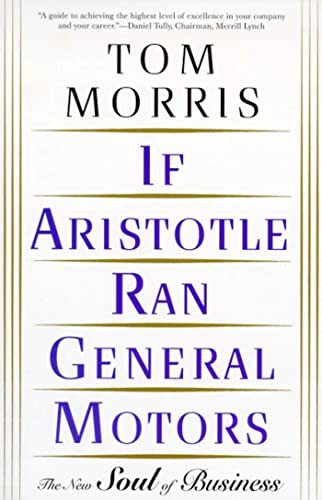
Verwandte Artikel zu If Aristotle Ran General Motors: The New Soul of Business
Inhaltsangabe
Discover the secrets to building great morale and productivity in your organization, drawing on the timeless wisdom of classical philosophy.
In If Aristotle Ran General Motors, Tom Morris, who taught philosophy at Notre Dame for fifteen years, shares the knowledge he garnered from a lifetime of studying history's wisest thinkers and shows how to apply their ideas in today's business environment. Morris finds inspiration in the teachings of a wide array of thinkers from many different traditions and eras, including Aristotle, Confucius, Seneca, Saint Augustine, Ralph Waldo Emerson, and Abraham Lincoln.
By looking at the inside workings of various businesses, from GE to Tom's of Maine, Morris demonstrates why any company that is serious about attaining true excellence must adhere to four timeless virtues first identified by Aristotle: Truth, Beauty, Goodness, and Unity. He argues that the most successful companies encourage a corporate culture that ensures all interactions are infused with dignity and humanity. The book provides clearly stated strategies for how everyone can make these qualities the foundation for their everyday business and personal lives.
If Aristotle Ran General Motors presents a compelling case for a new ethics in business and for a workplace where openness and integrity are the rule. It offers an optimistic vision for the future of leadership and a plan for reinvigorating the soul back into our professional lives.
Die Inhaltsangabe kann sich auf eine andere Ausgabe dieses Titels beziehen.
Über die Autorin bzw. den Autor
Tom Morris was a professor of philosophy at Notre Dame for fifteen years. Since leaving Notre Dame in 1994, he has gone on to become one of the most sought-after motivational speakers in the country. Each year he is invited to give keynote addresses at major gatherings of executives at hundreds of the leading companies around the world. The author of True Success: A New Philosophy of Excellence, he is also chairman of the Morris Institute for Human Values in Wilmington, North Carolina, where he makes his home.
Auszug. © Genehmigter Nachdruck. Alle Rechte vorbehalten.
If Aristotle Ran General Motors
The New Soul of Business
By Tom MorrisHenry Holt and Company
Copyright © 1997 Tom Morris
All rights reserved.
ISBN: 978-0-8050-5253-4All rights reserved.
Contents
Title Page,
Copyright Notice,
Preface: Reinventing Corporate Spirit,
Acknowledgments,
Introduction: Business Excellence and the Human Quest,
PART I: TRUTH,
1. The Intellectual Dimension at Work,
2. Truth and Lies,
3. The Truth About Excellence: A Powerful Idea,
PART II: BEAUTY,
4. The Aesthetic Dimension at Work,
5. Creativity and the Meaning of Life,
6. The Beauty of Business,
PART III: GOODNESS,
7. The Moral Dimension at Work,
8. The Challenge of Ethical Action,
9. Wisdom, Virtue, and Corporate Strength,
PART IV: UNITY,
10. The Spiritual Dimension at Work,
11. Uniqueness and Union,
12. Usefulness and Understanding,
Epilogue: Creating Corporate Excellence,
Copyright,
CHAPTER 1
The Intellectual Dimension at Work
The first universal dimension of human experience is the intellectual dimension, that aspect of our nature which aims at truth.
Every human being has a mind. Each of us has an intellectual dimension to his experience. We need ideas as much as we need food, air, or water. Ideas nourish the mind as the latter provide for the body. In light of this, it's clear that we need good ideas as much as we need good food, good air, and good water. And, finally, what we need is truth.
The soul is unwillingly deprived of truth.
— EPICTETUS
Truth is just that mapping of reality that corresponds to the way things are. Put another way, it is the relationship of accuracy that holds between a good map and the territory it represents. Aristotle wrote about truth, in contrast to falsehood, in this way: "To say of what is that it is not, or of what is not that it is so, is false; while to say of what is so that it is so, and of what is not so that it is not so, is true." Perhaps this is enough to make you glad that you're reading me rather than Aristotle. Truth is our lifeline. Truth is our guide. The truth about truth is simple.
No one can navigate well through life without an accurate map by which to steer. Knowledge is the possession of such a map, and truth is what that map gives us, linking us to reality. The absolutely vital importance of knowledge in any business is beginning to be widely recognized. For discerning the needs of clients, monitoring the moves of competitors, benefiting from the experience of associates, and serving others well, it's hard to see how there could be anything ultimately more important than truth.
But it may be that the simple importance of truth is still far from widely enough appreciated. It's often been said that people nowadays must view truth as precious, they use it so sparingly. Even this little witticism contains some insight.
As hypocrisy is said to be the highest compliment to virtue, the art of lying is the strongest acknowledgment of the force of truth.
— WILLIAM HAZLITT
People who tell the truth, however difficult that may be, obviously have a high regard for its importance. But even people who lie to you indicate in a backward sort of way their partial, and deeply flawed, recognition of at least some of the power of truth: They think of it as too powerful to be entrusted to you.
Is truth both important and powerful in our corporate endeavors? And, if so, then how should we treat the truth? How, correspondingly, should we treat each other with regard to the truth? These are some of the questions we'll address both in this chapter and in the next one.
Those who know the truth are not equal to those who love it, and they who love it are not equal to those who delight in it.
— CONFUCIUS
Truth and Respect
We all have minds that must be respected and used. The first implication of this is that mindless work cannot be satisfying. No human being is a machine, and yet that's exactly what much of the economic theory and management practice of the last hundred years has tended to assume.
Don Petersen, past president of Ford Motor Company, tells an interesting story. Once when he was visiting a stamping plant in Buffalo, New York, a huge bear of a man came up to him and said, "You know, I want to tell you one thing. I used to hate coming to work here. But lately I've been asked what I think, and that makes me feel like I'm somebody. I never thought the company saw me as a human being. Now I like coming to work."
One of the most ennobling gestures any of us can make toward another human being is to ask her, sincerely, what she thinks about what we are doing together. What is her take on the truth? When we ask, wanting to hear, we treat the other person with a fundamental respect, and this behavior is then much more likely to be mirrored back to us.
We should cultivate an environment in which people are not afraid to tell us the truth. We need the truth if we are to steer safely through the difficulties we may face as we move into the future, and we're unlikely to get enough of it unless others are open to sharing it with us. Too many frontline workers and managers are reluctant to pass on a hard truth to the person they report to, because they are working in a corporate culture where it's not clear what the value of truth is.
I search after truth, by which man never yet was harmed.
— MARCUS AURELIUS
In a recent book in which he profiled three of the top corporate CEOs recognized as masters at company renovation — Jack Welch (General Electric), the late Mike Walsh (Union Pacific Railroad), and Percy Barnevik (Asea Brown Boveri), Tom Peters points to eleven traits that seem responsible for their success. One of these eleven qualities, he says, is that these individuals appear to have "a visceral affinity for truth." The capacity to handle the truth, the ability to get at it, and the skill to use it well brings with its exercise great power. We aren't likely to be expert at exercising that capacity unless we place a certain value on the people around us. And this is an important issue in renewing corporate spirit.
A few years ago I met Tom Chappell, founder of Tom's of Maine, a highly regarded personal care products company. In the course of a morning together sitting and talking on the front porch of a beautiful house in Vermont, I heard one of the most interesting leadership stories in contemporary American business.
Tom had established his company on strong moral principles, but as the business grew and more people were hired for their technical expertise in managing that growth, Tom began to feel that the company was drifting away from its founding vision. To regain his grip on those values that ought to govern business lives, he decided to take a sabbatical of sorts and go for part of each week to the Harvard Divinity School, where he enrolled as a student. Now, notice clearly, we're talking about the Harvard Divinity School, not the Harvard Business School. The company's board thought Tom had lost his mind. They didn't understand that he was just trying to find his soul.
One of the most important discoveries he made in his studies was the writings of Martin Buber, an influential Jewish theologian who lived from 1878 until 1965. In his book I and Thou, Buber explains that there are basically two fundamental relationships that can exist between you and another...
„Über diesen Titel“ kann sich auf eine andere Ausgabe dieses Titels beziehen.
Suchergebnisse für If Aristotle Ran General Motors: The New Soul of Business

Foto des Verkäufers
If Aristotle Ran General Motors
Anbieter: Dream Books Co., Denver, CO, USA
Verkäuferbewertung 5 von 5 Sternen

Zustand: good. Gently used with minimal wear on the corners and cover. A few pages may contain light highlighting or writing, but the text remains fully legible. Dust jacket may be missing, and supplemental materials like CDs or codes may not be included. May be ex-library with library markings. Ships promptly! Artikel-Nr. DBV.0805052534.G
Gebraucht kaufen
EUR 3,88
Versand gratis
Versand innerhalb von USA
Versand innerhalb von USA
Anzahl: 1 verfügbar
Beispielbild für diese ISBN
If Aristotle Ran General Motors
Anbieter: World of Books (was SecondSale), Montgomery, IL, USA
Verkäuferbewertung 5 von 5 Sternen
Paperback. Zustand: Very Good. Since its hardcover publication in 1997, If Aristotle Ran General Motors has been one of the year's most talked about books, not only in the United States but around the world, where it has been translated into many languages. Author Tom Morris has emerged as one of America's most popular motivational speakers, bringing his inspirational message of ancient wisdom in modern business to thousands of employees at major companies like AT&T and Merrill Lynch. In 1998 Morris will give more than 100 keynote speeches at corporate seminars to further establish If Aristotle Ran General Motors as a must-read for anyone doing business today. Artikel-Nr. 00110871893
Gebraucht kaufen
EUR 3,93
Versand gratis
Versand innerhalb von USA
Versand innerhalb von USA
Anzahl: 3 verfügbar
Beispielbild für diese ISBN
If Aristotle Ran General Motors
Anbieter: World of Books (was SecondSale), Montgomery, IL, USA
Verkäuferbewertung 5 von 5 Sternen
Paperback. Zustand: Good. Since its hardcover publication in 1997, If Aristotle Ran General Motors has been one of the year's most talked about books, not only in the United States but around the world, where it has been translated into many languages. Author Tom Morris has emerged as one of America's most popular motivational speakers, bringing his inspirational message of ancient wisdom in modern business to thousands of employees at major companies like AT&T and Merrill Lynch. In 1998 Morris will give more than 100 keynote speeches at corporate seminars to further establish If Aristotle Ran General Motors as a must-read for anyone doing business today. Artikel-Nr. 00106369158
Gebraucht kaufen
EUR 3,93
Versand gratis
Versand innerhalb von USA
Versand innerhalb von USA
Anzahl: 5 verfügbar
Foto des Verkäufers
If Aristotle Ran General Motors
Anbieter: Dream Books Co., Denver, CO, USA
Verkäuferbewertung 5 von 5 Sternen
Zustand: acceptable. This copy has clearly been enjoyedâ"expect noticeable shelf wear and some minor creases to the cover. Binding is strong, and all pages are legible. May contain previous library markings or stamps. Artikel-Nr. DBV.0805052534.A
Gebraucht kaufen
EUR 5,89
Versand gratis
Versand innerhalb von USA
Versand innerhalb von USA
Anzahl: 1 verfügbar
Beispielbild für diese ISBN
If Aristotle Ran General Motors: The New Soul of Business
Anbieter: ThriftBooks-Atlanta, AUSTELL, GA, USA
Verkäuferbewertung 5 von 5 Sternen
Paperback. Zustand: Very Good. No Jacket. Former library book; May have limited writing in cover pages. Pages are unmarked. ~ ThriftBooks: Read More, Spend Less. Artikel-Nr. G0805052534I4N10
Gebraucht kaufen
EUR 5,94
Versand gratis
Versand innerhalb von USA
Versand innerhalb von USA
Anzahl: 1 verfügbar
Beispielbild für diese ISBN
If Aristotle Ran General Motors: The New Soul of Business
Anbieter: ThriftBooks-Dallas, Dallas, TX, USA
Verkäuferbewertung 5 von 5 Sternen
Paperback. Zustand: Very Good. No Jacket. May have limited writing in cover pages. Pages are unmarked. ~ ThriftBooks: Read More, Spend Less. Artikel-Nr. G0805052534I4N00
Gebraucht kaufen
EUR 5,94
Versand gratis
Versand innerhalb von USA
Versand innerhalb von USA
Anzahl: 1 verfügbar
Beispielbild für diese ISBN
If Aristotle Ran General Motors: The New Soul of Business
Anbieter: ThriftBooks-Atlanta, AUSTELL, GA, USA
Verkäuferbewertung 5 von 5 Sternen
Paperback. Zustand: Very Good. No Jacket. May have limited writing in cover pages. Pages are unmarked. ~ ThriftBooks: Read More, Spend Less. Artikel-Nr. G0805052534I4N00
Gebraucht kaufen
EUR 5,94
Versand gratis
Versand innerhalb von USA
Versand innerhalb von USA
Anzahl: 1 verfügbar
Beispielbild für diese ISBN
If Aristotle Ran General Motors: The New Soul of Business
Anbieter: ThriftBooks-Phoenix, Phoenix, AZ, USA
Verkäuferbewertung 5 von 5 Sternen
Paperback. Zustand: Very Good. No Jacket. May have limited writing in cover pages. Pages are unmarked. ~ ThriftBooks: Read More, Spend Less. Artikel-Nr. G0805052534I4N00
Gebraucht kaufen
EUR 5,94
Versand gratis
Versand innerhalb von USA
Versand innerhalb von USA
Anzahl: 1 verfügbar
Beispielbild für diese ISBN
If Aristotle Ran General Motors
Anbieter: Wonder Book, Frederick, MD, USA
Verkäuferbewertung 5 von 5 Sternen
Zustand: Very Good. Very Good condition. A copy that may have a few cosmetic defects. May also contain light spine creasing or a few markings such as an owner's name, short gifter's inscription or light stamp. Artikel-Nr. G07A-02381
Gebraucht kaufen
EUR 6,40
Versand gratis
Versand innerhalb von USA
Versand innerhalb von USA
Anzahl: 1 verfügbar
Beispielbild für diese ISBN
If Aristotle Ran General Motors : The New Soul of Business
Verlag:
Holt & Company, Henry, 1998
ISBN 10: 0805052534
ISBN 13: 9780805052534
Gebraucht
Softcover
Erstausgabe
Anbieter: Better World Books, Mishawaka, IN, USA
Verkäuferbewertung 5 von 5 Sternen
Zustand: Very Good. 1st. Former library copy. Pages intact with possible writing/highlighting. Binding strong with minor wear. Dust jackets/supplements may not be included. Includes library markings. Stock photo provided. Product includes identifying sticker. Better World Books: Buy Books. Do Good. Artikel-Nr. 6027124-6
Gebraucht kaufen
EUR 6,54
Versand gratis
Versand innerhalb von USA
Versand innerhalb von USA
Anzahl: 1 verfügbar