
Verwandte Artikel zu Hoops Nation: A Guide to America's Best Pick-Up...
Inhaltsangabe
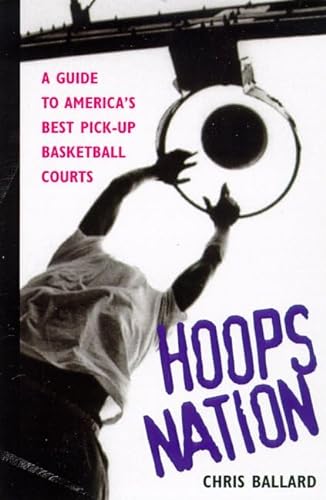
Find out where to play and what to expect in this street-smart and entertaining b-ball bible
For the millions of roundball junkies who are not in the NBA or the new WNBA, hoop dreams are lived out on playgrounds and in old gyms, in informal games that can be every bit as competitive as their big-league counterparts, no matter what the level of play. This is pick-up basketball, America's favorite way to play its favorite game.
Hoops Nation is the result of former college-basketball player Chris Ballard's six-month quest by van to find the best pick-up basketball games in the country. Entries from all forty-eight mainland states break down the key points of each game site, including level of play, number of hoops, playing surface, whether women play, average age of players, and whether night play is an option. Ballard also gives the entertaining low down on local basketball culture, lore, and etiquette. At-a-glance symbols for each court make for easy reference, and interspersed throughout are lively sections and sidebars on topics such as dunking technique, the pick-up court hall of fame, slang, and more. From the Venice Beach courts of White Men Can't Jump, through hallowed heartland hoops, to the legary rims rocked on New York City's West 4th Street, anyone who wants to lace up and play will find all they need to know about the court next door or across the country in Hoops Nation.
For the millions of roundball junkies who are not in the NBA or the new WNBA, hoop dreams are lived out on playgrounds and in old gyms, in informal games that can be every bit as competitive as their big-league counterparts, no matter what the level of play. This is pick-up basketball, America's favorite way to play its favorite game.
Hoops Nation is the result of former college-basketball player Chris Ballard's six-month quest by van to find the best pick-up basketball games in the country. Entries from all forty-eight mainland states break down the key points of each game site, including level of play, number of hoops, playing surface, whether women play, average age of players, and whether night play is an option. Ballard also gives the entertaining low down on local basketball culture, lore, and etiquette. At-a-glance symbols for each court make for easy reference, and interspersed throughout are lively sections and sidebars on topics such as dunking technique, the pick-up court hall of fame, slang, and more. From the Venice Beach courts of White Men Can't Jump, through hallowed heartland hoops, to the legary rims rocked on New York City's West 4th Street, anyone who wants to lace up and play will find all they need to know about the court next door or across the country in Hoops Nation.
Die Inhaltsangabe kann sich auf eine andere Ausgabe dieses Titels beziehen.
Über die Autorin bzw. den Autor
Chris Ballard is a former youth team coach and college basketball player (for Pomona College in Los Angeles). He is a freelance writer based in Philadelphia, contributing to such publications as Sports Illustrated and Men's Health. This is his first book.
Rezensionen
With acknowledgment to Alexander Wolff and Chuck Weilgus, authors of the In-Your-Face Basketball Book (1989), the classic guide to pickup hoops, Ballard, his brother, and a couple of buddies embarked on a seven-month, 48-state, 30,000-mile exodus in search of the country's best basketball courts. Ballard and crew would ask around, find the best games in each spot, and evaluate the experience in terms of such categories as physical facilities, quality of competition, and level of danger in the area. They played everywhere from West Fourth Street in Greenwich Village to Venice Beach to Yellowstone Park to various Yuppie lunchtime games. In addition to a tour of the country, Ballard supplies tips on court etiquette and fashion, advice for older players, a guide to dunking, and a glossary of playground terms (a clank, for example, is a big white guy with limited offensive skills). He concludes with a serious essay on the state of the game and the violence that has tainted inner-city programs, concluding that the culture of pickup hoops may be disappearing before our eyes. Maybe so, but this book is enough fun to inspire even a few old clanks to lace 'em and look for a game. Wes Lukowsky
If your neighborhood court isn't one of the nearly 700 visited by Ballard, then it just may remain undiscovered. Ballard, a magazine writer and former college player, toured 48 states sampling pickup games and customs?from Houston's MacGregor Park to the Mitchell, South Dakota, "Corn Palace," where the local Kernels play. On their six-month basketball odyssey, Ballard and his traveling companions learned a lot of regional court lingo and style, much of it contained in their fine glossary. That the guide's favorite court is New York's fabled West Fourth Street comes as little surprise, but it seems the journey was worthwhile anyway. Recommended for high school libraries and anywhere basketball books are popular.?Nathan Ward, "Library Journal"
Copyright 1998 Reed Business Information, Inc.
Auszug. © Genehmigter Nachdruck. Alle Rechte vorbehalten.
Hoops Nation
1
The Hoops Nation
A summer day at a park anywhere in America ... The rhythmic smack of a basketball on asphalt echoes across a crowded court. A fierce midday sun bastes shirtless players, their sweaty bodies shimmering in the light. Ten men sprint down the dusty blacktop, hurtling themselves forward in pursuit of a battered leather ball. The man controlling the ball bobs and weaves like a boxer, slipping through defenders while searching for cutters or a path to the bucket amidst all those legs, elbows, and grasping hands. He looks in toward the basket, where the physics of position are being played out in a jumble of heavy bodies, interlocking arms, and tree-trunk legs. Seeing no one open, he abruptly halts his forward motion, elevates into the air, and releases a soft jump shot. The other nine players tense up simultaneously, their eyes following the arc of the ball as they try to gauge the direction of the rebound.
On the sideline, those who have "nexts" sit or stand. Some watch sullenly, brooding over their performance in the previous game. You can see it in their eyes--"I should have hit that turnaround"; "I could have rebounded better"; "Why won't Frank pass the damn ball!" Others move around, following the game action, animated by the drama unfolding before them. "Ohhhh man! Good shot, G!" they yell out. "Traaavel! Damn, that boy walked bad!"
Players and spectators alike are absorbed in the game. For some, it is an intensely personal experience; they strive to shoot better, play better defense, or score more points than the day before. For others, it is less about personal performance and more about the camaraderie ofthe basketball court, an everyman's country club where friends can hang out, joke around, and enjoy life.
Regardless of their reasons, millions of people gather every day at parks, schoolyards, and gyms to play pickup basketball. Out on these courts, all of society's distinctions and stereotypes disintegrate. It doesn't matter if you're a highly paid executive, a construction worker, or a burger-flipper at the local fast food chain; what you do off the court quickly becomes irrelevant once you're on it. Your teammates could care less that you're two months behind on your rent and just got dumped by your fiancée; all they care about is whether you can stick a jump shot, snare a rebound, or make a no-look pass. And that isthe beauty of playing pickup hoops: it lets you forget the rest of your life and focus on a single challenge--can you and your squad beat the five guys with the bowling ball biceps who've held court all day? If you can't, see ya later, because in this game you've got to win to stay on the court.
Once the day's games are over, you have to make the cruel transition back to your other life. You have to shower, walk the dog, sleep, wake up, and go back to the real world. At least until tomorrow afternoon, when once again you can put on your smelly gym shorts, spend a couple seconds in a hasty attempt to stretch your oh-so-tight quadriceps, and start sprinting up and down the court. Out on the blacktop or the hardwood floor, you're back in a familiar world where picks and bounce passes are much more important than taxes or tollbooths.
For those who play basketball, that is how it is. Trying to describe this to someone who does not play the game is futile. "You're playing basketball again. But honey, didn't you just play yesterday?" The answer, of course, is yes. But for the ballplayer, this has absolutely no bearing on whether or not he or she needs to play today. Each day there is that internal debate: Can I make it to the gym and back during lunch break? Shouldn't I spend tonight working on that proposal? I really should rest my knee, but what if I don't play today and it feels even worse tomorrow?
Rationalizing that decision becomes easy: "If I play this afternoon, it will make me more productive tomorrow morning"; "if I don't play in the league game the guys will think I let them down,"; and, of course, "if I hit my next jumper, my shot is officially back."
How did all this happen? How did basketball become a national obsession, played by close to 50 million people in the United States? Weren't people just referring to baseball as the national pastime? Or maybe they meant baseball is "past its time," because basketball is now the American sport.
The sport's top players, household names like Michael Jordan, Grant Hill, and Shaquille O'Neal, are now multimillionaire superstars who act in movies, record rap albums, publish books, and smile out from our TVs while selling us everything from hydraulic sneakers to microwave popcorn. March Madness, the college game's frenetic spring tourney, now rivals the Super Bowl and the World Series as the sporting event of the year. The women's game has taken off as well,with the success of the 1996 Olympic team serving as a springboard for two new women's leagues.
It's not happening only here in the United States, either; NBA inroads abroad have turned the sport into a global phenomenon, with Europeans learning how to say "I luv zees game" at an early age. And get this: According to a study done by the Asian Basketball Confederation and the American Basketball Council, there are more basketball players in Asia than there are people in the United States. "Aih Johdan" is right.
Back stateside, America's popular culture has embraced basketball. Movies such as White Men Can't Jump and Hoop Dreams have introduced the non-fan to the raw, colorful game of streetball, and the language of the court has infiltrated our daily lives. Today's businessmen walk around saying things like, "That was a slam-dunk proposal, Ned," and, "This project wouldn't have been possible without an assist from the good folks at Wilson and Weasel Incorporated."
Not only are they talking hoops; these businessmen are playing the game. All around the country, in schools, tourneys, driveways, gyms, health clubs, and parks, people are playing basketball. This book is for those people. To write it, I went out in search of the game.
Accompanied by fellow hoop junkies Craig Harley, Dustin Ballard, and (for two months) Eric Kneedler, I hit the road in April 1996 in a blue Chevy van with 68,000 miles on it. Half a year later, the odometer read 99,000 miles, the van was on its third transmission, and we had visited all forty-eight contiguous states, stopping and popping at over 1,000 basketball courts in 166 cities in the process. Every day on the trip we played ball, and every day we steered our van down the highway. For six and a half glorious months, all that mattered was basketball. Breakfast? A healthy serving of hoops, with some orange juice on the side. Entertainment for tonight? Here's an idea--let's play some roundball. One day it was Texas, the next Oklahoma, but always that white line and the horizon, and always the chance that we'd find the ultimate pickup game that day.
We went looking for it, but we never found that one ultimate game. Instead, we found games, plural. We found games in run-down recreation centers where the rims are bent down like old men, we found games at city parks where spectators lounge on the sidelines clutching brown paper bags. We found games at luxurious health clubs where you can see your reflection in the polished wood floor, and we found games everywhere in between.
In Worcester, Massachusetts, we found a game at Newton Square Park, where we met an eleven-year-old kid with the Dream. He was sitting on a wooden bench next to an empty basketball court at three-thirty in the afternoon. We approached, carrying a ball. "Hey, can I play?" this little stringbean asked. We said sure, and the four of us shot around.
"I come here every day," he told us. "My dad goes to work at a spaghetti restaurant and he drops me off here."
Drops him off there. At noon. And, the kid tells us while practicing his between-the-legs dribble, he picks him up again every night. He does this all summer, all day, every day.
"The older guys let me play with them in the games. I'm pretty good, you know, and I've got big feet," he tells us with pride. "My doctor says I'm gonna be pretty tall. I hope to play college ball someday."
On the other end of the country, in Florida, we met a group of men who have started a hoops club. They call it the Sixth Man Club, and they meet three times a week to play basketball. They rent out gyms and play for two hours at a time, rotating in players. They play fast and hard; there's no time for whining, complaining, or arguing. They need to get back to their families, back to the office. Playing basketball for them is about exercising, but it's also about making connections. Jeff, a lawyer, has Bill as a client. Bill, a marketing executive, handles J.T.'s company's account. They trust each other because they have played basketball together. That is enough.
In Burlington, Vermont, we played with a bunch of locals at an outdoor court. Even in bucolic Vermont there was a lot of arguing and yelling. Everyone wanted to change the score, and everyone wanted to kick somebody's ass. If you didn't know better, you'd think ass was going to be kicked. Later that night, we went out to a bar to soak up the local atmosphere (as well as some cold beer). Whom do we see walk in but the guys from the park, the same guys who'd been intent on whupping each other earlier in the day, now laughing and high-fiving.
Through the Internet we met Pete, a thirty-nine-year-old Asian-American flight attendant who lives in Honolulu. For the last fifteenyears, he has carried his gym shoes with him wherever he travels. If the layover is long enough, Pete will head out into a city and search for a game, whether it be at a YMCA or a college gym. He has played all across the United States, he has played in China, and he has played in "some great games" in Auckland, New Zealand. In addition, Pete has been meeting three buddies of his, all flight attendants from different states on the mainland, every year for the last eleven years at a tournament held in Dallas, Texas. They call their three-on-three team "the Jet Set."
In New York City we met a woman who regularly plays in an all-male league, spending most of her time guarding male players. This doesn't bother her, though; she says she enjoys the competition from all that testosterone. She enjoys it so much that she has started her own monthly newsletter, which contains, among other things, tips for women ballplayers. A self-described "feminist basketball player," her motto is one I wish more people had: "Quit your yapping and play ball!"
And in Jackson, Mississippi, we met the morning crew at a gym on the outskirts of the city. When we walked in and signed up for the nextgame, one of the teams on the floor included two current NBA players. We stretched out and watched the game, apprehensive about guarding guys who played in the League. We never got the chance, though, because the squad with two NBAers got beat by five NMIers ("Never Made It") who weren't intimidated in the least by a 6' 10" Raptor or a starting shooting guard from Motown.
During our travels across the United States, we noticed that as the landscape changed, so did the game. Streetball is played with the most passion in the five big basketball cities: New York, Los Angeles, Chicago, Philly, and Detroit. It is played just as loyally in musty gyms in Greeneville, South Carolina, and Eugene, Oregon--just with a different flavor.
On the East Coast, the game is flashier and more physical; come hard or don't come at all. On the West Coast, players don't hesitate to shoot jumpers on the playground, and "finesse" isn't a dirty word (though "pass" often seems to be). On the courts of Indiana's small towns, kids actually want to play defense, as evidenced by the half-court games that are played "loser's outs" (as opposed to the offense-reliant "make-it, take-it" system). In the South, we often saw more team ball, in part because of the dearth of slick ball-handlers to dominate the rock. In the mountains of the West, television has brought the game to rural areas, and the pickup play reflects this influence; short white kids will go flying toward the hoop in hopes of replicating that Penny Hardaway move they witnessed during the NBC Game of the Week. In the Southwest, the asphalt-softening heat forces the game indoors, and as a result we came up against numerous deadeye shooters who'd grown up in breezeless gyms and could burn you with soft 20-footers. And in hoops hotbeds like Memphis, Tennessee, and Jackson, Mississippi, where the devotion to the game runs deep, basketball is like a job for many of the men who show up every day at noon to punch the clock at the local rec center.
What follows is a celebration of the game of basketball as it is played in America. For rookies, there is a chapter on the basics. For those ready to go play, courts are listed in every major city in the country, with pertinent info on each. For those interested in the human side of the game, I've included features on basketball's colorful characters and devotees, as well as a chapter on the potential decline of the street game. For those with an appreciation for the culture of pickup ball, there are chapters, called "Flavor of the Game," that clue you in on important issues like court fashion, dunking, and hoops lingo. And for those who wonder what it's like to be on the road for seven months playing ball, I've included "Tales from the Road," excerpts from a diary that eventually filled 300 pages.
Writing this book was a labor of love involving countless hours of phone calls, interviews, and typing, but I had a great time doing it because I love the game of basketball. After all, life's pretty good when your job is talking about and playing hoops. I hope you have as much fun reading it as I had writing it.
Copyright © 1998 by Chris Ballard
„Über diesen Titel“ kann sich auf eine andere Ausgabe dieses Titels beziehen.
Suchergebnisse für Hoops Nation: A Guide to America's Best Pick-Up...

Beispielbild für diese ISBN
Hoops Nation : A Guide to America's Best Pick-Up Basketball
Anbieter: Better World Books, Mishawaka, IN, USA
Verkäuferbewertung 5 von 5 Sternen

Zustand: Good. Pages intact with minimal writing/highlighting. The binding may be loose and creased. Dust jackets/supplements are not included. Stock photo provided. Product includes identifying sticker. Better World Books: Buy Books. Do Good. Artikel-Nr. 40399471-6
Gebraucht kaufen
EUR 6,35
Versand gratis
Versand innerhalb von USA
Versand innerhalb von USA
Anzahl: 1 verfügbar
Beispielbild für diese ISBN
Hoops Nation : A Guide to America's Best Pick-Up Basketball
Anbieter: Wonder Book, Frederick, MD, USA
Verkäuferbewertung 5 von 5 Sternen
Zustand: Very Good. Very Good condition. With remainder mark. A copy that may have a few cosmetic defects. May also contain light spine creasing or a few markings such as an owner's name, short gifter's inscription or light stamp. Artikel-Nr. H10A-03800
Gebraucht kaufen
EUR 6,45
Versand gratis
Versand innerhalb von USA
Versand innerhalb von USA
Anzahl: 1 verfügbar
Beispielbild für diese ISBN
Hoops Nation : A Guide to America's Best Pick-Up Basketball
Anbieter: ThriftBooks-Atlanta, AUSTELL, GA, USA
Verkäuferbewertung 5 von 5 Sternen
Paperback. Zustand: Very Good. No Jacket. May have limited writing in cover pages. Pages are unmarked. ~ ThriftBooks: Read More, Spend Less. Artikel-Nr. G0805048774I4N00
Gebraucht kaufen
EUR 7,37
Versand gratis
Versand innerhalb von USA
Versand innerhalb von USA
Anzahl: 1 verfügbar
Beispielbild für diese ISBN
Hoops Nation : A Guide to America's Best Pick-Up Basketball
Anbieter: ThriftBooks-Atlanta, AUSTELL, GA, USA
Verkäuferbewertung 5 von 5 Sternen
Paperback. Zustand: As New. No Jacket. Pages are clean and are not marred by notes or folds of any kind. ~ ThriftBooks: Read More, Spend Less. Artikel-Nr. G0805048774I2N00
Gebraucht kaufen
EUR 7,37
Versand gratis
Versand innerhalb von USA
Versand innerhalb von USA
Anzahl: 1 verfügbar
Beispielbild für diese ISBN
Hoops Nation : A Guide to America's Best Pick-Up Basketball
Anbieter: ThriftBooks-Dallas, Dallas, TX, USA
Verkäuferbewertung 5 von 5 Sternen
Paperback. Zustand: Very Good. No Jacket. May have limited writing in cover pages. Pages are unmarked. ~ ThriftBooks: Read More, Spend Less. Artikel-Nr. G0805048774I4N00
Gebraucht kaufen
EUR 7,37
Versand gratis
Versand innerhalb von USA
Versand innerhalb von USA
Anzahl: 1 verfügbar