
Verwandte Artikel zu Ten Mile Day: And the Building of the Transcontinental...
Inhaltsangabe
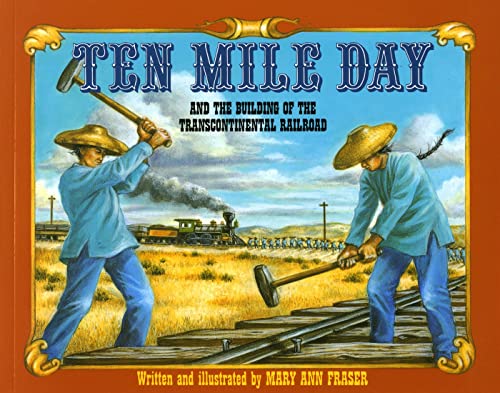
On May 10, 1869, the final spike in North America's first transcontinental railroad was driven home at Promontory Summit, Utah. Illustrated with the author's carefully researched, evocative paintings, here is a great adventure story in the history of the American West--the day Charles Crocker staked $10,000 on the crews' ability to lay a world record ten miles of track in a single, Ten Mile Day.
Die Inhaltsangabe kann sich auf eine andere Ausgabe dieses Titels beziehen.
Über die Autorin bzw. den Autor
Mary Ann Fraser has illustrated more than forty books for children, and is the author-illustrator of a growing list of popular middle-grade books that focus on U.S. history. Her In Search of the Grand Canyon was voted a Best Book of the Year by School Library Journal and Ten Mile Day was an American Bookseller Pick, of the Lists. A graduate of Exter College of Art Design, she lives with her husband and three children in Simi Valley, California.
Auszug. © Genehmigter Nachdruck. Alle Rechte vorbehalten.
Ten Mile Day
and the Building of the Transcontinental Railroad
By Mary Ann FraserHenry Holt and Company
Copyright © 1993 Mary Ann Fraser
All rights reserved.
ISBN: 978-0-8050-4703-5All rights reserved.
Contents
Title Page,
Copyright Notice,
Map,
Dedication,
Begin Reading,
The Next Day ... and Beyond,
Acknowledgments,
Suggested Reading,
Glossary,
Railroad Tools and Supplies,
About the Author,
Copyright,
CHAPTER 1
On April 28, 1869, reporters and photographers crawled from their tents into the cold, gray light of early dawn. Soon a small group of officials gathered on a ridge. As daylight spread, workers from rival construction camps jostled for the best view.
The nearly five thousand people who were camped out near the northeast shore of Great Salt Lake, Utah, made a lively and colorful crowd. Businessmen and workers, a military band, and army officers from the nearby garrisons had come to this desolate valley to see the last great push in the building of the first transcontinental railroad – Ten Mile Day.
Before the 1860s no railway ran across all of North America, from the Atlantic to the Pacific. Only rough and dangerous wagon roads linked the coasts. Aside from a few local West Coast lines, there were no tracks at all past Omaha, Nebraska, and the ice-capped Sierra Nevadas appeared impassable by rail. But railroad engineer Theodore Dehone Judah was determined to unite east and west with an iron trail. He spent years exploring the Sierras until at last, in 1860, he found the best route across, and through, the mountains.
In 1862, his plan in hand, Judah went to Washington, D.C., to convince Congress it should finance the transcontinental railroad – the greatest engineering feat in American history. The Pacific Railroad Act, which Judah helped to pass, finally made his dream possible, but he died only seven days after the first rails were laid.
Two companies were given the job of building the railroad. To attract investors, the government promised to give money, and even free land, to each company based on the amount of track it laid. The Central Pacific was to begin in Sacramento, California and move east. The Union Pacific would begin in Omaha, Nebraska, and move west. Promontory Summit, Utah, was later chosen as their meeting place.
The Central Pacific and the Union Pacific both broke ground in 1863. As the years went by, leaders of each team began to compete over who could lay the most track in a single day. In the beginning, even one mile a day was difficult. But with experience both companies had become highly skilled and organized. Like a large military campaign, the entire job was broken into smaller tasks, and each task was assigned a crew.
When Charles Crocker, construction boss for the Central Pacific, learned that the Union Pacific had set a new record of seven miles, eighteen hundred feet on October 26, 1868, he boasted that his men could lay ten miles. Dr. Thomas C. Durant, vice president of the Union Pacific, wagered $10,000 that it could not be done.
Most people believed that laying ten miles of track in a day was impossible. But the Central Pacific had already done the impossible many times. In the first years of construction Chinese laborers had blasted fifteen tunnels through the solid granite of the high Sierras. They had overcome dozens of fierce winter blizzards, some with snowdrifts over a hundred feet high, and avalanches that swept away whole crews.
Once past the mountains, the men faced new problems. In the scorching alkali deserts of the Nevada flats, they did not have enough water to drink, and they ran short of building supplies. When the Central Pacific reached Utah, rival Union Pacific crews attacked Chinese workers with pick handles and even detonated explosives near them, killing many.
But Crocker and his crew had learned from their hardships. Now they were an efficient force. As the transcontinental railroad was nearing completion, his army stood ready for its final battle, Ten Mile Day.
Early in the morning of April 28, 1869, Crocker and James Strobridge, his right-hand man, called for volunteers for the difficult task ahead. Each crew was promised four times its normal wages if it could meet the challenge. Nearly all of the team leaders stepped forward. Fourteen hundred of the Central Pacific's best laborers, both Irish and Chinese, were selected out of the almost five thousand volunteers.
At 7 A.M. all eyes rested on Charles Crocker as he steadied his horse beside the grade. The crews knew it would take sixteen railroad flatcars to carry everything they needed to lay two miles of track. Five trains, each made up of an engine and sixteen flatcars, now waited. Some stood at the end of the rails and others were parked on the sidings, the tracks built beside the main road. Wooden ties had already been placed along the entire ten mile route. Everything was set to go.
With a sharp command to the bosses, Crocker's arm rose and fell. The hogger, or engineer, on the first train pulled hard on the whistle cord, and a shrill blast pierced the cold, damp morning air. The race had begun.
Chinese laborers leaped onto the flatcars of the lead train. The noise was deafening as sledgehammers knocked out the side stakes and rails tumbled to the ground. The clanging of falling iron continued for eight minutes, until the first sixteen flatcars were empty.
As the supply train was unloaded, three men rushed to the end of the rails, what they called the end o' track. The three pioneers scrambled ahead to the first loose ties. Then they began lifting, prying, and shoving to center the bare ties on the grade.
The emptied train steamed back to the siding, and men hurried to load iron cars with exactly sixteen rails and thirty-two rail joiners, or fishplates, each. A crew of six Chinese workers and an Irish boss hopped aboard.
To the right of the track two horses were hitched by a long rope to an iron car. With a yell from the boss, the horses lurched against their harnesses and the cars rolled forward on the track. When the iron car reached the end o' track, a wooden keg was smashed over the rails. The iron car rambled ahead as new track was laid, spilling spikes through the open bottom and onto the ground where they could be used. Dust clouds choked the air.
With the iron car moving steadily along, eight Irishmen lay rails just ahead of its rolling wheels. These "ironmen" were Michael Shay, Thomas Daley, George Elliot, Michael Sulivan, Edward Killeen, Patrick Joice, Michael Kenedy, and Fred McNamare. The four forward men seized the 560-pound, thirty-foot-long rails, while the four rear men slid the rails to the rollers on each side of the iron car. The lead ironmen ran forward. "Down," shouted the foreman. With a loud thud the iron hit the ties within inches of the previous rail. Without a moment to rest, the eight ironmen went back for more. On average, two rails were laid every twenty seconds.
While rails clanked to the ground, the Chinese crew from the iron car loaded fishplates, nuts, and bolts into baskets attached to poles slung over their shoulders. Then they sped up the line, tossing out ironware every ten yards. Where rail ends met, another team fastened the fishplates loosely with nuts and thrusting bolts.
When each handcar was unloaded, the horses were detached from the front and hitched to the back. At a gallop they hauled the empty iron car back to the supply dump. If a returning car got in the way of a full iron car, the empty one was flipped off...
„Über diesen Titel“ kann sich auf eine andere Ausgabe dieses Titels beziehen.
Suchergebnisse für Ten Mile Day: And the Building of the Transcontinental...

Beispielbild für diese ISBN
Ten Mile Day: And the Building
Anbieter: World of Books (was SecondSale), Montgomery, IL, USA
Verkäuferbewertung 5 von 5 Sternen

Zustand: Good. Item in good condition. Textbooks may not include supplemental items i.e. CDs, access codes etc. Artikel-Nr. 00108507547
Gebraucht kaufen
EUR 5,67
Versand gratis
Versand innerhalb von USA
Versand innerhalb von USA
Anzahl: 6 verfügbar
Beispielbild für diese ISBN
Ten Mile Day: And the Building
Anbieter: World of Books (was SecondSale), Montgomery, IL, USA
Verkäuferbewertung 5 von 5 Sternen
Zustand: Acceptable. Item in acceptable condition! Textbooks may not include supplemental items i.e. CDs, access codes etc. Artikel-Nr. 00110465139
Gebraucht kaufen
EUR 5,67
Versand gratis
Versand innerhalb von USA
Versand innerhalb von USA
Anzahl: 1 verfügbar
Beispielbild für diese ISBN
Ten Mile Day: And the Building of the Transcontinental Railroad
Anbieter: ThriftBooks-Phoenix, Phoenix, AZ, USA
Verkäuferbewertung 5 von 5 Sternen
Paperback. Zustand: Fair. No Jacket. Readable copy. Pages may have considerable notes/highlighting. ~ ThriftBooks: Read More, Spend Less. Artikel-Nr. G0805047034I5N00
Gebraucht kaufen
EUR 5,91
Versand gratis
Versand innerhalb von USA
Versand innerhalb von USA
Anzahl: 1 verfügbar
Beispielbild für diese ISBN
Ten Mile Day: And the Building of the Transcontinental Railroad
Anbieter: ThriftBooks-Reno, Reno, NV, USA
Verkäuferbewertung 5 von 5 Sternen
Paperback. Zustand: Fair. No Jacket. Readable copy. Pages may have considerable notes/highlighting. ~ ThriftBooks: Read More, Spend Less. Artikel-Nr. G0805047034I5N00
Gebraucht kaufen
EUR 5,91
Versand gratis
Versand innerhalb von USA
Versand innerhalb von USA
Anzahl: 1 verfügbar
Beispielbild für diese ISBN
Ten Mile Day: And the Building of the Transcontinental Railroad
Anbieter: ThriftBooks-Phoenix, Phoenix, AZ, USA
Verkäuferbewertung 5 von 5 Sternen
Paperback. Zustand: Very Good. No Jacket. May have limited writing in cover pages. Pages are unmarked. ~ ThriftBooks: Read More, Spend Less. Artikel-Nr. G0805047034I4N00
Gebraucht kaufen
EUR 5,91
Versand gratis
Versand innerhalb von USA
Versand innerhalb von USA
Anzahl: 1 verfügbar
Beispielbild für diese ISBN
Ten Mile Day: And the Building of the Transcontinental Railroad
Anbieter: ThriftBooks-Atlanta, AUSTELL, GA, USA
Verkäuferbewertung 5 von 5 Sternen
Paperback. Zustand: Very Good. No Jacket. Former library book; May have limited writing in cover pages. Pages are unmarked. ~ ThriftBooks: Read More, Spend Less. Artikel-Nr. G0805047034I4N10
Gebraucht kaufen
EUR 5,91
Versand gratis
Versand innerhalb von USA
Versand innerhalb von USA
Anzahl: 1 verfügbar
Beispielbild für diese ISBN
Ten Mile Day: And the Building of the Transcontinental Railroad
Anbieter: ThriftBooks-Phoenix, Phoenix, AZ, USA
Verkäuferbewertung 5 von 5 Sternen
Paperback. Zustand: Good. No Jacket. Pages can have notes/highlighting. Spine may show signs of wear. ~ ThriftBooks: Read More, Spend Less. Artikel-Nr. G0805047034I3N00
Gebraucht kaufen
EUR 5,91
Versand gratis
Versand innerhalb von USA
Versand innerhalb von USA
Anzahl: 1 verfügbar
Beispielbild für diese ISBN
Ten Mile Day: And the Building of the Transcontinental Railroad
Anbieter: ThriftBooks-Dallas, Dallas, TX, USA
Verkäuferbewertung 5 von 5 Sternen
Paperback. Zustand: Good. No Jacket. Pages can have notes/highlighting. Spine may show signs of wear. ~ ThriftBooks: Read More, Spend Less. Artikel-Nr. G0805047034I3N00
Gebraucht kaufen
EUR 5,91
Versand gratis
Versand innerhalb von USA
Versand innerhalb von USA
Anzahl: 1 verfügbar
Beispielbild für diese ISBN
Ten Mile Day: And the Building of the Transcontinental Railroad
Anbieter: ThriftBooks-Atlanta, AUSTELL, GA, USA
Verkäuferbewertung 5 von 5 Sternen
Paperback. Zustand: Very Good. No Jacket. May have limited writing in cover pages. Pages are unmarked. ~ ThriftBooks: Read More, Spend Less. Artikel-Nr. G0805047034I4N00
Gebraucht kaufen
EUR 5,91
Versand gratis
Versand innerhalb von USA
Versand innerhalb von USA
Anzahl: 2 verfügbar
Beispielbild für diese ISBN
Ten Mile Day: And the Building of the Transcontinental Railroad
Anbieter: ThriftBooks-Atlanta, AUSTELL, GA, USA
Verkäuferbewertung 5 von 5 Sternen
Paperback. Zustand: Fair. No Jacket. Readable copy. Pages may have considerable notes/highlighting. ~ ThriftBooks: Read More, Spend Less. Artikel-Nr. G0805047034I5N00
Gebraucht kaufen
EUR 5,91
Versand gratis
Versand innerhalb von USA
Versand innerhalb von USA
Anzahl: 1 verfügbar